
ᐅ Reducing Traffic Noise Through Construction Methods and Noise Barrier Walls
Created on: 9 Jun 2021 09:30
W
werner71
Hello,
we are planning to build a small single-family house on our plot. The location of the plot is generally good, but there is increased noise in the mornings and evenings due to rush hour traffic.
I measured the sound pressure level using a smartphone app. I cannot vouch for the accuracy of the values, but they roughly correspond (subjectively) to confirmed measurements from similar plots that I know of.
When no vehicle passes by: 55 dB.
With a car: up to 68 dB.
With a truck: up to 78 dB.
At the moment, the noise level outdoors seems too high to me. To still be able to build on the plot, I am considering a noise barrier wall and a house design oriented away from the street (solid construction, soundproof windows, insulation with mineral wool) (see attachment, noise barrier wall marked with red dashed line).
I have no doubts about achieving the desired quietness inside the house through these measures. My question is: what about the outdoor areas?
I am already in contact with a specialist for soundproof walls, and the next step will be to discuss the overall planning with an architect. For this, I wanted to provide a few wishes and ideas. That’s why I have the following questions:
Thank you very much for your suggestions!
Best regards
Werner
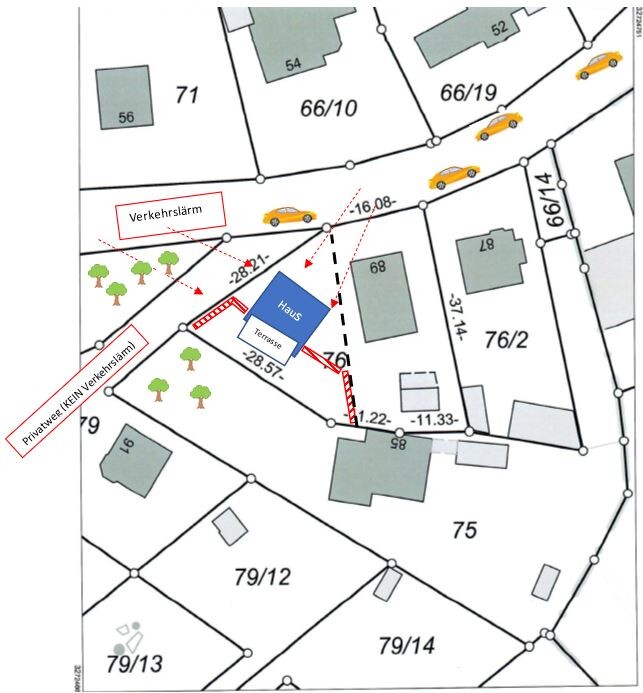
we are planning to build a small single-family house on our plot. The location of the plot is generally good, but there is increased noise in the mornings and evenings due to rush hour traffic.
I measured the sound pressure level using a smartphone app. I cannot vouch for the accuracy of the values, but they roughly correspond (subjectively) to confirmed measurements from similar plots that I know of.
When no vehicle passes by: 55 dB.
With a car: up to 68 dB.
With a truck: up to 78 dB.
At the moment, the noise level outdoors seems too high to me. To still be able to build on the plot, I am considering a noise barrier wall and a house design oriented away from the street (solid construction, soundproof windows, insulation with mineral wool) (see attachment, noise barrier wall marked with red dashed line).
I have no doubts about achieving the desired quietness inside the house through these measures. My question is: what about the outdoor areas?
I am already in contact with a specialist for soundproof walls, and the next step will be to discuss the overall planning with an architect. For this, I wanted to provide a few wishes and ideas. That’s why I have the following questions:
- What do you estimate the noise reduction would be from a suitable building design on the terrace (e.g. -15 dB)?
- Do you have any suggestions for the design to keep noise levels low on the terrace?
- Are there any experiences with noise reduction from the combination of a noise barrier wall and a terrace oriented away from the street (e.g. noise barrier wall - 15 dB, house design an additional - 8 dB)?
- Do you have any other suggestions for measures I could take to keep noise exposure low?
Thank you very much for your suggestions!
Best regards
Werner
H
hampshire9 Jun 2021 13:07werner71 schrieb:
The road is classified in a way that makes a 30 km/h (20 mph) speed limit impossible.I am not familiar with the specifics, and it is quite possible that when weighing responsibility and jurisdiction, a change is unlikely and opposed by too many interests. In that case, the status quo remains. Declaring something "impossible" is a common tactic to enforce rejection. No one has to accept such a statement—especially not when it concerns administrative decisions. In any case, there seem to be many reasons to believe that you will have to tolerate the noise on your property. I hope you will cope well with it.
Hannes S schrieb:
Well, if the professional is a specialist (and seller?) for soundproof walls, you can pretty much guess what the result will look like ;-)I would expect the expert (with the 3 letters) to provide a figure showing how much the exposure is reduced. That could then be easily verified.hampshire schrieb:
I’m not familiar with the specific circumstances, and it’s quite possible that, when weighing responsibility and jurisdiction, a change is unlikely and opposed by too many interests. In that case, the status quo remains. Declaring something “impossible” is a common tactic to enforce rejection. Nobody has to accept such a statement—especially not when it concerns administrative decisions.
In any case, it seems likely that you will have to tolerate the noise on your property. I hope you will manage well with it. That’s true. It’s worth considering whether the effort is justified and then being labeled a troublemaker. In our small town, people just know each other.
Thanks for your ideas!
Listen to when the noise occurs. For us, it’s Monday to Friday from 6 a.m. to 6 p.m., Saturday from 6 a.m. to 1 p.m., otherwise it’s relatively quiet. So, that’s when I’m at home and want peace and quiet.
When electric cars become standard, it will be very quiet. Okay, I wouldn’t count on that.
The 30 km/h (about 20 mph) zone is a tricky issue. The district authority keeps rejecting it. This has been going on for years. The municipality wants the 30 km/h (about 20 mph) zone, applies for it, and it gets rejected by the district.
When electric cars become standard, it will be very quiet. Okay, I wouldn’t count on that.
The 30 km/h (about 20 mph) zone is a tricky issue. The district authority keeps rejecting it. This has been going on for years. The municipality wants the 30 km/h (about 20 mph) zone, applies for it, and it gets rejected by the district.
haydee schrieb:
Listen to when the noise occurs. For us, it’s Monday to Friday from 6 a.m. to 6 p.m., Saturday from 6 a.m. to 1 p.m., otherwise it’s relatively quiet. So basically, when I’m at home and want some peace and quiet.
If electric cars become standard, it will be completely quiet. Though I wouldn’t count on that.
The 30 km/h (about 20 mph) zone is a tricky issue. The district authority keeps rejecting it. This has been going on for years. The local council wants 30 km/h (about 20 mph), applies for it, and the district rejects it. Good point, thanks!
We have lived right next door for 20 years now, and the main issue is the rush hour traffic in the mornings and evenings, plus the occasional truck working here.
I’ve also thought about electric vehicles. However, the main problem isn’t the engine noise but the tire noise on the road surface.
A 30 km/h (about 20 mph) speed limit would definitely be great. If I remember correctly, the road is classified as a state road (or main road), which apparently excludes a 30 km/h (about 20 mph) limit.
Hannes S schrieb:
Exactly. The noise only occurs for about 2 hours in the morning and afternoon. If a noise barrier wall helps at all, it would split the property right down the middle.
I agree with MarCh. Orienting the house more along the north-south axis and installing proper soundproof windows facing the street would likely be much more effective than a wall in the garden—and probably more cost-efficient too.
The reflection from number 91, for example, remains the same with or without the wall. So if you build a 2.5m (8 feet) high wall there, you still have to deal with the view 🙂We expect the interior of the house to be almost noise-free, and I’m confident about that. My only concern is the terrace.
We will pay close attention to the orientation—thank you for your opinion!