
I
itsmemario20 May 2015 20:30Hello,
I just inspected the completed masonry work at the construction site (my mother’s house). Since I’m a layperson in this field, I wanted to ask if the issues I noticed are significant. Please don’t be too general in your answers. I have already tried researching on Google, but couldn’t really find anything about this. My mother does not have an independent inspector from DEKRA, and I’m asking simply because these things stood out to me.
1.) The hollow-core bricks at the back wall have noticeable damage in several areas, both on the outside and inside, with visible holes up to 3x4 cm (1.2x1.6 inches) in size. They are heavily compressed and broken up to the first internal webs, which also appear to be damaged.
If these holes and breaks are later "filled with filler," could this negatively affect the stability and/or thermal insulation?
2.) In some places, there are gaps up to 2.5 cm (1 inch) wide between the hollow bricks at the back wall. Some are not filled with mortar, while others are already filled. Does this pose any disadvantages regarding stability and/or thermal insulation? As far as I understand, these bricks should interlock with each other based on their shape, right?
3.) It is recommended not to use hammer drills on these bricks, but what about nails?
4.) In front of the house, there is a "Delta-MS" foundation protection / clean layer. Is this membrane installed beneath the screed, which has not been laid yet? Or was it forgotten?
I’m asking these questions out of curiosity and so I can participate in the discussion with the site manager tomorrow or the day after. 🙂
Thanks in advance!
I just inspected the completed masonry work at the construction site (my mother’s house). Since I’m a layperson in this field, I wanted to ask if the issues I noticed are significant. Please don’t be too general in your answers. I have already tried researching on Google, but couldn’t really find anything about this. My mother does not have an independent inspector from DEKRA, and I’m asking simply because these things stood out to me.
1.) The hollow-core bricks at the back wall have noticeable damage in several areas, both on the outside and inside, with visible holes up to 3x4 cm (1.2x1.6 inches) in size. They are heavily compressed and broken up to the first internal webs, which also appear to be damaged.
If these holes and breaks are later "filled with filler," could this negatively affect the stability and/or thermal insulation?
2.) In some places, there are gaps up to 2.5 cm (1 inch) wide between the hollow bricks at the back wall. Some are not filled with mortar, while others are already filled. Does this pose any disadvantages regarding stability and/or thermal insulation? As far as I understand, these bricks should interlock with each other based on their shape, right?
3.) It is recommended not to use hammer drills on these bricks, but what about nails?
4.) In front of the house, there is a "Delta-MS" foundation protection / clean layer. Is this membrane installed beneath the screed, which has not been laid yet? Or was it forgotten?
I’m asking these questions out of curiosity and so I can participate in the discussion with the site manager tomorrow or the day after. 🙂
Thanks in advance!
I
itsmemario21 May 2015 09:35This is how it looks in about 20 places, and sometimes the joints between the individual bricks are 2–3 cm (1–1.2 inches) wide and either already filled with mortar or not.
The construction manager said today, "They will just fill everything in."
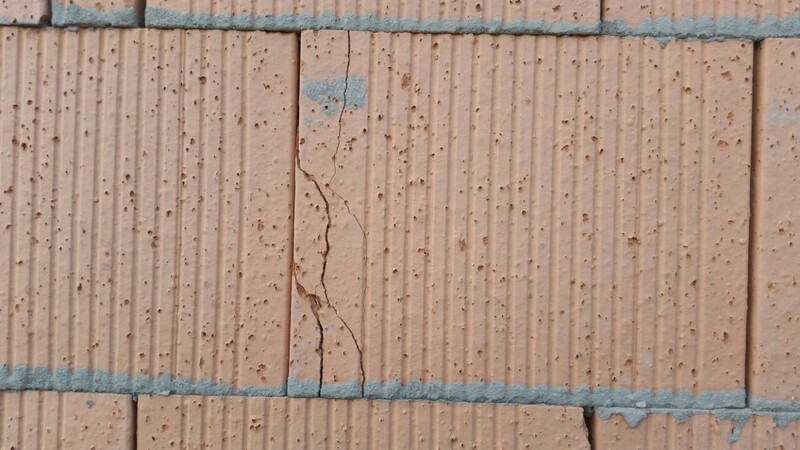

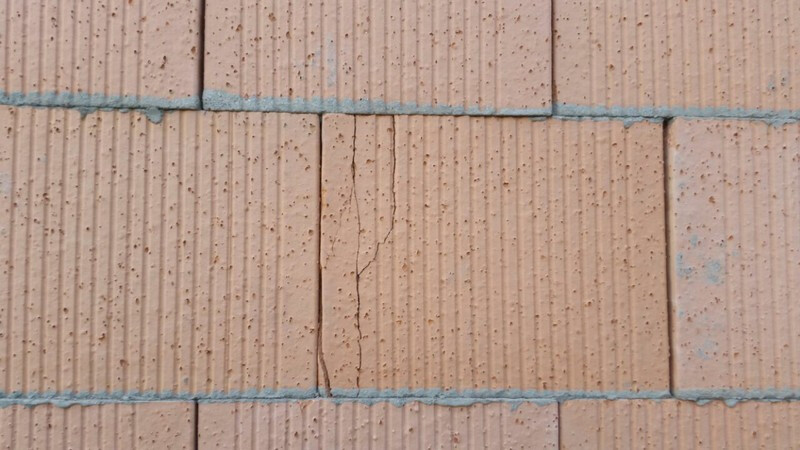
The construction manager said today, "They will just fill everything in."
B
Bauexperte21 May 2015 10:41Hello,
I’ll do my best 😀
Please convince your mother to have an independent inspector involved. Not because the pictures shown indicate poor workmanship—in fact, quite the opposite. But so that your questions can be answered in a personal conversation. And incidentally, it’s not a bad idea to hire an independent expert as a construction consultant.
Anyone building with hollow clay bricks should know that during the firing process, dimensional tolerances of up to 1 cm (0.4 inches) can occur, which will later be compensated for by the plaster. Also, hollow clay bricks are somewhat more sensitive to handling and tend to show dents or cracks during installation. This is not a problem and completely normal!
Building a house does not mean sacrificing quality for aesthetics, but receiving a building free of defects 😉
Best regards, Bauexperte
itsmemario schrieb:
Since I am a layperson in this field, I wanted to ask if the things I noticed are relevant. Please don’t give me too rough an answer. I have already tried to research via Google but couldn’t really find anything on it. My mother does not have an independent inspector from DEKRA, and I’m just asking because it seems striking to me.
I’ll do my best 😀
Please convince your mother to have an independent inspector involved. Not because the pictures shown indicate poor workmanship—in fact, quite the opposite. But so that your questions can be answered in a personal conversation. And incidentally, it’s not a bad idea to hire an independent expert as a construction consultant.
Anyone building with hollow clay bricks should know that during the firing process, dimensional tolerances of up to 1 cm (0.4 inches) can occur, which will later be compensated for by the plaster. Also, hollow clay bricks are somewhat more sensitive to handling and tend to show dents or cracks during installation. This is not a problem and completely normal!
Building a house does not mean sacrificing quality for aesthetics, but receiving a building free of defects 😉
Best regards, Bauexperte
I
itsmemario21 May 2015 10:54Thanks first of all for the reassuring response 🙂
Of course, an independent expert, like DEKRA for example, sounds good since I wouldn’t have to keep googling and asking in the forum. Are such experts paid by the hour? What additional costs should I roughly expect for a construction period of about 3 months? (I’ve already heard figures between 5,000 and 10,000 euros.) The budget is almost fully used up because there were issues with the excavation. “Leveling” was the solution in the end, and much more had to be excavated and later filled in. :S
Of course, an independent expert, like DEKRA for example, sounds good since I wouldn’t have to keep googling and asking in the forum. Are such experts paid by the hour? What additional costs should I roughly expect for a construction period of about 3 months? (I’ve already heard figures between 5,000 and 10,000 euros.) The budget is almost fully used up because there were issues with the excavation. “Leveling” was the solution in the end, and much more had to be excavated and later filled in. :S
Similar topics