
ᐅ Raised terrace with L-shaped retaining blocks / angle blocks – How to implement slope?
Created on: 13 May 2025 23:31
H
HerrBach
Good evening!
We also want to start working on our garden this summer, specifically our raised terrace. This will be renovated this year.
The terrace is approximately 3.5m x 6m (11.5ft x 20ft) in size and is located 70cm (28 inches) above ground level.
The terrace edging will be constructed using L-shaped stones measuring 80cm (31.5 inches) high and 100cm (39 inches) wide. However, during the planning process, I keep running into an issue regarding how to create a slope using these L-shaped stones.
To create a slope, the side walls must be installed at a slight angle. This causes a larger gap at the bottom of the front wall compared to the top. With an 80cm (31.5 inches) height and a 2% slope, the gap at the bottom would be almost 2cm (0.8 inches) larger than at the top.
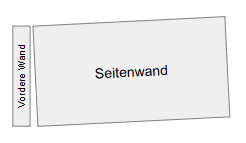
To compensate for this, the front wall would also need to be installed at a slight angle, or alternatively, the side walls would have to be cut accordingly.
However, in all the photos of raised terraces with L-shaped stones that I’ve seen, I can’t identify either of these solutions.
How is this difference usually resolved in practice? Or are raised terrace constructions with L-shaped stones often built without any slope?
The latter option would, of course, be the simplest. We are planning to build an aluminum roof over the entire raised terrace. Would this be a suitable alternative to a slope in such a case, knowing it isn’t ideal?
Best regards,
Daniel
We also want to start working on our garden this summer, specifically our raised terrace. This will be renovated this year.
The terrace is approximately 3.5m x 6m (11.5ft x 20ft) in size and is located 70cm (28 inches) above ground level.
The terrace edging will be constructed using L-shaped stones measuring 80cm (31.5 inches) high and 100cm (39 inches) wide. However, during the planning process, I keep running into an issue regarding how to create a slope using these L-shaped stones.
To create a slope, the side walls must be installed at a slight angle. This causes a larger gap at the bottom of the front wall compared to the top. With an 80cm (31.5 inches) height and a 2% slope, the gap at the bottom would be almost 2cm (0.8 inches) larger than at the top.
To compensate for this, the front wall would also need to be installed at a slight angle, or alternatively, the side walls would have to be cut accordingly.
However, in all the photos of raised terraces with L-shaped stones that I’ve seen, I can’t identify either of these solutions.
How is this difference usually resolved in practice? Or are raised terrace constructions with L-shaped stones often built without any slope?
The latter option would, of course, be the simplest. We are planning to build an aluminum roof over the entire raised terrace. Would this be a suitable alternative to a slope in such a case, knowing it isn’t ideal?
Best regards,
Daniel
M
motorradsilke14 May 2025 18:54Tolentino schrieb:
I think that’s a good idea, @motorradsilke.
At 80cm (31.5 inches) vertical drop, it’s usually required. Well, it depends on whether anyone actually comes to check. But for me and my family, I would have to do it for my own safety; otherwise, I’d have to get additional accident insurance... Especially for you in Berlin, it’s not mandatory until 1 m (39.4 inches). But in the end, everyone has to decide based on their own situation.

Oh, I got mixed up about the required height of the window sills.
It even says “more than 1 meter” (3.3 feet). So, at exactly 1 meter (3.3 feet) you could still manage without a railing, which I think is a bit careless. But anyway.
As I said, I find your idea of a slope or stepped design much more interesting.
Or, if that’s not possible due to limited space, you could place planter boxes along the edge of the terrace to disguise the step.
It even says “more than 1 meter” (3.3 feet). So, at exactly 1 meter (3.3 feet) you could still manage without a railing, which I think is a bit careless. But anyway.
As I said, I find your idea of a slope or stepped design much more interesting.
Or, if that’s not possible due to limited space, you could place planter boxes along the edge of the terrace to disguise the step.
motorradsilke schrieb:
Do you want to leave the L-shaped blocks visible? If there’s enough space, I would suggest filling the outside with soil at an angle and creating a beautiful rock garden or several stone steps with plants. This way, you can also disguise the ledge with ground cover plants. You wouldn’t need a railing either (which I wouldn’t install anyway at 80 cm (31 inches)). Yes, the L-shaped blocks should remain partially visible. Here is a graphic showing how it should look in the end.
We don’t want a railing. It simply doesn’t fit, and we want free access to the garden. A railing roof cover will be added to the terrace later.
A stepped design is of course an option. I was hoping for something a bit more “invisible.”
Reminder:
You only have that where the steps are planned. And steps are usually not called "direct access."
HerrBach schrieb:
we want direct access to the garden
You only have that where the steps are planned. And steps are usually not called "direct access."
Similar topics