
ᐅ Railing Guidelines – Head Injury Protection and Climbability
Created on: 15 Feb 2023 13:54
F
Fertighaus123
Hello everyone,
Yesterday, we had a crisis meeting with the managing director of our house building company. The situation is getting out of hand, and we are close to involving a lawyer because there are issues where reason no longer helps. One of these issues is the following topic.
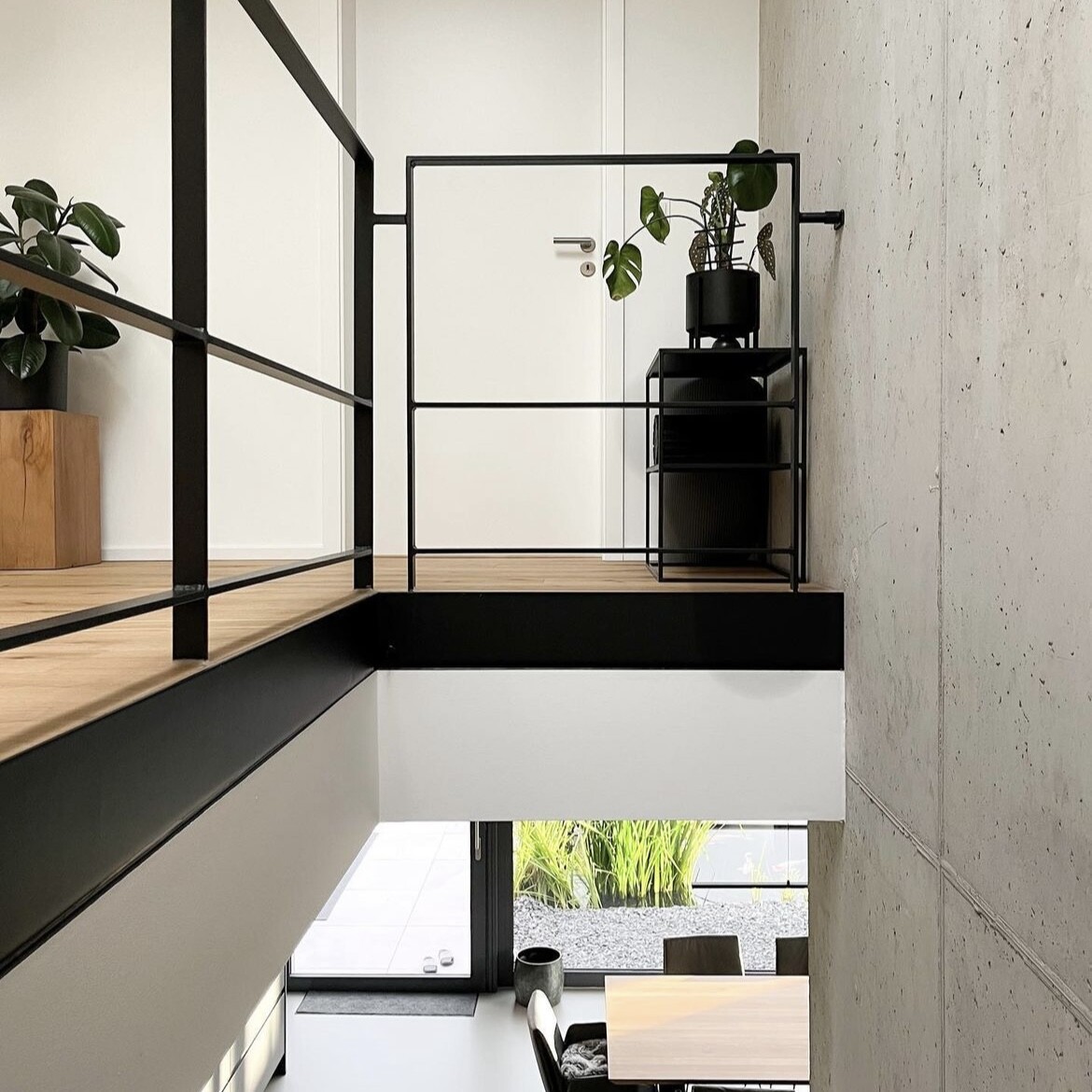
The latest development is that we have been contracted to install railings over a gallery between the ground floor and first floor, as well as on the outside balcony. We want these railings to have horizontal bars (rough sketches for reference attached). Now the building company says they won’t make such railings and that we should remove this item from the contract and hire a metalworker instead.
When we asked why, they told us something about entrapment hazards for children, and that the bars cannot be spaced more than 120mm (4.7 inches) apart. Also, they said the rails should not be horizontal because children might climb on them.
I find both reasons quite far-fetched. I know about entrapment hazards from public spaces, but only in a specific range, for example between 89mm (3.5 inches) and 230mm (9 inches); anything above or below is usually considered safe. But this shouldn’t apply to private residential buildings, right? Or does it?
The argument about climbing is also nonsense; dangers are everywhere, so why would railings be more problematic?
One can debate the pros and cons of such railings all day long. I just want to know if any of you are aware that this is actually forbidden, as he claims. Removing the railings from the contract also makes no sense; we would likely only receive a fraction of the credit compared to what such railings actually cost (credits are still pending).
Do you have any advice or are there guidelines for railings that a metalworker would need to follow?
I would really appreciate your feedback.
Best regards

Yesterday, we had a crisis meeting with the managing director of our house building company. The situation is getting out of hand, and we are close to involving a lawyer because there are issues where reason no longer helps. One of these issues is the following topic.
The latest development is that we have been contracted to install railings over a gallery between the ground floor and first floor, as well as on the outside balcony. We want these railings to have horizontal bars (rough sketches for reference attached). Now the building company says they won’t make such railings and that we should remove this item from the contract and hire a metalworker instead.
When we asked why, they told us something about entrapment hazards for children, and that the bars cannot be spaced more than 120mm (4.7 inches) apart. Also, they said the rails should not be horizontal because children might climb on them.
I find both reasons quite far-fetched. I know about entrapment hazards from public spaces, but only in a specific range, for example between 89mm (3.5 inches) and 230mm (9 inches); anything above or below is usually considered safe. But this shouldn’t apply to private residential buildings, right? Or does it?
The argument about climbing is also nonsense; dangers are everywhere, so why would railings be more problematic?
One can debate the pros and cons of such railings all day long. I just want to know if any of you are aware that this is actually forbidden, as he claims. Removing the railings from the contract also makes no sense; we would likely only receive a fraction of the credit compared to what such railings actually cost (credits are still pending).
Do you have any advice or are there guidelines for railings that a metalworker would need to follow?
I would really appreciate your feedback.
Best regards
F
Fertighaus12315 Feb 2023 15:06Tassimat schrieb:
Just take a look at the requirements according to § 3 LBOAVO yourself. Thank you very much! That’s exactly what I needed.
Can you help me break this down further?
(5) Openings in guardrails, as per paragraph 1, on areas where the presence of children up to six years old is generally expected,
1. for horizontally arranged railing elements, openings up to a guardrail height of 0.6 m (2 feet) must not be larger than 2 cm (0.8 inches), and above that height may not exceed 12 cm (4.7 inches),
2. for vertically arranged railing elements, openings must not be wider than 12 cm (4.7 inches),
3. for irregular openings, climbing must not be made easier and no dimension in any direction may be larger than 12 cm (4.7 inches).
In our case, there is no regular expectation of children visiting, so I assume there are no restrictions on the spacing of the balusters. Is that correct?
The distance of these guardrails from the area to be secured, measured vertically, must not exceed 12 cm (4.7 inches). Sentences 1 and 2 do not apply to residential buildings classified in building classes 1 and 2 and to apartments.
What exactly does this mean?
I know everything is questionable, but I would like to clarify the situation here: what is allowed and what is not?
S
Schorsch_baut15 Feb 2023 15:11Fertighaus123 schrieb:
Thank you very much! This is exactly what I needed.
Can you help me break this down further?
(5) Openings in guardrails according to paragraph 1 are allowed on surfaces where the presence of children up to six years old is generally expected,
1. for horizontally arranged baluster elements, openings up to the guardrail height of 0.6 m (2 feet) may be no larger than 2 cm (0.8 inch), and above that height no larger than 12 cm (4.7 inches),
2. for vertically arranged baluster elements, openings may not be wider than 12 cm (4.7 inches),
3. for irregular openings, climbing must not be facilitated, and no opening may be larger than 12 cm (4.7 inches) in any direction.
In our case, there will hardly ever be children visiting regularly, so I assume these spacing restrictions for the balusters don’t apply. Is that correct?
The distance of these guardrails from the surface to be secured may not exceed 12 cm (4.7 inches) when measured perpendicularly. Sentences 1 and 2 do not apply to residential buildings of building classes 1 and 2 and to apartments.
What exactly does this mean?
I know many questions remain, but I want to clarify the situation here: what is allowed and what is not? “Generally” and “regularly” describe two different aspects.
The presence of children under 6 can usually be excluded in data centers, chemical laboratories, or crematories. Can you definitely rule out that a child will ever visit your property?
F
Fertighaus12315 Feb 2023 15:19Schorsch_baut schrieb:
Can you be absolutely sure that a child will never visit your home? No, I certainly cannot.
The sentence here:
Sentences 1 and 2 do not apply to residential buildings of building classes 1 and 2 and to apartments.
combined with this explanation:
3. What is meant by building classes 1 to 3?
The classification of building classes can be found in § 2 para. 4 of the state building code:
- Building class 1:
freestanding buildings up to 7 m (23 ft) in height with no more than two occupancy units and a total area of no more than 400 m² (4,305 sq ft)
- Building class 2:
buildings up to 7 m (23 ft) in height with no more than two occupancy units and a total area of no more than 400 m² (4,305 sq ft)
- Building class 3:
other buildings up to 7 m (23 ft) in height
Note: There are no restrictions on length and width or floor area for building class 3!
Height in this definition means the measurement from the finished floor surface of the highest storey in which living space is possible, to the average ground level.
Our house has no basement and measures 6.9 m (22.6 ft) from the raw floor to the ridge.
F
Fertighaus12315 Feb 2023 15:34Unfortunately, I can no longer edit the post...
Does this then mean that even if, due to the definition of the building classification, sentences 1 and 2 are excluded, sentence 3 still applies and states:
3. irregular openings must not facilitate climbing over and must not be larger than 12 cm (5 inches) in any direction.
Does this mean that the gaps must not be larger than 12 cm (5 inches) either horizontally or vertically?
So, in Baden-Württemberg, it’s simply a lost cause, right? (If even a single visit by children cannot be excluded.)
Does this then mean that even if, due to the definition of the building classification, sentences 1 and 2 are excluded, sentence 3 still applies and states:
3. irregular openings must not facilitate climbing over and must not be larger than 12 cm (5 inches) in any direction.
Does this mean that the gaps must not be larger than 12 cm (5 inches) either horizontally or vertically?
So, in Baden-Württemberg, it’s simply a lost cause, right? (If even a single visit by children cannot be excluded.)

S
Simon-18915 Feb 2023 16:13Hello,
the clear spacing between vertical infill bars must be less than 120mm (5 inches). If, as you requested, horizontal infill bars are used, the clear spacing should be a maximum of 20-25mm (about 1 inch). These small gaps are intended to prevent a child’s foot from climbing up or slipping through. There is a helpful overview in the DIN 18065 standard from TÜV Süd—just search for “child safety” to find the relevant information. That’s the official part.
I have already had the opportunity to design the version you showed. In that case, clear Plexiglas panels were temporarily mounted on the inside of the railing while the kids were still small, to prevent climbing. Once the children were old enough, the Plexiglas was removed and everything seemed fine. Until someone was leaning on the handrail while talking from above to below, placing their foot on a horizontal infill bar and applying some pressure. The bar bent immediately… and this with post spacing under 90cm (35 inches). Flat bars lying horizontally or, even worse, round rods are simply not made for this.
Horizontal clear spacings of 20-25mm (about 1 inch) are not only a nightmare to manufacture but also an eyesore.
I’m not familiar with the regulations in Baden-Württemberg; is the construction there inspected again by the building authorities (building permit/planning permission office)? From the perspective of construction companies, I can understand well why they want to avoid responsibility here. If something happens, it would be their fault. As long as there’s no insurance-relevant incident, one might turn a blind eye, but nobody willingly takes on that risk.
the clear spacing between vertical infill bars must be less than 120mm (5 inches). If, as you requested, horizontal infill bars are used, the clear spacing should be a maximum of 20-25mm (about 1 inch). These small gaps are intended to prevent a child’s foot from climbing up or slipping through. There is a helpful overview in the DIN 18065 standard from TÜV Süd—just search for “child safety” to find the relevant information. That’s the official part.
I have already had the opportunity to design the version you showed. In that case, clear Plexiglas panels were temporarily mounted on the inside of the railing while the kids were still small, to prevent climbing. Once the children were old enough, the Plexiglas was removed and everything seemed fine. Until someone was leaning on the handrail while talking from above to below, placing their foot on a horizontal infill bar and applying some pressure. The bar bent immediately… and this with post spacing under 90cm (35 inches). Flat bars lying horizontally or, even worse, round rods are simply not made for this.
Horizontal clear spacings of 20-25mm (about 1 inch) are not only a nightmare to manufacture but also an eyesore.
I’m not familiar with the regulations in Baden-Württemberg; is the construction there inspected again by the building authorities (building permit/planning permission office)? From the perspective of construction companies, I can understand well why they want to avoid responsibility here. If something happens, it would be their fault. As long as there’s no insurance-relevant incident, one might turn a blind eye, but nobody willingly takes on that risk.
Similar topics