
Hello everyone,
I have insulated a heating niche with a 20mm XPS board (0.8 inches) and plastered over it. I glued the board directly to the wall using adhesive and reinforcing mortar.
Now my big question is whether I can simply mount standard wall brackets for the heating unit on it.
Is there anything special I need to consider (apart from using anchors and screws that are long enough)?
I’m a bit concerned that the brackets might press into the XPS insulation.
I have insulated a heating niche with a 20mm XPS board (0.8 inches) and plastered over it. I glued the board directly to the wall using adhesive and reinforcing mortar.
Now my big question is whether I can simply mount standard wall brackets for the heating unit on it.
Is there anything special I need to consider (apart from using anchors and screws that are long enough)?
I’m a bit concerned that the brackets might press into the XPS insulation.
Hi,
if you are drilling into an XPS board, you should make sure that the anchors and screws are not only long enough but also suitable for this specific substrate. XPS is stable, but you should use anchors designed specifically for this type of material, such as hollow wall anchors or special XPS anchors. Simply using standard anchors won’t provide a lasting hold.
But honestly – a 20mm (0.8 inch) XPS board? It’s worth considering how stable that will actually be. You know that heating niches with brackets can carry significant weight. Have you thought about whether it might be a good idea to secure the brackets not only into the XPS board but also into the underlying wall? Just to be on the safe side.
And speaking of plastering – that doesn’t make it more stable but rather more flexible. Make sure the plaster adheres well; otherwise, you might get cracks later. It’s better to use some reinforcement mesh beforehand to avoid problems.
Do you already have specific brackets in mind? Sometimes there are models designed especially for thin boards or layered constructions.
if you are drilling into an XPS board, you should make sure that the anchors and screws are not only long enough but also suitable for this specific substrate. XPS is stable, but you should use anchors designed specifically for this type of material, such as hollow wall anchors or special XPS anchors. Simply using standard anchors won’t provide a lasting hold.
But honestly – a 20mm (0.8 inch) XPS board? It’s worth considering how stable that will actually be. You know that heating niches with brackets can carry significant weight. Have you thought about whether it might be a good idea to secure the brackets not only into the XPS board but also into the underlying wall? Just to be on the safe side.
And speaking of plastering – that doesn’t make it more stable but rather more flexible. Make sure the plaster adheres well; otherwise, you might get cracks later. It’s better to use some reinforcement mesh beforehand to avoid problems.
Do you already have specific brackets in mind? Sometimes there are models designed especially for thin boards or layered constructions.
I am considering this radiator:
Buderus radiator, profiled radiator C-profile.2, type 22, 600x1200 mm (H x W)
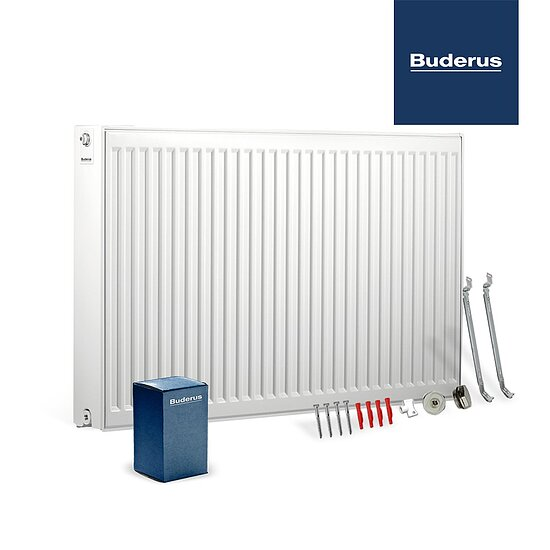
It comes with standard brackets, nothing special. If I have read and understood correctly, the radiator including water weighs about 50 kg (110 lbs).
Do I need hollow wall anchors if the XPS foam boards are glued directly onto the wall? The screws go all the way through into the wall anyway.
Buderus radiator, profiled radiator C-profile.2, type 22, 600x1200 mm (H x W)
It comes with standard brackets, nothing special. If I have read and understood correctly, the radiator including water weighs about 50 kg (110 lbs).
Do I need hollow wall anchors if the XPS foam boards are glued directly onto the wall? The screws go all the way through into the wall anyway.
For a Type 22 radiator measuring 600x1200mm (24x47 inches), you quickly reach a dry weight of nearly 40kg (88 lbs) plus the water content, sometimes even a bit more depending on the manufacturer. Honestly, I wouldn’t rely on any "XPS somehow holds" experiments, even if the manufacturer’s brochures like to present it that way. The bracket must be securely anchored into the masonry behind; anything else will likely cause problems over time.
The 20mm (0.8 inch) XPS insulation itself is less of an issue than the point load on the brackets. That’s exactly where the material tends to compress slightly, which eventually causes the radiator to hang unevenly—this often only becomes visible after one or two heating seasons. Especially since a Type 22 radiator already has considerable depth. If someone accidentally bumps into it while cleaning, you quickly notice how much leverage is actually applied.
I would recommend using spacer sleeves or appropriate mounting spacers so the bracket does not rest directly on the XPS. Long screws alone are usually not sufficient. Also, don’t use cheap drywall anchors from a hardware store; people often save on this until the radiator eventually tilts toward the floor. What kind of wall is behind it—solid brick, calcium silicate blocks, or some kind of hollow construction? That makes a significant difference when choosing the type of anchor.
By the way, the plastered surface itself contributes almost nothing to stability, even if you like to believe it after plastering. The Buderus radiator is generally solid, although the factory-mounted brackets sometimes appear a bit delicate, but that has become common everywhere nowadays—saving material has become fashionable.
The 20mm (0.8 inch) XPS insulation itself is less of an issue than the point load on the brackets. That’s exactly where the material tends to compress slightly, which eventually causes the radiator to hang unevenly—this often only becomes visible after one or two heating seasons. Especially since a Type 22 radiator already has considerable depth. If someone accidentally bumps into it while cleaning, you quickly notice how much leverage is actually applied.
I would recommend using spacer sleeves or appropriate mounting spacers so the bracket does not rest directly on the XPS. Long screws alone are usually not sufficient. Also, don’t use cheap drywall anchors from a hardware store; people often save on this until the radiator eventually tilts toward the floor. What kind of wall is behind it—solid brick, calcium silicate blocks, or some kind of hollow construction? That makes a significant difference when choosing the type of anchor.
By the way, the plastered surface itself contributes almost nothing to stability, even if you like to believe it after plastering. The Buderus radiator is generally solid, although the factory-mounted brackets sometimes appear a bit delicate, but that has become common everywhere nowadays—saving material has become fashionable.
I have now purchased two sets of rough-in adapters. They allow me to create some distance. Besides, they should be quite sturdy.
By the way, I also made a mistake... the radiator is a type 21. The wall behind it is made of lightweight concrete with Lavalite. Drilling into that is always a real challenge ;-)
By the way, I also made a mistake... the radiator is a type 21. The wall behind it is made of lightweight concrete with Lavalite. Drilling into that is always a real challenge ;-)
Similar topics