
Hello everyone, we are in the final phase of our house planning and would appreciate your tips on the following topics:
1.: The door between the living room and kitchen will be a wide wooden sliding door (2-panel) to prevent cooking smells from entering the living room. For aesthetic and practical reasons, it should be hidden inside the wall. The architect suggested installing it on the kitchen side, as otherwise a full-width casing would have to run in the living room, causing loss of space. We find this impractical because in case of any issue with the door, not only the wall but also the kitchen would have to be dismantled. Do you have experience with how often a sliding door comes off its track and requires opening the casing?
There is an exhaust hood planned that vents outside, but I am very sensitive to odors. How satisfied are those of you with a sensitive nose and an open kitchen? Could this be an alternative? Or has anyone installed glass in between? We want as much light as possible from the living room to reach the kitchen because, in the long term, a semi-detached house might be built next to ours, potentially blocking the kitchen window. Therefore, our idea was a wooden sliding door that closes tightly when needed but remains mostly hidden in the wall.
The other kitchen issue is the door to the hallway. Either access to the cabinets behind it is difficult, or if the door swings the other way, it would block the room, and a door opening into the hallway would be in the way there. Could that also be a sliding door? Hidden? Or something completely different?
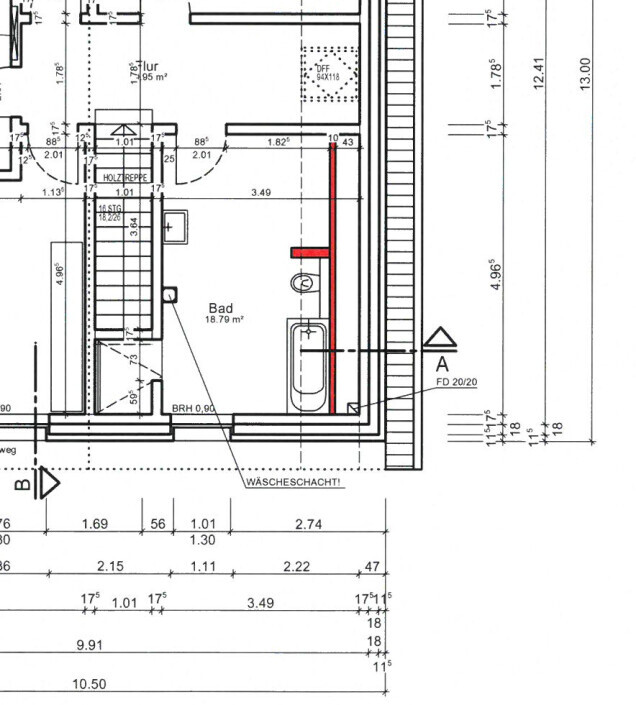
2.: The arrangement of the sanitary fixtures in the bathroom is not quite satisfying yet. The position of the laundry chute is fixed. So is the location of the shower on the upper floor. There is a sloped ceiling there, but we want to build a wall at a reasonable depth so that the height above the bathtub is comfortable even for taller people. The toilet should also be usable without having to keep your head tucked in. Additionally, a washbasin between 80–100cm (31–39 inches), a bathtub measuring 180cm x 80cm x 43cm (71 inches x 31 inches x 17 inches), as well as built-in cabinets and possibly a plinth are planned, since something needs to be done with the laundry chute area anyway. Behind the door, 50cm (20 inches) are planned to potentially fit a cabinet or towel rack. Otherwise, an integrated cabinet could be placed under the slope.
What do you think about built-in ledges in the shower or next to the bathtub?
3.: Sanitary fixtures:
- The washbasin in the guest toilet is 60cm x 48cm (24 inches x 19 inches). For the bathroom upstairs, we are looking for a basin that also has a rim to prevent water from running backward, but is wider. So, the basin bowl including the surrounding edge, not just the basin itself, since we do not need any shelf space next to it. So far, we haven’t found one.
- The shower drain is not planned as a linear channel, as I find those unhygienic and difficult to clean. Has anyone had experience with a wall drain, or do most people choose the classic round drain?
Thank you very much for your feedback and ideas.
Jörn
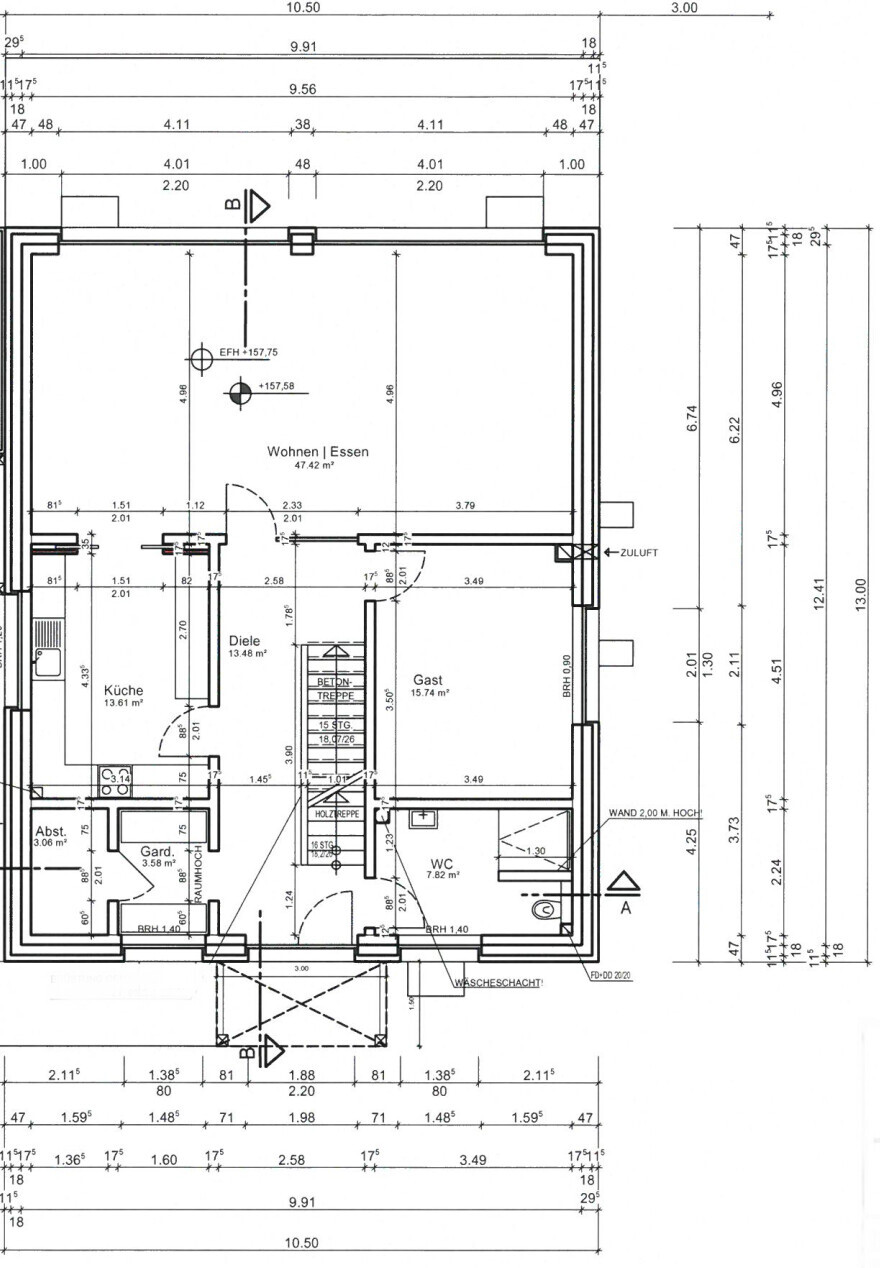
1.: The door between the living room and kitchen will be a wide wooden sliding door (2-panel) to prevent cooking smells from entering the living room. For aesthetic and practical reasons, it should be hidden inside the wall. The architect suggested installing it on the kitchen side, as otherwise a full-width casing would have to run in the living room, causing loss of space. We find this impractical because in case of any issue with the door, not only the wall but also the kitchen would have to be dismantled. Do you have experience with how often a sliding door comes off its track and requires opening the casing?
There is an exhaust hood planned that vents outside, but I am very sensitive to odors. How satisfied are those of you with a sensitive nose and an open kitchen? Could this be an alternative? Or has anyone installed glass in between? We want as much light as possible from the living room to reach the kitchen because, in the long term, a semi-detached house might be built next to ours, potentially blocking the kitchen window. Therefore, our idea was a wooden sliding door that closes tightly when needed but remains mostly hidden in the wall.
The other kitchen issue is the door to the hallway. Either access to the cabinets behind it is difficult, or if the door swings the other way, it would block the room, and a door opening into the hallway would be in the way there. Could that also be a sliding door? Hidden? Or something completely different?
2.: The arrangement of the sanitary fixtures in the bathroom is not quite satisfying yet. The position of the laundry chute is fixed. So is the location of the shower on the upper floor. There is a sloped ceiling there, but we want to build a wall at a reasonable depth so that the height above the bathtub is comfortable even for taller people. The toilet should also be usable without having to keep your head tucked in. Additionally, a washbasin between 80–100cm (31–39 inches), a bathtub measuring 180cm x 80cm x 43cm (71 inches x 31 inches x 17 inches), as well as built-in cabinets and possibly a plinth are planned, since something needs to be done with the laundry chute area anyway. Behind the door, 50cm (20 inches) are planned to potentially fit a cabinet or towel rack. Otherwise, an integrated cabinet could be placed under the slope.
What do you think about built-in ledges in the shower or next to the bathtub?
3.: Sanitary fixtures:
- The washbasin in the guest toilet is 60cm x 48cm (24 inches x 19 inches). For the bathroom upstairs, we are looking for a basin that also has a rim to prevent water from running backward, but is wider. So, the basin bowl including the surrounding edge, not just the basin itself, since we do not need any shelf space next to it. So far, we haven’t found one.
- The shower drain is not planned as a linear channel, as I find those unhygienic and difficult to clean. Has anyone had experience with a wall drain, or do most people choose the classic round drain?
Thank you very much for your feedback and ideas.
Jörn
Curly schrieb:
The next larger standard size is 212.5 cm (7 feet), which looks much better. In most show homes, the doors are also over 2 m (6 ft 7 in) high; people usually don’t pay attention to this and end up planning lower doors themselves.
Best regards,
SabineI can hardly believe that, especially since most builders already cut corners on staircases… so why offer more than the standard for doors?!
Regards, Yvonne