
ᐅ Protection sleeve for underfloor heating pipes missing in the area of movement joints
Created on: 27 Feb 2020 17:39
L
lesmue79
In the course of dealing with the issue of the movement joints with my floor installer, I have now identified a defect (in my opinion).
In the area of the movement joints in the dining and kitchen areas (L-shaped room), it appears that the protective conduit around the connection and pipe of the underfloor heating was forgotten. According to the underfloor heating manufacturer and probably several standards, the underfloor heating pipes crossing the movement joints should be fitted with a 30cm (12 inch) protective conduit.
I have already had this issue recorded in the defect report as a precaution and requested feedback on it.
Now I’m wondering how serious this issue is or could become.
I hardly believe the screed installer will replace the screed to add a protective conduit around the pipes. I think it’s more likely that an extension of the warranty will need to be discussed (my preferred option), or financial compensation (which the general contractor will probably prefer, perhaps offering around $500). But how should this be assessed? Or should I already consider hiring an expert or appraiser?
In the area of the movement joints in the dining and kitchen areas (L-shaped room), it appears that the protective conduit around the connection and pipe of the underfloor heating was forgotten. According to the underfloor heating manufacturer and probably several standards, the underfloor heating pipes crossing the movement joints should be fitted with a 30cm (12 inch) protective conduit.
I have already had this issue recorded in the defect report as a precaution and requested feedback on it.
Now I’m wondering how serious this issue is or could become.
I hardly believe the screed installer will replace the screed to add a protective conduit around the pipes. I think it’s more likely that an extension of the warranty will need to be discussed (my preferred option), or financial compensation (which the general contractor will probably prefer, perhaps offering around $500). But how should this be assessed? Or should I already consider hiring an expert or appraiser?
 Vicky Pedia28 Feb 2020 18:35
Zaba12 schrieb:
It's basically the same as doing this here.Exactly!In my opinion, the responsibility actually lies with the general contractor (GC) or their site manager. There is a reason why the industry association for surface heating has issued a guideline called “interface coordination for surface/floor heating.”
In the area of underfloor heating, three trades come together: screed installers, HVAC technicians, and floor finishers—whether that is a painter or a tiler.
It is the role of the site manager or GC to ensure that these trades work hand in hand for the overall project.
In the worst case, everyone has tunnel vision and relies on the others, even though each trade’s own standards, guidelines, or installation instructions address these issues to some extent.
In the area of underfloor heating, three trades come together: screed installers, HVAC technicians, and floor finishers—whether that is a painter or a tiler.
It is the role of the site manager or GC to ensure that these trades work hand in hand for the overall project.
In the worst case, everyone has tunnel vision and relies on the others, even though each trade’s own standards, guidelines, or installation instructions address these issues to some extent.

Zaba12 schrieb:
That’s mostly the case, at least for me!
It’s really unfortunate that you can’t rely on proper workmanship even for just two trades and minor items. It’s basically the same as doing this here.
[ATTACH alt="F204AADA-D937-4275-87DB-2875D6E2A572.png"]43437[/ATTACH] Hello,
If I understand correctly so far, protective conduits have been installed in the door areas.
Not in the angled living and dining room. If the heating circuit runs through the joint there, fixing it afterward will be twice as difficult and, in my opinion, doesn’t make sense at all.
Olli
@wrobel
In my case, it concerns the angled dining and kitchen area where no protective conduit was installed. Protective conduit has been used inside the doors. The joint essentially runs from the edge of the wall next to the right door, across to the left towards the exterior wall where the Euro pallet is hanging (where the red dot is above the edge insulation strip).
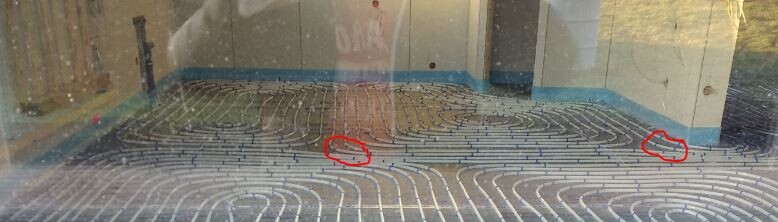
Most of the heating pipes are located to the right and left alongside the joint, but the areas marked in red cross over the joint. Regardless of whether fixing this is unnecessary work or not, is it acceptable to leave incorrect, incomplete, or only partial work? Or should it be done properly? After all, I am charged for complete and thorough work.
In my case, it concerns the angled dining and kitchen area where no protective conduit was installed. Protective conduit has been used inside the doors. The joint essentially runs from the edge of the wall next to the right door, across to the left towards the exterior wall where the Euro pallet is hanging (where the red dot is above the edge insulation strip).
Most of the heating pipes are located to the right and left alongside the joint, but the areas marked in red cross over the joint. Regardless of whether fixing this is unnecessary work or not, is it acceptable to leave incorrect, incomplete, or only partial work? Or should it be done properly? After all, I am charged for complete and thorough work.
Vicky Pedia28 Feb 2020 20:13I agree with @wrobel. No worries, nothing will happen. Try to get a depreciation of 500, and that’s it!
Similar topics