
ᐅ Protecting Exposed Concrete Stairs During Construction – Which Type of Wood Is Best?
Created on: 8 Jun 2019 21:30
M
MadameP
Hello everyone,
We are getting two straight exposed concrete staircases, which we only plan to seal afterwards. The protection of the stairs during the construction phase is on us. So, myself.
The plan is as follows: wrap the stairs with a self-adhesive stair protection fleece, then formwork the steps with wood. This means having wood cut to the width of the steps and the tread area as well as the width and the nosing, then screwing it in from top to bottom along the edge. (Plus, of course, plenty of warning signs in all the languages spoken on our site.)
My question: which type of wood would be best? It should serve the purpose but be as inexpensive as possible, since it will be removed afterwards anyway. Would OSB boards cut accordingly be a good choice?
Or does anyone have a much better idea for protecting the stairs?
Thanks in advance!
We are getting two straight exposed concrete staircases, which we only plan to seal afterwards. The protection of the stairs during the construction phase is on us. So, myself.
The plan is as follows: wrap the stairs with a self-adhesive stair protection fleece, then formwork the steps with wood. This means having wood cut to the width of the steps and the tread area as well as the width and the nosing, then screwing it in from top to bottom along the edge. (Plus, of course, plenty of warning signs in all the languages spoken on our site.)
My question: which type of wood would be best? It should serve the purpose but be as inexpensive as possible, since it will be removed afterwards anyway. Would OSB boards cut accordingly be a good choice?
Or does anyone have a much better idea for protecting the stairs?
Thanks in advance!
We had a carpenter make something for the same purpose. He charged 300 EUR.
A cut-out was made from chipboard for the tread and riser, connected with battens, essentially fully enclosing the staircase. Thin cork material was laid underneath to minimize friction on the chipboard.
There were signs in multiple languages as well. It worked!
The stair protection served us well for several months! You can maybe see it a bit in the photo.
In our case, it wasn’t a precast concrete element but was cast on site. The foreman did an excellent job! So far, the staircase is still completely raw, just as it came out of the formwork; we haven’t got around to plastering yet, and somehow we’ve gotten used to the construction stairs.
What are you planning to use for plastering?
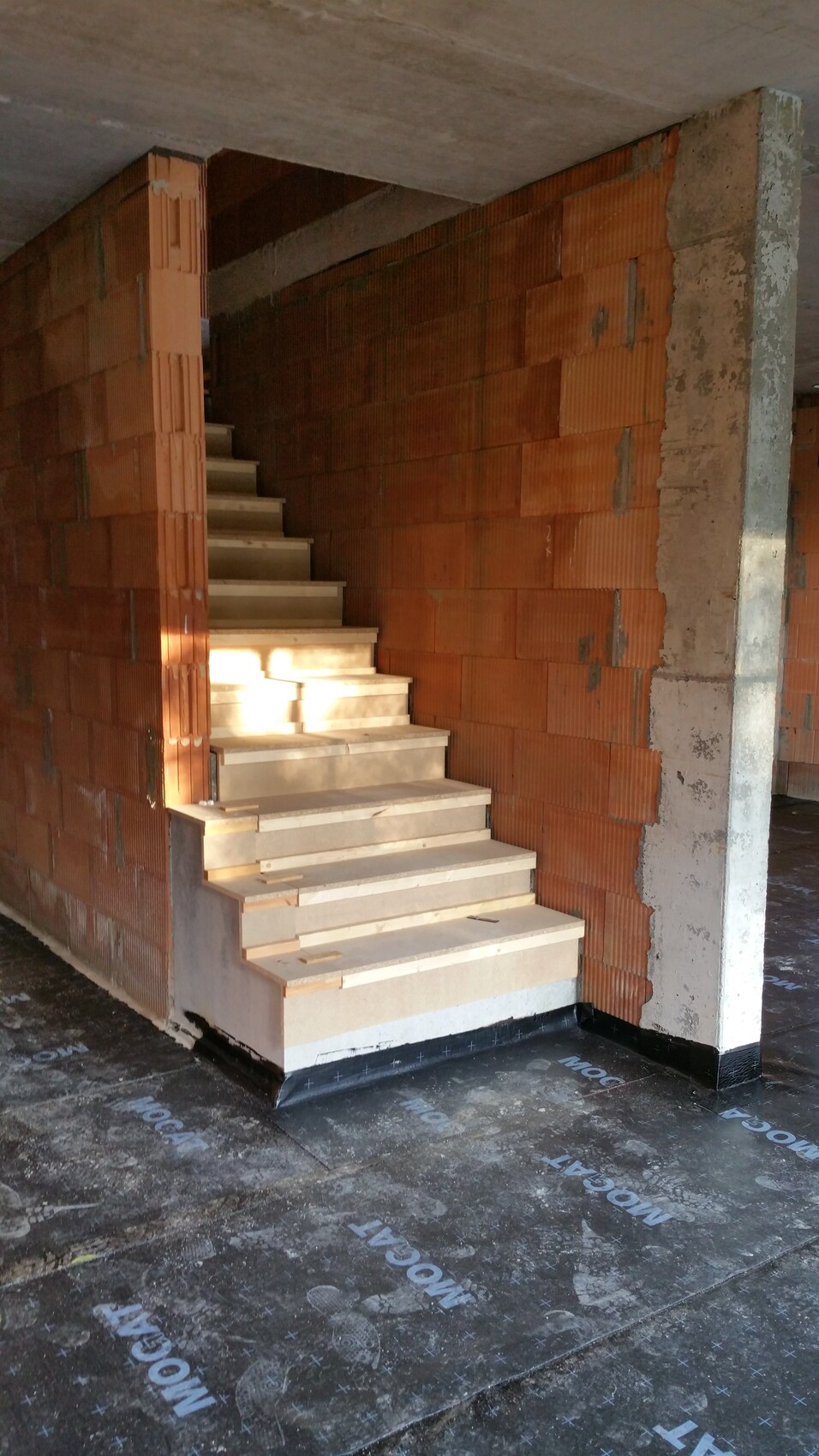
A cut-out was made from chipboard for the tread and riser, connected with battens, essentially fully enclosing the staircase. Thin cork material was laid underneath to minimize friction on the chipboard.
There were signs in multiple languages as well. It worked!
The stair protection served us well for several months! You can maybe see it a bit in the photo.
In our case, it wasn’t a precast concrete element but was cast on site. The foreman did an excellent job! So far, the staircase is still completely raw, just as it came out of the formwork; we haven’t got around to plastering yet, and somehow we’ve gotten used to the construction stairs.
What are you planning to use for plastering?
We had the concrete plant apply a sealant and ordered the packaging as well. Basically, it’s a formwork made of construction timber with a tarp underneath.
What kind of filler are you referring to? The concrete has a smooth form finish. If you apply filler on top, it won’t be exposed concrete anymore.
What kind of filler are you referring to? The concrete has a smooth form finish. If you apply filler on top, it won’t be exposed concrete anymore.
Yes, that’s exactly how we have planned it now. First, a kind of padded membrane, then formwork with OSB cut to size. I will do it myself, and the materials cost me about 120.
There will be no filling or spackling, as @guckuck2 mentioned. Just sealing. Would you like to show your stairs?
There will be no filling or spackling, as @guckuck2 mentioned. Just sealing. Would you like to show your stairs?
Since the concrete was poured on site, the surface is not as smooth as with precast exposed concrete stairs. In the long term, it was supposed to be treated with béton ciré, which is applied in a 1mm (0.04 inch) layer. However, we are no longer sure whether to go ahead with that or simply apply a sealant.
Similar topics