
Hello everyone,
maybe this thread is a bit early since we don’t have a planned floor plan yet. But we would still appreciate your advice. First of all, because this is probably the most important information: We are planning with a budget of 600,000 euros for the house plus additional building-related costs. We have received approval to purchase the plot shown here. We will sign the purchase contract at the end of next week. Now to our problem:
We are very uncertain about which is the better decision for our plot: a (partial) basement with a smaller floor plan (about 130 – 140 m² (1400 – 1500 sq ft)) (Option A), or a slab foundation with a slightly larger floor plan (about 170 m² (1800 sq ft)) (Option B).
I will list the pros and cons as we see them for each option.
Option A:
+ Utility room in the basement frees up space on the ground floor; no noise issues
+ More usable space overall
+ Hobby room can also be used flexibly for gatherings
+ Storage space!
+ Possibility of a double parking space
- Expensive (a full basement is probably unrealistic with our budget; is a partial basement more sensible?)
- Less space on the ground and upper floors
Option B:
+ More living space on the ground and upper floors
+ High potential for cost savings!
+ Possible to use the attic for storage?
- Is there still enough space for a double parking space?
- Possible issues with the plot ratio? If we understand correctly, the footprint of the house may be limited to 143 m² (1540 sq ft) plus 70 m² (750 sq ft) for driveway, garage, etc. My feeling is that the developed area might easily be underestimated and reach the limit quickly.
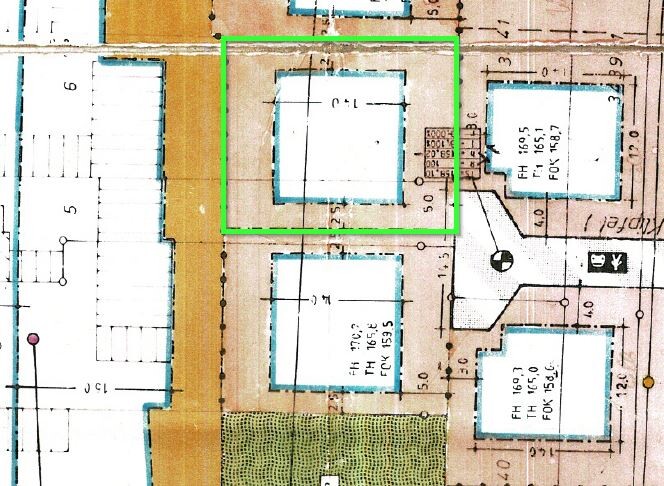
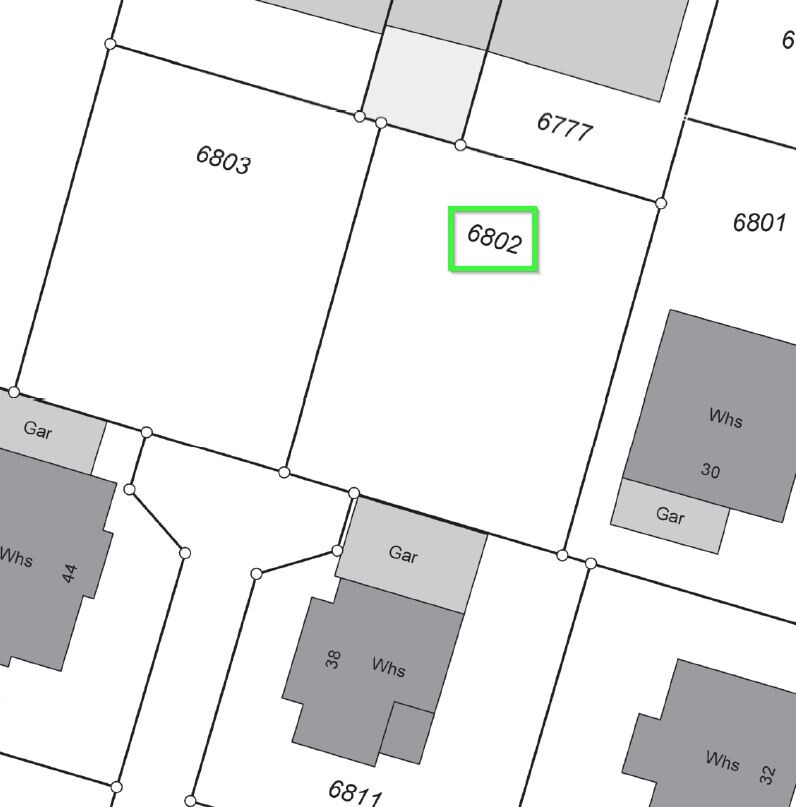
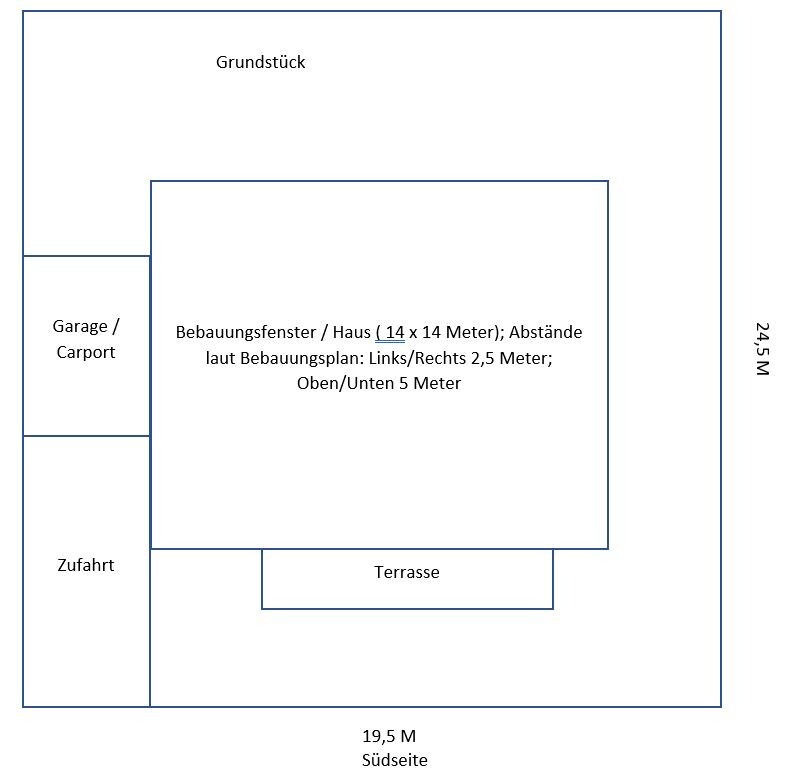
We would be interested in your opinion on how you would build on this plot. I have made a very rough sketch of how we imagine the orientation of the house and placement of parking spaces, etc. I have also attached the site plan and development plan. The questionnaire is mostly filled out, but a “final” floor plan is still missing, as mentioned. This will also largely depend on the question of whether to have a basement or not.
I hope I haven’t forgotten anything...
Best regards
Development Plan / Restrictions
Plot size 477 m² (5130 sq ft)
Slope Minimal
Plot ratio (ground coverage ratio) 0.3
Floor area ratio 0.8
Building envelope, building line, boundary 14 x 14 meters (see image)
Edge development see image
Number of parking spaces unknown
Building height up to 2 full stories
Roof type Hip roof or gable roof 30-40 degrees
Architectural style unknown
Orientation unknown
Maximum height / limits unknown
Other requirements unknown
Homeowners’ Requirements
Architectural style, Roof type Gable or hip roof (open to either)
Basement, number of floors Basement yes/no is the big question. 1.5 – 2 full stories
Number of occupants, ages 2 adults (32 and 33), 1 child (1), 1 more child planned
Room requirements on ground and upper floors Utility room, guest toilet with shower, guest room, study (a study nook might also be sufficient), 2 children’s rooms, master bedroom, bathroom
Office: family use or home office? Both
Overnight guests per year Parents-in-law should be able to stay regularly (about once a month)
Open or closed layout Open kitchen / living / dining area
Conservative or modern design Exterior should be clean and simple – relatively straightforward
Open kitchen, kitchen island Yes, at least a peninsula
Number of dining places in the kitchen No dining space needed in the kitchen; the dining room should have space for a large table
Fireplace If budget allows; not mandatory
Music / sound wall 11.2.4 sound system + TV to be integrated into the study (or guest room)
Balcony, roof terrace Not necessary
Garage, carport Double carport or double garage would be nice if space allows; otherwise 2 parking spaces in tandem
Utility garden, greenhouse Not planned
Other wishes / special features / daily routine, including reasons why some options are preferred or rejected Smart home with KNX (or Loxone); controlled ventilation system, photovoltaic system (+ possibly battery storage), air-to-water heat pump
House Design
Who did the planning:
- Planner from a construction company
- Architect
- Do-it-yourself
What do you especially like? Why?
What do you dislike? Why?
Estimated cost according to architect/planner:
Personal budget limit for the house, including equipment:
Preferred heating technology: Air-to-water heat pump + photovoltaic system (+ possibly small battery storage)
If you have to give up something, which details or features
- can you do without:
- cannot do without:
maybe this thread is a bit early since we don’t have a planned floor plan yet. But we would still appreciate your advice. First of all, because this is probably the most important information: We are planning with a budget of 600,000 euros for the house plus additional building-related costs. We have received approval to purchase the plot shown here. We will sign the purchase contract at the end of next week. Now to our problem:
We are very uncertain about which is the better decision for our plot: a (partial) basement with a smaller floor plan (about 130 – 140 m² (1400 – 1500 sq ft)) (Option A), or a slab foundation with a slightly larger floor plan (about 170 m² (1800 sq ft)) (Option B).
I will list the pros and cons as we see them for each option.
Option A:
+ Utility room in the basement frees up space on the ground floor; no noise issues
+ More usable space overall
+ Hobby room can also be used flexibly for gatherings
+ Storage space!
+ Possibility of a double parking space
- Expensive (a full basement is probably unrealistic with our budget; is a partial basement more sensible?)
- Less space on the ground and upper floors
Option B:
+ More living space on the ground and upper floors
+ High potential for cost savings!
+ Possible to use the attic for storage?
- Is there still enough space for a double parking space?
- Possible issues with the plot ratio? If we understand correctly, the footprint of the house may be limited to 143 m² (1540 sq ft) plus 70 m² (750 sq ft) for driveway, garage, etc. My feeling is that the developed area might easily be underestimated and reach the limit quickly.
We would be interested in your opinion on how you would build on this plot. I have made a very rough sketch of how we imagine the orientation of the house and placement of parking spaces, etc. I have also attached the site plan and development plan. The questionnaire is mostly filled out, but a “final” floor plan is still missing, as mentioned. This will also largely depend on the question of whether to have a basement or not.
I hope I haven’t forgotten anything...
Best regards
Development Plan / Restrictions
Plot size 477 m² (5130 sq ft)
Slope Minimal
Plot ratio (ground coverage ratio) 0.3
Floor area ratio 0.8
Building envelope, building line, boundary 14 x 14 meters (see image)
Edge development see image
Number of parking spaces unknown
Building height up to 2 full stories
Roof type Hip roof or gable roof 30-40 degrees
Architectural style unknown
Orientation unknown
Maximum height / limits unknown
Other requirements unknown
Homeowners’ Requirements
Architectural style, Roof type Gable or hip roof (open to either)
Basement, number of floors Basement yes/no is the big question. 1.5 – 2 full stories
Number of occupants, ages 2 adults (32 and 33), 1 child (1), 1 more child planned
Room requirements on ground and upper floors Utility room, guest toilet with shower, guest room, study (a study nook might also be sufficient), 2 children’s rooms, master bedroom, bathroom
Office: family use or home office? Both
Overnight guests per year Parents-in-law should be able to stay regularly (about once a month)
Open or closed layout Open kitchen / living / dining area
Conservative or modern design Exterior should be clean and simple – relatively straightforward
Open kitchen, kitchen island Yes, at least a peninsula
Number of dining places in the kitchen No dining space needed in the kitchen; the dining room should have space for a large table
Fireplace If budget allows; not mandatory
Music / sound wall 11.2.4 sound system + TV to be integrated into the study (or guest room)
Balcony, roof terrace Not necessary
Garage, carport Double carport or double garage would be nice if space allows; otherwise 2 parking spaces in tandem
Utility garden, greenhouse Not planned
Other wishes / special features / daily routine, including reasons why some options are preferred or rejected Smart home with KNX (or Loxone); controlled ventilation system, photovoltaic system (+ possibly battery storage), air-to-water heat pump
House Design
Who did the planning:
- Planner from a construction company
- Architect
- Do-it-yourself
What do you especially like? Why?
What do you dislike? Why?
Estimated cost according to architect/planner:
Personal budget limit for the house, including equipment:
Preferred heating technology: Air-to-water heat pump + photovoltaic system (+ possibly small battery storage)
If you have to give up something, which details or features
- can you do without:
- cannot do without:

altoderneu schrieb:
How is it possible that two different architects plan EXACTLY THE SAME house? Every year, this happens thousands of times: at least one house, which can only be distinguished under a microscope, is planned individually as an alleged "unique piece" because families like the Müllers, Meiers, and Schulzes—with almost identical requirements—each independently approach different architects. This kind of planning redundancy causes unnecessary costs (the economic term is "waste"). There is no nobler reason for this than simple vanity, indulging in an illusion of individuality that, for the typical self-assured person from the West, is tied to their cherished notion of freedom.
This is how dozens, even dozens times two, architects plan effectively the same "production house" without even realizing it :-(
https://www.instagram.com/11antgmxde/
https://www.linkedin.com/company/bauen-jetzt/
S
SandyBlack18 Feb 2022 07:48The background to my question was:
We met some acquaintances this week who are building with an architect, and during the conversation, we probably just got a bit unsettled 😉.
But we realize that the architect is the wrong area to cut costs by looking for one who charges well below the HOAI fee scale.
We met some acquaintances this week who are building with an architect, and during the conversation, we probably just got a bit unsettled 😉.
But we realize that the architect is the wrong area to cut costs by looking for one who charges well below the HOAI fee scale.
S
SandyBlack2 Mar 2022 19:4911ant schrieb:
Yes, I usually recommend having design, detailed planning, tendering, and site supervision all handled by the same party. Of course, the tendering process is not just about materials, quantities, and volumes, but also includes execution timeframes and price validity periods. I don’t know who keeps feeding prospective builders the nonsense that fixed price guarantees are only available with a general contractor. Since we are talking about architects, I wanted to add something about "fixed price guarantees" from architects – this might be interesting for others as well.
If you tender and then award the contracts to a general contractor, you get a fixed price guarantee. However, if you contract the trades separately, you practically don’t get one. This is because offer validity periods are usually about 10 days. Since the trades are needed one after another, prices can—and in the current situation likely will—change over time. Especially trades that come towards the end, like tilers, often quote very different prices when it’s their turn.
However, it’s important to keep in mind that the general contractors include price increases in their fixed price guarantees. In the end, it’s a kind of gamble. If prices rise more than the general contractor estimates, you could be better off without a fixed price guarantee through the architect. But if price increases are higher than what the general contractor factored in, the fixed price guarantee will definitely be cheaper.
@SandyBlack: Actually, I should now respond to you exactly with what you initially quoted from my post #53 in this thread :-(
Requesting offers for separate contracts gradually—and then “often” generating a domino effect of underestimated or initially insufficiently considered bid validity periods—is a common mistake by novice owner-builders. Repeatedly blaming this on the choice of “for/against GC contracting” remains untrue despite countless repetitions. If an owner fears unexpected price increases, they only need to remember to avoid taking on phases 6 and 7 (execution and handover phases) as a layperson doing self-performance. For inexperienced owners, this will regularly be a poor decision (and have to be).
https://www.instagram.com/11antgmxde/
https://www.linkedin.com/company/bauen-jetzt/
SandyBlack schrieb:It is certainly interesting for many readers, so it is very much appreciated that you address this package of misunderstandings and myths again, as these are genuine evergreen topics. However, the phrase “fixed price guarantees” with architects is misleading, because it is not the architect who actually “guarantees” the prices.
Since we just came from the architect, I wanted to add something on the topic of “fixed price guarantees” with architects – this might also be interesting for others.
SandyBlack schrieb:In a tender, the documents also specify the execution period for which the bid prices are valid, meaning the bid validity period (commonly referred to by owners as a “guarantee”). Basically, these validity periods do not change depending on whether a bidder offers on single packages or on the entire scope as a “GC.” In the case of a GC, the validity period of the last package effectively applies to the overall contract. When “the time comes” is determined by the scheduling (which is also part of the tender information in a proper tender process).
If you tender the project and then assign the contracts to a general contractor (GC), you have a fixed price guarantee. If you contract trades separately, however, almost never. Because the bid validity periods are usually 10 days. Since the trades are needed gradually, prices can (and especially in the current situation will) always change. Trades that are scheduled toward the end, such as tilers, usually quote completely different prices when their work is due.
SandyBlack schrieb:What you call a “bet” here is simply the normal commercial calculation risk, which affects GCs no more and no less than the subcontractors bidding on single packages. Material price increases make up the largest part of this risk (because labor and social contribution increases are more predictable), and the fact that actual costs exceed forecasts is never a reason to cancel the bid price validity.
However, you also have to keep in mind that fixed price guarantees from GCs naturally include built-in contingencies for price increases. At the end of the day, it’s a kind of bet. If prices rise more than the GC anticipated, you come out better without the architect’s price guarantee. If price increases are less than what was included by the GC, the GC’s fixed price guarantee is certainly cheaper.
Requesting offers for separate contracts gradually—and then “often” generating a domino effect of underestimated or initially insufficiently considered bid validity periods—is a common mistake by novice owner-builders. Repeatedly blaming this on the choice of “for/against GC contracting” remains untrue despite countless repetitions. If an owner fears unexpected price increases, they only need to remember to avoid taking on phases 6 and 7 (execution and handover phases) as a layperson doing self-performance. For inexperienced owners, this will regularly be a poor decision (and have to be).
https://www.instagram.com/11antgmxde/
https://www.linkedin.com/company/bauen-jetzt/
S
SandyBlack3 Mar 2022 09:3511ant schrieb:
@SandyBlack: Actually, I should now reply to you exactly with what you initially quoted from my post #53 in this thread :-(That quote is exactly why I wanted to add this clarification 😉.
As I said, the statement comes directly from our architect, so it is not inherently "wrong." Perhaps our architect or our region is an exception and things work differently elsewhere. I can’t really judge that.
11ant schrieb:
It is certainly interesting for many readers, so it is very much appreciated that you bring up these family-package misconceptions and misunderstandings again, as they are real evergreen topics. However, the phrase “fixed price guarantees” with architects is misleading since it is not actually the architect who “guarantees” the prices.From my perspective, it’s not crucial how exactly it is labeled or who provides the guarantee or fixed offer period. At the end of the day, as a client, what matters most to me is cost calculation certainty.11ant schrieb:
A tender also includes information about the execution period to which the offer prices should relate, meaning what the binding period (often called a “guarantee” by clients) is. In principle, these binding periods are not affected by whether a bidder offers only on individual packages or all of them as a “general contractor” (GC). If it’s a GC, the binding period of the last package effectively applies to the entire contract. The timing of “when the time has come” is determined by the schedule, which is also part of the tender information in a proper tender process.And this is exactly where our architect’s statement does not align with yours. I am not interested in who is right or wrong here. But it might be useful for other clients to know that it does not always work exactly as you describe. Our architect stated that there is of course a binding period, but usually it is very short (about 10 days). And while the tender refers to a specific execution period, if there were material price increases up to that time, the trades pass those costs on to the client.
As I said, I do not know if our architect makes mistakes in the tendering process, if something is handled incorrectly, or if it is simply more complex than you suggest.
11ant schrieb:
What you see as a “bet” here is the usual commercial calculation risk, which affects a GC no more and no less than trades bidding on individual packages. Material price increases make up most of this risk (since increases in wages and social contributions are calculable), and reality exceeding projections is no valid reason to terminate the offer price binding.I can also understand your argument of course. I will discuss this more thoroughly with our architect and share feedback. If a contract gets signed, I can report my experience firsthand 😉.11ant schrieb:
Getting individual offers successively (and quite often with a domino effect of underestimated or initially insufficiently considered binding periods) is a popular clumsy approach by inexperienced client-builders. Blaming this repeatedly on the chosen way “for/against GC contracts” does not make it more true, even after countless repetitions. Clients who fear unexpected price increases only need to learn one thing: do not attempt to carry out phases 6 and 7 of the design and construction process (typically costing and contract awarding) as an amateur. For laypersons, this usually results in poor outcomes.No worries — we would never even think of doing this ourselves 😉. If we sign with the architect, it will be for all service phases.
One different question:
We will receive initial drafts for our floor plan in the coming weeks.
Is it okay if I start a new topic with these and reference this thread? I think that would be clearer.
Or would it be better to attach them directly here?
SandyBlack schrieb:
As I said, the statement comes directly from our architect. So it is not "wrong" per se.Which statement do you mean now? SandyBlack schrieb:
From my point of view, it is not so important how exactly it is called or who provides the guarantee / commitment period. At the end of the day, for me as the builder, the key point is cost certainty.Call it whatever you want (with permission from Stoffel and Wolfgang) – it still is not the architect who gives these "guarantees." SandyBlack schrieb:
Our architect stated that there is, of course, a commitment period, but it is usually very short (about 10 days).He must have been sick during the lectures on tendering. A roofer’s offer that expires before excavation of the foundation pit would make the tender a joke. Offers should not reflect spot prices at the moment of tendering, but should make the execution predictable. SandyBlack schrieb:
If we sign with the architect, then for all service phases.Maybe better not with this one after all. By the way (see also: “A house construction roadmap, for you too: the HOAI phase model!”) I do recommend commissioning the same architect for “the full package,” but not all phases “in one go” (but rather as modules A, B, and C – available at the same source – with a break after A). SandyBlack schrieb:
Is it okay if I start a separate topic with these and set a cross-reference to this thread? I think that would be clearer.Yes – so you can have the questionnaire in the opening post there. But also create cross-references from here to there.https://www.instagram.com/11antgmxde/
https://www.linkedin.com/company/bauen-jetzt/
Similar topics