
Hello everyone,
After a long search, we have finally found a plot of land that we want (and can afford). Now the question is how to build.
To explain briefly, it is a slight slope parallel to the street. In front of the plot, there are two parking spaces, so the driveway can only be on the upper left side.
A soil report states that the soil is clayey. Building is allowed at 200 meters (656 feet) above sea level ± 0.50 meters (1.6 feet). The total height for shed roofs must not exceed 7.50 meters (25 feet). The shed roof must have a pitch between 10° and 15°, the orientation does not matter (preferably facing south due to a planned photovoltaic system). We would like to build two full stories.
The construction will be solid masonry, but we are still undecided between aerated concrete, clay blocks, or Neopor concrete.
Now the question is whether it makes sense to plan a basement, which would only be used as storage and for the building’s technical equipment. Possibly, depending on the size, also for a hobby room.
On the topic of basements, you find very different cost estimates ranging from €15,000 to €70,000. Since the basement will be finished by ourselves, I am mainly interested in the cost of the basement shell itself, not the complete finish.
Is a basement even possible with the maximum building height and two full stories?
What are the additional costs compared to building without a basement? Because of the slight slope, quite a bit of excavation would be required to create the foundation for the slab.
To give you a rough idea of our plans, I have attached two images.
The red numbers indicate the elevation in meters above sea level at the corners.
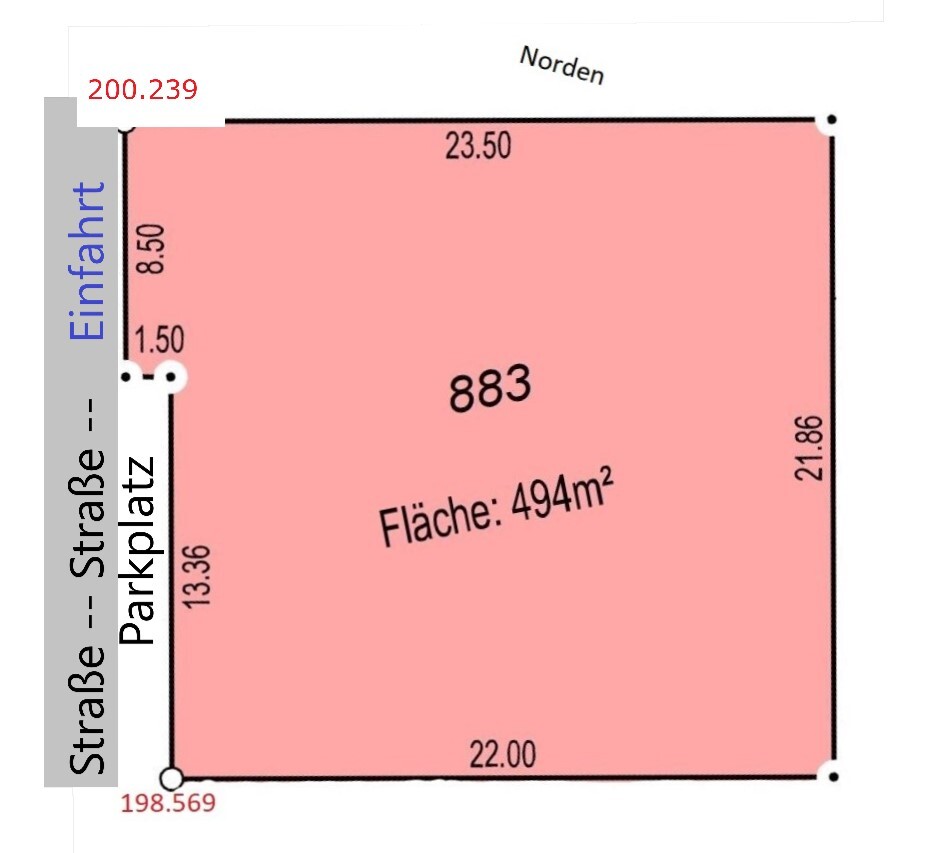
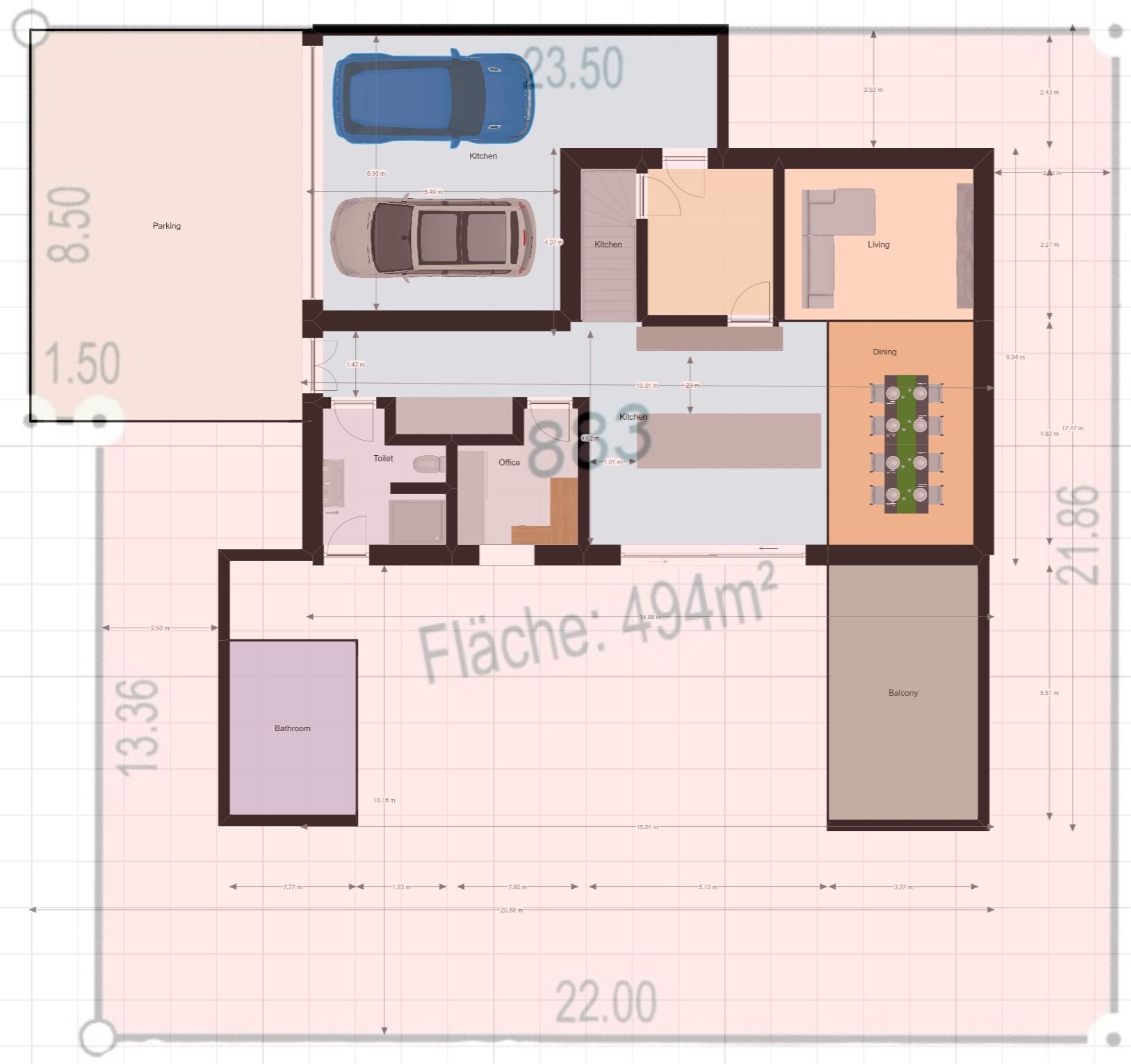
What do you think about the basement? We find it hard to design a floor plan where there is enough space on the ground floor for both the technical and storage rooms. But we also don’t want to “bury” unnecessary money.
PS: I’m happy to receive suggestions for the floor plan as well, but the main focus should be on the basement question.
After a long search, we have finally found a plot of land that we want (and can afford). Now the question is how to build.
To explain briefly, it is a slight slope parallel to the street. In front of the plot, there are two parking spaces, so the driveway can only be on the upper left side.
A soil report states that the soil is clayey. Building is allowed at 200 meters (656 feet) above sea level ± 0.50 meters (1.6 feet). The total height for shed roofs must not exceed 7.50 meters (25 feet). The shed roof must have a pitch between 10° and 15°, the orientation does not matter (preferably facing south due to a planned photovoltaic system). We would like to build two full stories.
The construction will be solid masonry, but we are still undecided between aerated concrete, clay blocks, or Neopor concrete.
Now the question is whether it makes sense to plan a basement, which would only be used as storage and for the building’s technical equipment. Possibly, depending on the size, also for a hobby room.
On the topic of basements, you find very different cost estimates ranging from €15,000 to €70,000. Since the basement will be finished by ourselves, I am mainly interested in the cost of the basement shell itself, not the complete finish.
Is a basement even possible with the maximum building height and two full stories?
What are the additional costs compared to building without a basement? Because of the slight slope, quite a bit of excavation would be required to create the foundation for the slab.
To give you a rough idea of our plans, I have attached two images.
The red numbers indicate the elevation in meters above sea level at the corners.
What do you think about the basement? We find it hard to design a floor plan where there is enough space on the ground floor for both the technical and storage rooms. But we also don’t want to “bury” unnecessary money.
PS: I’m happy to receive suggestions for the floor plan as well, but the main focus should be on the basement question.

To operate radiators, you usually need a significantly higher supply temperature than for underfloor heating systems. However, heat pumps are not suitable for such high supply temperatures and therefore must rely on the built-in electric heating element. This effectively means you are creating a purely electric heating system with the associated operating costs.
For occasional use, an electric heater (infrared) at the workspace might be a good option. It is inexpensive to purchase, and the high energy consumption is offset by the limited usage time.
For occasional use, an electric heater (infrared) at the workspace might be a good option. It is inexpensive to purchase, and the high energy consumption is offset by the limited usage time.
OK, then this topic is probably settled.
Now I would like to hear your opinions on my plan.
So, photovoltaic system, air-to-water heat pump, controlled ventilation with heat recovery.
PS: We will be building in a LEGO style, using Neopor blocks filled with concrete.
Regards
Now I would like to hear your opinions on my plan.
So, photovoltaic system, air-to-water heat pump, controlled ventilation with heat recovery.
PS: We will be building in a LEGO style, using Neopor blocks filled with concrete.
Regards

red-ed schrieb:
Now I would like to hear your opinions on my plan. I think the floor plans are okay; the fact that the bathtub is the first thing you see standing in the middle of the bathroom reminds me a bit of a massage clinic.
Are there any elevations or exterior views available?
red-ed schrieb:
PS: We will be building in LEGO style, using Neopor blocks filled with concrete. There are several discussions on this topic here; my most detailed comments can be found in this thread: https://www.hausbau-forum.de/threads/Erfahrungen-mit-bausatzhaus-aus-neopor-o-ae.14531/page-4
https://www.instagram.com/11antgmxde/
https://www.linkedin.com/company/bauen-jetzt/
Radiators require significantly higher supply temperatures compared to underfloor heating. Using radiators negates the advantage of an AIR-TO-WATER heat pump.
For heating: If the room is within the heated building envelope, then install underfloor heating and keep it running continuously at a very low level. Yes, the warming-up behavior is noticeably slower than with radiators.
If it is a room with very few hours of use, then an electric radiant heater in addition to underfloor heating could be an alternative.
For heating: If the room is within the heated building envelope, then install underfloor heating and keep it running continuously at a very low level. Yes, the warming-up behavior is noticeably slower than with radiators.
If it is a room with very few hours of use, then an electric radiant heater in addition to underfloor heating could be an alternative.
Yes, there are views.
I designed the house in Sweethome 3D. Without this software, I wouldn’t have noticed quite a few mistakes made by the architect.
My wife would like a black bathtub as an eye-catcher, which is why it is placed so centrally.
With the ceiling height (about 4m (13 feet)), it could really look very nice.
I read the thread you linked.
I see a few other aspects but find your opinion very helpful.
I like the idea of good insulation and a very solid construction using concrete. After all, there is increasing radiation and external influences. Concrete is a very dense building material that effectively shields against radiation, noise, etc.
In our case, we also have friends who live in a similar house from the 1970s (at least I think so) and are very satisfied. Their only problem is ventilation, which leads to mold if adequate air exchange is not maintained.
For this reason, a mechanical ventilation system with heat recovery is necessary. I believe such a system should be mandatory nowadays.
Builders are required to construct ever more airtight buildings, but the responsibility to ventilate properly is left to the residents.
Although somewhat older, I find it very interesting
Regards
PS: I would gladly connect with other LEGO builders. If there are any, please get in touch.
I designed the house in Sweethome 3D. Without this software, I wouldn’t have noticed quite a few mistakes made by the architect.
My wife would like a black bathtub as an eye-catcher, which is why it is placed so centrally.
With the ceiling height (about 4m (13 feet)), it could really look very nice.
I read the thread you linked.
I see a few other aspects but find your opinion very helpful.
I like the idea of good insulation and a very solid construction using concrete. After all, there is increasing radiation and external influences. Concrete is a very dense building material that effectively shields against radiation, noise, etc.
In our case, we also have friends who live in a similar house from the 1970s (at least I think so) and are very satisfied. Their only problem is ventilation, which leads to mold if adequate air exchange is not maintained.
For this reason, a mechanical ventilation system with heat recovery is necessary. I believe such a system should be mandatory nowadays.
Builders are required to construct ever more airtight buildings, but the responsibility to ventilate properly is left to the residents.
Although somewhat older, I find it very interesting
Regards
PS: I would gladly connect with other LEGO builders. If there are any, please get in touch.
Similar topics