
Hello everyone,
After a long search, we have finally found a plot of land that we want (and can afford). Now the question is how to build.
To explain briefly, it is a slight slope parallel to the street. In front of the plot, there are two parking spaces, so the driveway can only be on the upper left side.
A soil report states that the soil is clayey. Building is allowed at 200 meters (656 feet) above sea level ± 0.50 meters (1.6 feet). The total height for shed roofs must not exceed 7.50 meters (25 feet). The shed roof must have a pitch between 10° and 15°, the orientation does not matter (preferably facing south due to a planned photovoltaic system). We would like to build two full stories.
The construction will be solid masonry, but we are still undecided between aerated concrete, clay blocks, or Neopor concrete.
Now the question is whether it makes sense to plan a basement, which would only be used as storage and for the building’s technical equipment. Possibly, depending on the size, also for a hobby room.
On the topic of basements, you find very different cost estimates ranging from €15,000 to €70,000. Since the basement will be finished by ourselves, I am mainly interested in the cost of the basement shell itself, not the complete finish.
Is a basement even possible with the maximum building height and two full stories?
What are the additional costs compared to building without a basement? Because of the slight slope, quite a bit of excavation would be required to create the foundation for the slab.
To give you a rough idea of our plans, I have attached two images.
The red numbers indicate the elevation in meters above sea level at the corners.
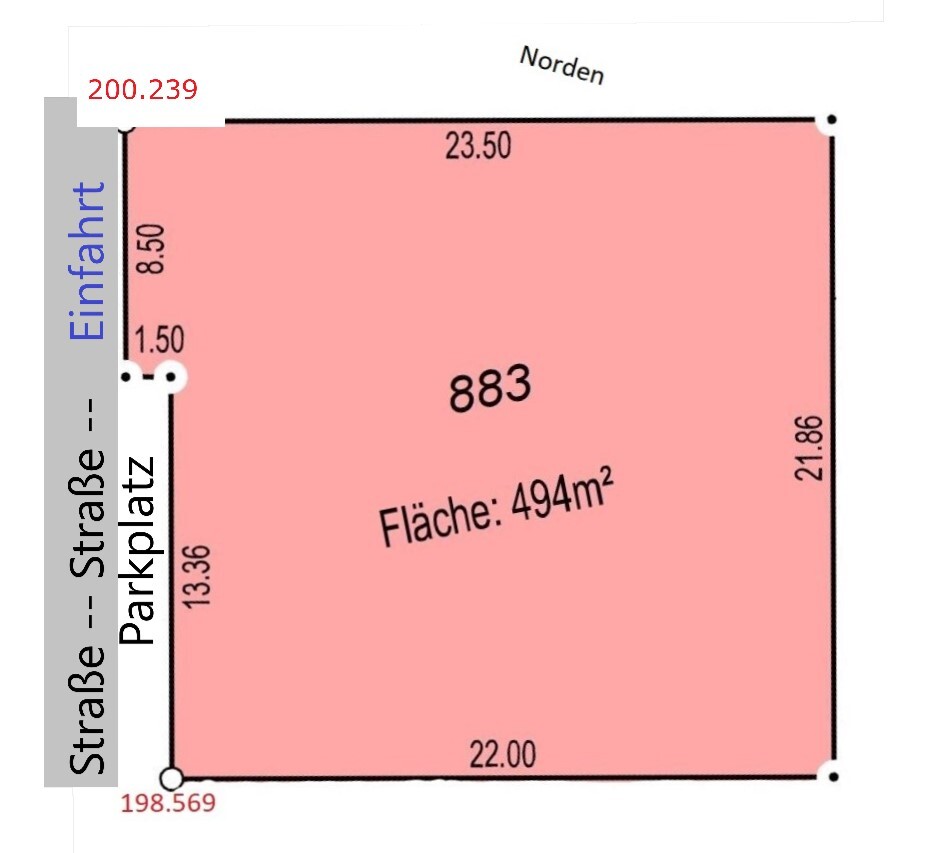
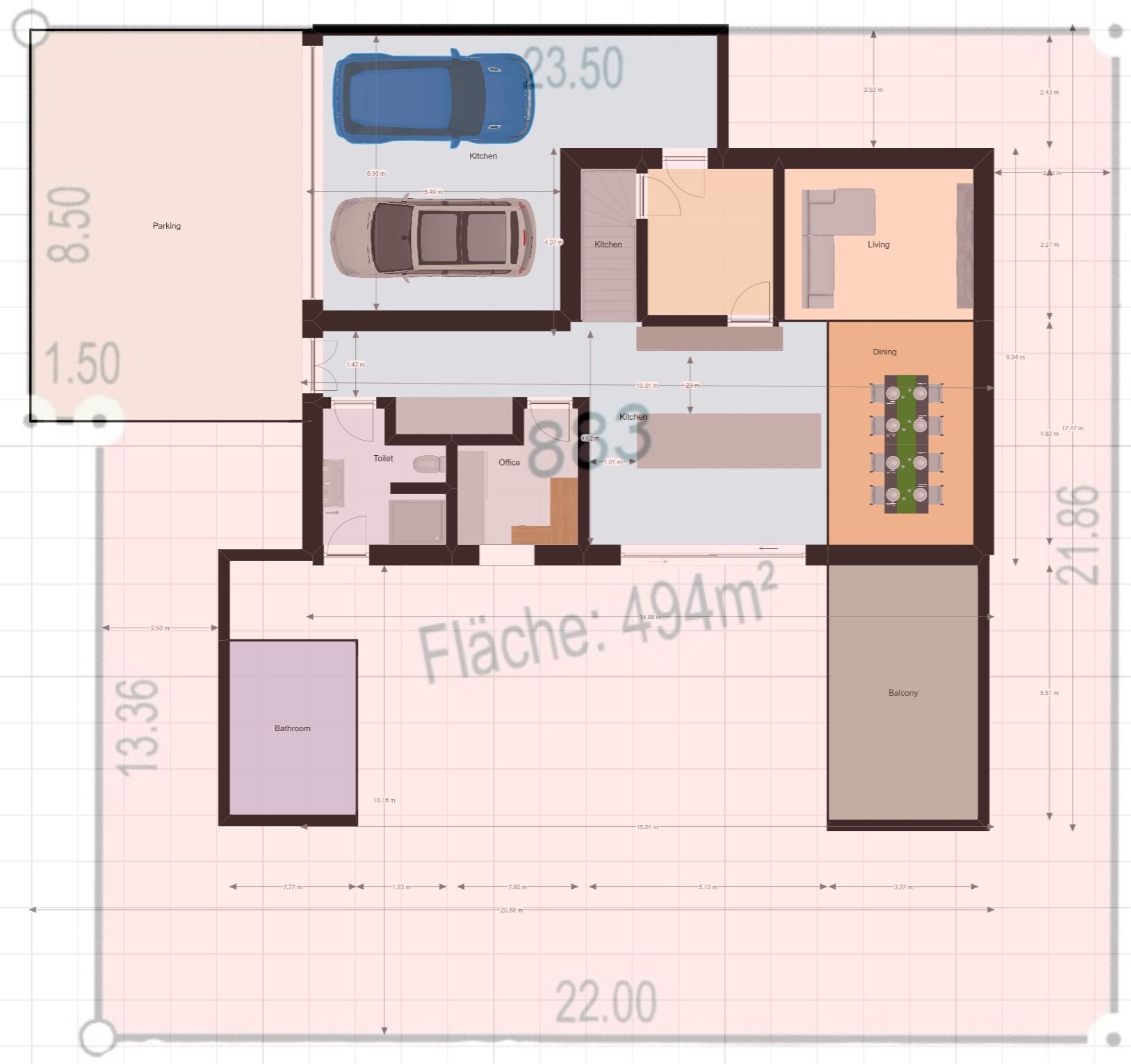
What do you think about the basement? We find it hard to design a floor plan where there is enough space on the ground floor for both the technical and storage rooms. But we also don’t want to “bury” unnecessary money.
PS: I’m happy to receive suggestions for the floor plan as well, but the main focus should be on the basement question.
After a long search, we have finally found a plot of land that we want (and can afford). Now the question is how to build.
To explain briefly, it is a slight slope parallel to the street. In front of the plot, there are two parking spaces, so the driveway can only be on the upper left side.
A soil report states that the soil is clayey. Building is allowed at 200 meters (656 feet) above sea level ± 0.50 meters (1.6 feet). The total height for shed roofs must not exceed 7.50 meters (25 feet). The shed roof must have a pitch between 10° and 15°, the orientation does not matter (preferably facing south due to a planned photovoltaic system). We would like to build two full stories.
The construction will be solid masonry, but we are still undecided between aerated concrete, clay blocks, or Neopor concrete.
Now the question is whether it makes sense to plan a basement, which would only be used as storage and for the building’s technical equipment. Possibly, depending on the size, also for a hobby room.
On the topic of basements, you find very different cost estimates ranging from €15,000 to €70,000. Since the basement will be finished by ourselves, I am mainly interested in the cost of the basement shell itself, not the complete finish.
Is a basement even possible with the maximum building height and two full stories?
What are the additional costs compared to building without a basement? Because of the slight slope, quite a bit of excavation would be required to create the foundation for the slab.
To give you a rough idea of our plans, I have attached two images.
The red numbers indicate the elevation in meters above sea level at the corners.
What do you think about the basement? We find it hard to design a floor plan where there is enough space on the ground floor for both the technical and storage rooms. But we also don’t want to “bury” unnecessary money.
PS: I’m happy to receive suggestions for the floor plan as well, but the main focus should be on the basement question.
Egon12 schrieb:
Because you need the appropriate skilled tradespeople with expertise for that, otherwise an apparent advantage can quickly turn into a disadvantage. I am aware of that and fully agree with you.
However, if the company is available that has been doing this professionally and successfully for years, there should be no objection, right?
I simply like the idea of having everything from the foundation slab to the roof as part of a single integrated system and having a solid concrete core as a massive base.
However, this construction method is not common, and I would be interested in the reasons why.
Regarding the basement, the advantage with the Neopor house would be that everything is formed in one piece.
There is no necessary transition between different materials.
Regards and good night

red-ed schrieb:
The building will be solid construction, but we haven’t yet decided between aerated concrete, clay blocks, or Neopor concrete construction. Formwork blocks (Neopor, Isorast & others) or aerated concrete? – we’ve already discussed this here before: https://www.hausbau-forum.de/threads/Erfahrungen-mit-bausatzhaus-aus-neopor-o-ae.14531/
red-ed schrieb:
Regarding the basement, the advantage of the Neopor house would be that everything is made in one “piece.”
No need for transitions between different materials. Or maybe not? – formwork blocks and concrete are different materials as well. Even without groundwater pressure, formwork blocks are not my favorite for basement construction.
“One piece” solutions are available elsewhere too: aerated concrete manufacturers offer complete building systems, and there are also precast floor slabs made from bricks…
https://www.instagram.com/11antgmxde/
https://www.linkedin.com/company/bauen-jetzt/
Basement / Lower Ground Floor and Two Full Floors Are Not Mutually Exclusive.
We have a classic layout with the entrance, cloakroom, utility/technical room, restroom, kitchen, living room, dining area, and garden access on the lower level. Upstairs are the bathroom, bedrooms, laundry/utility room, and children's rooms. Arifas arranged the rooms differently, also with two full floors despite the sloping site. Our friends did it differently again. We only have a slightly steeper slope.
Adding too much fill costs money, but excavation also costs.
1. Are you allowed to build your desired house according to the building permit / planning permission?
2. What is the slope gradient within the building area? Whether with or without a basement, it is usually desired that the kitchen, dining area, and possibly the living room are on the same level as the terrace.
3. How much excavation would be necessary to build a basement? Does your planned house still fit within the permitted height then?
4. How much fill would be required to build on a slab foundation?
5. Obtain quotes for:
Filling, house on slab foundation with larger footprint
Excavation, basement, house with smaller footprint
6. Does your room layout fit within the smaller footprint?
We have a classic layout with the entrance, cloakroom, utility/technical room, restroom, kitchen, living room, dining area, and garden access on the lower level. Upstairs are the bathroom, bedrooms, laundry/utility room, and children's rooms. Arifas arranged the rooms differently, also with two full floors despite the sloping site. Our friends did it differently again. We only have a slightly steeper slope.
Adding too much fill costs money, but excavation also costs.
1. Are you allowed to build your desired house according to the building permit / planning permission?
2. What is the slope gradient within the building area? Whether with or without a basement, it is usually desired that the kitchen, dining area, and possibly the living room are on the same level as the terrace.
3. How much excavation would be necessary to build a basement? Does your planned house still fit within the permitted height then?
4. How much fill would be required to build on a slab foundation?
5. Obtain quotes for:
Filling, house on slab foundation with larger footprint
Excavation, basement, house with smaller footprint
6. Does your room layout fit within the smaller footprint?
OK, so we have a company with many years of experience in this field. There is also an architect involved who has planned and built such houses multiple times.
But let's stay on topic. What do you think about basements?
Have you heard about the price per square meter?
Ground floor, upper floor: around 350€ per sqm (square meter)
Garage: approximately ???
Basement: approximately ???
I know it’s hard to say exactly, but most architects mention such figures to give a rough estimate.
Best regards
But let's stay on topic. What do you think about basements?
Have you heard about the price per square meter?
Ground floor, upper floor: around 350€ per sqm (square meter)
Garage: approximately ???
Basement: approximately ???
I know it’s hard to say exactly, but most architects mention such figures to give a rough estimate.
Best regards
My "rule of thumb" is that for every 20cm (8 inches) of height difference, the basement cost increases by about 10%. If you don’t build a basement but still have foundation walls at basement height, you essentially have a basement filled with earth, without interior walls or windows. That costs roughly the same as a full basement without interior walls and windows. Since both are relatively minor expenses, the costs are practically equal. In that case, it makes sense to officially build the basement to have storage space. And you might need that: only a few people are throwaway types. If you’re more of a collector and don’t have a basement, eventually both cars end up parked in front of the double garage. Still, based on my rule of thumb, I wouldn’t build a basement for a minor slope.
My conclusion is this: if the height difference (measured over the building depth) is less than 1m (3 feet), definitely no basement; if it’s 2m (6.5 feet) or more, definitely yes. The range in between depends on an honest self-assessment of whether you’re more of an eBay/flea market/throwaway type—or someone who will leave the clearing out to their heirs.
https://www.instagram.com/11antgmxde/
https://www.linkedin.com/company/bauen-jetzt/
My conclusion is this: if the height difference (measured over the building depth) is less than 1m (3 feet), definitely no basement; if it’s 2m (6.5 feet) or more, definitely yes. The range in between depends on an honest self-assessment of whether you’re more of an eBay/flea market/throwaway type—or someone who will leave the clearing out to their heirs.
https://www.instagram.com/11antgmxde/
https://www.linkedin.com/company/bauen-jetzt/
Similar topics