
Hello everyone,
After a long search, we have finally found a plot of land that we want (and can afford). Now the question is how to build.
To explain briefly, it is a slight slope parallel to the street. In front of the plot, there are two parking spaces, so the driveway can only be on the upper left side.
A soil report states that the soil is clayey. Building is allowed at 200 meters (656 feet) above sea level ± 0.50 meters (1.6 feet). The total height for shed roofs must not exceed 7.50 meters (25 feet). The shed roof must have a pitch between 10° and 15°, the orientation does not matter (preferably facing south due to a planned photovoltaic system). We would like to build two full stories.
The construction will be solid masonry, but we are still undecided between aerated concrete, clay blocks, or Neopor concrete.
Now the question is whether it makes sense to plan a basement, which would only be used as storage and for the building’s technical equipment. Possibly, depending on the size, also for a hobby room.
On the topic of basements, you find very different cost estimates ranging from €15,000 to €70,000. Since the basement will be finished by ourselves, I am mainly interested in the cost of the basement shell itself, not the complete finish.
Is a basement even possible with the maximum building height and two full stories?
What are the additional costs compared to building without a basement? Because of the slight slope, quite a bit of excavation would be required to create the foundation for the slab.
To give you a rough idea of our plans, I have attached two images.
The red numbers indicate the elevation in meters above sea level at the corners.
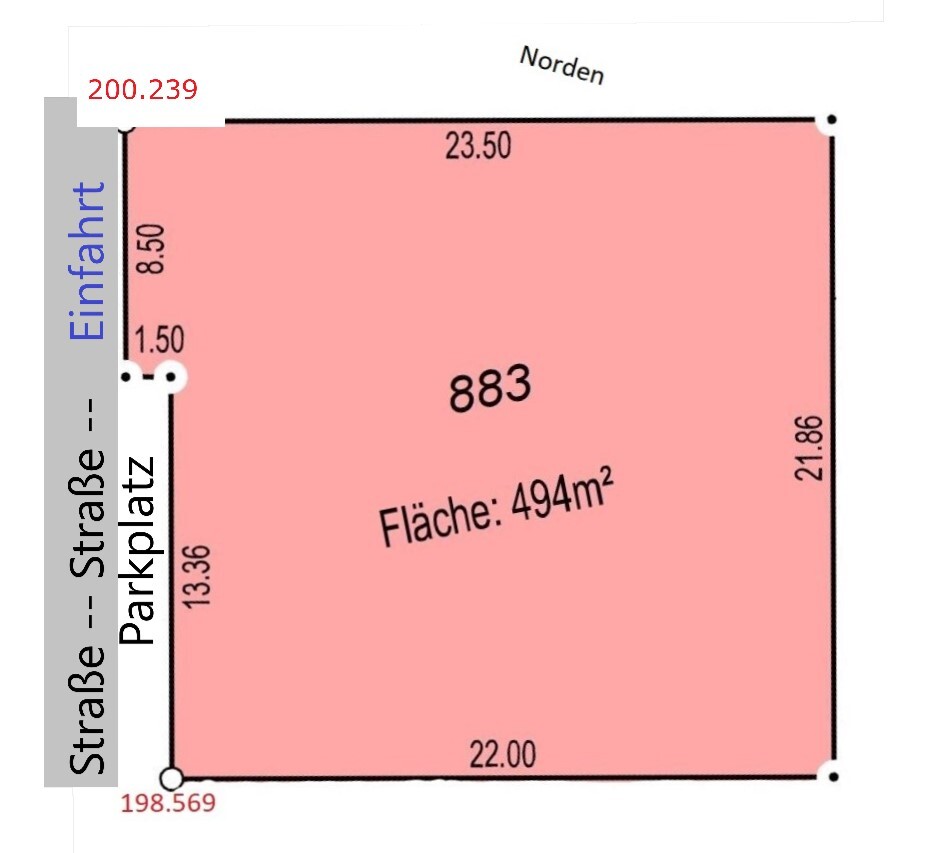
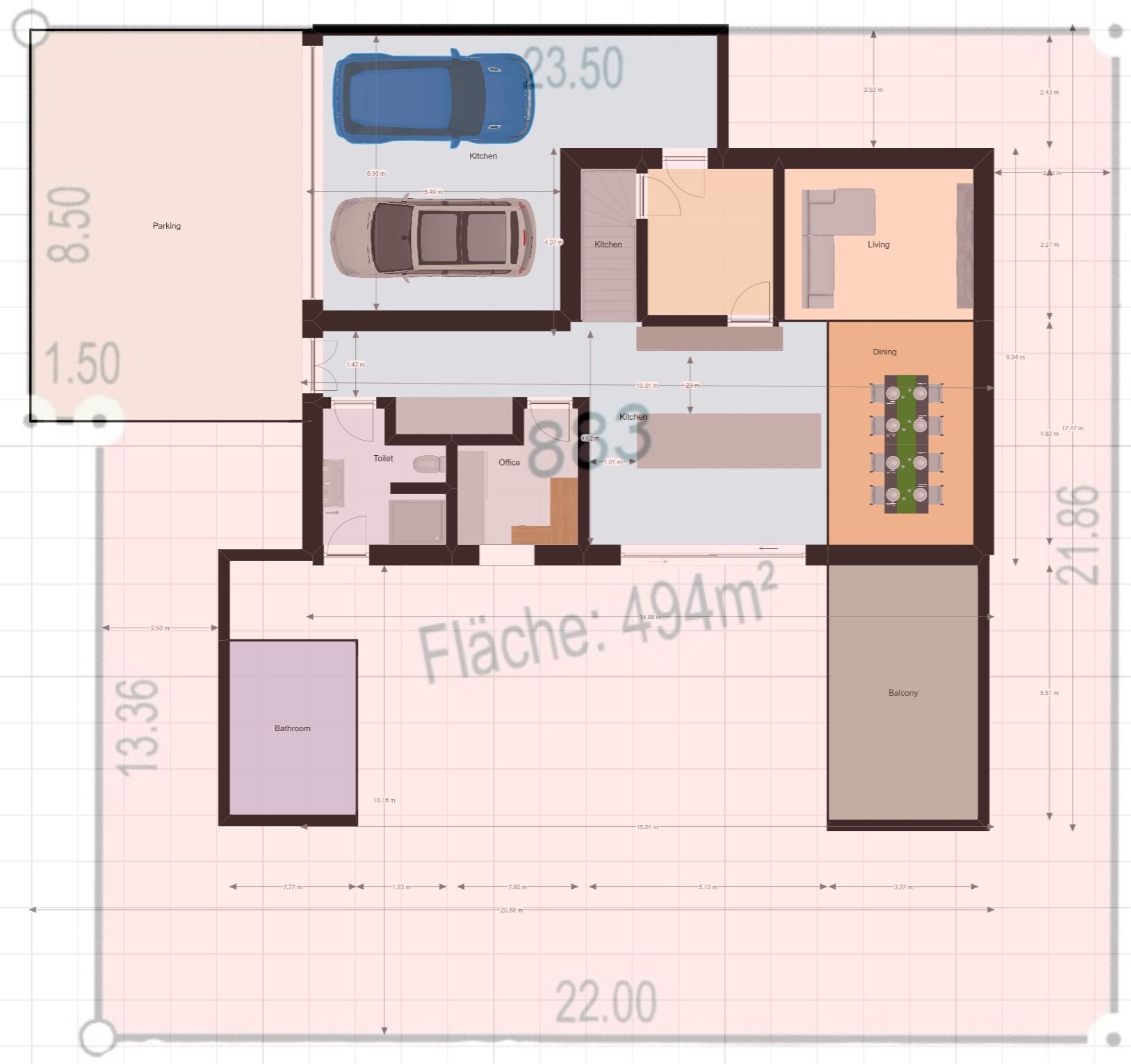
What do you think about the basement? We find it hard to design a floor plan where there is enough space on the ground floor for both the technical and storage rooms. But we also don’t want to “bury” unnecessary money.
PS: I’m happy to receive suggestions for the floor plan as well, but the main focus should be on the basement question.
After a long search, we have finally found a plot of land that we want (and can afford). Now the question is how to build.
To explain briefly, it is a slight slope parallel to the street. In front of the plot, there are two parking spaces, so the driveway can only be on the upper left side.
A soil report states that the soil is clayey. Building is allowed at 200 meters (656 feet) above sea level ± 0.50 meters (1.6 feet). The total height for shed roofs must not exceed 7.50 meters (25 feet). The shed roof must have a pitch between 10° and 15°, the orientation does not matter (preferably facing south due to a planned photovoltaic system). We would like to build two full stories.
The construction will be solid masonry, but we are still undecided between aerated concrete, clay blocks, or Neopor concrete.
Now the question is whether it makes sense to plan a basement, which would only be used as storage and for the building’s technical equipment. Possibly, depending on the size, also for a hobby room.
On the topic of basements, you find very different cost estimates ranging from €15,000 to €70,000. Since the basement will be finished by ourselves, I am mainly interested in the cost of the basement shell itself, not the complete finish.
Is a basement even possible with the maximum building height and two full stories?
What are the additional costs compared to building without a basement? Because of the slight slope, quite a bit of excavation would be required to create the foundation for the slab.
To give you a rough idea of our plans, I have attached two images.
The red numbers indicate the elevation in meters above sea level at the corners.
What do you think about the basement? We find it hard to design a floor plan where there is enough space on the ground floor for both the technical and storage rooms. But we also don’t want to “bury” unnecessary money.
PS: I’m happy to receive suggestions for the floor plan as well, but the main focus should be on the basement question.
ypg schrieb:
That’s why such things (house and technical systems) should be planned by a professional, so that everything is sensible. Why should anyone here speculate and tell you something, only for the professional to do it differently? The professional will implement it according to the client’s instructions, no matter how sensible or nonsensical they may be. They are a service provider.
And not every professional evaluates everything correctly. There isn’t just one right way. Who says the professional always chooses the best path? That’s why it’s useful to get a few opinions online, isn’t it?

Based on the information you provided, not even a professional could create a plan. Let alone a "service provider" or even us here.
What is the ceiling height of the room?
How large will the riser shaft be?
Where should the supply/exhaust air vents of the mechanical ventilation system be placed; where the intake/exhaust air? What pipe dimensions and distributor sizes are required?
How many (electrical) cables/circuits run where, and where is the main distribution board located?
Where is the wastewater connection?
Where do the water pipes run?
Where does the hot water come from?
Where are the kitchen and main bathroom located?
Is there underfloor heating? If yes, where should the heating circuit manifolds be placed?
Have you considered space for the installations (e.g., expansion tanks, filling station)?
What is "WKW"?
You won’t benefit from me telling you now that you can definitely fit your mechanical ventilation central unit with distributor on a 260cm (8 ft 6 in) wall if, in the end, 20 pipes of 75mm (3 inches) won’t fit through the riser shaft planned to be only 30x30cm (12x12 inches). Your building services will somehow have to be accommodated in this room. For optimizations, you’ll have to take action yourself.
Whether, as suggested by @Nordlys, or based on your own research: if you don’t want to spend money on a planner (which I can understand given the fees!), you won’t avoid putting this together yourself with great effort (welcome to everyday construction). Once you have mostly finished that, feel free to come back here with detailed questions, but simply tossing out a "hero quest game board" and expecting someone to do it for you won’t work due to insufficient information.
What is the ceiling height of the room?
How large will the riser shaft be?
Where should the supply/exhaust air vents of the mechanical ventilation system be placed; where the intake/exhaust air? What pipe dimensions and distributor sizes are required?
How many (electrical) cables/circuits run where, and where is the main distribution board located?
Where is the wastewater connection?
Where do the water pipes run?
Where does the hot water come from?
Where are the kitchen and main bathroom located?
Is there underfloor heating? If yes, where should the heating circuit manifolds be placed?
Have you considered space for the installations (e.g., expansion tanks, filling station)?
What is "WKW"?
You won’t benefit from me telling you now that you can definitely fit your mechanical ventilation central unit with distributor on a 260cm (8 ft 6 in) wall if, in the end, 20 pipes of 75mm (3 inches) won’t fit through the riser shaft planned to be only 30x30cm (12x12 inches). Your building services will somehow have to be accommodated in this room. For optimizations, you’ll have to take action yourself.
Whether, as suggested by @Nordlys, or based on your own research: if you don’t want to spend money on a planner (which I can understand given the fees!), you won’t avoid putting this together yourself with great effort (welcome to everyday construction). Once you have mostly finished that, feel free to come back here with detailed questions, but simply tossing out a "hero quest game board" and expecting someone to do it for you won’t work due to insufficient information.
P
pffreestyler29 Mar 2019 09:53I can understand both sides well.
We were present at every trade meeting to discuss the positioning since we don’t have an architect handling this for us. In the end: if I hadn’t paid attention and noticed at some point that there wasn’t enough space for a distribution box in the planned 60cm (24 inches), we would have had a major problem. Also, if I hadn’t happened to be on-site all day when the plumber was working, the exhaust pipe would have run through the ceiling (a special permit from the chimney sweep was already in place) — which is really problematic for a wooden beam ceiling with a vapor barrier, especially if you ever need access there — and the hot water heater would have been placed so that you’d bump into it every time you walked through the utility room. The boss had insisted on that, and as a layperson, you tend to follow the expert’s recommendations. Luckily, the plumber was thoughtful, discussed everything with me on-site, and even contradicted his boss. The boss then came over, realized his mistake, and corrected it. Had I not been there, he probably would have rigidly followed instructions, and we would have been frustrated for a long time.
What I want to say? You are right to seek opinions here because experts don’t always plan everything with everyday practicality in mind, and an outside opinion can be invaluable. However, my previous commenters are also correct that you need to gain some technical knowledge yourself to understand the plans properly.
We were present at every trade meeting to discuss the positioning since we don’t have an architect handling this for us. In the end: if I hadn’t paid attention and noticed at some point that there wasn’t enough space for a distribution box in the planned 60cm (24 inches), we would have had a major problem. Also, if I hadn’t happened to be on-site all day when the plumber was working, the exhaust pipe would have run through the ceiling (a special permit from the chimney sweep was already in place) — which is really problematic for a wooden beam ceiling with a vapor barrier, especially if you ever need access there — and the hot water heater would have been placed so that you’d bump into it every time you walked through the utility room. The boss had insisted on that, and as a layperson, you tend to follow the expert’s recommendations. Luckily, the plumber was thoughtful, discussed everything with me on-site, and even contradicted his boss. The boss then came over, realized his mistake, and corrected it. Had I not been there, he probably would have rigidly followed instructions, and we would have been frustrated for a long time.
What I want to say? You are right to seek opinions here because experts don’t always plan everything with everyday practicality in mind, and an outside opinion can be invaluable. However, my previous commenters are also correct that you need to gain some technical knowledge yourself to understand the plans properly.

red-ed schrieb:
and not answers meant to show me that, in your opinion, I chose the wrong way to build. I wouldn't necessarily interpret the saying that you build your first house for an enemy as a "guide."
https://www.instagram.com/11antgmxde/
https://www.linkedin.com/company/bauen-jetzt/
Dr Hix schrieb:
Based on your information, not even a professional could create a plan. Let alone a “service provider” or even us here.
What is the ceiling height of the room?
How big will the riser shaft be?
Where should the supply/exhaust air vents of the mechanical ventilation system be placed; where the outdoor/exhaust air, what pipe diameters, size of the distributor?
How many (electrical) cables/circuits go where, and where is the main electrical panel located?
Where is the wastewater outlet?
Where do the water pipes run?
Where does the hot water come from?
Where are the kitchen and main bathroom located?
Is there underfloor heating? If yes, where should the heating circuit manifolds be placed?
Have you planned space for installations (e.g. expansion vessels, filling station)?
What does “WKW” mean?
You won’t gain anything if I tell you now that you can definitely fit your mechanical ventilation central unit with distributor on a 260cm (8 ft 6 in) wall, if at the end 20 pipes of 75mm (3 inches) diameter do not fit through the riser shaft planned at 30x30cm (12x12 inches). The building services will somehow be fit into this room. You have to take action yourself to optimize it.
Whether, as suggested by @Nordlys, or based on your own research: If you don’t want to spend money on a planner (which I understand given the fees!), you will have to compile this yourself with some effort (welcome to everyday construction). Once you are mostly done with that, feel free to bring detailed questions here, but simply posting a “hero quest game board” and expecting someone to do it for you won’t work due to insufficient information. I’ve been caught up for a while now, and meanwhile we have also started building—mostly on our own. The windows are coming this week and well, progress is being made.
As usual with this type of construction, not everything is as great as it seems. The earthworks are the most frustrating part—reliable earthmoving contractors who actually show up and keep their price promises seem to be rare in our area. So we are prolonging the earthworks a bit, especially since we still need to agree with the neighbors about the height of the wall.
I will try to check in here more often again in the future.
Best regards,
Red.Ed
Similar topics