
Hello everyone,
After a long search, we have finally found a plot of land that we want (and can afford). Now the question is how to build.
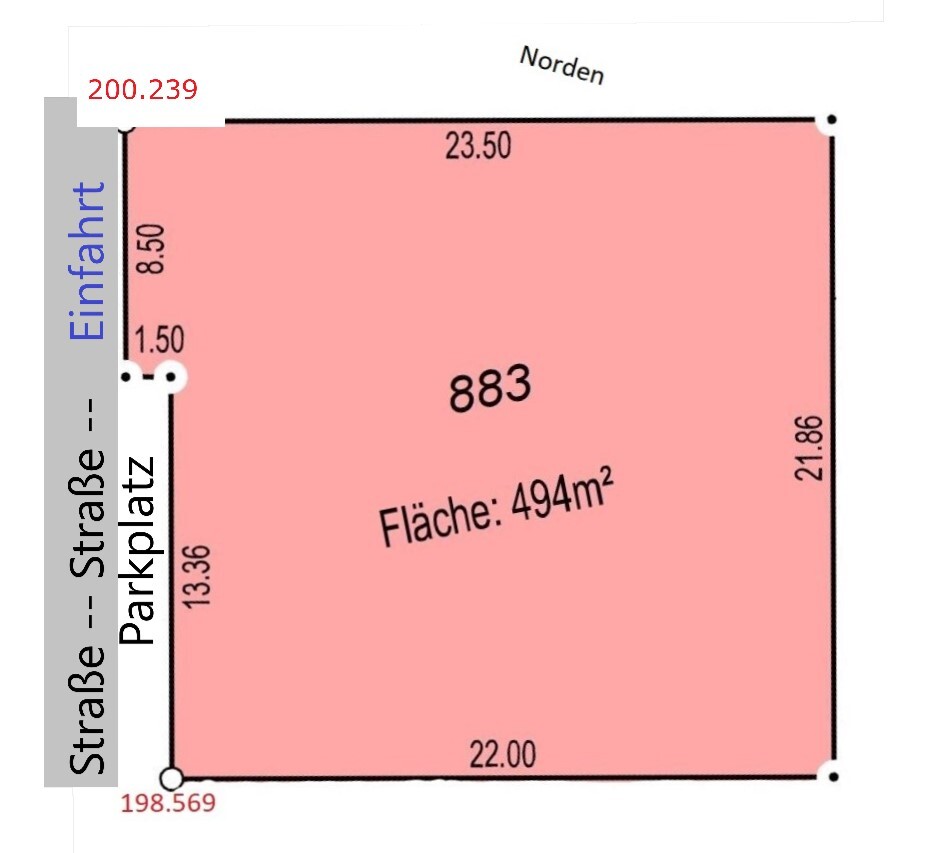
To explain briefly, it is a slight slope parallel to the street. In front of the plot, there are two parking spaces, so the driveway can only be on the upper left side.
A soil report states that the soil is clayey. Building is allowed at 200 meters (656 feet) above sea level ± 0.50 meters (1.6 feet). The total height for shed roofs must not exceed 7.50 meters (25 feet). The shed roof must have a pitch between 10° and 15°, the orientation does not matter (preferably facing south due to a planned photovoltaic system). We would like to build two full stories.
The construction will be solid masonry, but we are still undecided between aerated concrete, clay blocks, or Neopor concrete.
Now the question is whether it makes sense to plan a basement, which would only be used as storage and for the building’s technical equipment. Possibly, depending on the size, also for a hobby room.
On the topic of basements, you find very different cost estimates ranging from €15,000 to €70,000. Since the basement will be finished by ourselves, I am mainly interested in the cost of the basement shell itself, not the complete finish.
Is a basement even possible with the maximum building height and two full stories?
What are the additional costs compared to building without a basement? Because of the slight slope, quite a bit of excavation would be required to create the foundation for the slab.
To give you a rough idea of our plans, I have attached two images.
The red numbers indicate the elevation in meters above sea level at the corners.
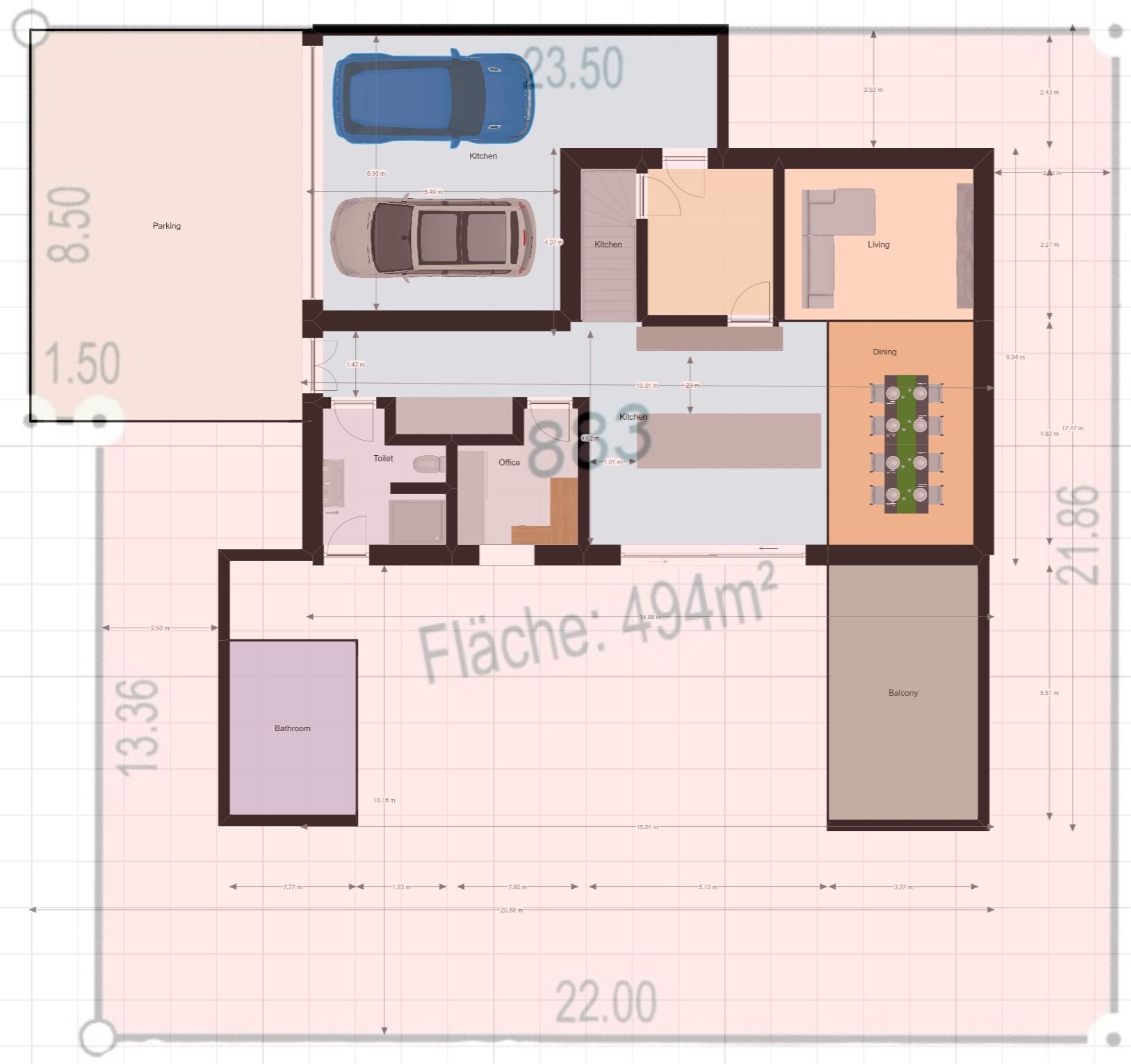
What do you think about the basement? We find it hard to design a floor plan where there is enough space on the ground floor for both the technical and storage rooms. But we also don’t want to “bury” unnecessary money.
PS: I’m happy to receive suggestions for the floor plan as well, but the main focus should be on the basement question.
After a long search, we have finally found a plot of land that we want (and can afford). Now the question is how to build.
To explain briefly, it is a slight slope parallel to the street. In front of the plot, there are two parking spaces, so the driveway can only be on the upper left side.
A soil report states that the soil is clayey. Building is allowed at 200 meters (656 feet) above sea level ± 0.50 meters (1.6 feet). The total height for shed roofs must not exceed 7.50 meters (25 feet). The shed roof must have a pitch between 10° and 15°, the orientation does not matter (preferably facing south due to a planned photovoltaic system). We would like to build two full stories.
The construction will be solid masonry, but we are still undecided between aerated concrete, clay blocks, or Neopor concrete.
Now the question is whether it makes sense to plan a basement, which would only be used as storage and for the building’s technical equipment. Possibly, depending on the size, also for a hobby room.
On the topic of basements, you find very different cost estimates ranging from €15,000 to €70,000. Since the basement will be finished by ourselves, I am mainly interested in the cost of the basement shell itself, not the complete finish.
Is a basement even possible with the maximum building height and two full stories?
What are the additional costs compared to building without a basement? Because of the slight slope, quite a bit of excavation would be required to create the foundation for the slab.
To give you a rough idea of our plans, I have attached two images.
The red numbers indicate the elevation in meters above sea level at the corners.
What do you think about the basement? We find it hard to design a floor plan where there is enough space on the ground floor for both the technical and storage rooms. But we also don’t want to “bury” unnecessary money.
PS: I’m happy to receive suggestions for the floor plan as well, but the main focus should be on the basement question.

red-ed schrieb:
But who cares about comparing concrete and aerated concrete blocks of the same thickness? Anyone who wants to make a meaningful comparison first establishes a "common denominator" to avoid comparing apples and oranges.
Originally, I said that concrete is only really "usable" when combined with insulation around it, and the insulation on both sides is simply the same insulation, assuming the total amount is equal.
From my monolithic construction perspective, I always ask whether the sausage still tastes good without mustard.
You say that wrapped in mustard, it goes down easier. Those are two very different things.
https://www.instagram.com/11antgmxde/
https://www.linkedin.com/company/bauen-jetzt/
11ant schrieb:
There are several threads on this topic here; my most detailed comments can be found in this one: https://www.hausbau-forum.de/threads/Erfahrungen-mit-bausatzhaus-aus-neopor-o-ae.14531/page-4 ... and today I was reminded of another thread that also deals with Neopor: https://www.hausbau-forum.de/threads/Neubau-2-fh-in-bw-aus-neopor-schalungssteinen-Baufirmen.28639/
https://www.instagram.com/11antgmxde/
https://www.linkedin.com/company/bauen-jetzt/
Hello,
it has been quiet from us for a while. The floor plan has changed again. The building permit / planning permission is still pending.
Now I have a different question and would appreciate it if you could share your experiences with me.
It is about the technical room in the basement.
The following needs to fit inside:
Connections for:
Water
Electricity
Domestic water system (for rainwater tank)
Supply and exhaust air for controlled ventilation system
Air-to-water heat pump (unfortunately still unclear whether split system with outdoor or indoor unit; the trend is towards the split unit)
Supply and exhaust lines for the split unit
Water storage tank (for 4–5 persons)
Central unit and distribution for controlled ventilation system
Circuit breaker and KNX control cabinets
Server cabinet (800 x 800 cm (315 x 315 inches))
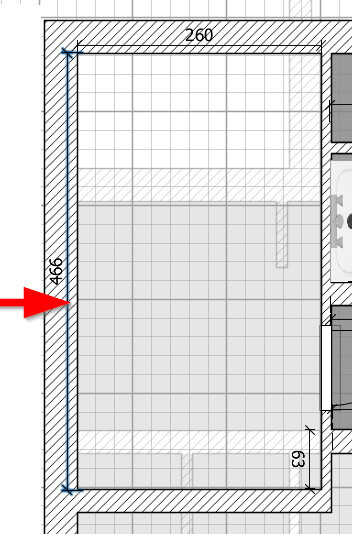
To clarify, all connections come in from the left side (street side). At the top, the route to the outside for the heat pump split unit could be implemented.
How would you arrange the equipment? I really find it difficult to imagine how much space each device requires and especially what clearances should be maintained where.
Thanks in advance.
it has been quiet from us for a while. The floor plan has changed again. The building permit / planning permission is still pending.
Now I have a different question and would appreciate it if you could share your experiences with me.
It is about the technical room in the basement.
The following needs to fit inside:
Connections for:
Water
Electricity
Domestic water system (for rainwater tank)
Supply and exhaust air for controlled ventilation system
Air-to-water heat pump (unfortunately still unclear whether split system with outdoor or indoor unit; the trend is towards the split unit)
Supply and exhaust lines for the split unit
Water storage tank (for 4–5 persons)
Central unit and distribution for controlled ventilation system
Circuit breaker and KNX control cabinets
Server cabinet (800 x 800 cm (315 x 315 inches))
To clarify, all connections come in from the left side (street side). At the top, the route to the outside for the heat pump split unit could be implemented.
How would you arrange the equipment? I really find it difficult to imagine how much space each device requires and especially what clearances should be maintained where.
Thanks in advance.

I wouldn’t be so relaxed about this. It’s not just a question of “if,” but also “how,” and that becomes especially important when different tradespeople need to work there in a few years (for repairs, replacements, or additions like a water softening system, for example).
Of course, there are many small details involved. For instance, if the hot water pipe has to run across the room for nearly 7m (23 feet), you will have unavoidable heat losses over its lifetime and might also need circulation.
If the KNX control panel is located between the mechanical ventilation system and the supply or exhaust air ducts, you may end up with large pipes running across the center of the room near the ceiling or the vents positioned too close to a terrace or window.
If too many lines cross each other, ceiling height becomes tight.
And when contracting individual trades separately, you end up paying extra for all that (unnecessary) effort, including materials.
That said, I’m not really able to offer helpful advice here. Try to consider in advance which specific devices will be used, look at their technical drawings or installation manuals, and then sketch it out. Keep in mind where the various lines will run later, allow plenty of space for accessibility, and set proper priorities. A cable conduit can be relatively easily extended by a few meters, but for hot water pipes or the mechanical ventilation system, I would strongly recommend keeping pipe runs as short as possible.
Of course, there are many small details involved. For instance, if the hot water pipe has to run across the room for nearly 7m (23 feet), you will have unavoidable heat losses over its lifetime and might also need circulation.
If the KNX control panel is located between the mechanical ventilation system and the supply or exhaust air ducts, you may end up with large pipes running across the center of the room near the ceiling or the vents positioned too close to a terrace or window.
If too many lines cross each other, ceiling height becomes tight.
And when contracting individual trades separately, you end up paying extra for all that (unnecessary) effort, including materials.
That said, I’m not really able to offer helpful advice here. Try to consider in advance which specific devices will be used, look at their technical drawings or installation manuals, and then sketch it out. Keep in mind where the various lines will run later, allow plenty of space for accessibility, and set proper priorities. A cable conduit can be relatively easily extended by a few meters, but for hot water pipes or the mechanical ventilation system, I would strongly recommend keeping pipe runs as short as possible.
Dr Hix schrieb:
If too many pipes cross each other, the ceiling height becomes very tight.
And with separate contracting, you also end up paying for all the (unnecessary) effort including materials separately. This cannot be emphasized enough: separate contracting requires detailed planning, ideally with every pipe clamp drawn in individually, otherwise you end up with chaos and confusion all mixed together.
https://www.instagram.com/11antgmxde/
https://www.linkedin.com/company/bauen-jetzt/