
Hello everyone,
After a long search, we have finally found a plot of land that we want (and can afford). Now the question is how to build.
To explain briefly, it is a slight slope parallel to the street. In front of the plot, there are two parking spaces, so the driveway can only be on the upper left side.
A soil report states that the soil is clayey. Building is allowed at 200 meters (656 feet) above sea level ± 0.50 meters (1.6 feet). The total height for shed roofs must not exceed 7.50 meters (25 feet). The shed roof must have a pitch between 10° and 15°, the orientation does not matter (preferably facing south due to a planned photovoltaic system). We would like to build two full stories.
The construction will be solid masonry, but we are still undecided between aerated concrete, clay blocks, or Neopor concrete.
Now the question is whether it makes sense to plan a basement, which would only be used as storage and for the building’s technical equipment. Possibly, depending on the size, also for a hobby room.
On the topic of basements, you find very different cost estimates ranging from €15,000 to €70,000. Since the basement will be finished by ourselves, I am mainly interested in the cost of the basement shell itself, not the complete finish.
Is a basement even possible with the maximum building height and two full stories?
What are the additional costs compared to building without a basement? Because of the slight slope, quite a bit of excavation would be required to create the foundation for the slab.
To give you a rough idea of our plans, I have attached two images.
The red numbers indicate the elevation in meters above sea level at the corners.
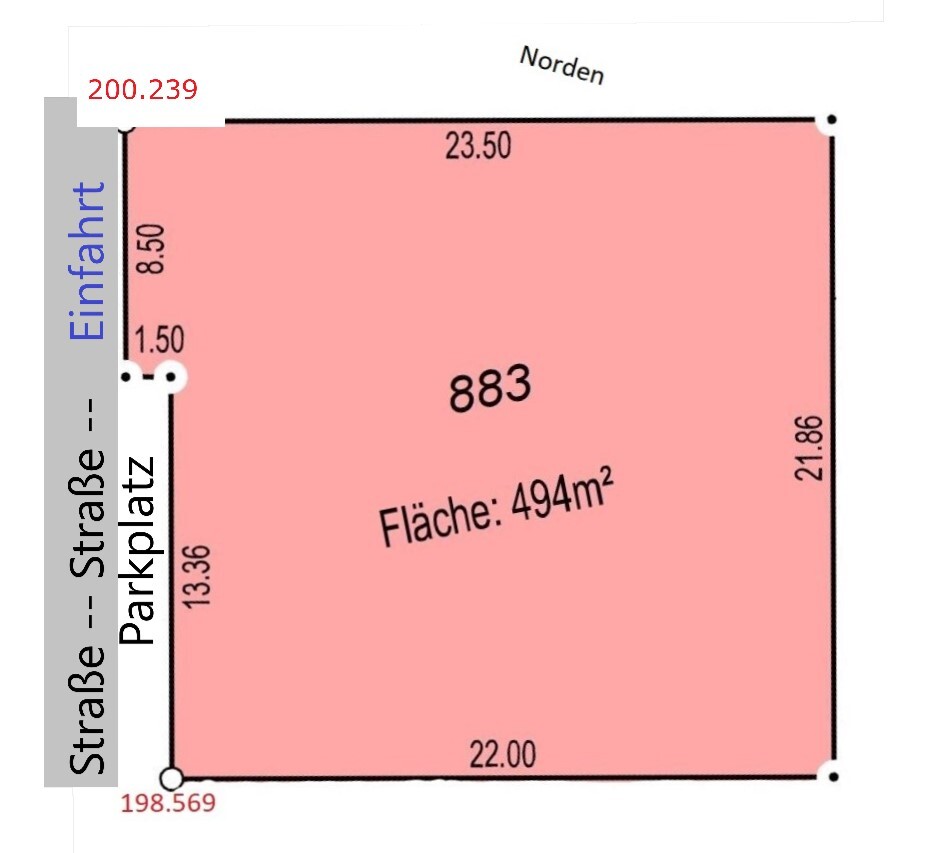
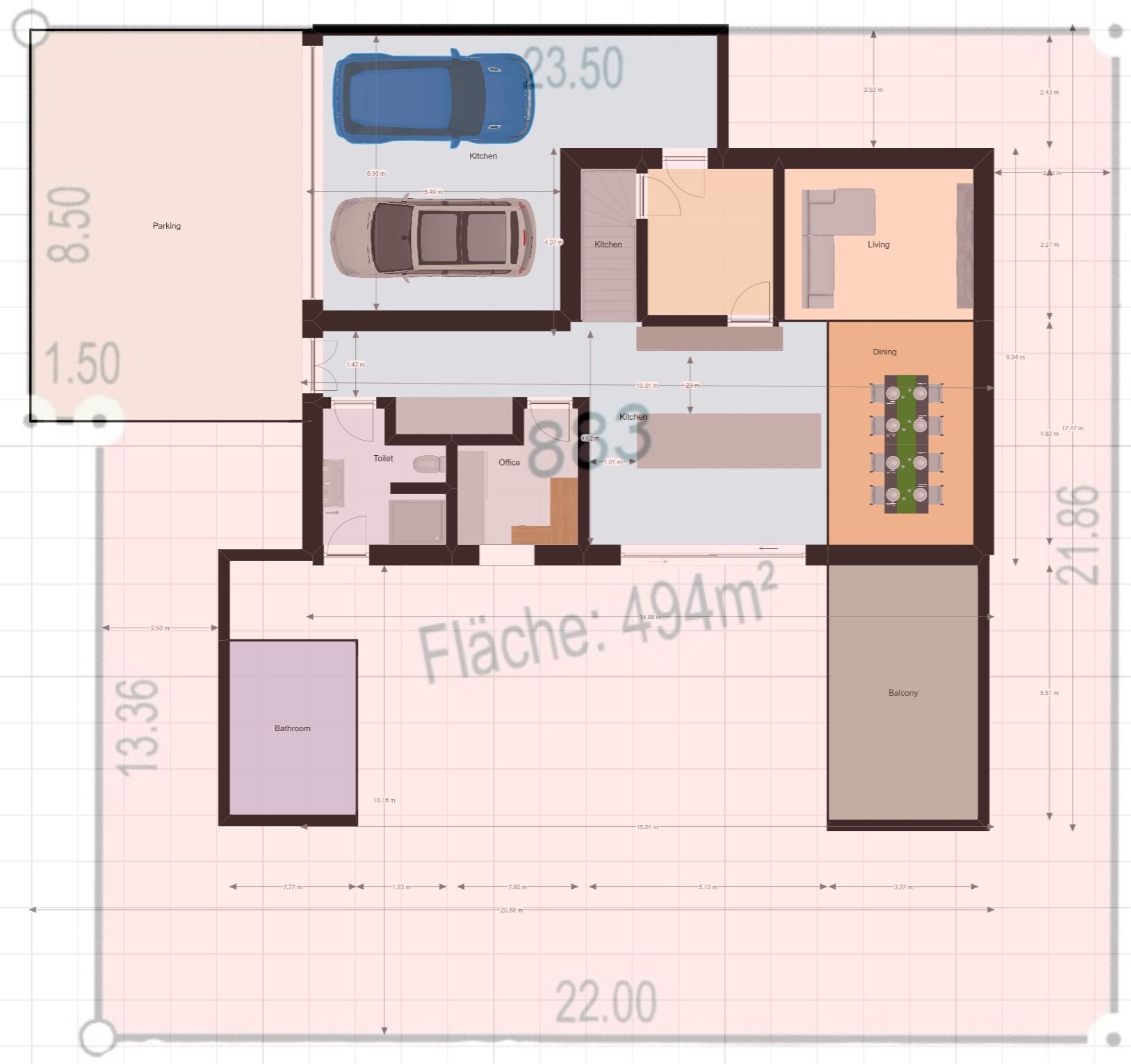
What do you think about the basement? We find it hard to design a floor plan where there is enough space on the ground floor for both the technical and storage rooms. But we also don’t want to “bury” unnecessary money.
PS: I’m happy to receive suggestions for the floor plan as well, but the main focus should be on the basement question.
After a long search, we have finally found a plot of land that we want (and can afford). Now the question is how to build.
To explain briefly, it is a slight slope parallel to the street. In front of the plot, there are two parking spaces, so the driveway can only be on the upper left side.
A soil report states that the soil is clayey. Building is allowed at 200 meters (656 feet) above sea level ± 0.50 meters (1.6 feet). The total height for shed roofs must not exceed 7.50 meters (25 feet). The shed roof must have a pitch between 10° and 15°, the orientation does not matter (preferably facing south due to a planned photovoltaic system). We would like to build two full stories.
The construction will be solid masonry, but we are still undecided between aerated concrete, clay blocks, or Neopor concrete.
Now the question is whether it makes sense to plan a basement, which would only be used as storage and for the building’s technical equipment. Possibly, depending on the size, also for a hobby room.
On the topic of basements, you find very different cost estimates ranging from €15,000 to €70,000. Since the basement will be finished by ourselves, I am mainly interested in the cost of the basement shell itself, not the complete finish.
Is a basement even possible with the maximum building height and two full stories?
What are the additional costs compared to building without a basement? Because of the slight slope, quite a bit of excavation would be required to create the foundation for the slab.
To give you a rough idea of our plans, I have attached two images.
The red numbers indicate the elevation in meters above sea level at the corners.
What do you think about the basement? We find it hard to design a floor plan where there is enough space on the ground floor for both the technical and storage rooms. But we also don’t want to “bury” unnecessary money.
PS: I’m happy to receive suggestions for the floor plan as well, but the main focus should be on the basement question.
A basement can also be a lower ground floor (LGF) with fully functional living spaces.
Despite having partially steep slopes, we and a few other users do not have a traditional basement.
For the floor plan, consider which rooms you need, look at floor plans, and visit show homes to get a sense of the sizes. Pay attention to what you like in other houses and apartments. This way, you should be able to gather your requirements well, and an architect will create a design for you, which we are happy to review here.
Despite having partially steep slopes, we and a few other users do not have a traditional basement.
For the floor plan, consider which rooms you need, look at floor plans, and visit show homes to get a sense of the sizes. Pay attention to what you like in other houses and apartments. This way, you should be able to gather your requirements well, and an architect will create a design for you, which we are happy to review here.
Hello Haydee,
thank you for your reply.
As I said, we are not really interested in a basement suitable for living. We actually want to live in the two full stories.
I wouldn’t really call it a hillside location; 1.8m (5.9 feet) over 22m (72 feet) length isn’t much. That’s why I’m wondering if it makes sense. The basement is really only necessary for storage and the utility room.
We have already visited model home parks several times, so we have a clear "wish list." However, the topic of the basement is still quite uncertain for us.
We would also appreciate any experience with Neopor concrete construction, as there is little information about it available in Germany.
thank you for your reply.
As I said, we are not really interested in a basement suitable for living. We actually want to live in the two full stories.
I wouldn’t really call it a hillside location; 1.8m (5.9 feet) over 22m (72 feet) length isn’t much. That’s why I’m wondering if it makes sense. The basement is really only necessary for storage and the utility room.
We have already visited model home parks several times, so we have a clear "wish list." However, the topic of the basement is still quite uncertain for us.
We would also appreciate any experience with Neopor concrete construction, as there is little information about it available in Germany.
Are you generally considering which material you prefer, or do you have specialists for each option? Let your contractors work with the materials they know best to minimize errors. I personally would avoid building with materials that are rarely used or known in Germany, even if they might be slightly better than the common ones (assuming flawless installation, as mentioned above).
Hello kekse,
for Neopor concrete construction, we have a specialist on hand. Red brick and aerated concrete blocks are the current standard for construction companies.
So, this is basically a fundamental question. Regarding the companies, we haven’t decided yet and are still asking around and gathering information.
We don’t really want people to get back to us later saying they have done this and don’t like it.
Why wouldn’t you want to build with something that is better, just because it’s not the standard?
Or what is your reasoning?
Thank you.
for Neopor concrete construction, we have a specialist on hand. Red brick and aerated concrete blocks are the current standard for construction companies.
So, this is basically a fundamental question. Regarding the companies, we haven’t decided yet and are still asking around and gathering information.
We don’t really want people to get back to us later saying they have done this and don’t like it.
Why wouldn’t you want to build with something that is better, just because it’s not the standard?
Or what is your reasoning?
Thank you.
Similar topics