
ᐅ Converting a Barn into a Workshop: Which Flooring Options Are Suitable?
Created on: 14 Aug 2020 17:47
S
Säsch85Hello everyone,
I recently bought a house that has a disused pigsty as an outbuilding. I want to convert this 58sqm (625 sq ft) stable into a workshop. I have already removed the trough, and in the middle of the room there is a concrete platform that ranges from 2cm (0.8 inches) at its lowest point to 12cm (4.7 inches) at its highest. Now I would like to level the floor by pouring concrete or a similar material.
I have a few questions:
1. Which material should I use? Concrete, screed, or concrete screed?
2. Should I do it myself or hire a professional company?
3. What costs should I expect?
I could borrow a concrete mixer from a friend, but considering the volume, I suspect that using a truck with a pump would be much easier.
Here is a photo of the current situation:
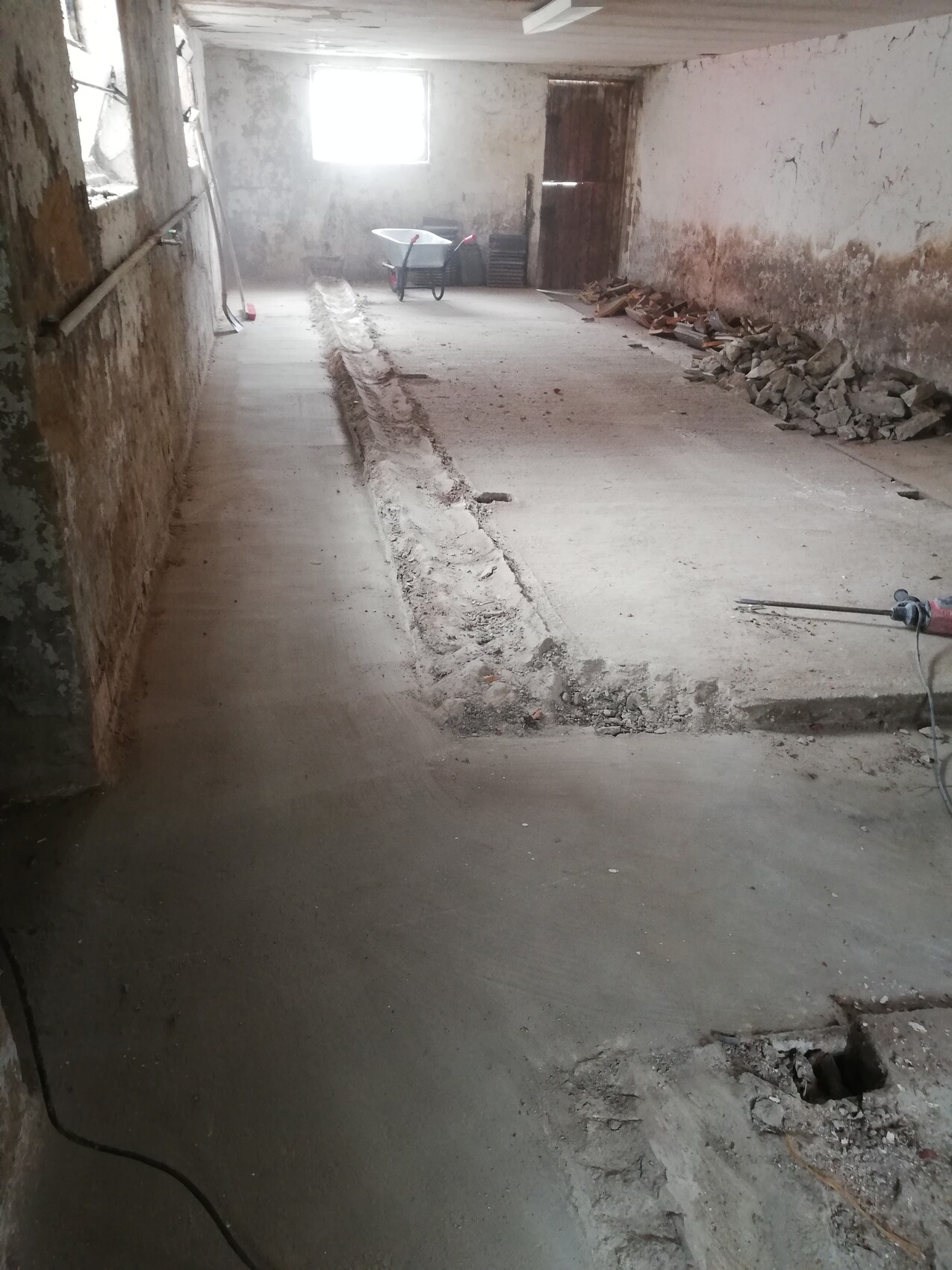
I will still remove the remains of the trough to make the surface reasonably level.
I recently bought a house that has a disused pigsty as an outbuilding. I want to convert this 58sqm (625 sq ft) stable into a workshop. I have already removed the trough, and in the middle of the room there is a concrete platform that ranges from 2cm (0.8 inches) at its lowest point to 12cm (4.7 inches) at its highest. Now I would like to level the floor by pouring concrete or a similar material.
I have a few questions:
1. Which material should I use? Concrete, screed, or concrete screed?
2. Should I do it myself or hire a professional company?
3. What costs should I expect?
I could borrow a concrete mixer from a friend, but considering the volume, I suspect that using a truck with a pump would be much easier.
Here is a photo of the current situation:
I will still remove the remains of the trough to make the surface reasonably level.

Hello questioner.
The issue you described regarding the renovation is relatively easy to solve. A few years ago, I made a proposal to a local winemaker with a similar starting situation to convert a former pigsty into a tasting room with catering facilities. This has worked flawlessly to this day, as expected.
From the picture, I can see that a concrete slab is already in place, probably in contact with the ground. The gaps caused by removing the troughs do not pose a problem initially.
The room is first leveled to check whether the slab has settled anywhere or if there are any bumps across the surface.
The surface is either shot-blasted or thoroughly ground, then the gaps (after priming the edges) are filled with a screed mortar. The entire surface is moistened, coated piece by piece with a mineral bonding agent, and then a cement-based (naturally vapor-permeable) bonded screed CT-C35-F5 is installed, with an average thickness of 25mm to 30mm (1 to 1.2 inches).
Since a moisture rise from behind cannot be ruled out later, the simplest option for the floor covering would be a paint coating or tile covering.
Because we are working with a bonded screed and the slab cannot warp due to drying-related shrinkage, no time is lost if tile laying begins after two weeks.
Use of elastic (vapor-tight) floor coverings or anything involving wood-based materials (e.g., laminate, etc.) is strongly discouraged. This will definitely not work!
Using a "concrete mixer" designed for masonry mortar is also not recommended! This would most likely result in total failure of the later layering, as the mixing principle used here (gravity mixer) is not suitable for screeds and the required screed strength likely will not be achieved.
I would hand over the procedure to a screed installation specialist, as the described process contains many pitfalls that a layperson simply cannot know. Besides, the expertise and equipment required for each step are typically missing in non-professionals.
------------------
Which approach you choose is up to you. However, if you decide to go it alone, you also accept the risk.
I hope this advice is helpful and helps you avoid future damage.
Oh, and I almost forgot the cost question.
Calculate roughly €50/m² (per square meter) (approx. $50/sq ft), which also includes a warranty for the work.
Best regards, KlaRa
The issue you described regarding the renovation is relatively easy to solve. A few years ago, I made a proposal to a local winemaker with a similar starting situation to convert a former pigsty into a tasting room with catering facilities. This has worked flawlessly to this day, as expected.
From the picture, I can see that a concrete slab is already in place, probably in contact with the ground. The gaps caused by removing the troughs do not pose a problem initially.
The room is first leveled to check whether the slab has settled anywhere or if there are any bumps across the surface.
The surface is either shot-blasted or thoroughly ground, then the gaps (after priming the edges) are filled with a screed mortar. The entire surface is moistened, coated piece by piece with a mineral bonding agent, and then a cement-based (naturally vapor-permeable) bonded screed CT-C35-F5 is installed, with an average thickness of 25mm to 30mm (1 to 1.2 inches).
Since a moisture rise from behind cannot be ruled out later, the simplest option for the floor covering would be a paint coating or tile covering.
Because we are working with a bonded screed and the slab cannot warp due to drying-related shrinkage, no time is lost if tile laying begins after two weeks.
Use of elastic (vapor-tight) floor coverings or anything involving wood-based materials (e.g., laminate, etc.) is strongly discouraged. This will definitely not work!
Using a "concrete mixer" designed for masonry mortar is also not recommended! This would most likely result in total failure of the later layering, as the mixing principle used here (gravity mixer) is not suitable for screeds and the required screed strength likely will not be achieved.
I would hand over the procedure to a screed installation specialist, as the described process contains many pitfalls that a layperson simply cannot know. Besides, the expertise and equipment required for each step are typically missing in non-professionals.
------------------
Which approach you choose is up to you. However, if you decide to go it alone, you also accept the risk.
I hope this advice is helpful and helps you avoid future damage.
Oh, and I almost forgot the cost question.
Calculate roughly €50/m² (per square meter) (approx. $50/sq ft), which also includes a warranty for the work.
Best regards, KlaRa
@Säsch85: You can let me/us know soon how the further planning is progressing after the first meeting with the screed specialist company. I’ll repeat once more: As described, the whole issue should actually be solvable without any problems! This is especially true if there are no requirements related to height reference points (meaning: from the workshop continuing to other rooms or even staircases).
Similar topics