
ᐅ Procedure for Building a New Single-Family Home on an Existing Plot of Land
Created on: 18 Nov 2022 07:55
D
Dachshund90
Hello everyone,
I know no one has a crystal ball here, but I would still like to hear your opinions:
We have just purchased a plot of land in Hesse, currently live cheaply, and have no urgent time pressure to build (although sooner is always better), except for the 5-year building obligation required by the municipality, which, however, can be extended by 1-2 years for justified reasons. We have slowly started planning and would like to possibly have the completed plans along with the building permit for our new single-family home ready to go, so we can react relatively quickly.
My assessment is that construction prices and interest rates will change little in 2023, even if they might stabilize at a high level. How 2024 or 2025 will look, of course, no one knows. But what is your feeling:
1. Rush the planning and possibly take advantage of a small "interest dip" in 2023 for financing and start with the belief that neither interest rates nor prices will significantly fall in the medium term, and waiting is just lost time.
2. Plan completely calmly, continue to build up equity, and assume that conditions for a new build may improve by the end of 2024 or possibly 2025.
If things become more concrete soon, I would be happy to provide more information for planning and share your feedback.
I welcome any questions and opinions 🙂
Best regards
I know no one has a crystal ball here, but I would still like to hear your opinions:
We have just purchased a plot of land in Hesse, currently live cheaply, and have no urgent time pressure to build (although sooner is always better), except for the 5-year building obligation required by the municipality, which, however, can be extended by 1-2 years for justified reasons. We have slowly started planning and would like to possibly have the completed plans along with the building permit for our new single-family home ready to go, so we can react relatively quickly.
My assessment is that construction prices and interest rates will change little in 2023, even if they might stabilize at a high level. How 2024 or 2025 will look, of course, no one knows. But what is your feeling:
1. Rush the planning and possibly take advantage of a small "interest dip" in 2023 for financing and start with the belief that neither interest rates nor prices will significantly fall in the medium term, and waiting is just lost time.
2. Plan completely calmly, continue to build up equity, and assume that conditions for a new build may improve by the end of 2024 or possibly 2025.
If things become more concrete soon, I would be happy to provide more information for planning and share your feedback.
I welcome any questions and opinions 🙂
Best regards
S
Sunshine38723 Jan 2023 20:47Exactly a basement (which this is not) and a ground floor are more than sufficient, especially if designed cleverly into the slope.


K a t j a schrieb:
@11ant OT: Forgotten how to quote? (#68)
Words are being put into my mouth...tsk.Very strange. I have no idea how the HTML brackets disappeared by some ghostly force when submitting.The second block from post #68 should correctly read:
mayglow schrieb:
That means if the slope roughly fits (possibly with a few steps), the entrance on the street side is on the "ground floor" and on the garden side it’s on the "basement level" (or vice versa depending on the slope). Whether this legally counts as a basement being an exception or simply as a full story depends, among other things, on how deep the excavation is on average...K a t j a schrieb:
Stories are above-ground floors if their ceiling tops are on average more than 1.40 m (4.6 ft) above the ground level, otherwise they are considered basement levels.An ideal partly below-grade living basement according to this definition protrudes from the terrain so far that the valley side has window sills at normal height well above the ground surface, while on the uphill street side the ceiling top of the entrance floor is positioned so the sill plate remains dry even during heavy rain. For doors or floor-to-ceiling windows below ground level, light wells are then required.https://www.instagram.com/11antgmxde/
https://www.linkedin.com/company/bauen-jetzt/
H
hanghaus202324 Jan 2023 10:21I have slightly modified my version.
Garage / storage room 9 x 6 m (29.5 x 19.7 ft)
House 14 x 7.5 m (46 x 24.6 ft)
Ground floor upper half and garage at 499 m (1637.8 ft) split level, lower half at 498.10 m (1634.4 ft). Ground floor with guest room, WC with shower, utility room (above), and living room (below).
Upper floor at 502 m (1647.6 ft) with 2 children’s rooms, bathroom, bedroom, and laundry room.
Gable roof about 30 degrees.
The narrow house allows for relatively high walls on the second floor. (8 m (26.2 ft) is quite tight for a gable roof).
Connection between garage and house with glass roof or windbreak, partially solid construction?
Road elevation and reference for building height unknown!
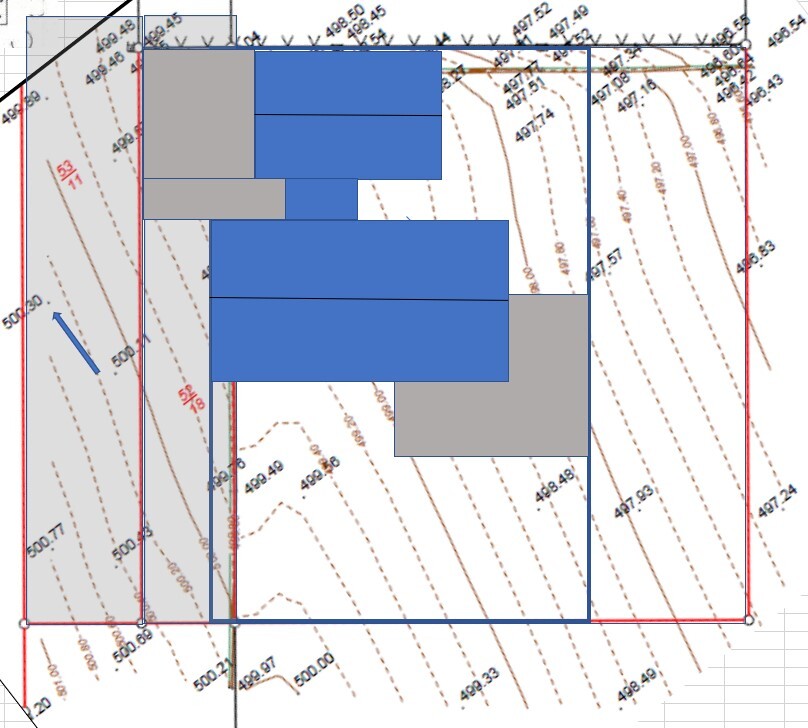
This works with minimal terrain modeling and no basement.
Who is responsible for building the road?
Garage / storage room 9 x 6 m (29.5 x 19.7 ft)
House 14 x 7.5 m (46 x 24.6 ft)
Ground floor upper half and garage at 499 m (1637.8 ft) split level, lower half at 498.10 m (1634.4 ft). Ground floor with guest room, WC with shower, utility room (above), and living room (below).
Upper floor at 502 m (1647.6 ft) with 2 children’s rooms, bathroom, bedroom, and laundry room.
Gable roof about 30 degrees.
The narrow house allows for relatively high walls on the second floor. (8 m (26.2 ft) is quite tight for a gable roof).
Connection between garage and house with glass roof or windbreak, partially solid construction?
Road elevation and reference for building height unknown!
This works with minimal terrain modeling and no basement.
Who is responsible for building the road?
D
Dachshund9024 Jan 2023 10:56hanghaus2023 schrieb:
I have made some modifications to my design.
Garage / storage room 9 x 6 m (29.5 x 19.7 ft)
House 14 x 7.5 m (46 x 24.6 ft)
Ground floor upper half and garage at 499 m (1637.7 ft) split-level, lower half at 498.10 m (1634.5 ft). Ground floor with guest room, toilet with shower, utility room (upper part) and living area (lower part).
Upper floor at 502 m (1647.6 ft) (2 children’s rooms, bathroom, master bedroom, laundry room)
Gable roof approx. 30 degrees
The narrow house design allows for relatively high walls on the second floor. (8 m (26.2 ft) ceiling height is rather tight for a gable roof.)
Connection between garage and house with glass roof or windbreak, partially solid structure?
Road level and reference for building height unknown!
[ATTACH alt="Grundstueck132.jpg"]77752[/ATTACH]
This works with minimal land grading and no basement.
Who is responsible for building the road? Thanks for sharing your design, it looks interesting. By split-level do you mean that there is a staircase or step (approx. height 90 cm (35.4 inches)) between the living area and the upper part?
Why does the narrow house result in higher walls?
We have to arrange our own site access.
It will end in a construction road, which will be provided by the neighboring builder to the northwest and ourselves. The municipality will continue developing the area in a few years, which we have to factor in, but it may take some time. As mentioned, no further land sales are planned.
Best regards
H
hanghaus202324 Jan 2023 11:01who
Because the roof doesn’t have to be as tall, the walls can be higher.
Of course, you can also simply choose a flat roof or a different house shape. This was just an idea.
Dachshund90 schrieb:
Why do narrow houses have taller walls?
Because the roof doesn’t have to be as tall, the walls can be higher.
Of course, you can also simply choose a flat roof or a different house shape. This was just an idea.
Similar topics