
Hello everyone,
According to the district office, there is an issue with the building permit: the proposed location of the heat pump is not being accepted. The district office refers to a "guideline for improving protection against noise from stationary equipment."
Question: Has this guideline been legally established as binding in a law in Baden-Württemberg? In my opinion, the requirements are "can" rather than "must."
Specific details
Heat pump model: Weishaupt WWP L 12 AD
(According to my general contractor, Weishaupt does not offer a quieter heat pump.)
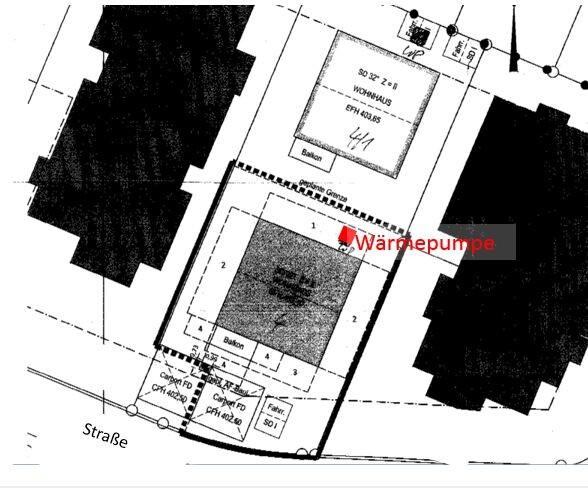
Heat pump location: See plan.
It should also be mentioned that this is a developed residential area, and the plot is a building gap. The buildings there were constructed in the 1980s/1990s. Accordingly, (oil) central heating systems are installed in the neighboring buildings, as there have been no new constructions. Therefore, there cannot be any heat pumps in the immediate vicinity.
Statement from the district office:
"If the heat pump were placed elsewhere, for example on the south side of the property, a greater distance to the neighbors would be possible. Due to the short distance to the house, reflections (within 3 m (10 feet) distance to a reflective surface) are to be expected. There may also be other noise sources in the vicinity."
"The planned location of the heat pump does not comply with the 'guideline for improving protection against noise from stationary equipment' in the following points:"
"According to the guideline, a maximum distance from and ideally a position facing away from the neighbors should be aimed for (see item 1 in the annex to the above-mentioned guideline).
"Given the tight building situation, internal or enclosed heat pumps, or heat pumps with significantly lower sound power levels, should be considered."
The unbelievable part:
The case officer at the district office even suggested to my general contractor that the whole house could basically be rotated so that the utility room (!) faces south, and then the heat pump location proposed by the district office on the south side would not result in long cables or pipes.
My reaction: "Seriously?"
Tomorrow I want to speak with the case officer myself.
Do you have any tips for how to proceed? Do you see good arguments I could raise?
Thank you for your input.
According to the district office, there is an issue with the building permit: the proposed location of the heat pump is not being accepted. The district office refers to a "guideline for improving protection against noise from stationary equipment."
Question: Has this guideline been legally established as binding in a law in Baden-Württemberg? In my opinion, the requirements are "can" rather than "must."
Specific details
Heat pump model: Weishaupt WWP L 12 AD
(According to my general contractor, Weishaupt does not offer a quieter heat pump.)
Heat pump location: See plan.
It should also be mentioned that this is a developed residential area, and the plot is a building gap. The buildings there were constructed in the 1980s/1990s. Accordingly, (oil) central heating systems are installed in the neighboring buildings, as there have been no new constructions. Therefore, there cannot be any heat pumps in the immediate vicinity.
Statement from the district office:
"If the heat pump were placed elsewhere, for example on the south side of the property, a greater distance to the neighbors would be possible. Due to the short distance to the house, reflections (within 3 m (10 feet) distance to a reflective surface) are to be expected. There may also be other noise sources in the vicinity."
"The planned location of the heat pump does not comply with the 'guideline for improving protection against noise from stationary equipment' in the following points:"
"According to the guideline, a maximum distance from and ideally a position facing away from the neighbors should be aimed for (see item 1 in the annex to the above-mentioned guideline).
- Heat pumps must be installed according to the state of noise reduction technology in a way that additional noise emissions, for example due to reflections on walls, are avoided.
"Given the tight building situation, internal or enclosed heat pumps, or heat pumps with significantly lower sound power levels, should be considered."
The unbelievable part:
The case officer at the district office even suggested to my general contractor that the whole house could basically be rotated so that the utility room (!) faces south, and then the heat pump location proposed by the district office on the south side would not result in long cables or pipes.
My reaction: "Seriously?"
Tomorrow I want to speak with the case officer myself.
Do you have any tips for how to proceed? Do you see good arguments I could raise?
Thank you for your input.
S
Steffen805 Apr 2017 16:30I also think those things should be banned! Thank goodness we don’t have any neighbors who install such nonsense. I know of several cases where they caused serious trouble.
Knallkörper schrieb:
A guideline can also be considered a recognized technical standard, so your statement is not correct. Unfortunately, the LAI guideline is not a recognized technical standard. It first needs to prove itself through practical application. How long that takes… courts have ruled that after about 3 years following introduction, a guideline can become a recognized technical standard if it stands the test of time.
Currently, 4 out of 10 builders follow the authorities’ recommendations, and the others experience conflicts.
The fact is: authorities may issue recommendations based on the guideline in their statements (location, distance in meters, device), but if the builder does not comply, the authority has no leverage as long as the immission limit values according to TA Lärm are met. In enforcement (e.g., a device purchased and installed through online retailers), the distances based on sound power levels in the LAI guideline do not matter because it is not legally binding. In these cases, evaluation is done solely by the local immission control authorities (districts) according to TA Lärm (for example, in urban areas, 63dB during the day, 48dB at night… well, cheers!).
In principle, these devices should be covered under 32nd BImSchV (Federal Immission Control Ordinance). An amendment was planned from 2013 and was dropped at the end of 2015 for political reasons at the federal level (in my view, the Energy Saving Ordinance, Energy Saving Act, and Climate Protection Plan 2050 were likely motives).
The guideline serves as a source of knowledge for land use planning and is only legally binding when incorporated into the development plan (not just as a note or a statement).
cheers