
Hello everyone,
According to the district office, there is an issue with the building permit: the proposed location of the heat pump is not being accepted. The district office refers to a "guideline for improving protection against noise from stationary equipment."
Question: Has this guideline been legally established as binding in a law in Baden-Württemberg? In my opinion, the requirements are "can" rather than "must."
Specific details
Heat pump model: Weishaupt WWP L 12 AD
(According to my general contractor, Weishaupt does not offer a quieter heat pump.)
Heat pump location: See plan.
It should also be mentioned that this is a developed residential area, and the plot is a building gap. The buildings there were constructed in the 1980s/1990s. Accordingly, (oil) central heating systems are installed in the neighboring buildings, as there have been no new constructions. Therefore, there cannot be any heat pumps in the immediate vicinity.
Statement from the district office:
"If the heat pump were placed elsewhere, for example on the south side of the property, a greater distance to the neighbors would be possible. Due to the short distance to the house, reflections (within 3 m (10 feet) distance to a reflective surface) are to be expected. There may also be other noise sources in the vicinity."
"The planned location of the heat pump does not comply with the 'guideline for improving protection against noise from stationary equipment' in the following points:"
"According to the guideline, a maximum distance from and ideally a position facing away from the neighbors should be aimed for (see item 1 in the annex to the above-mentioned guideline).
"Given the tight building situation, internal or enclosed heat pumps, or heat pumps with significantly lower sound power levels, should be considered."
The unbelievable part:
The case officer at the district office even suggested to my general contractor that the whole house could basically be rotated so that the utility room (!) faces south, and then the heat pump location proposed by the district office on the south side would not result in long cables or pipes.
My reaction: "Seriously?"
Tomorrow I want to speak with the case officer myself.
Do you have any tips for how to proceed? Do you see good arguments I could raise?
Thank you for your input.
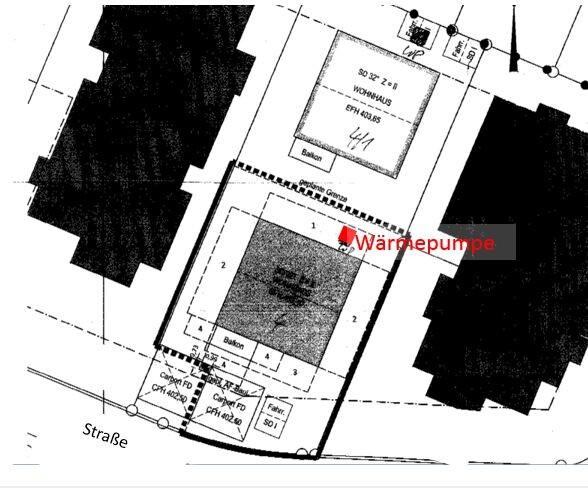
According to the district office, there is an issue with the building permit: the proposed location of the heat pump is not being accepted. The district office refers to a "guideline for improving protection against noise from stationary equipment."
Question: Has this guideline been legally established as binding in a law in Baden-Württemberg? In my opinion, the requirements are "can" rather than "must."
Specific details
Heat pump model: Weishaupt WWP L 12 AD
(According to my general contractor, Weishaupt does not offer a quieter heat pump.)
Heat pump location: See plan.
It should also be mentioned that this is a developed residential area, and the plot is a building gap. The buildings there were constructed in the 1980s/1990s. Accordingly, (oil) central heating systems are installed in the neighboring buildings, as there have been no new constructions. Therefore, there cannot be any heat pumps in the immediate vicinity.
Statement from the district office:
"If the heat pump were placed elsewhere, for example on the south side of the property, a greater distance to the neighbors would be possible. Due to the short distance to the house, reflections (within 3 m (10 feet) distance to a reflective surface) are to be expected. There may also be other noise sources in the vicinity."
"The planned location of the heat pump does not comply with the 'guideline for improving protection against noise from stationary equipment' in the following points:"
"According to the guideline, a maximum distance from and ideally a position facing away from the neighbors should be aimed for (see item 1 in the annex to the above-mentioned guideline).
- Heat pumps must be installed according to the state of noise reduction technology in a way that additional noise emissions, for example due to reflections on walls, are avoided.
"Given the tight building situation, internal or enclosed heat pumps, or heat pumps with significantly lower sound power levels, should be considered."
The unbelievable part:
The case officer at the district office even suggested to my general contractor that the whole house could basically be rotated so that the utility room (!) faces south, and then the heat pump location proposed by the district office on the south side would not result in long cables or pipes.
My reaction: "Seriously?"
Tomorrow I want to speak with the case officer myself.
Do you have any tips for how to proceed? Do you see good arguments I could raise?
Thank you for your input.

Alex85 schrieb:
that the builder did everything correctly: facing the street and not the neighbors!and on the opposite side there is also a neighbor, or rather on the street, which is considered:
Alex85 schrieb:
public spaceand on what basis does someone place something there that disturbs others?
With the "my energy consultant said so" right?
https://www.instagram.com/11antgmxde/
https://www.linkedin.com/company/bauen-jetzt/
This is about clearances. These are increased by the minimum distances to the property boundary plus the street/sidewalk when the heat pump is facing the street. In my opinion, the disturbance to a passing pedestrian can also be considered negligible compared to the alternative of constant noise on a patio or in bedrooms. Furthermore, a pedestrian is walking right along a street where every passing vehicle is significantly louder than a heat pump.
By the way, since you asked about legal requirements, this is exactly what is mandated in our building area (including visually hiding the heat pump so it is not immediately visible) and, in my opinion, is absolutely correct.
However, we are planning to use geothermal energy ourselves. Incidentally, there is no gas available.
By the way, since you asked about legal requirements, this is exactly what is mandated in our building area (including visually hiding the heat pump so it is not immediately visible) and, in my opinion, is absolutely correct.
However, we are planning to use geothermal energy ourselves. Incidentally, there is no gas available.
Alex85 schrieb:
In my opinion, the disturbance to a passing pedestrian is negligible when the alternative is continuous noise affecting an outdoor seating area or bedrooms. Additionally, the pedestrian is walking along a street where every passing vehicle is considerably louder than a heat pump.In my view, relocating something that causes a disturbance to a place where it causes slightly less disturbance is still a far worse "alternative" than simply ensuring your house is heated in a non-disruptive way.
With sound insulation in some kind of enclosure similar to a trash bin housing, such a device can, if need be, also be placed by the street.
Regarding the relativity of noise pollution: I am not talking about locations in commercial or mixed-use areas with through traffic. I mean residential streets in quiet neighborhoods, where people have deliberately chosen to live for the peace and quiet. And even as a pedestrian there, I do not want to be the unfortunate recipient of side effects from a trendy heating technology—especially since there are other options. Those, to me, are the real "alternatives."
https://www.instagram.com/11antgmxde/
https://www.linkedin.com/company/bauen-jetzt/
I agree with you that air-to-water heat pumps are a major nuisance in today’s new buildings (in my opinion, just like decorative stoves that pollute the air). But:
What chance do you see of banning air-to-water heat pumps in Western Australia or even Michigan?
For my part, I see none, since the alternative—fossil fuels—is equally undesirable, and other decentralized systems (such as pellet boilers) also require significant investments, not least due to land use. Since building is already a luxury anyway, the discussion about banning air-to-water heat pumps is pointless. It makes more sense to create guidelines and influence authorities on the placement of outdoor units.
What chance do you see of banning air-to-water heat pumps in Western Australia or even Michigan?
For my part, I see none, since the alternative—fossil fuels—is equally undesirable, and other decentralized systems (such as pellet boilers) also require significant investments, not least due to land use. Since building is already a luxury anyway, the discussion about banning air-to-water heat pumps is pointless. It makes more sense to create guidelines and influence authorities on the placement of outdoor units.
Hello smartsurfer
Here’s something to consider: a ground source heat pump requires a higher initial investment but is much cheaper to maintain. Plus, you can use it for cooling in the summer. It’s purely a calculation.
I have one and I’m very satisfied.
The probes could be installed even before the house is built.
Steven
Here’s something to consider: a ground source heat pump requires a higher initial investment but is much cheaper to maintain. Plus, you can use it for cooling in the summer. It’s purely a calculation.
I have one and I’m very satisfied.
The probes could be installed even before the house is built.
Steven
Alex85 schrieb:
What are the chances of banning air-to-water heat pumps in WA or even MI? There’s no question of banning them. What is needed is more detailed regulation. The LAI guideline is going in the right direction.
There is a law (1st Federal Immission Control Ordinance) regulating the requirements and monitoring of small combustion installations. For air-to-water heat pumps, there is nothing comparable yet.
In my opinion, when applying for approval, the acoustic compatibility with neighboring properties must be demonstrated. This proof can be easily provided using the sound power levels from the technical data sheets. Before commissioning the system, an emission measurement must then be carried out (similar to small combustion installations), but referring to noise instead of air pollutants. My practical experience shows that the sound power levels specified by the manufacturers often seem to be largely exaggerated, and the installation conditions of the units quite often do not meet the state of the art in noise reduction technology at all.
Additionally, the air-to-water heat pump units should be subject to recurring inspections, in line with the 1st Federal Immission Control Ordinance, for example every 3 years.
@TE: As has often been hinted here, with your installation situation you are legally, technically, and especially socially in a difficult position. If the location of the system was determined by the planner: I would have them redesign it. Cost-neutral, of course.
Similar topics