
Hello everyone,
This forum was recommended to me to find help with the problem I’m describing below. First of all, Happy New Year to everyone! 🙂
Our weekend house, built with a timber frame structure, has blown-in insulation of the Yuma-Perl type in the external cladding, which, in my opinion, is completely unsuitable for the house. The wooden cladding has gaps and cracks through which the EPS granules are leaking out. Since the wood cladding used to be ventilated from behind, a pest protection mesh was installed underneath. However, the mesh holes are larger than the EPS granules, so the granules also fall out there. This is a huge mess, as the granules are scattered all over the garden. I tried sealing the pest protection mesh with duct tape, but of course, it doesn't stick permanently. Then I wedged wooden battens underneath it, but that is only a temporary solution. I also tried sealing the gaps in the wooden cladding, but that doesn’t hold well either.
Ideally, I would like to remove all the material. I have already contacted a company specializing in this, but their suction nozzles don’t fit behind the cladding because it’s too narrow. I also got the impression they weren’t very enthusiastic about the job. So, as a test, I drilled a few 8cm (3 inch) holes with a hole saw and tried to vacuum out the granules. That worked somewhat, but it is incredibly time-consuming and can only be done in nice weather with no wind.
Do you perhaps have some ideas on how to best handle this?
Remove the granulate? But what’s the smartest way? Who could be hired for this?
Leave the granulate in place and seal it? But how?
Another problem is the pest protection mesh, which is loose in some places and needs to be replaced. We have mice in the cladding, and they also contribute to pushing the granules out. Who can be hired for such work?
Thanks in advance!
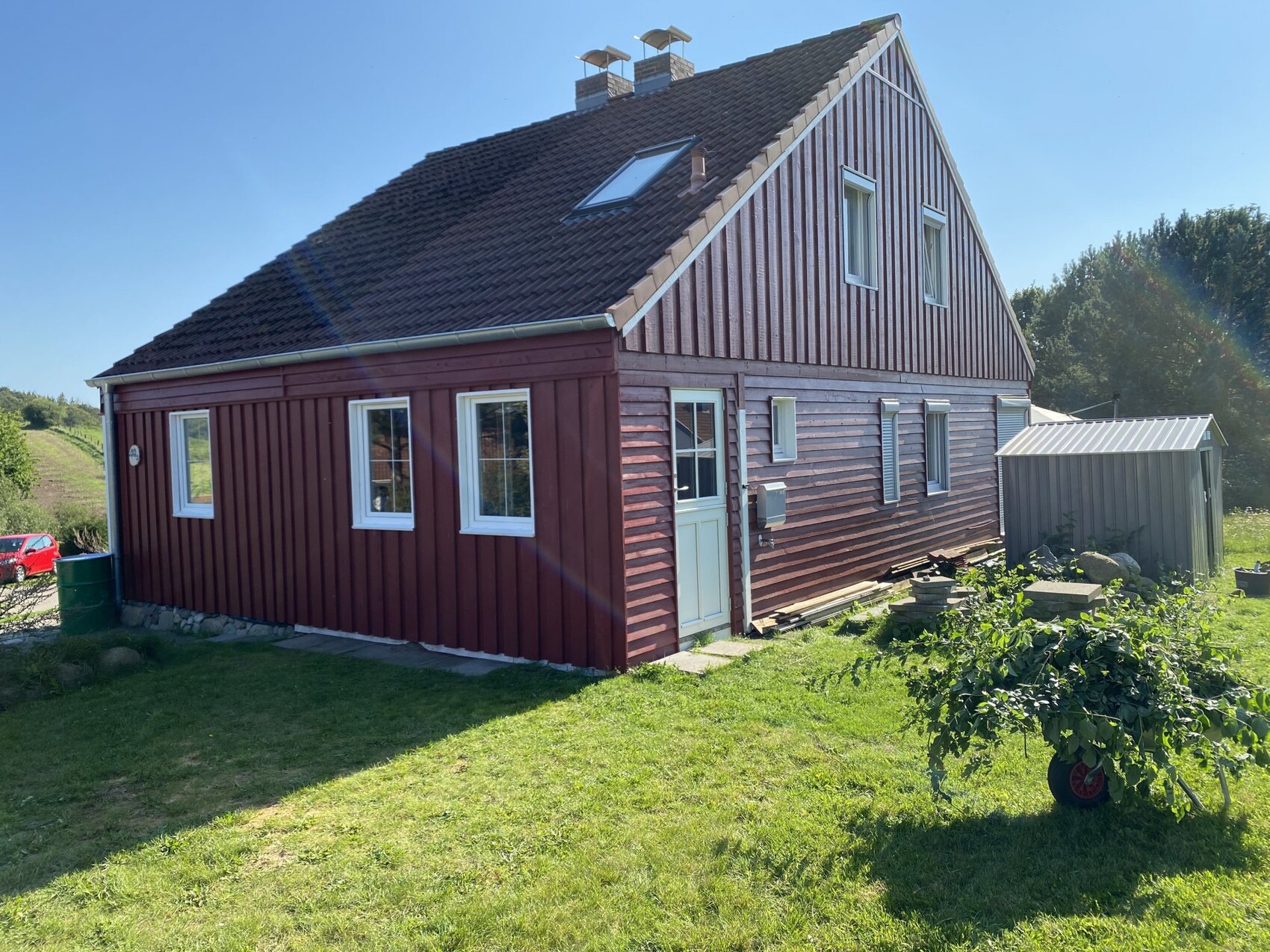
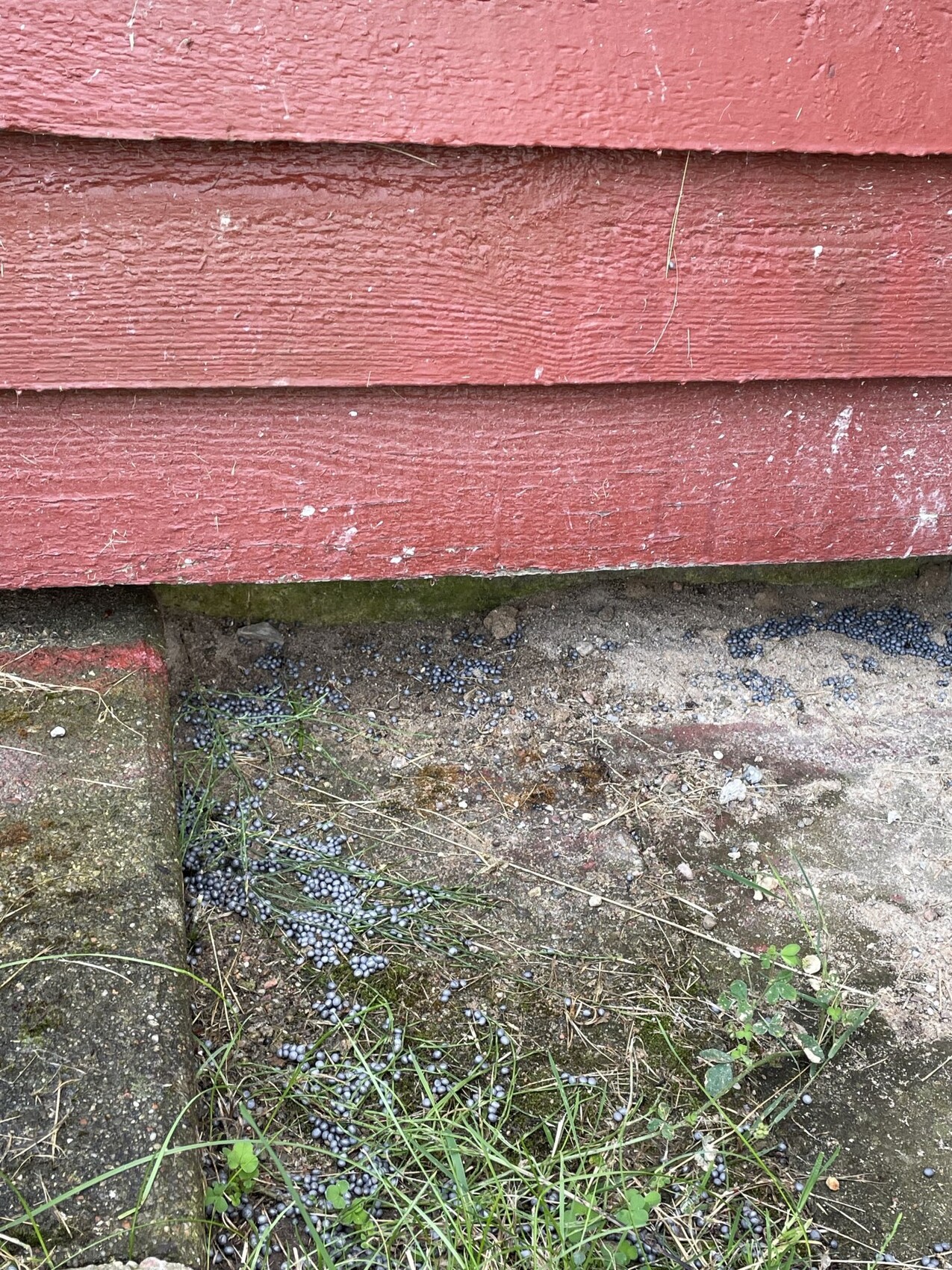
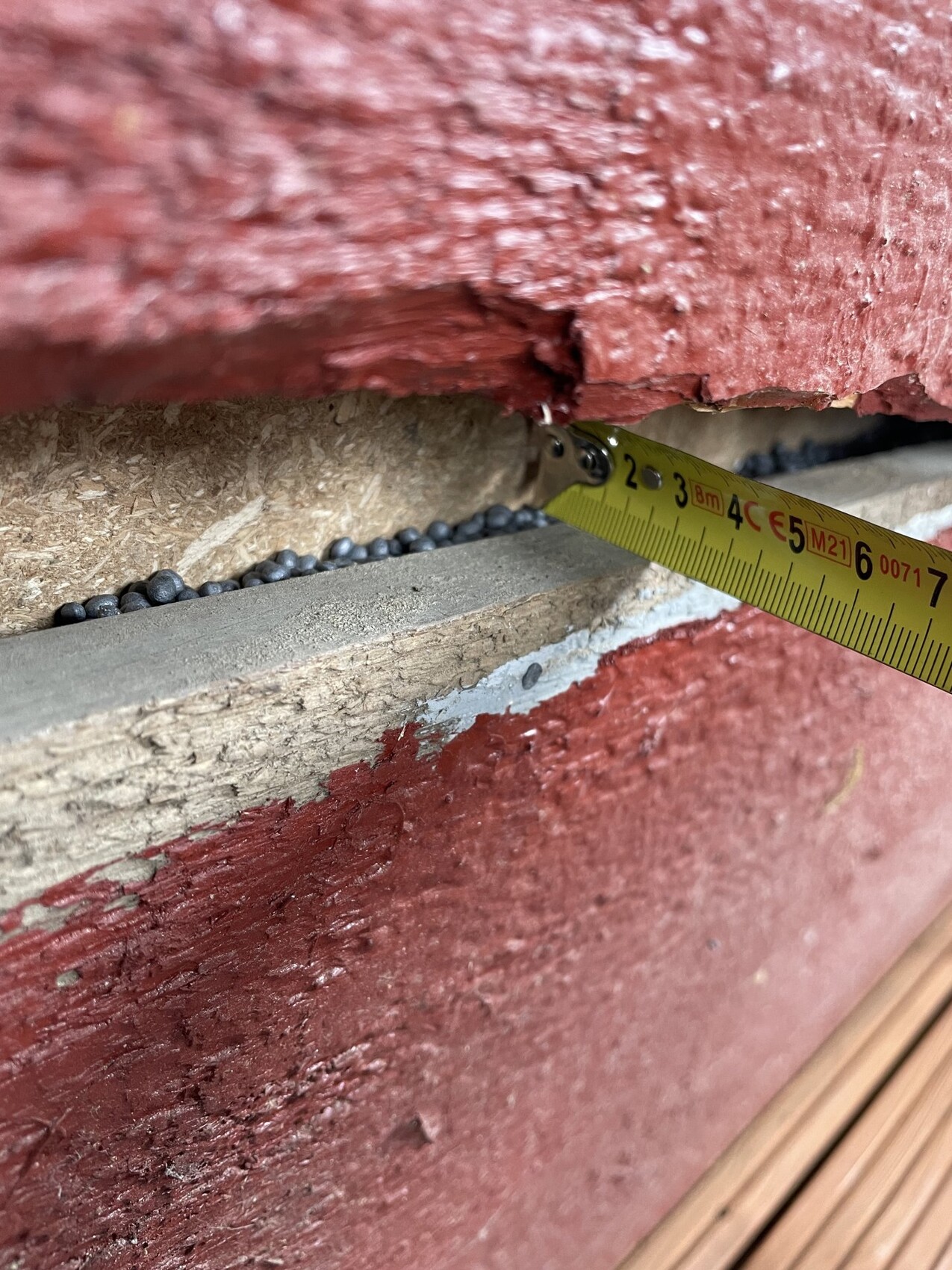
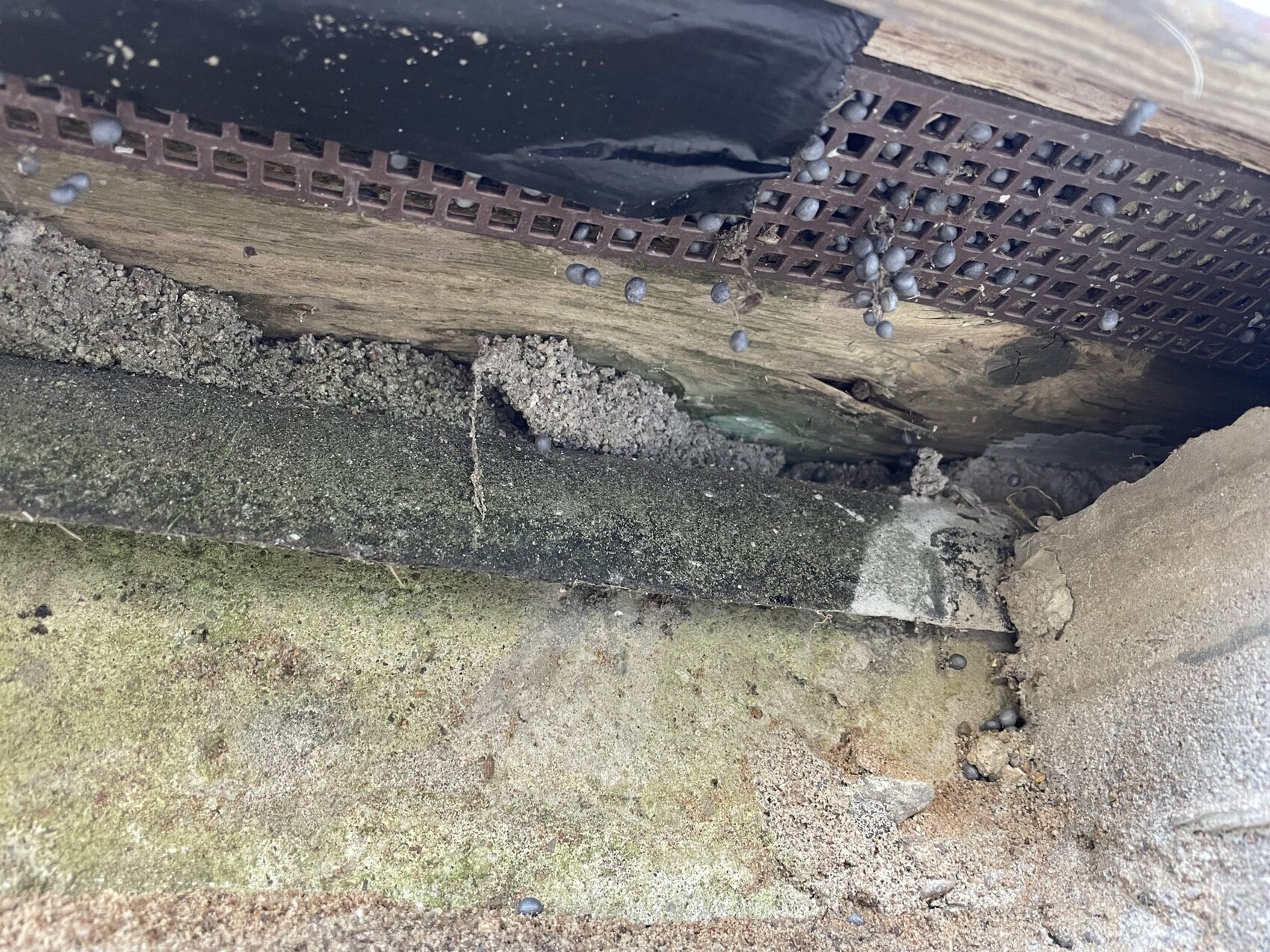
This forum was recommended to me to find help with the problem I’m describing below. First of all, Happy New Year to everyone! 🙂
Our weekend house, built with a timber frame structure, has blown-in insulation of the Yuma-Perl type in the external cladding, which, in my opinion, is completely unsuitable for the house. The wooden cladding has gaps and cracks through which the EPS granules are leaking out. Since the wood cladding used to be ventilated from behind, a pest protection mesh was installed underneath. However, the mesh holes are larger than the EPS granules, so the granules also fall out there. This is a huge mess, as the granules are scattered all over the garden. I tried sealing the pest protection mesh with duct tape, but of course, it doesn't stick permanently. Then I wedged wooden battens underneath it, but that is only a temporary solution. I also tried sealing the gaps in the wooden cladding, but that doesn’t hold well either.
Ideally, I would like to remove all the material. I have already contacted a company specializing in this, but their suction nozzles don’t fit behind the cladding because it’s too narrow. I also got the impression they weren’t very enthusiastic about the job. So, as a test, I drilled a few 8cm (3 inch) holes with a hole saw and tried to vacuum out the granules. That worked somewhat, but it is incredibly time-consuming and can only be done in nice weather with no wind.
Do you perhaps have some ideas on how to best handle this?
Remove the granulate? But what’s the smartest way? Who could be hired for this?
Leave the granulate in place and seal it? But how?
Another problem is the pest protection mesh, which is loose in some places and needs to be replaced. We have mice in the cladding, and they also contribute to pushing the granules out. Who can be hired for such work?
Thanks in advance!
Hi,
Honestly, placing Yuma-Perl behind an open timber cladding is as problematic as using carpet in a rainforest. The issue is less about the material itself and more about the overall construction. EPS granulate requires a completely airtight installation; otherwise, it will find every 2mm (0.08 inch) gap and always escape. The fact that it was ventilated in the past makes it even more problematic because the system now is neither fully effective nor properly functioning from a building physics perspective. Sealing from the outside with tape or battens is well-intentioned but won’t last more than two winters, as you have already noticed yourself. Removing the granulate by vacuum is technically possible, but only with multiple access points and negative pressure; companies specializing in removing external thermal insulation composite systems (ETICS) can do this. However, it often isn’t economically viable for small cabins, which likely explains the lack of interest. Leaving the granulate in place and sealing properly would only work if you install a fine-mesh stainless steel screen at the bottom and fully close the cladding; otherwise, mice will push the material out, and they won’t need much incentive to do so. Speaking of mice, they are attracted not by the EPS itself but by the cavities around it, which is a common misconception. Have you checked whether there is actually a functioning barrier between the insulation and the cladding, or is it all fully filled? And how old is the cabin, about 10 years or closer to 30 years?
Honestly, placing Yuma-Perl behind an open timber cladding is as problematic as using carpet in a rainforest. The issue is less about the material itself and more about the overall construction. EPS granulate requires a completely airtight installation; otherwise, it will find every 2mm (0.08 inch) gap and always escape. The fact that it was ventilated in the past makes it even more problematic because the system now is neither fully effective nor properly functioning from a building physics perspective. Sealing from the outside with tape or battens is well-intentioned but won’t last more than two winters, as you have already noticed yourself. Removing the granulate by vacuum is technically possible, but only with multiple access points and negative pressure; companies specializing in removing external thermal insulation composite systems (ETICS) can do this. However, it often isn’t economically viable for small cabins, which likely explains the lack of interest. Leaving the granulate in place and sealing properly would only work if you install a fine-mesh stainless steel screen at the bottom and fully close the cladding; otherwise, mice will push the material out, and they won’t need much incentive to do so. Speaking of mice, they are attracted not by the EPS itself but by the cavities around it, which is a common misconception. Have you checked whether there is actually a functioning barrier between the insulation and the cladding, or is it all fully filled? And how old is the cabin, about 10 years or closer to 30 years?
Hello,
The house was built in 1990.
I have also considered installing a finer mesh at the bottom, but how do you do that afterwards? Or who would you hire for something like this? A carpenter?
What would be a good way to properly seal the formwork? We tried using window sealing tape, but it doesn't last long.
The house was built in 1990.
I have also considered installing a finer mesh at the bottom, but how do you do that afterwards? Or who would you hire for something like this? A carpenter?
What would be a good way to properly seal the formwork? We tried using window sealing tape, but it doesn't last long.

The whole approach is building physics nonsense and can even damage the structure. Apparently, you have insulated the ventilation gap of the wall construction, which causes it to lose its function. It would have been better to consider a new insulated wall assembly for the timber frame.
Similar topics