
ᐅ Issue – Laminate Flooring and an Old, Raised Door Threshold
Created on: 6 Nov 2013 12:05
S
saturnineS
saturnine6 Nov 2013 12:05Hello,
here is the situation:
we want to install laminate flooring over old (very poorly painted) floorboards. Sanding is not an option (over 100sqm (1076 sq ft)) because it would be too expensive and time-consuming (would require a professional company).
The old apartment has several door thresholds that are noticeably higher than the floorboards currently installed (estimated max. 2 to 2.5cm (0.8 to 1 inch)).
See photos (unfortunately, I don’t have better ones at the moment). Some thresholds are wider, some narrower. Most of the door thresholds also have a kind of step at the start, so their height varies even within the threshold itself. I am not sure how to properly deal with the height difference.
wide threshold

narrow threshold
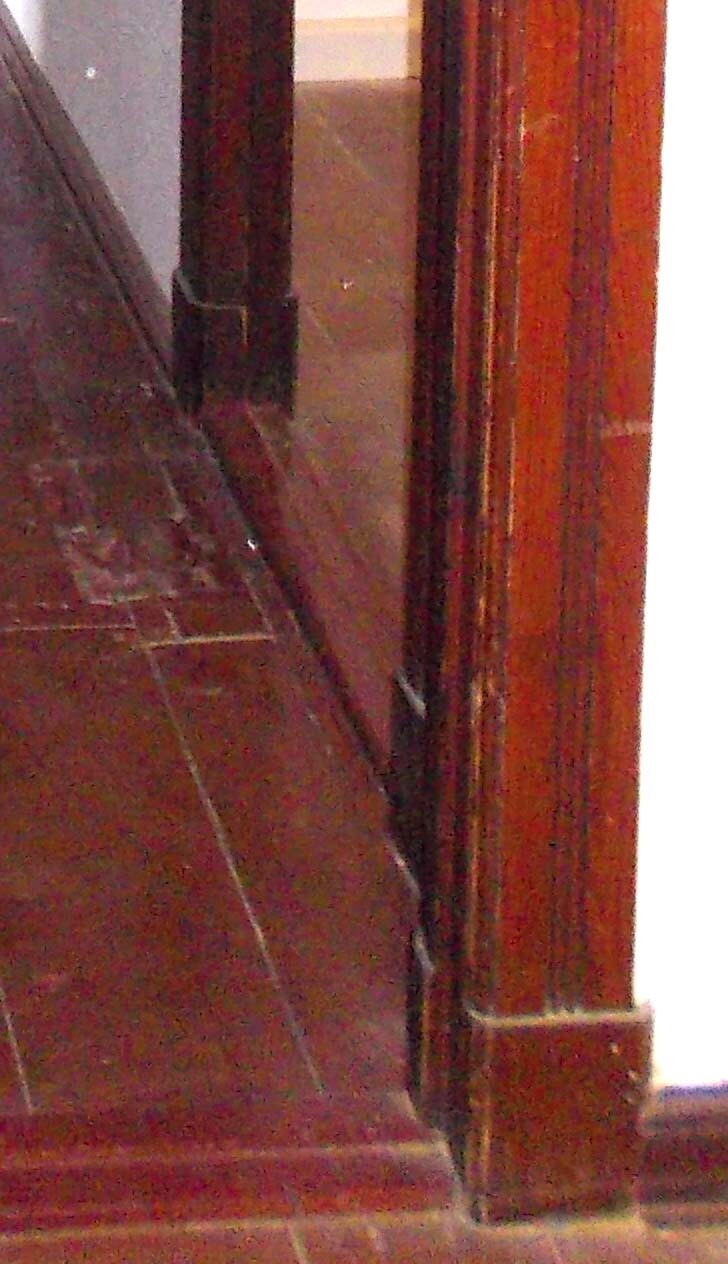
I am considering three scenarios:
1.) Lay the laminate up to the door and use an appropriate transition strip to compensate for the height difference.
QUESTION: Is this even possible with this height difference?
The problem with this option is that the ugly brown threshold remains and is quite an eyesore.
2.) Lay the laminate up to the door and use a transition strip to compensate for the height difference.
Beforehand, sand down the threshold to at least restore a nice wood tone. The problem remains that the threshold will still have a different color than the laminate laid in front of the door.
3.) Cut out the threshold so that the laminate can be laid flush where the threshold was.
The problem is that the threshold most likely has to stay in place, and even if we were allowed to remove it, I lack the experience to do this.
How would you professionally and aesthetically handle a situation like this? Do you have any other good ideas? I have moderate DIY skills; my father-in-law is already quite experienced in these matters.
here is the situation:
we want to install laminate flooring over old (very poorly painted) floorboards. Sanding is not an option (over 100sqm (1076 sq ft)) because it would be too expensive and time-consuming (would require a professional company).
The old apartment has several door thresholds that are noticeably higher than the floorboards currently installed (estimated max. 2 to 2.5cm (0.8 to 1 inch)).
See photos (unfortunately, I don’t have better ones at the moment). Some thresholds are wider, some narrower. Most of the door thresholds also have a kind of step at the start, so their height varies even within the threshold itself. I am not sure how to properly deal with the height difference.
wide threshold
narrow threshold
I am considering three scenarios:
1.) Lay the laminate up to the door and use an appropriate transition strip to compensate for the height difference.
QUESTION: Is this even possible with this height difference?
The problem with this option is that the ugly brown threshold remains and is quite an eyesore.
2.) Lay the laminate up to the door and use a transition strip to compensate for the height difference.
Beforehand, sand down the threshold to at least restore a nice wood tone. The problem remains that the threshold will still have a different color than the laminate laid in front of the door.
3.) Cut out the threshold so that the laminate can be laid flush where the threshold was.
The problem is that the threshold most likely has to stay in place, and even if we were allowed to remove it, I lack the experience to do this.
How would you professionally and aesthetically handle a situation like this? Do you have any other good ideas? I have moderate DIY skills; my father-in-law is already quite experienced in these matters.
Regardless of the details: I consider installing laminate over wooden planks problematic. The plank floor is quite flexible, which is why it creaks and groans when you walk on it. Some planks are thinner and bend more, others less. Therefore, the floor is not an ideal base for laminate because it moves with the flexible plank floor, causing gaps to form all over the laminate. You could probably lay some plastic or rigid foam boards underneath to improve the situation somewhat, but it still wouldn’t be ideal and would also increase the cost.
I would reconsider sanding the floor. A good wooden plank floor is something truly special! (It’s a pity that it hardly fits into new builds and is not compatible with underfloor heating.)
With your laminate, you won’t enjoy it for long because of the subfloor, and then you’ll be annoyed (and end up throwing it out again...).
If money is really tight: just repaint it in a different color. Visually, it’s not perfect, but it doesn’t cost much either.
I would reconsider sanding the floor. A good wooden plank floor is something truly special! (It’s a pity that it hardly fits into new builds and is not compatible with underfloor heating.)
With your laminate, you won’t enjoy it for long because of the subfloor, and then you’ll be annoyed (and end up throwing it out again...).
If money is really tight: just repaint it in a different color. Visually, it’s not perfect, but it doesn’t cost much either.

S
saturnine6 Nov 2013 14:49Well, the problem with the floorboards is that they are painted in an unattractive brown color, and were probably designed that way from the start. So, I’m not sure what kind of wood grain to expect when sanding them down. If the floorboards were intended to be painted, there might not be any nice wood underneath. A knowledgeable person at a DIY store suggested that installing laminate over the floorboards wouldn’t be much of an issue, provided the floorboards are still intact, which they are. He recommended using 5mm (0.2 inch) impact sound insulation mats as an underlay.
Another major issue has just come up for me. If you install laminate flooring, the current old baseboards will need to be removed and replaced with new ones. The old baseboards (vintage Berlin veneer, see photo) are taller than any baseboards currently available on the market, which are at most 6cm (2.4 inches) high. Even if taller baseboards are found, the problem, according to the DIY store employee, is that the new baseboard for the laminate would no longer sit flush against the wall, since the old baseboards were firmly attached to it. When replacing them, the new baseboard would always stand a bit away from the wall. Apparently, this gap can’t be neatly covered. CAN ANYONE CONFIRM THIS?
I’m really getting frustrated here... If that’s the case, after removing the original baseboards, you would have to buy new wooden baseboards, treat them, and screw them to the wall—which I find quite unattractive, and I have even less enthusiasm for doing it ;-(
Another major issue has just come up for me. If you install laminate flooring, the current old baseboards will need to be removed and replaced with new ones. The old baseboards (vintage Berlin veneer, see photo) are taller than any baseboards currently available on the market, which are at most 6cm (2.4 inches) high. Even if taller baseboards are found, the problem, according to the DIY store employee, is that the new baseboard for the laminate would no longer sit flush against the wall, since the old baseboards were firmly attached to it. When replacing them, the new baseboard would always stand a bit away from the wall. Apparently, this gap can’t be neatly covered. CAN ANYONE CONFIRM THIS?
I’m really getting frustrated here... If that’s the case, after removing the original baseboards, you would have to buy new wooden baseboards, treat them, and screw them to the wall—which I find quite unattractive, and I have even less enthusiasm for doing it ;-(
Similar topics