

Hello everyone,
I’m a bit surprised that I can’t find an answer to this question online... maybe it’s actually a silly question 😉
Do I need to apply a primer on top of leveling compound before applying flexible tile adhesive?
The absorbency of the leveling compound is low – I poured some water on it, and it sits on the surface; after wiping it off, a dark spot remains...
The leveling compound was poured 5 years ago. Since then, I’ve wanted to lay the tiles, but there was always something more urgent... 😕
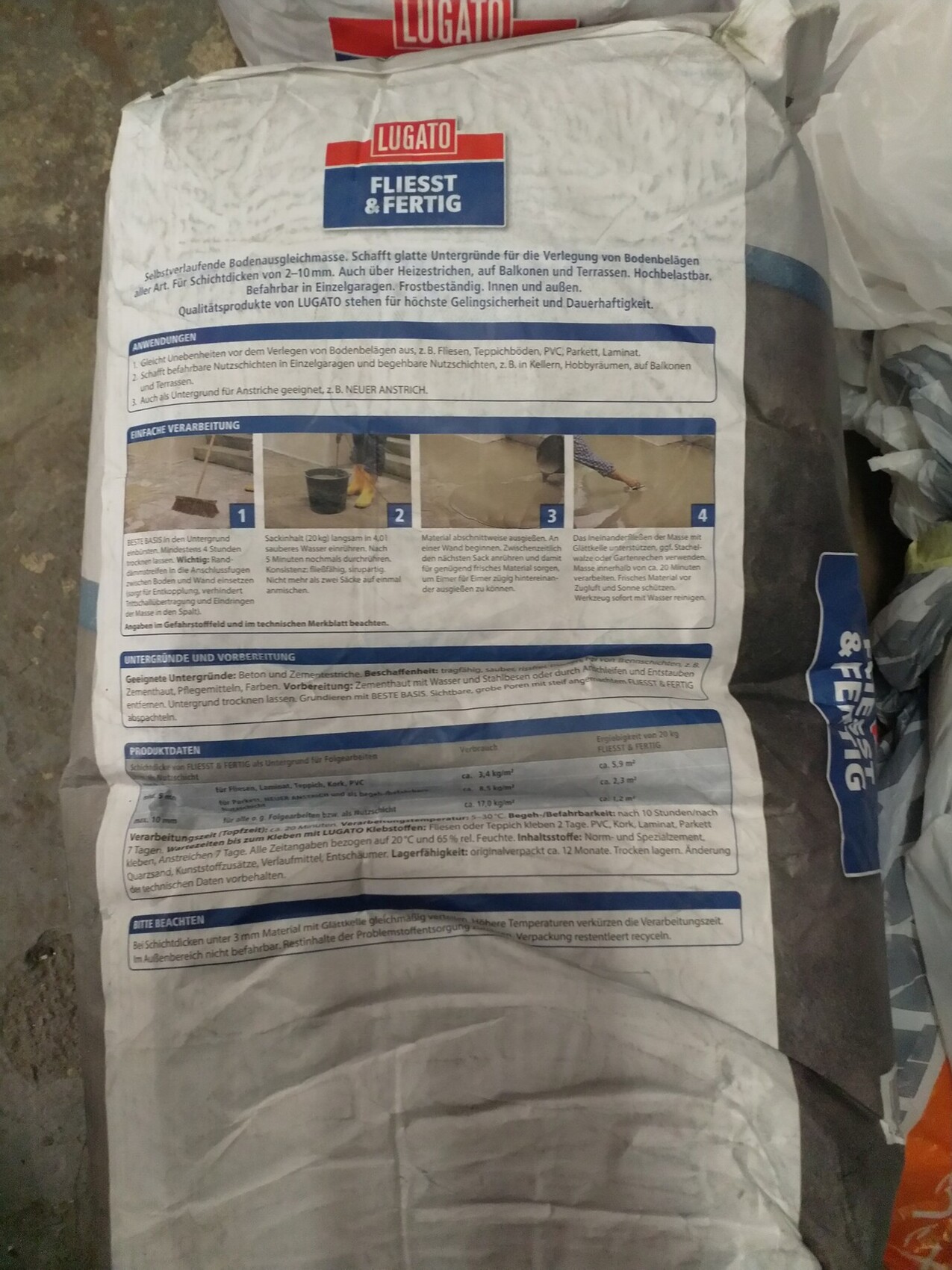
It is the “Lugato Fliesst und Fertig.” I can’t find any information about this from the manufacturer.
Thanks and best regards
Jan
I’m a bit surprised that I can’t find an answer to this question online... maybe it’s actually a silly question 😉
Do I need to apply a primer on top of leveling compound before applying flexible tile adhesive?
The absorbency of the leveling compound is low – I poured some water on it, and it sits on the surface; after wiping it off, a dark spot remains...
The leveling compound was poured 5 years ago. Since then, I’ve wanted to lay the tiles, but there was always something more urgent... 😕
It is the “Lugato Fliesst und Fertig.” I can’t find any information about this from the manufacturer.
Thanks and best regards
Jan

@JanStu8 :
With a new filler compound, I would have no concerns about applying tile adhesive directly on top.
However, with an older filler, especially after 5 years, we cannot be sure what may have happened to the surface over time.
Here you have to weigh the risk of potential later delamination or hollow spots if you skip a primer, against the option to quickly apply a relatively inexpensive dispersion-based primer by roller, thus adding an extra level of SAFETY.
After 5 years, the old filler surface should definitely be cleaned by sanding (+ vacuuming to remove dust particles) before proceeding!
----------------------------------
Good luck: KlaRa
With a new filler compound, I would have no concerns about applying tile adhesive directly on top.
However, with an older filler, especially after 5 years, we cannot be sure what may have happened to the surface over time.
Here you have to weigh the risk of potential later delamination or hollow spots if you skip a primer, against the option to quickly apply a relatively inexpensive dispersion-based primer by roller, thus adding an extra level of SAFETY.
After 5 years, the old filler surface should definitely be cleaned by sanding (+ vacuuming to remove dust particles) before proceeding!
----------------------------------
Good luck: KlaRa
Hello @KlaRa
First of all, thanks for the very quick reply!
I was planning to roughen the surface a bit with a sanding machine using 40 grit and then vacuum it.
I should probably mention that this is for a basement room (dry but unheated). Is dispersion primer the right choice for that?
I will definitely invest the few extra euros.
Best regards, Jan
First of all, thanks for the very quick reply!
I was planning to roughen the surface a bit with a sanding machine using 40 grit and then vacuum it.
I should probably mention that this is for a basement room (dry but unheated). Is dispersion primer the right choice for that?
I will definitely invest the few extra euros.
Best regards, Jan
So: a grit size of 40 with a single-disc machine is almost equivalent to removing the entire layer of leveling compound. I wouldn’t recommend that, as the grit is simply too coarse. It is used to grind an uneven screed surface.
----------
A dispersion-based primer can of course also be applied in a basement room. Only if you notice that there is very high humidity in the room caused by moisture continuously rising from the concrete slab (which I don’t assume here), there would be a risk that the dispersion-based material could re-emulsify. Without making it too complicated: what seems crucial to me is that the substrate is mechanically properly prepared. However, if grinding results in defects in the old leveling compound layer, it would be better to grind off the entire leveling compound and reapply it.
-------------
KlaRa
----------
A dispersion-based primer can of course also be applied in a basement room. Only if you notice that there is very high humidity in the room caused by moisture continuously rising from the concrete slab (which I don’t assume here), there would be a risk that the dispersion-based material could re-emulsify. Without making it too complicated: what seems crucial to me is that the substrate is mechanically properly prepared. However, if grinding results in defects in the old leveling compound layer, it would be better to grind off the entire leveling compound and reapply it.
-------------
KlaRa
Similar topics