
ᐅ Manufactured wood house providers for single-family homes in Lower Saxony
Created on: 12 Feb 2025 17:46
B
Ben3001
Hello dear forum members,
We are a family of four planning to build a 180sqm (1,938 sq ft) single-family house with two full floors plus a basement in Lower Saxony, on a flat 650sqm (7,000 sq ft) plot in a new development area, and we are looking for a prefab house company (timber frame, exterior brick). We have had the preliminary design of the house created by an architect. Our budget is about €3,600 per sqm (plus basement and additional costs).
At the moment, we are overwhelmed by the sheer number of providers and their marketing. So far, we have researched mostly small to medium-sized companies. Wolf, Isowood, and Büdenbender have appealed to us quite well (criteria mainly being wall construction, company size, and solid financial standing). However, the selection is probably somewhat arbitrary.
We would be interested in additional comparable or alternative providers in our price range from whom we can request an offer.
Thank you very much for your recommendations and kind regards!
We are a family of four planning to build a 180sqm (1,938 sq ft) single-family house with two full floors plus a basement in Lower Saxony, on a flat 650sqm (7,000 sq ft) plot in a new development area, and we are looking for a prefab house company (timber frame, exterior brick). We have had the preliminary design of the house created by an architect. Our budget is about €3,600 per sqm (plus basement and additional costs).
At the moment, we are overwhelmed by the sheer number of providers and their marketing. So far, we have researched mostly small to medium-sized companies. Wolf, Isowood, and Büdenbender have appealed to us quite well (criteria mainly being wall construction, company size, and solid financial standing). However, the selection is probably somewhat arbitrary.
We would be interested in additional comparable or alternative providers in our price range from whom we can request an offer.
Thank you very much for your recommendations and kind regards!
Thank you very much for your feedback!
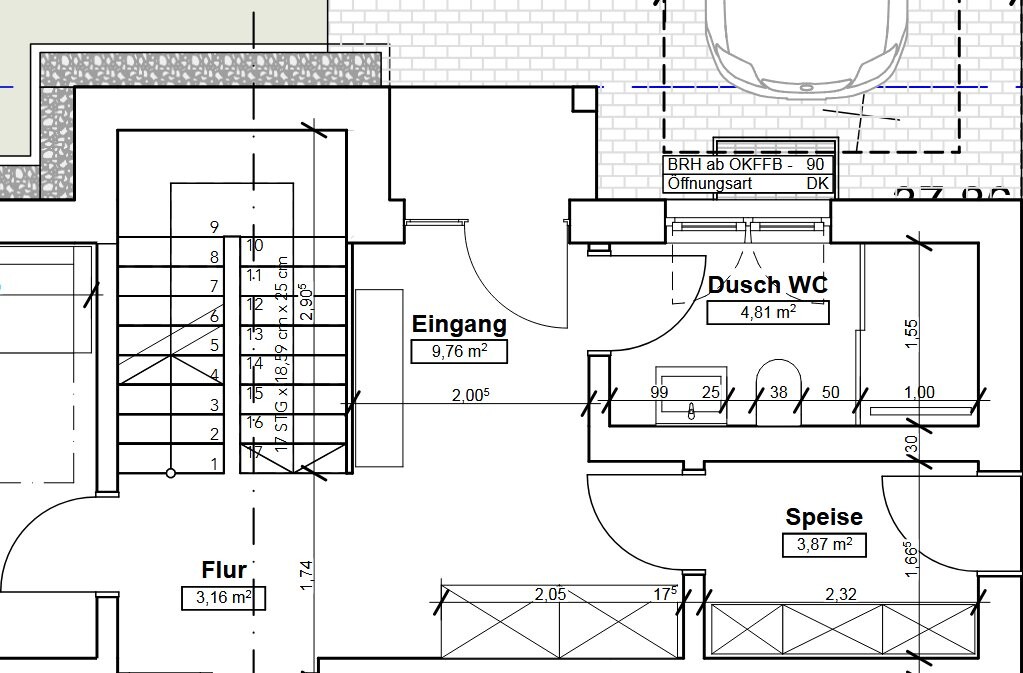
We were/are aware that this might be an issue. We once had a version with the entrance recessed (see attachment). From the outside, however, it looked a bit odd. We are now considering simply attaching a basic rain shield to the exterior wall. The 60cm (24 inches) roof overhang probably isn’t enough?
In the first design, it was literally separated by a door, as you can see in the attachment.
The 1.50m (5 feet) matches our current dining table, which we extend when guests come.
It bothers me much more on the north side than on the south, but unfortunately it’s not something you can argue away.
The bay window is meant to have a seating bench, not a sofa. Not practical?
You wouldn’t. We’re happily TV-free. There’s a piano next to the south window and an organ opposite.
Without going into kitchen planning details: would you say the kitchen’s dimensions make the room generally suboptimal, or is it just the current layout that’s poor? Our only requirements for the kitchen were, besides separation from the living room, that it can seat four people briefly and space-efficiently for breakfast.
You can also access the terrace from the living room at the back.
Good point, I hadn’t noticed that before. The narrow kids’ bathroom is a result of the plan’s evolution. Originally, we didn’t want an extra room upstairs, so the guest room in the first draft was the kids’ bathroom. The current kids’ bathroom used to be a laundry room. As we don’t spend much time in the bathroom, the bathroom area seemed a bit oversized relative to the whole house, so the kids’ bathroom moved into the former laundry, and the laundry moved to the basement. Not having a shower and no TV are also conscious decisions. Do you think this problem can be solved? A light switch outside? Or a motion sensor?
No classic home office per se. But evening and weekend work is a thing. One spare room would be sufficient for that.
I’m also becoming more comfortable with that idea. It might also solve the symmetry issue. The floor area ratio is 0.25. I will calculate that.
ypg schrieb:
- Entrance has no canopy.
We were/are aware that this might be an issue. We once had a version with the entrance recessed (see attachment). From the outside, however, it looked a bit odd. We are now considering simply attaching a basic rain shield to the exterior wall. The 60cm (24 inches) roof overhang probably isn’t enough?
ypg schrieb:
- The cloakroom/hallway is somewhat divided, but you can get used to it.
In the first design, it was literally separated by a door, as you can see in the attachment.
ypg schrieb:
- The dining table is marked quite boldly small at 1.50m (5 feet). The architect should definitely consider 1.80m (6 feet), otherwise 2.00m (6.5 feet), or for larger families or frequent guests 2.40m (8 feet) should be possible.
The 1.50m (5 feet) matches our current dining table, which we extend when guests come.
ypg schrieb:
- The bay window in the dining area is off-center (seen from the outside). Okay, maybe I’m just a bit particular about that.
It bothers me much more on the north side than on the south, but unfortunately it’s not something you can argue away.
ypg schrieb:
- There’s a sofa planned in the bay window. Basically, think about who would want to rub their back against the window muntins or cold surfaces there.
The bay window is meant to have a seating bench, not a sofa. Not practical?
ypg schrieb:
- Living room: how would you position the TV without having to strain your neck?
You wouldn’t. We’re happily TV-free. There’s a piano next to the south window and an organ opposite.
ypg schrieb:
- Small kitchen, little storage. Sitting close together like chickens on a perch, which didn’t work out as expected even in the 2000s. The seating arrangement also obstructs the main access to the terrace.
Without going into kitchen planning details: would you say the kitchen’s dimensions make the room generally suboptimal, or is it just the current layout that’s poor? Our only requirements for the kitchen were, besides separation from the living room, that it can seat four people briefly and space-efficiently for breakfast.
ypg schrieb:
- If I read that the doors are closed during cooking, it sort of makes access to the terrace impossible?
You can also access the terrace from the living room at the back.
ypg schrieb:
- The children’s bathroom upstairs has a 73cm (29 inches) door… there is no room for a light switch beside it, the shower’s rough opening is 90cm (35 inches), so the effective width is about 80cm (31 inches)?
- There’s no bathtub.
Good point, I hadn’t noticed that before. The narrow kids’ bathroom is a result of the plan’s evolution. Originally, we didn’t want an extra room upstairs, so the guest room in the first draft was the kids’ bathroom. The current kids’ bathroom used to be a laundry room. As we don’t spend much time in the bathroom, the bathroom area seemed a bit oversized relative to the whole house, so the kids’ bathroom moved into the former laundry, and the laundry moved to the basement. Not having a shower and no TV are also conscious decisions. Do you think this problem can be solved? A light switch outside? Or a motion sensor?
ypg schrieb:
There are now two spare rooms; I don’t remember if working from home is relevant at all,
No classic home office per se. But evening and weekend work is a thing. One spare room would be sufficient for that.
ypg schrieb:
Personally, I would probably prefer the all-purpose room to be one meter (3 feet) wider for four people rather than having an extra floor. But with a floor area ratio of 0.2, that might get rather tight.
I’m also becoming more comfortable with that idea. It might also solve the symmetry issue. The floor area ratio is 0.25. I will calculate that.

I’ll try to respond to various comments in summary rather than chronologically and then address the design methodology:
I always say, "Symmetry is a (substitute) aesthetic for those with proportion dyslexia (and as a non-intrinsic value perfectly dispensable)." The "deadliest combination," however, is to distribute wall openings asymmetrically but then place elements of similar size across the facade.
The architect plans wall thicknesses typical for masonry construction (supposedly to stay neutral regarding construction methods), with the novel argument that average wall thicknesses in timber framing are similar. Unfortunately, the result falls between two stools because she uses odd “Pippi Longstocking” measurements—that is, she neither adheres to the eight-meter modular grid of masonry nor the actual construction module of timber framing. This would lead to numerous problems: in masonry, a proliferation of cut bricks and improvised pockets; and in timber framing, countless additional structural reinforcements. With a brick veneer, the approximate reference dimension of 365mm (14.4 inches) cannot be maintained in either masonry or timber frame, almost inevitably causing an overshoot of about 10cm (4 inches) in overall wall thickness.
In layman’s terms, you could put it that way.
This is a typical example of a naïve design interpretation. Such an approach may seem sympathetic, but that’s not why you hire a professional. You expect the expert to explain the alternative of a professional approach to the client. Methodical planning is precisely the most effective preventive medicine against the almost predictably ensuing redesigns. The cost of “tuition” here is essentially the fee for repeating the design phase plus the time invested by all involved.
Note well: the wasted time also counts as part of the redesign cost. Effects on the ground floor layout when starting the design with the upper floor and taking stairs location and roof form into conceptual consideration: invaluable.
Then apart from the core goal, nothing was missed.
Here we finally see reasonable basics for design development, although I never get tired of pointing out that "equal-sized rooms for equally loved children" is a parental mindset rarely expressed or appreciated by the children themselves. They will always find reasons to complain about perceived unfair treatment compared to siblings and are unmoved by facts. Furthermore, children have completely different criteria for what makes a great bedroom.
Questions like these should have been discussed by a professional with the builders *before* starting the drawings.
Whenever I see "first draft," I get nervous. First, second, third, forty-seventh drafts are exactly what happens when you skip the preliminary design phase.
See above.
How can a redundant breakfast spot save space? I detect a contradiction here.
No piano without a zigzag wall (see @chrisw81)!
https://www.instagram.com/11antgmxde/
https://www.linkedin.com/company/bauen-jetzt/
ypg schrieb:
I can tell you how the exterior facade looks: completely crooked. I wouldn’t want it like that.
I always say, "Symmetry is a (substitute) aesthetic for those with proportion dyslexia (and as a non-intrinsic value perfectly dispensable)." The "deadliest combination," however, is to distribute wall openings asymmetrically but then place elements of similar size across the facade.
Rübe1 schrieb:
Hmm, with a 36.5cm (14.4 inches) exterior wall (including brick veneer), I’d be very interested in the intended wall assembly… especially in timber frame construction… [...] 36.5cm sounds monolithic to me—so no brick veneer. With insulation and an air gap, it would get even thicker, hence my question.
The architect plans wall thicknesses typical for masonry construction (supposedly to stay neutral regarding construction methods), with the novel argument that average wall thicknesses in timber framing are similar. Unfortunately, the result falls between two stools because she uses odd “Pippi Longstocking” measurements—that is, she neither adheres to the eight-meter modular grid of masonry nor the actual construction module of timber framing. This would lead to numerous problems: in masonry, a proliferation of cut bricks and improvised pockets; and in timber framing, countless additional structural reinforcements. With a brick veneer, the approximate reference dimension of 365mm (14.4 inches) cannot be maintained in either masonry or timber frame, almost inevitably causing an overshoot of about 10cm (4 inches) in overall wall thickness.
Ben3001 schrieb:
Yes, this is the same error 11ant mentioned—design planning that is not adapted to the construction method.
In layman’s terms, you could put it that way.
Ben3001 schrieb:
We initially wanted a 1.5-story house with a gable roof. The architect then recommended two full stories for a more flexible upper floor. We find the usual square townhouse villas with flat hipped roofs aesthetically rather dreadful, so we proposed a more rectangular shape with bay windows and a steeper roof. As of now, we are quite satisfied with the exterior look. [...] A redesign should definitely still be possible at this stage. We expected to pay some “tuition” on this project.
This is a typical example of a naïve design interpretation. Such an approach may seem sympathetic, but that’s not why you hire a professional. You expect the expert to explain the alternative of a professional approach to the client. Methodical planning is precisely the most effective preventive medicine against the almost predictably ensuing redesigns. The cost of “tuition” here is essentially the fee for repeating the design phase plus the time invested by all involved.
Ben3001 schrieb:
It does bother me. I can’t yet say if it bothers me enough to restart planning from scratch. The asymmetry of the sides is 89cm (35 inches). Increasing the left side by this length would add 8.2m² (88 sq ft) of space and cost about €30,000 plus redesign costs. The guest WC downstairs could have its window centered, and the current bathroom upstairs is missing 7cm (3 inches) in layout. Functionally, a bathroom 89cm wider probably wouldn’t help much with the current upstairs layout. Effects on the ground floor layout: no idea.
Note well: the wasted time also counts as part of the redesign cost. Effects on the ground floor layout when starting the design with the upper floor and taking stairs location and roof form into conceptual consideration: invaluable.
Ben3001 schrieb:
Our lifestyle is probably pretty average; meaning we would have been happy with a proven standard floor plan from any prefab house supplier. The main reason to hire the architect was mainly to have a uniform basis for comparing offers.
Then apart from the core goal, nothing was missed.
Ben3001 schrieb:
Planning requirements were: two roughly equal-sized children’s rooms upstairs, separate children’s bathroom, a study with space for two desks downstairs, no open living-dining-kitchen area or at least the option to visually and olfactorily separate the kitchen from the living/dining area, sauna in the master bathroom, and a south-facing window seat in the living room.
Here we finally see reasonable basics for design development, although I never get tired of pointing out that "equal-sized rooms for equally loved children" is a parental mindset rarely expressed or appreciated by the children themselves. They will always find reasons to complain about perceived unfair treatment compared to siblings and are unmoved by facts. Furthermore, children have completely different criteria for what makes a great bedroom.
Ben3001 schrieb:
Our plan was that the kitchen sliding door would be closed a few times a week during cooking and mostly open otherwise. The door to the living room might actually be better as a double door. I still can’t quite judge what’s more practical.
Questions like these should have been discussed by a professional with the builders *before* starting the drawings.
Ben3001 schrieb:
Would the house really have needed a completely different design after the first draft? Maybe. [...] In the first draft, it was literally separated by a door, as you can see in the attachment.
Whenever I see "first draft," I get nervous. First, second, third, forty-seventh drafts are exactly what happens when you skip the preliminary design phase.
Ben3001 schrieb:
The narrow children’s bathroom also reflects the plan’s development. We originally did not want any extra rooms upstairs, so the guest room in the first draft was the children’s bathroom. The current children’s bathroom used to be the laundry room. Since we spend relatively little time in the bathrooms, the ratio of bathroom area to total house area seemed somewhat oversized, so the children’s bathroom moved into the laundry room and the laundry moved to the basement. The absence of a shower and TV is a conscious decision. Do you think this problem could be solved? Light switch outside? Or motion sensor?
See above.
Ben3001 schrieb:
Our only requirement for the kitchen was that besides separation from the living room there had to be space for four people to have a quick, space-saving breakfast in the morning.
How can a redundant breakfast spot save space? I detect a contradiction here.
Ben3001 schrieb:
Not at all. We’re happy without a TV. Next to the south window is a piano. Opposite that is an organ.
No piano without a zigzag wall (see @chrisw81)!
https://www.instagram.com/11antgmxde/
https://www.linkedin.com/company/bauen-jetzt/

11ant schrieb:
The architect designs wall thicknesses typical for masonry construction (to appear neutral in terms of building methods) with the original reasoning that, on average, the wall thicknesses of timber frame panels are similar. Unfortunately, the result ends up somewhere in between, as she uses arbitrary dimensions, disregarding both the octameter grid typical of masonry and the actual construction grid used in timber construction. This would inevitably lead to numerous patchwork repairs in masonry, and equally countless adjustments in timber construction. With a facing brick layer, the dimension of 365mm (14 inches) as an approximate reference measure—whether masonry or timber frame construction—cannot even remotely be maintained, making an error of nearly 10 cm (4 inches) in additional wall thickness unavoidable. With all due respect, that is quite nonsense.
The architect is clearly designing in timber stud construction and asks in advance about the desired energy efficiency. The specified wall thickness is an average value commonly used, which is absolutely sufficient for comparing suppliers. Each manufacturer offers slightly different thicknesses. Sometimes, even within one manufacturer, you can choose between different wall assemblies. A lift-and-slide door requires a different wall thickness, and so on... This is just how supplier comparisons work.
In our project, no adjustments were necessary. We received everything exactly as planned and at a very attractive price.
If you want to build with masonry, that should be communicated accordingly in advance. But even then, changes are possible. I just had a conversation last week where the main contractor was changed after the building permit/planning permission because the timber builder could not offer an appointment for the selection of finishes during the COVID-19 period.
roteweste schrieb:
With all due respect, that is quite nonsense. Unfortunately not—although I’m happy for your likeable architect that you are satisfied with her. But I can’t recommend her to 90% of those who ask me for advice, precisely because of this approach.
roteweste schrieb:
The architect simply designs using timber frame construction and asks in advance about the desired energy efficiency. The wall thickness is an average standard value, which is absolutely sufficient for comparing suppliers. Every manufacturer offers slightly different dimensions here. Sometimes you can even choose between different wall constructions within one manufacturer. The wall build-up formulas differ only marginally between manufacturers Meier and Müller; the facing brick is certainly mentioned by the builders, and across the board, this generally results in a thickness of about 44 to 46 cm (17 to 18 inches). All manufacturers provide made-to-measure dimensions accurate to the centimeter, but still mainly design using a standard modular grid of predominantly 625 mm (25 inches), less commonly 833 mm (33 inches), and only a few with other structurally justified panel widths. Ignorance of practical issues does not really reduce additional effort with timber framing compared to masonry.
roteweste schrieb:
If you want to build with masonry, then you should communicate that accordingly in advance. But even then, switching is possible. Just last week, I had a conversation where the general contractor was changed after the building permit because the timber builder wasn’t able to offer a sample selection appointment during the COVID period. If you want to build with masonry (or when this was not originally planned but later occurs), the plans should not need to be corrected despite the wall thicknesses already fitting, just to fix pockets of poor craftsmanship. Your design also contains a generous amount of these, even though there are no justified reasons anywhere for exceptions to a clean modular grid. 62.5 cm (25 inches) is exactly five times 12.5 cm (5 inches), thus a fully compatible modular dimension. Raster steps of 80/40/20/10 cm (31/15.7/7.9/3.9 inches) or 60/20/10 cm (23.6/7.9/3.9 inches) in the plans would clearly indicate example dimensions adapted to the nearest production sizes. But if you have specific measurements like 142 or even 141.5 cm (56 or 55.7 inches), the production planner will read this as an explicit customer request and will move heaven and earth to realize this unusual dimension. Sometimes there are indeed reasons, for example, if the clients have fallen for a special historic or foreign brick format and want to avoid any cutting in the labor-intensive decorative façade. To me, this irresponsibly plays with the clients’ trust in the professional and their expertise. This is what I mean by Pippi Longstocking behavior (I could have also said Lucilectric). Nice but sloppy. I wouldn’t, as a layperson, go to someone who supposedly “learned” this and is therefore “reliably better” if this were the result. The professional title “architect” is perceived by customers as a seal of quality—vegan guests want to trust that there won’t be ham cubes in the salad. Unfortunately, some planners do not live up to this. If you personally are still not disappointed, I sincerely wish that for all involved. But on my recommendation list, this will be reflected by a reservation.
https://www.instagram.com/11antgmxde/
https://www.linkedin.com/company/bauen-jetzt/
Ben3001 schrieb:
The 1.50m (5 feet) corresponds to our current dining table, which we extend when we have guests. Still, a new build with these dimensions should be able to accommodate a dining table of 2 x 1m (6.5 x 3.3 feet), even if someone uses a different one. If the current size was generally sufficient, there would be no need to build.
Ben3001 schrieb:
It bothers me much more on the north side than on the south, but unfortunately you can’t argue it away. I wouldn’t build something that really bothers me.
Ben3001 schrieb:
The bay window is intended to have a window seat, not a sofa. Not practical? In most cases, a window seat is a current trend and often expensive. Sitting there tends to be uncomfortable. Trends are temporary and can quickly look outdated in a house.
Arauki11 schrieb:
Nevertheless, a new build of this size should be able to accommodate a dining table measuring 2x1m (6.6x3.3 ft), even if a different one is used. If the current one were generally sufficient, there wouldn’t be a need to build. The space isn’t small. There should actually be room for a slightly larger dining table, right?
Arauki11 schrieb:
What really bothers me, I wouldn’t build. We won’t be building that in the current form either.
Arauki11 schrieb:
A window seat is usually a current trend, which often comes with a high cost. Sitting there is mostly uncomfortable. Trends are temporary and can quickly seem outdated in a house. Whether it’s trendy or outdated is not a deciding factor for us. Combined with a bookshelf wall, I find it visually quite appealing on its own. The idea was also to break up the long, narrow living room a bit.
Similar topics