
ᐅ Electricity Supply from the Utility to the House – How Does It Work?
Created on: 28 Mar 2014 19:25
C
cem80Hello everyone,
I have recently started trying to understand the house I live in – more specifically, the electricity (wiring/current flow, etc.).
I bought two books on the topic (Electrical Installations in the Home and ABC of Electrical Installations).
There are three points I don’t fully understand.
1. Electric current works as follows:
Voltage builds up in the blue cable, and when the blue cable touches the black cable, the free protons start moving toward the electrical device (current consumer)...
Question:
So, does that mean the free protons are basically being consumed? Shouldn’t the cable eventually run out of movable protons?
Image related to the question:

2. I don’t quite understand how the electricity supply from the utility company connects to the internal house wiring.
The blue cable (L) is delivered from the utility company to the house, where the thick cable meets smaller cable connections inside the house (distribution panel handover).
Shouldn’t the large current in the thick (L) cable overload the thinner (L) cables it connects to and cause them to melt?
Image related to the question:
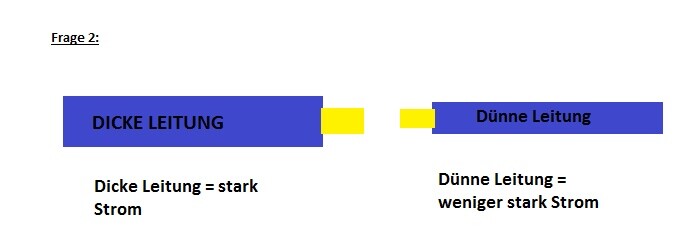
3. What happens if you use too thick a cable for a standard 230V (230V) line?
Is there power loss or maybe no power at all?
Is it safer?
Thank you for your help and best regards.
I have recently started trying to understand the house I live in – more specifically, the electricity (wiring/current flow, etc.).
I bought two books on the topic (Electrical Installations in the Home and ABC of Electrical Installations).
There are three points I don’t fully understand.
1. Electric current works as follows:
Voltage builds up in the blue cable, and when the blue cable touches the black cable, the free protons start moving toward the electrical device (current consumer)...
Question:
So, does that mean the free protons are basically being consumed? Shouldn’t the cable eventually run out of movable protons?
Image related to the question:
2. I don’t quite understand how the electricity supply from the utility company connects to the internal house wiring.
The blue cable (L) is delivered from the utility company to the house, where the thick cable meets smaller cable connections inside the house (distribution panel handover).
Shouldn’t the large current in the thick (L) cable overload the thinner (L) cables it connects to and cause them to melt?
Image related to the question:
3. What happens if you use too thick a cable for a standard 230V (230V) line?
Is there power loss or maybe no power at all?
Is it safer?
Thank you for your help and best regards.

I only know that when routing cables around corners, you have to be careful that the protons don’t get thrown out by centrifugal force, so no current reaches the end of the cable.
What is especially important is how many electrical devices you have per phase and how much power they will draw or can draw in total.
This determines the cable diameter and cable length. For example, every power strip from a hardware store states the maximum power allowed before it starts to overheat or the circuit breaker trips.
I’m not an electrician, but I think that bus and star topologies, in addition to the distribution board and the included circuit breakers and protective switches, play a significant role here.
What is especially important is how many electrical devices you have per phase and how much power they will draw or can draw in total.
This determines the cable diameter and cable length. For example, every power strip from a hardware store states the maximum power allowed before it starts to overheat or the circuit breaker trips.
I’m not an electrician, but I think that bus and star topologies, in addition to the distribution board and the included circuit breakers and protective switches, play a significant role here.

The blue cable is the neutral conductor, marked as N, not L.
Regarding point 1: No, nothing can "run out." The protons only slow down slightly due to consumption, which causes the current to decrease.
Regarding point 2: As long as the circuit is not closed, you can connect as many thinner cables to the thicker one without any issues. However, if you connect a 20A device to a conductor rated, for example, for 16A, the cable will warm up because the power demand exceeds what the cable can safely carry, causing heat buildup. If this gets extreme, it can lead to insulation fires and melting of the copper conductor.
Regarding point 3: Yes, nothing harmful will happen except that your wallet will shrink because thicker cables are generally more expensive than thinner ones. An uninformed person might mistake the thicker cable for one that can handle more power and then connect a higher-demand device to it. This could cause the upstream fuse or breaker to fail. Therefore, never connect thicker cables to thinner ones; always connect thinner cables to thicker ones.
Regarding point 1: No, nothing can "run out." The protons only slow down slightly due to consumption, which causes the current to decrease.
Regarding point 2: As long as the circuit is not closed, you can connect as many thinner cables to the thicker one without any issues. However, if you connect a 20A device to a conductor rated, for example, for 16A, the cable will warm up because the power demand exceeds what the cable can safely carry, causing heat buildup. If this gets extreme, it can lead to insulation fires and melting of the copper conductor.
Regarding point 3: Yes, nothing harmful will happen except that your wallet will shrink because thicker cables are generally more expensive than thinner ones. An uninformed person might mistake the thicker cable for one that can handle more power and then connect a higher-demand device to it. This could cause the upstream fuse or breaker to fail. Therefore, never connect thicker cables to thinner ones; always connect thinner cables to thicker ones.
T
toxicmolotof28 Mar 2014 20:46My last physics class was more than 10 years ago, but I hope that no protons are moving much through my electrical wiring, only the electrons.
And thanks to alternating current, fortunately, they don’t travel very far either. Nothing is actually consumed here. Both electrons and protons stay where they are.
And thanks to alternating current, fortunately, they don’t travel very far either. Nothing is actually consumed here. Both electrons and protons stay where they are.
Similar topics