
Hello everyone,
We are currently planning our outdoor area and would like to build a pool ourselves. The pool will be constructed from 17.5 cm (7 inch) concrete formwork blocks and will be fully embedded in the ground on two sides, while about two-thirds of it will extend above ground on the other two sides.
We have put together a cost estimate and are now looking to cut expenses where possible.
One major cost item is the concrete slab. Originally, a concrete truck with a pump was budgeted, but this is one of the largest expenses in the plan, so we would like to pour the slab ourselves.
We definitely have the necessary skills and sufficient physical strength.
The pool will measure 7 x 4 meters (23 x 13 feet), and with a 20 cm (8 inch) thick slab, about 5.6 cubic meters (about 7.3 cubic yards) of concrete will need to be poured.
That is quite a lot of concrete to mix and work by hand with a concrete mixer.
Therefore, our question is whether the slab can be poured in sections.
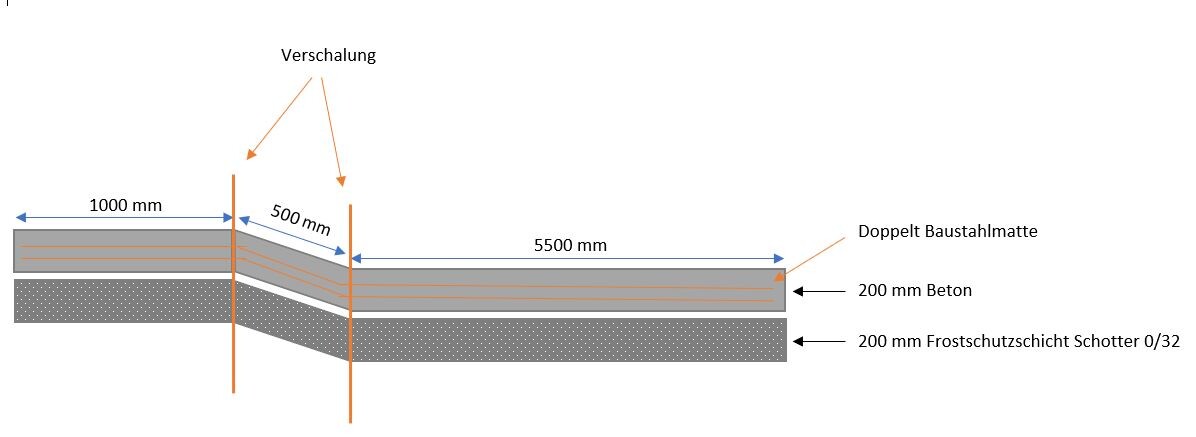
The setup would be 20 mm (0.8 inch) gravel, then a mesh of double-layer steel reinforcement mats. The pool will have two levels connected by a slope.
As shown in the attached sketch, can the slab be divided into these three sections and poured separately, or would that be ineffective and not durable in the long term?
The connecting reinforcement would be in place for the individual sections.
I’m looking forward to your knowledge and feedback.
Thank you very much.
We are currently planning our outdoor area and would like to build a pool ourselves. The pool will be constructed from 17.5 cm (7 inch) concrete formwork blocks and will be fully embedded in the ground on two sides, while about two-thirds of it will extend above ground on the other two sides.
We have put together a cost estimate and are now looking to cut expenses where possible.
One major cost item is the concrete slab. Originally, a concrete truck with a pump was budgeted, but this is one of the largest expenses in the plan, so we would like to pour the slab ourselves.
We definitely have the necessary skills and sufficient physical strength.
The pool will measure 7 x 4 meters (23 x 13 feet), and with a 20 cm (8 inch) thick slab, about 5.6 cubic meters (about 7.3 cubic yards) of concrete will need to be poured.
That is quite a lot of concrete to mix and work by hand with a concrete mixer.
Therefore, our question is whether the slab can be poured in sections.
The setup would be 20 mm (0.8 inch) gravel, then a mesh of double-layer steel reinforcement mats. The pool will have two levels connected by a slope.
As shown in the attached sketch, can the slab be divided into these three sections and poured separately, or would that be ineffective and not durable in the long term?
The connecting reinforcement would be in place for the individual sections.
I’m looking forward to your knowledge and feedback.
Thank you very much.
abc12345 schrieb:
@11ant
How can I possibly pour the floor slab in the specified sections, and what should I pay attention to?HelloOf course, you can pour the floor slab yourself. Set up the formwork, place the reinforcement, extend the reinforcement well into the future second and third sections of the slab, and pour each section on the same day.
However, I agree with previous commenters. This is saving money in the wrong place. The formwork still has to be done anyway. That’s the most labor-intensive part. And you will never be able to mix the concrete by hand to the consistent quality you get from a ready-mix truck.
7-8 m² (75-85 square feet) of ready-mix concrete isn’t much more expensive than doing it yourself. How far would the concrete pump need to reach? A crane might be enough. Around 200 euros per hour (approx. $210 USD). In two hours, the job would be done.
Use waterproof (WU) concrete to be on the safe side.
Save money elsewhere instead. You can do the formwork yourself. Reinforcement is straightforward. You can lay electrical cables yourself. But pour just 2 m² (22 square feet) of concrete in one day—that’s hard work.
Steven
So, I now have the quotes, and indeed there are no major differences compared to doing it myself—nothing that would justify the extra effort. Basically, I would save about 400 euros (around $430), but then I might end up with back problems.
Once the excavation is done, I will spread gravel, install the reinforcement, and figure out how to create a sturdy formwork that won't blow away.
I’ll also use concrete with better flow properties, so I can skip the compaction with a vibrating poker, and this concrete only costs me about 8 euros (around $8.60) more per cubic meter.
Once the excavation is done, I will spread gravel, install the reinforcement, and figure out how to create a sturdy formwork that won't blow away.
I’ll also use concrete with better flow properties, so I can skip the compaction with a vibrating poker, and this concrete only costs me about 8 euros (around $8.60) more per cubic meter.
Brief experience:
Here, earth-moist concrete can also be delivered from contractors using tipper trucks or containers. They deliver a maximum of 10m³ (13 cubic yards).
The delivery is much cheaper than from a concrete plant, but it’s only available as earth-moist concrete. They dump it onto a tarp in the driveway, and you rent a small skid steer loader, for example an AVANT. One person operates it (about 300 liters (80 gallons) per bucket), while two others shovel in the foundation pit. Rent a vibrating needle (poker) compactor, and the earth-moist concrete will settle nicely between the reinforcement mats.
I mixed 1.5 pallets of concrete with my neighbor using a 120–140 liter (32–37 gallon) mixer. The bags were 40 kg (88 pounds) each. It took a morning of work and three days of backache.
Here, earth-moist concrete can also be delivered from contractors using tipper trucks or containers. They deliver a maximum of 10m³ (13 cubic yards).
The delivery is much cheaper than from a concrete plant, but it’s only available as earth-moist concrete. They dump it onto a tarp in the driveway, and you rent a small skid steer loader, for example an AVANT. One person operates it (about 300 liters (80 gallons) per bucket), while two others shovel in the foundation pit. Rent a vibrating needle (poker) compactor, and the earth-moist concrete will settle nicely between the reinforcement mats.
I mixed 1.5 pallets of concrete with my neighbor using a 120–140 liter (32–37 gallon) mixer. The bags were 40 kg (88 pounds) each. It took a morning of work and three days of backache.
abc12345 schrieb:
with better flow properties, then you save yourself the compaction with the needle vibratorHello
That will go wrong.
Make a drawing of the foundation slab. To scale, including the slope. Show it when you order the concrete. They will then tell you which consistency you need.
And rent a needle vibrator.
Steven
Okay, thanks for the tip. I will create a drawing and send it to them. Alternatively, I will ask around about the delivery of damp concrete. The problem is that I think it won’t be cheaper with the skid-steer loader since it still needs to be delivered to me. Unfortunately, I don’t have a trailer.
But I’ll look into it and report back.
Thanks anyway.
But I’ll look into it and report back.
Thanks anyway.
Similar topics