
Hello everyone,
We are currently planning our outdoor area and would like to build a pool ourselves. The pool will be constructed from 17.5 cm (7 inch) concrete formwork blocks and will be fully embedded in the ground on two sides, while about two-thirds of it will extend above ground on the other two sides.
We have put together a cost estimate and are now looking to cut expenses where possible.
One major cost item is the concrete slab. Originally, a concrete truck with a pump was budgeted, but this is one of the largest expenses in the plan, so we would like to pour the slab ourselves.
We definitely have the necessary skills and sufficient physical strength.
The pool will measure 7 x 4 meters (23 x 13 feet), and with a 20 cm (8 inch) thick slab, about 5.6 cubic meters (about 7.3 cubic yards) of concrete will need to be poured.
That is quite a lot of concrete to mix and work by hand with a concrete mixer.
Therefore, our question is whether the slab can be poured in sections.
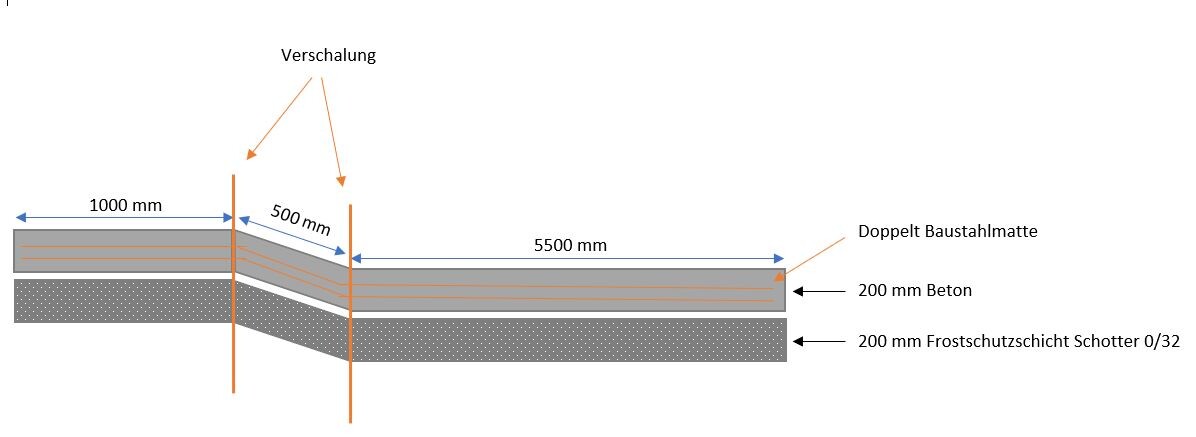
The setup would be 20 mm (0.8 inch) gravel, then a mesh of double-layer steel reinforcement mats. The pool will have two levels connected by a slope.
As shown in the attached sketch, can the slab be divided into these three sections and poured separately, or would that be ineffective and not durable in the long term?
The connecting reinforcement would be in place for the individual sections.
I’m looking forward to your knowledge and feedback.
Thank you very much.
We are currently planning our outdoor area and would like to build a pool ourselves. The pool will be constructed from 17.5 cm (7 inch) concrete formwork blocks and will be fully embedded in the ground on two sides, while about two-thirds of it will extend above ground on the other two sides.
We have put together a cost estimate and are now looking to cut expenses where possible.
One major cost item is the concrete slab. Originally, a concrete truck with a pump was budgeted, but this is one of the largest expenses in the plan, so we would like to pour the slab ourselves.
We definitely have the necessary skills and sufficient physical strength.
The pool will measure 7 x 4 meters (23 x 13 feet), and with a 20 cm (8 inch) thick slab, about 5.6 cubic meters (about 7.3 cubic yards) of concrete will need to be poured.
That is quite a lot of concrete to mix and work by hand with a concrete mixer.
Therefore, our question is whether the slab can be poured in sections.
The setup would be 20 mm (0.8 inch) gravel, then a mesh of double-layer steel reinforcement mats. The pool will have two levels connected by a slope.
As shown in the attached sketch, can the slab be divided into these three sections and poured separately, or would that be ineffective and not durable in the long term?
The connecting reinforcement would be in place for the individual sections.
I’m looking forward to your knowledge and feedback.
Thank you very much.

Why don’t you simply make a sloped, continuous slab foundation?
https://www.instagram.com/11antgmxde/
https://www.linkedin.com/company/bauen-jetzt/
https://www.instagram.com/11antgmxde/
https://www.linkedin.com/company/bauen-jetzt/
I’d say you probably save at most a small three-digit amount.
With a 160-liter (42-gallon) stationary mixer, you basically won’t finish.
Here, concrete with aggregate 0-16 costs about 130 euros per cubic meter, plus around 250 euros per hour for the pump. So all in, for 6 cubic meters, you’re looking at less than 1,500 euros. Just calculate the material costs: a pallet of cement usually costs around 200 euros, but depending on transport, it can quickly go up to 300 euros.
With a 160-liter (42-gallon) stationary mixer, you basically won’t finish.
Here, concrete with aggregate 0-16 costs about 130 euros per cubic meter, plus around 250 euros per hour for the pump. So all in, for 6 cubic meters, you’re looking at less than 1,500 euros. Just calculate the material costs: a pallet of cement usually costs around 200 euros, but depending on transport, it can quickly go up to 300 euros.

You are not building a pool but a swimming pond. A natural pool has a regeneration zone mainly for aesthetic reasons.
Due to the concept, you do not install much technical equipment. This balances the cost again. The water should not be heated above 23°C (73°F).
Please keep us updated. With pictures.
We also considered it for a while but then switched to a conventional pool for several reasons.
Due to the concept, you do not install much technical equipment. This balances the cost again. The water should not be heated above 23°C (73°F).
Please keep us updated. With pictures.
We also considered it for a while but then switched to a conventional pool for several reasons.
@11ant
The plan was to avoid a continuous slope so that the concrete can be poured in separate sections AND so that when you enter from the top onto the masonry stairs, there is a small "landing" to stand on before it slopes down.
@Domski
I have now requested quotes from four different suppliers, so I will see exactly how much this will cost me. Then I can compare that to the cost of doing it myself with labor. I will report back.
@rick2018
Not entirely correct. The regeneration zone is not for aesthetics. After passing through a coarse filter, the water is directed into this zone and then cleaned of fine particles through the plant filter and gravel before being returned to the swimming area. The water is artificially heated only in spring and autumn to start the swimming season earlier and keep it longer, because anything below 23 degrees Celsius (73°F) is no fun… at least for us.
In midsummer, the water quickly rises to 30 degrees Celsius (86°F), but that is no problem either. The plants adapt perfectly to the cycle. The only mistake would be planting species that contribute to algae growth… here, only a handful of grasses are suitable for this. By recirculating the water through a filter back into the swimming area, all suspended particles released by the plants are filtered out.
But back to the original question
How can I pour the concrete slab in those specific sections, and what should I pay attention to?
The plan was to avoid a continuous slope so that the concrete can be poured in separate sections AND so that when you enter from the top onto the masonry stairs, there is a small "landing" to stand on before it slopes down.
@Domski
I have now requested quotes from four different suppliers, so I will see exactly how much this will cost me. Then I can compare that to the cost of doing it myself with labor. I will report back.
@rick2018
Not entirely correct. The regeneration zone is not for aesthetics. After passing through a coarse filter, the water is directed into this zone and then cleaned of fine particles through the plant filter and gravel before being returned to the swimming area. The water is artificially heated only in spring and autumn to start the swimming season earlier and keep it longer, because anything below 23 degrees Celsius (73°F) is no fun… at least for us.
In midsummer, the water quickly rises to 30 degrees Celsius (86°F), but that is no problem either. The plants adapt perfectly to the cycle. The only mistake would be planting species that contribute to algae growth… here, only a handful of grasses are suitable for this. By recirculating the water through a filter back into the swimming area, all suspended particles released by the plants are filtered out.
But back to the original question
How can I pour the concrete slab in those specific sections, and what should I pay attention to?
In a natural pool, the regeneration zone is mainly for aesthetics since a filtration system with a biological stage (not the regeneration zone) is used.
I had mentioned that you are building a swimming pond (with mechanical coarse filtration).
There are various degrees of technological use and resulting ratios between the swimming area and regeneration zone for swimming ponds up to natural pools.
Please read carefully.
The company you mentioned doesn’t even have reference images.
I suspect you have little to no experience with pool or pond construction. Just the statement that all suspended solids are filtered out... You are probably relying solely on the pond builder’s claims. Definitions are often misused as well.
A bow screen is a coarse filter. For a natural pool, drum filters or (endless) belt filters are used, similar to koi ponds. The filtration is much finer.
Your system can work. However, don’t expect perfectly clear water once there is any movement.
For example, koi ponds are designed with a turnover of the entire pond volume once per hour. Even there, you still have suspended solids (even without fish), despite much finer filtration and higher flow rates.
Regarding the concrete work, you have already received answers. Doing the mixing yourself probably won’t be cost-effective. You might save a low three-digit amount.
If you do it yourself, it should be possible in one day.
Simply strip the formwork and install the connecting reinforcement.
I had mentioned that you are building a swimming pond (with mechanical coarse filtration).
There are various degrees of technological use and resulting ratios between the swimming area and regeneration zone for swimming ponds up to natural pools.
Please read carefully.
The company you mentioned doesn’t even have reference images.
I suspect you have little to no experience with pool or pond construction. Just the statement that all suspended solids are filtered out... You are probably relying solely on the pond builder’s claims. Definitions are often misused as well.
A bow screen is a coarse filter. For a natural pool, drum filters or (endless) belt filters are used, similar to koi ponds. The filtration is much finer.
Your system can work. However, don’t expect perfectly clear water once there is any movement.
For example, koi ponds are designed with a turnover of the entire pond volume once per hour. Even there, you still have suspended solids (even without fish), despite much finer filtration and higher flow rates.
Regarding the concrete work, you have already received answers. Doing the mixing yourself probably won’t be cost-effective. You might save a low three-digit amount.
If you do it yourself, it should be possible in one day.
Simply strip the formwork and install the connecting reinforcement.
N
nordanney12 Apr 2020 11:48abc12345 schrieb:
I have now requested quotes from four different suppliers to see exactly how much the whole project would cost me, and then I can compare that to the cost of doing it with labor. I will report back. Tip: transport the concrete to the construction site without a pump. Rent a small motorized dumper and accept a somewhat longer waiting time for the concrete mixer. I did this a few years ago. With two people, the base slab for a steel wall pool was finished in 1.5 hours.
Similar topics