
ᐅ Location of Combustion Appliances / LED Spotlights / LED Panels
Created on: 4 Aug 2022 19:45
R
RemusLazar
Hello everyone,
we are building a single-family house, and the ceiling on the upper floor is currently being worked on. Now we need to decide on the exact positions of the light fixtures, i.e., spots or panels, as well as the cutouts, etc.
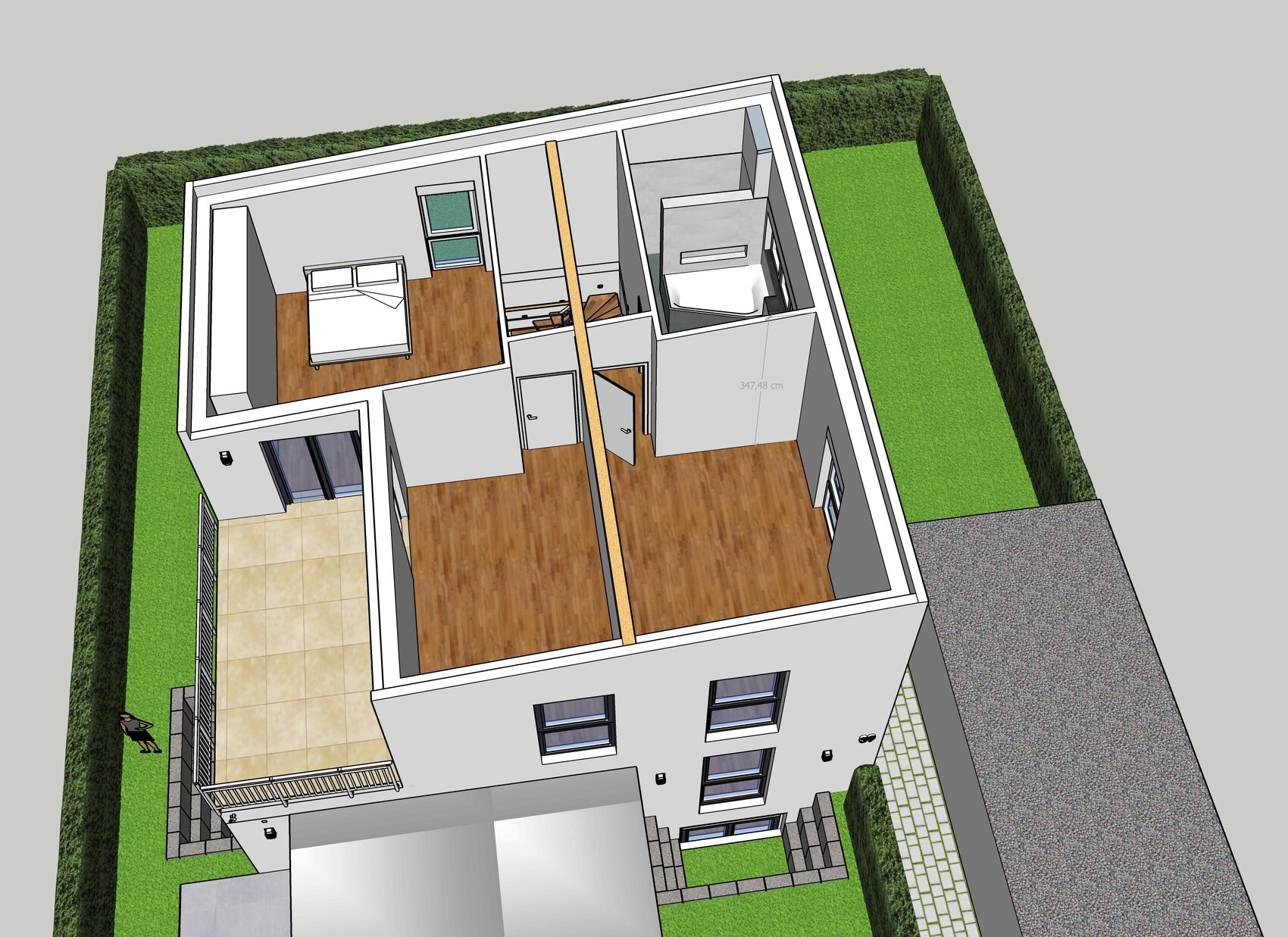
Here is the current plan: the bedroom is at the top left, with two children's rooms below. I’m also attaching a perspective image to give an idea of how the rooms look. Due to the 6-degree pitch of the roof, the room height is quite high, especially in the bathroom and hallway.
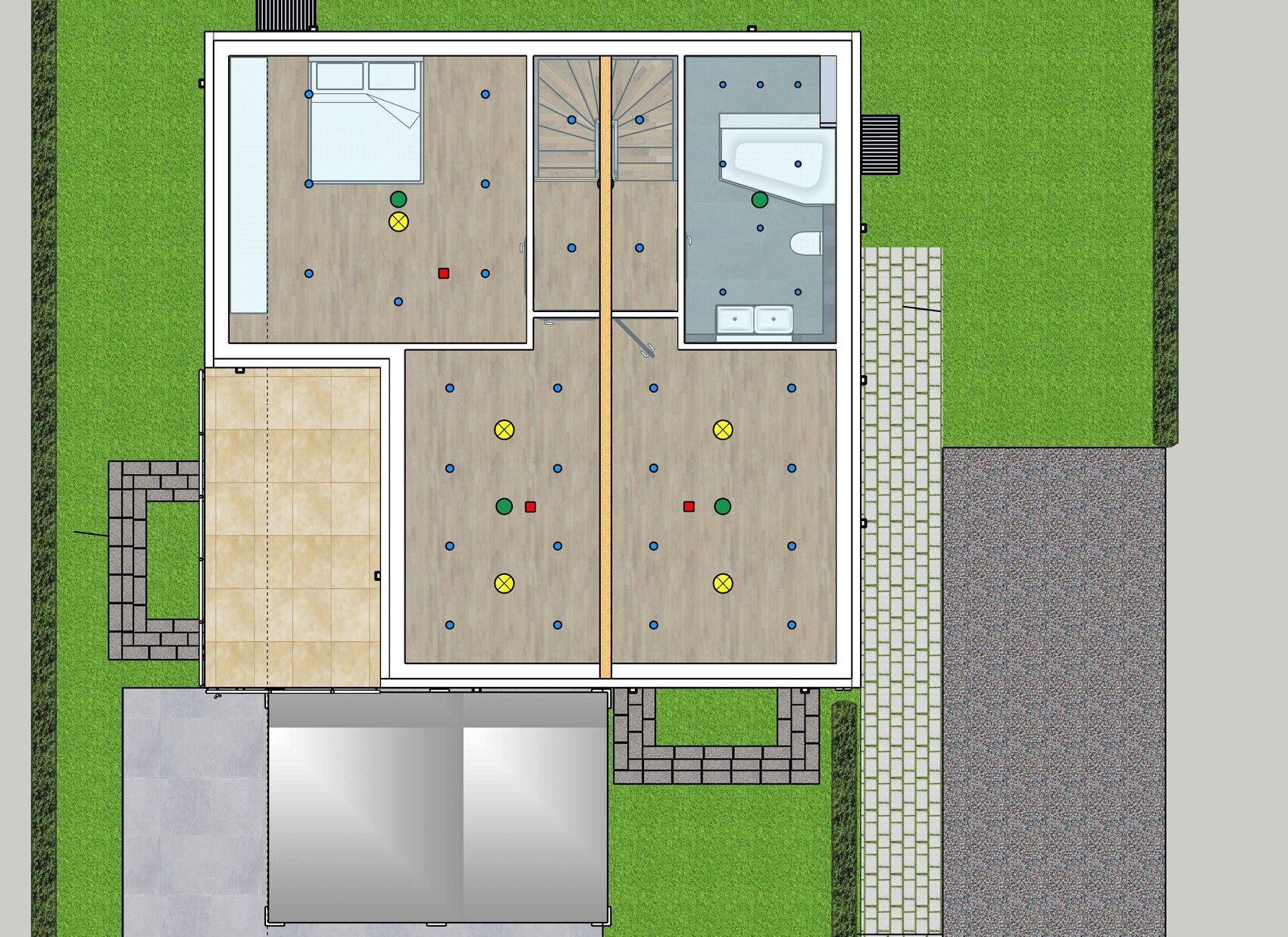
Currently, I have planned many smaller spots (6cm (2.4 inches) diameter) that can be tilted or rotated up to 30 degrees. In the bedroom, there is also an additional surface-mounted lamp (yellow circle), for example, a chandelier.
The ceiling will consist of a 30mm (1.2 inches) layer of boards with 12mm (0.5 inches) drywall panels on top, resulting in a total depth of only 42mm (1.7 inches).
Now we are unsure whether to proceed with many spots as planned or rather choose smaller or medium-sized LED panels that have a more modern look. I have shortlisted some panels from EVN in sizes 12cm (4.7 inches), 17.2cm (6.8 inches), 22.5cm (8.9 inches), and 28cm (11 inches) diameter, which provide good lighting. Dimmable lights are planned for all rooms. All rooms have been wired in a star topology with 5-core cables (from the distribution box), allowing either DALI control or the creation of up to three separate groups that can be switched independently. The entire lighting system will be operated via KNX.
We are looking for ideas and suggestions. We are considering completely changing the current plan and using panels instead of spots. For example, in the children’s rooms, we might install two 22.5cm (8.9 inches) or 28cm (11 inches) panels at the upper and lower parts of the rooms that can be separately switched and dimmed. One panel in the center would probably not be sufficient to provide good illumination.
We are also uncertain whether to make cutouts now for the panels or just install cable outlets to stay flexible and avoid committing to specific sizes or locations prematurely. The surface-mounted option is also worth considering, especially since the rooms have quite high ceilings.
Thanks in advance!
Best regards,
Remus
we are building a single-family house, and the ceiling on the upper floor is currently being worked on. Now we need to decide on the exact positions of the light fixtures, i.e., spots or panels, as well as the cutouts, etc.
Here is the current plan: the bedroom is at the top left, with two children's rooms below. I’m also attaching a perspective image to give an idea of how the rooms look. Due to the 6-degree pitch of the roof, the room height is quite high, especially in the bathroom and hallway.
Currently, I have planned many smaller spots (6cm (2.4 inches) diameter) that can be tilted or rotated up to 30 degrees. In the bedroom, there is also an additional surface-mounted lamp (yellow circle), for example, a chandelier.
The ceiling will consist of a 30mm (1.2 inches) layer of boards with 12mm (0.5 inches) drywall panels on top, resulting in a total depth of only 42mm (1.7 inches).
Now we are unsure whether to proceed with many spots as planned or rather choose smaller or medium-sized LED panels that have a more modern look. I have shortlisted some panels from EVN in sizes 12cm (4.7 inches), 17.2cm (6.8 inches), 22.5cm (8.9 inches), and 28cm (11 inches) diameter, which provide good lighting. Dimmable lights are planned for all rooms. All rooms have been wired in a star topology with 5-core cables (from the distribution box), allowing either DALI control or the creation of up to three separate groups that can be switched independently. The entire lighting system will be operated via KNX.
We are looking for ideas and suggestions. We are considering completely changing the current plan and using panels instead of spots. For example, in the children’s rooms, we might install two 22.5cm (8.9 inches) or 28cm (11 inches) panels at the upper and lower parts of the rooms that can be separately switched and dimmed. One panel in the center would probably not be sufficient to provide good illumination.
We are also uncertain whether to make cutouts now for the panels or just install cable outlets to stay flexible and avoid committing to specific sizes or locations prematurely. The surface-mounted option is also worth considering, especially since the rooms have quite high ceilings.
Thanks in advance!
Best regards,
Remus
RemusLazar schrieb:
Do you have any ideas where to position the heating spots in the bedroom?LED strips under the bed. It’s quite convenient if you need to get up at night or early in the morning, as you can light the "path" without turning on the main lights 🙂
RemusLazar schrieb:
We’re also unsure in the bedroom whether to install a nice chandelier and then add a floor lamp or something similar for additional lighting.Use both. First, always have a central ceiling light to properly illuminate the room. Then, add indirect lighting for a cozy atmosphere or so you don’t wake your partner when you need light earlier. This approach is always a safe choice. RemusLazar4 Aug 2022 23:07
Tassimat schrieb:
Both. First of all, just a ceiling light in the center of the room that illuminates the space nicely. Additionally, indirect lighting for a cozy atmosphere or so you don’t wake your partner directly if you need light early in the morning. You can’t go wrong with that at first.Yes, that’s what we thought too. I believe more than one ceiling light in the room would be too much anyway.
For the ceiling light, I was also thinking of something with tunable white, so in the morning you have a cool light color (4000-5000 K) that really energizes you, and in the evening it shifts to around 2700 K or less for a cozy atmosphere. Since we are using smart home with KNX and DALI, all of this can be easily retrofitted.
In the bathroom, the same concept applies: use cool light (daylight white) in the morning to help wake up properly, especially in winter, and then in the evening move to around 2300 K or so.
RemusLazar4 Aug 2022 23:10sysrun80 schrieb:
LED strips under the bed. It’s quite convenient when you need to get up at night or early in the morning and can illuminate the "path" without having to turn on the main lighting 🙂That’s exactly what I have planned! I’ve specifically included a cable outlet with DALI control under the bed, so you can also use an RGB LED strip there, which is centrally controlled – I want to work a lot with scenes. Also, there is a switched socket at the top of the wardrobe, so the wardrobe light can be integrated into the central control system as well.
T
Traufgänger4 Aug 2022 23:16A 68mm (2.7 inches) hole is the standard size, so with a 42mm (1.7 inches) hole, you generally can't install recessed spotlights with reflectors. The type of spotlight is important for the lighting effect in the room. Surface-mounted panels provide different lighting and are also less commonly available in 2700K. Send me the room dimensions and ceiling heights, and I can model something in Relux for you.
RemusLazar4 Aug 2022 23:20Traufgänger schrieb:
A 68mm (2.7 inches) hole is standard, so with 42mm (1.7 inches) you usually can’t install a recessed downlight with a reflector. The type of light fixture is of course important for the lighting effect in the room. Surface-mounted panels create different light and are also less common in 2700K. Send me the room dimensions and ceiling heights, and I can set something up in Relux.Thanks a lot already! As a Mac user, I wasn’t able to do this myself..
Similar topics