
ᐅ Looking for Poroton blocks suitable for sound insulation requirements
Created on: 23 Nov 2019 13:32
L
lucciano-sL
lucciano-s23 Nov 2019 13:32Hello everyone,
I’m a bit unsure and need your help regarding Poroton blocks, especially concerning sound insulation.
I am planning to build a single-family house (town villa, 10 x 10 m (33 x 33 ft)) including a basement.
The construction will use 36.5 cm (14.4 inches) unfilled Poroton blocks without additional insulation.
Unfortunately, there are noise protection requirements in the development plan because we are located in noise level zone 4 (66-70 dB).
The wall requirements therefore specify at least 40 dB sound insulation.
Which block would you recommend to achieve the best balance between thermal conductivity, strength/density, and sound insulation?
Example for 2 manufacturers:
For the S7 and S9, I can’t find any sound data at all. How is this usually handled?
I would really appreciate if someone could help me out here. Thanks!
I’m a bit unsure and need your help regarding Poroton blocks, especially concerning sound insulation.
I am planning to build a single-family house (town villa, 10 x 10 m (33 x 33 ft)) including a basement.
The construction will use 36.5 cm (14.4 inches) unfilled Poroton blocks without additional insulation.
Unfortunately, there are noise protection requirements in the development plan because we are located in noise level zone 4 (66-70 dB).
The wall requirements therefore specify at least 40 dB sound insulation.
Which block would you recommend to achieve the best balance between thermal conductivity, strength/density, and sound insulation?
Example for 2 manufacturers:
- Wienerberger T8 unfilled; 0.08 W/mK thermal conductivity; strength class 6; 41.6 dB sound rating
- Thermoplan S7 unfilled; 0.075 W/mK thermal conductivity; strength class 6; NO DATA
- ThermoPlan TS11 unfilled; 0.11 W/mK thermal conductivity; 49.5 dB
For the S7 and S9, I can’t find any sound data at all. How is this usually handled?
I would really appreciate if someone could help me out here. Thanks!

I wouldn’t choose an unfilled one either.
Is the 40 dB value for the walls explicitly stated like that?
Or does it mean that the noise level inside the rooms should not exceed that value?
If you need to prove this by calculation, it gets a bit more complicated since many factors come into play.
In reality, go for a filled insulation and check for good values on the windows, as Bookstar mentioned.
Also, use a controlled residential ventilation system. The best block won’t help if you open the windows at night to sleep.
By the way, we decided on the MZ70 Bellenberg.
Is the 40 dB value for the walls explicitly stated like that?
Or does it mean that the noise level inside the rooms should not exceed that value?
If you need to prove this by calculation, it gets a bit more complicated since many factors come into play.
In reality, go for a filled insulation and check for good values on the windows, as Bookstar mentioned.
Also, use a controlled residential ventilation system. The best block won’t help if you open the windows at night to sleep.
By the way, we decided on the MZ70 Bellenberg.
L
lucciano-s24 Nov 2019 22:26Hello, thank you for your feedback. The 40 dB value can be found in DIN 4109. What does controlled residential ventilation mean?
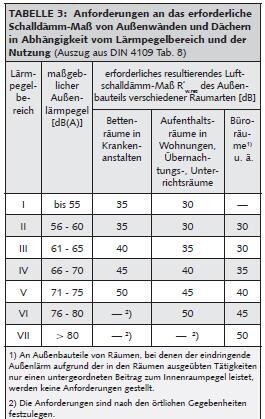
lucciano-s schrieb:
Hello, thank you for your feedback. The 40 dB value can be found in DIN 4109. What does controlled residential ventilation mean?Controlled residential ventilation.Controlled residential ventilation = controlled residential ventilation
Yes, I am familiar with the table. What does the building authority require? A verification?
I have already had different experiences with this, both personally and with an acquaintance (different location, different building authority). We had to have a calculated verification prepared. An engineering firm handled it, and it was more complex than just the sound insulation rating of the wall. It involved windows, roof structure, room height, ratio of exterior wall to room size, and so on. For my acquaintance, it was a self-prepared A4 sheet with three data points including the technical datasheet of the brick manufacturer.
Yes, I am familiar with the table. What does the building authority require? A verification?
I have already had different experiences with this, both personally and with an acquaintance (different location, different building authority). We had to have a calculated verification prepared. An engineering firm handled it, and it was more complex than just the sound insulation rating of the wall. It involved windows, roof structure, room height, ratio of exterior wall to room size, and so on. For my acquaintance, it was a self-prepared A4 sheet with three data points including the technical datasheet of the brick manufacturer.
Similar topics