
Hello everyone,
We have the opportunity to start a house construction project soon, and as complete beginners, we are not entirely sure about the most sensible next steps.
Background:
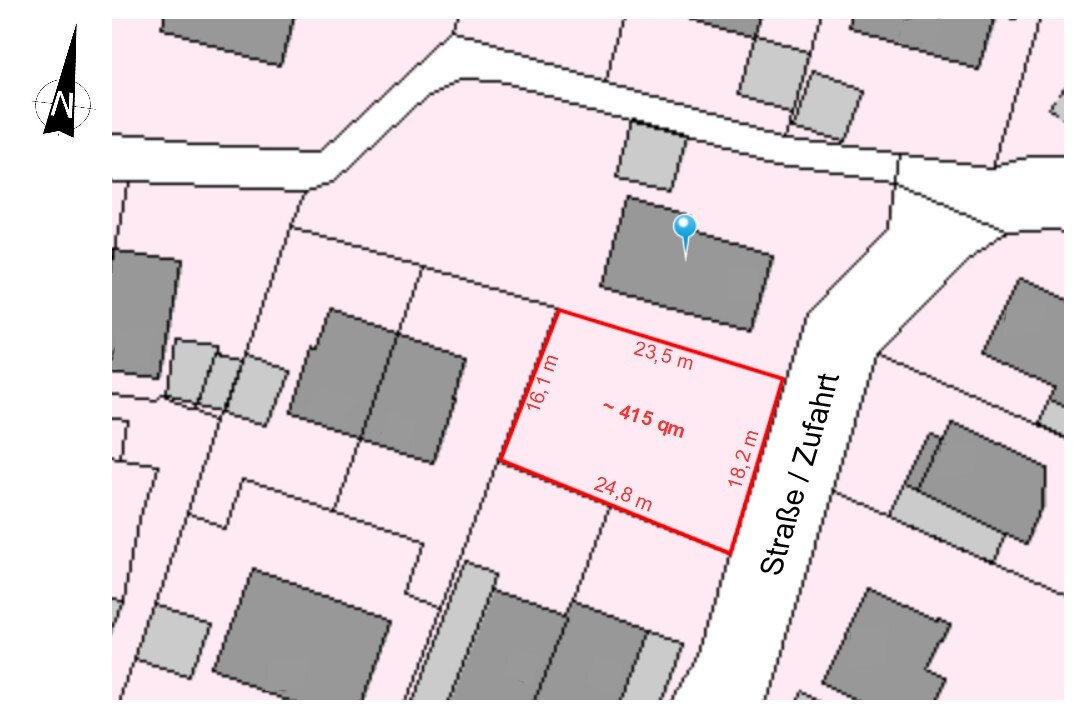
My parents have offered to provide us (my wife and me) with the plot of land shown below to build a single-family house.
Currently, we live in a cozy older apartment. Children are planned in the foreseeable future, so a single-family house with a small garden and proximity to my parents would be ideal.
Development plan / restrictions:
Plot size: 415 sqm (approximately 4465 sq ft), details below
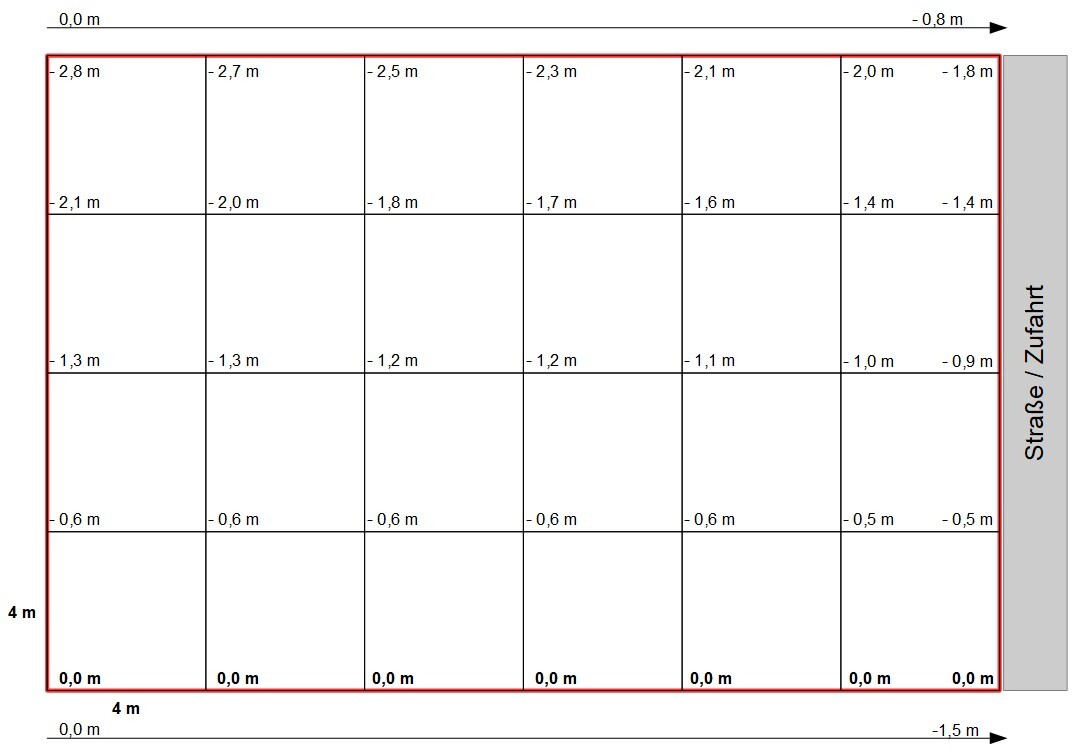
Slope: yes, north-facing slope, details below
Old building area, no formal development plan / §34 Federal Building Code, in the neighborhood there is a mix of buildings (e.g., 1-3 stories, monopitch roof, flat roof, gabled roof)
Homeowners’ requirements:
Style, roof shape, building type: simple building form, clear structure, roof shape e.g. shallow gabled roof
Basement, floors: with or without basement (see question below), in any case 2 full stories
Number of occupants: 2 adults (28, 27), no children yet, 2 children’s rooms planned
Space requirements: optimized for family life, e.g., we particularly like this design from the forum: https://www.hausbau-forum.de/threads/grundriss-efh-140-qm-mit-keller.18255/
Office: 1 person home office
Overnight guests per year: few to none
Open or closed architecture: mix
Conservative or modern design: the house should ideally fit into the slope; otherwise, we are flexible
Number of dining seats: 6-8
Fireplace: not essential
Music/stereo wall: no
Balcony, roof terrace: wooden terrace in the garden (we like to be outside), possibly a roof terrace for the view
Garage, carport: 2 vehicle parking spaces, indoors or outdoors / carport
Vegetable garden, greenhouse: no vegetable garden
Here are our questions:
1) Do you consider the plot generally suitable to build a single-family house roughly as described above?
What kind of budget would you estimate for this (“standard quality”)?
2) The slope and side access are somewhat challenging. Where would you place the building area and main house entrance?
3) Does the slope necessarily argue for a basement / partially underground basement, or would you recommend leveling the site and building on a slab foundation without a basement?
4) Friends of ours recently built a solid wood house, which we like very much.
Is it possible to build a solid wood house on a concrete basement? Are there construction materials or wall systems you would especially recommend for a sloping site?
5) What is the best approach to start this project? In our opinion, the result will only be really good if the house is ideally integrated into the relatively small plot and slope. Therefore, we would now look for an independent architect and have them design freely based on the rough framework given above.
The general contractor’s planner or prefabricated house manufacturer is, in our view, only partly suitable because they tend to adapt their house types to the customer or plot, which does not necessarily lead to an optimal result. What do you think?
Many thanks and regards!
Andy
We have the opportunity to start a house construction project soon, and as complete beginners, we are not entirely sure about the most sensible next steps.
Background:
My parents have offered to provide us (my wife and me) with the plot of land shown below to build a single-family house.
Currently, we live in a cozy older apartment. Children are planned in the foreseeable future, so a single-family house with a small garden and proximity to my parents would be ideal.
Development plan / restrictions:
Plot size: 415 sqm (approximately 4465 sq ft), details below
Slope: yes, north-facing slope, details below
Old building area, no formal development plan / §34 Federal Building Code, in the neighborhood there is a mix of buildings (e.g., 1-3 stories, monopitch roof, flat roof, gabled roof)
Homeowners’ requirements:
Style, roof shape, building type: simple building form, clear structure, roof shape e.g. shallow gabled roof
Basement, floors: with or without basement (see question below), in any case 2 full stories
Number of occupants: 2 adults (28, 27), no children yet, 2 children’s rooms planned
Space requirements: optimized for family life, e.g., we particularly like this design from the forum: https://www.hausbau-forum.de/threads/grundriss-efh-140-qm-mit-keller.18255/
Office: 1 person home office
Overnight guests per year: few to none
Open or closed architecture: mix
Conservative or modern design: the house should ideally fit into the slope; otherwise, we are flexible
Number of dining seats: 6-8
Fireplace: not essential
Music/stereo wall: no
Balcony, roof terrace: wooden terrace in the garden (we like to be outside), possibly a roof terrace for the view
Garage, carport: 2 vehicle parking spaces, indoors or outdoors / carport
Vegetable garden, greenhouse: no vegetable garden
Here are our questions:
1) Do you consider the plot generally suitable to build a single-family house roughly as described above?
What kind of budget would you estimate for this (“standard quality”)?
2) The slope and side access are somewhat challenging. Where would you place the building area and main house entrance?
3) Does the slope necessarily argue for a basement / partially underground basement, or would you recommend leveling the site and building on a slab foundation without a basement?
4) Friends of ours recently built a solid wood house, which we like very much.
Is it possible to build a solid wood house on a concrete basement? Are there construction materials or wall systems you would especially recommend for a sloping site?
5) What is the best approach to start this project? In our opinion, the result will only be really good if the house is ideally integrated into the relatively small plot and slope. Therefore, we would now look for an independent architect and have them design freely based on the rough framework given above.
The general contractor’s planner or prefabricated house manufacturer is, in our view, only partly suitable because they tend to adapt their house types to the customer or plot, which does not necessarily lead to an optimal result. What do you think?
Many thanks and regards!
Andy
The neighboring buildings provide examples of harmonious design solutions. Ultimately, the main issue is how the building line is integrated and whether a basement is desired as a result. I do not see any particular challenges for the planning process, as long as all owners agree.

icandoit schrieb:
@11ant The plots below will probably be accessed from the lower side. No helicopter access.I also suspect that for the lower left on the plan (a typical case of fullscreen zoom on one’s own plot with as little surrounding area as possible – the questioners never seem to realize that the context is what really matters), but the plot on the left side of the plan remains an enclosed lot and must be accessed indirectly from somewhere.https://www.instagram.com/11antgmxde/
https://www.linkedin.com/company/bauen-jetzt/
11ant schrieb:
but the plot on the left side remains landlocked and must be indirectly accessed from somewhere else. The original poster cannot know that. According to their statement, all plots have access, and no right of way over their property is needed.
Perhaps the Google Maps view I would like to share would show something. But that would be too much effort to post here.
@11ant:
Thank you for your clarification regarding the concept of a "preliminary design."
In fact, with our house building project, we are not aiming for a dissertation, nor is our house meant to win any "best design" awards in lifestyle magazines.
We want a "normal" house with a proven room layout/floor plan that has already been implemented many times, suitable for an average family of four.
@parcus:
OK, once the right architect is found, the plan is to initially commission design phases 1 to 4 as a single "package."
Of course, with the further goal that the architect will cover all phases later on, but that would require a separate contract.
Is that correct? Is there anything specific to consider when commissioning phases 1 to 4?
For example, are there any applicable construction cost limits or minimum/maximum fee rates?
My research suggests that the architect’s fees are typically calculated at about 10% to 15% of the eligible construction costs. Is that accurate?
@icandoit:
The arrows above and below indicate that the plot slopes not only from south to north (see the values in the boxes) but also slightly from west to east.
The land drops about 1.5m (5 feet) from southwest to southeast and 0.8m (2.6 feet) from northwest to northeast.
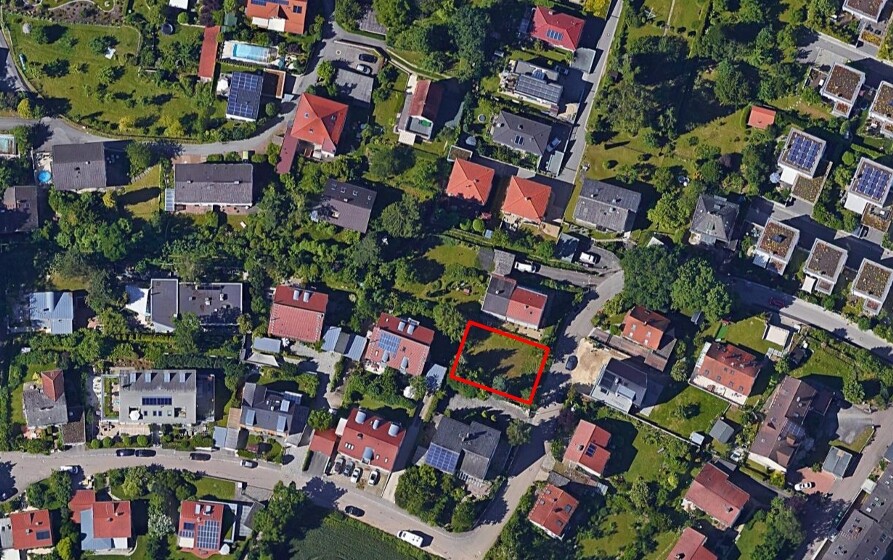
My parents’ western plot (around 470 sqm (5,059 sq ft)) would basically also be a possible option for our construction.
However, it is currently their usable and recreational garden, so they "live" in their west garden, which is nicely terraced on two levels.
Additionally, the southern plot would be easier to separate and design with its own access road.
A Google Maps image is attached.
Andy
Thank you for your clarification regarding the concept of a "preliminary design."
In fact, with our house building project, we are not aiming for a dissertation, nor is our house meant to win any "best design" awards in lifestyle magazines.
We want a "normal" house with a proven room layout/floor plan that has already been implemented many times, suitable for an average family of four.
@parcus:
OK, once the right architect is found, the plan is to initially commission design phases 1 to 4 as a single "package."
Of course, with the further goal that the architect will cover all phases later on, but that would require a separate contract.
Is that correct? Is there anything specific to consider when commissioning phases 1 to 4?
For example, are there any applicable construction cost limits or minimum/maximum fee rates?
My research suggests that the architect’s fees are typically calculated at about 10% to 15% of the eligible construction costs. Is that accurate?
@icandoit:
The arrows above and below indicate that the plot slopes not only from south to north (see the values in the boxes) but also slightly from west to east.
The land drops about 1.5m (5 feet) from southwest to southeast and 0.8m (2.6 feet) from northwest to northeast.
My parents’ western plot (around 470 sqm (5,059 sq ft)) would basically also be a possible option for our construction.
However, it is currently their usable and recreational garden, so they "live" in their west garden, which is nicely terraced on two levels.
Additionally, the southern plot would be easier to separate and design with its own access road.
A Google Maps image is attached.
Andy
AndyM92 schrieb:
@icandoit:
The arrows at the top and bottom indicate that the plot not only slopes from south to north (see the values in the boxes) but also slightly from west to east.
From southwest to southeast, the plot slopes down by 1.5 m (5 feet), and from northwest to northeast by 0.8 m (2.6 feet).
The western plot (about 470 sqm (5,060 sq ft)) owned by my parents would basically also be an option for us to build on.
However, it is currently their utility and living garden, so they "live" in the west garden, which is nicely terraced (2 levels).
The southern plot would also be better to separate and easier to design with its own access road.
A Google Maps image is attached.
Andy Thanks. But with that slope, you would shade your parents’ house. In winter, they would hardly get any sun.
If the plot is going to be sold anyway, of course, that’s not an issue anymore. 😉
@11ant In the picture, you can see that the access roads to the eastern Heli plots come from the south.
As far as I know, the HOAI is no longer legally binding for single-family house construction.
But the construction boom has its consequences. Prices, including those for architects, are rising.
Phases 1 to 4 of service are not a bad idea. After that, you can have a general contractor build. They will then create the working drawings with a draftsman. For a standard house, that always works. But building on a slope is rarely an easy project.
@AndyM92
I would always recommend commissioning design phases 1-4 together for legal certainty. All other phases can be ordered as needed. Construction management without detailed execution planning is almost pointless.
I can’t speak for other firms, but in our case, we first gather the client’s ideas, know the budget framework, and then an internal “competition” takes place. After that, we come together to see which design best matches the client’s expectations or if we combine several good design concepts into one.
There are online calculators for fees, but generally, I tell clients to expect about 10-15% in additional costs.
Of course, I always try to secure the €4,000 (about $4,400) KfW subsidy for the client. Our scope always includes the thermal insulation certificate, although this is often provided by the structural engineer rather than the architect.
Every firm will offer some form of bonus. The firm should definitely have references that can be visited.
In fact, we rarely accept designs that have been previously discussed in forums or found online, because the consulting effort required afterwards is usually too high for us.
I would always recommend commissioning design phases 1-4 together for legal certainty. All other phases can be ordered as needed. Construction management without detailed execution planning is almost pointless.
I can’t speak for other firms, but in our case, we first gather the client’s ideas, know the budget framework, and then an internal “competition” takes place. After that, we come together to see which design best matches the client’s expectations or if we combine several good design concepts into one.
There are online calculators for fees, but generally, I tell clients to expect about 10-15% in additional costs.
Of course, I always try to secure the €4,000 (about $4,400) KfW subsidy for the client. Our scope always includes the thermal insulation certificate, although this is often provided by the structural engineer rather than the architect.
Every firm will offer some form of bonus. The firm should definitely have references that can be visited.
In fact, we rarely accept designs that have been previously discussed in forums or found online, because the consulting effort required afterwards is usually too high for us.
Similar topics