
Hello everyone,
we have now started the first "internal" draft planning and I would be very grateful for any feedback – especially if there are any of our “ideas” that are completely off the mark...
Development Plan / Restrictions:
"Facts"
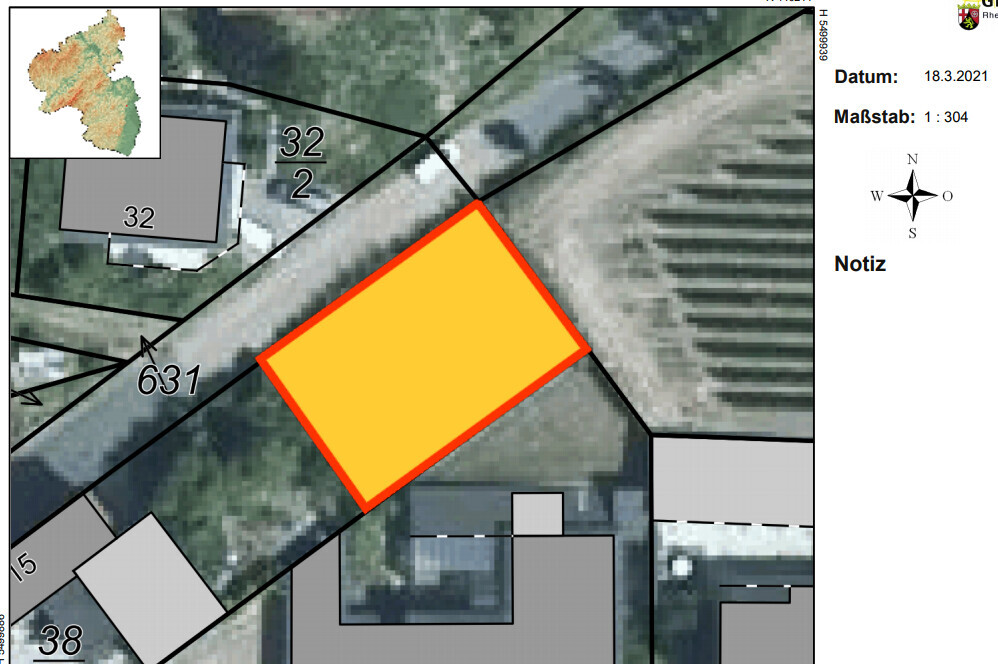
no development plan, last plot at the edge of a village area
Plot size: 330m² (approx. 21.8m x 14.8m / 71.5ft x 48.5ft)
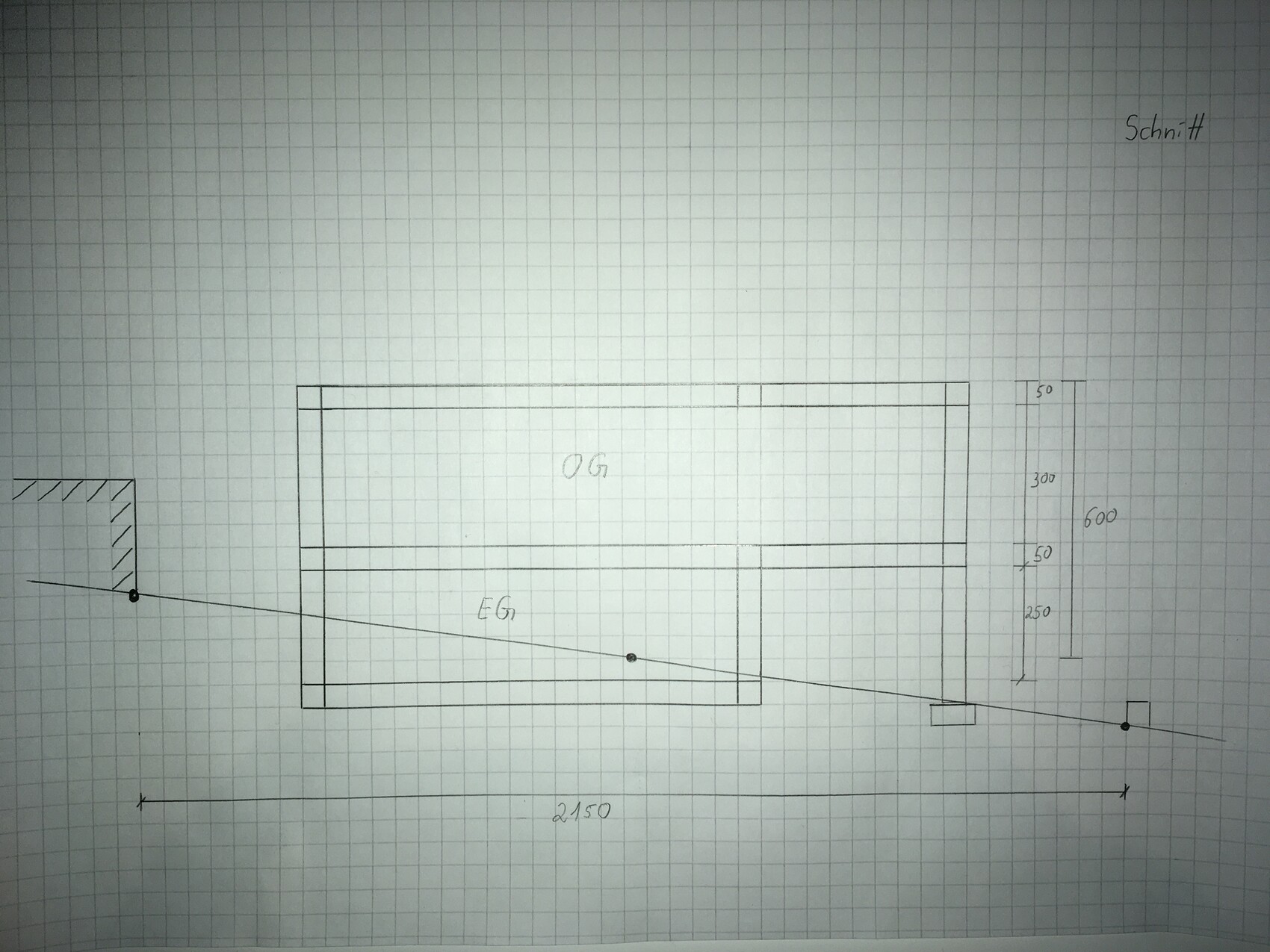
Slope: about 7°
Clay-loam soil, limestone at shallow depth
Information according to building permit inquiry
Site coverage ratio: 0.6
Floor area ratio: 1.2
Street = building line
2 parking spaces
Number of storeys: max. 2 full storeys
Roof style: any
Eaves height 6m (20ft)
Ridge height 10m (33ft)
Client requirements
Style, roof type, building type: flat roof preferred, but e.g., also “modern barn” style
Basement with daylight from the slope as a lower ground floor, above that a “real” storey
2 persons (35, 36 years old)
Space requirement ground floor and upper floor: approx. 200m² (2,150 sq ft) total
Office: 2x home offices
Guest stays per year: none
Open architecture
Modern construction method
Open kitchen with kitchen island: yes
Number of dining seats: 4
Fireplace: no
Garage, carport: not essential, 2 parking spaces sufficient
Utility garden, greenhouse: as little garden as possible
Other wishes: KNX system, air conditioning for main rooms
House design
Designer: do-it-yourself
What do you like most? Why?: main living areas all on one level
What do you dislike? Why?: bathroom and dressing room borderline “small”
Personal budget for the house, including fixtures: approx. 500,000 to max. 700,000 euros
Preferred heating system: we don’t really care
If you had to cut back, on which details or extensions
- Can be omitted: lounge on ground floor, pantry
- Cannot be omitted: guest WC on upper floor, dressing room, minimum clear ceiling height on upper floor 2.70m (better 3m / 9ft 10in)
Why has the design turned out as it is now?, for example:
“Optimizing” the eaves height while maximizing the use of setback distances
Minimize earthworks as much as possible (considering the soil...)
What is the most important/basic question about the floor plan in 130 characters?
Have I completely misjudged any fundamental aspect? Is any detail of the design “absurdly expensive”?
Note 1: Views are just for a general idea of the plot situation at this stage – windows and so on still look pretty rough…
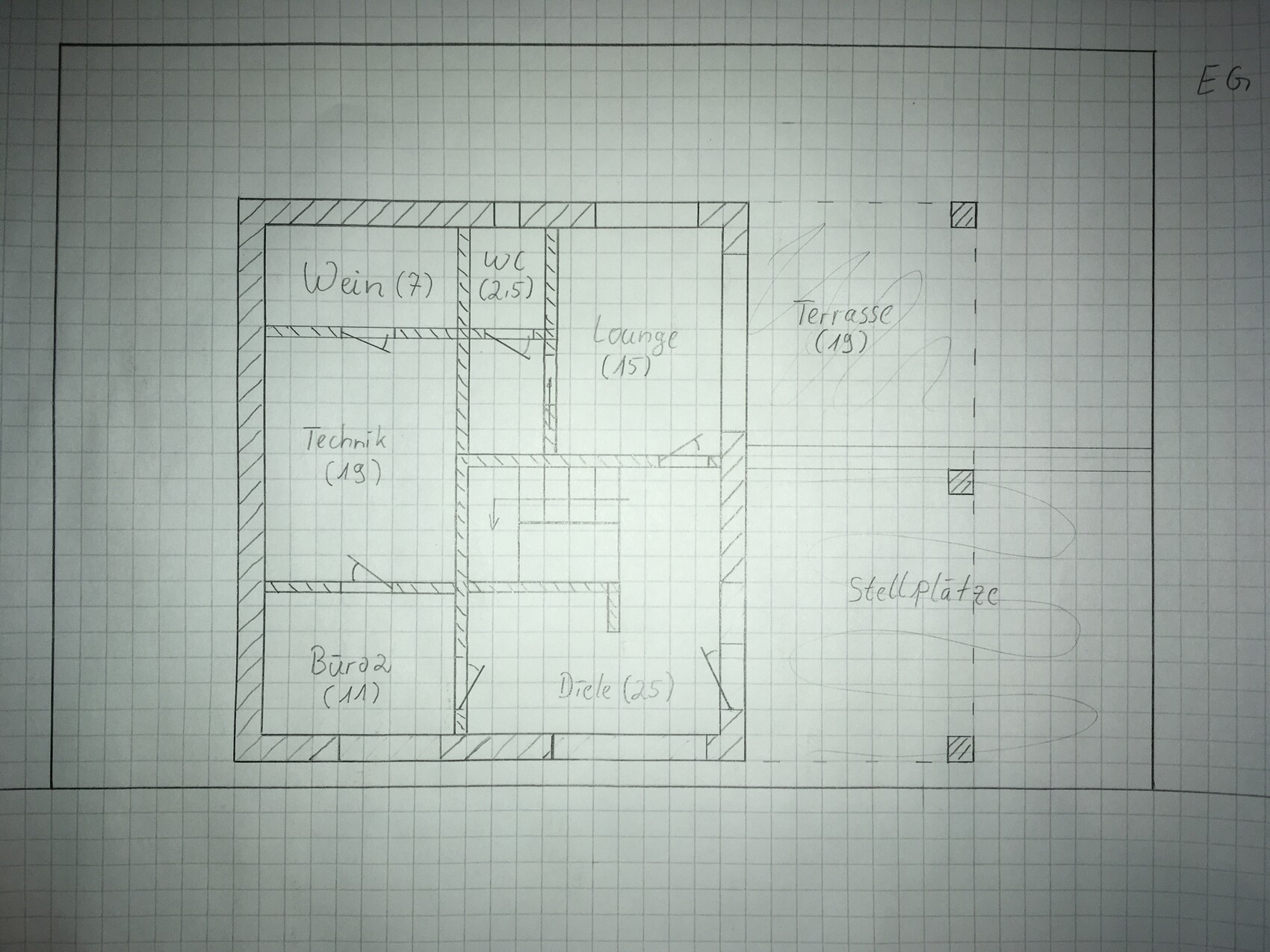
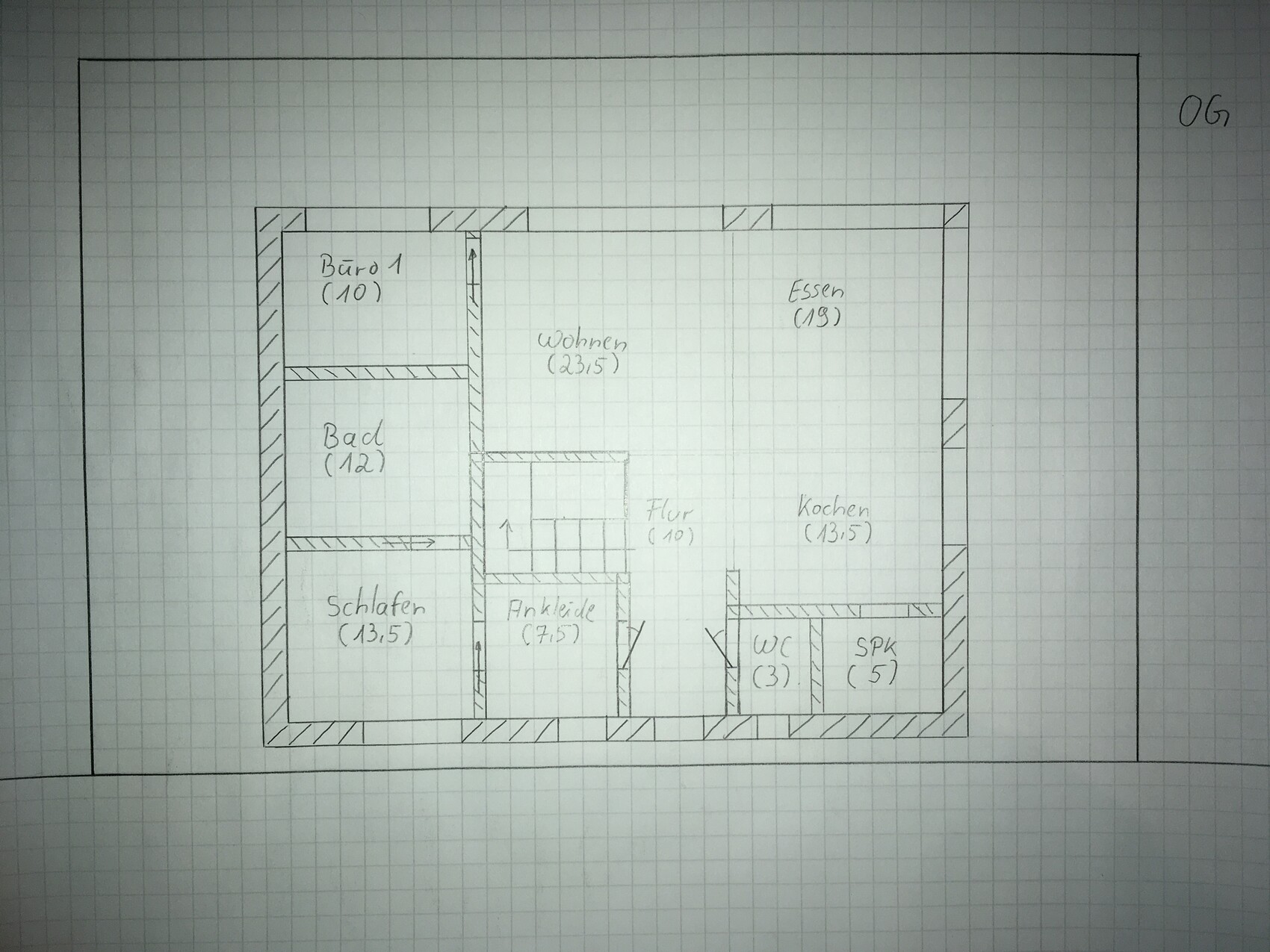
Note 2: Plan is drawn roughly to scale (5mm grid = 50cm / 20 inches), numbers in () are m²; north is bottom left on ground floor and upper floor plans, the beautiful view to the south is top right :-)
Already now: many thanks for all your feedback!!!
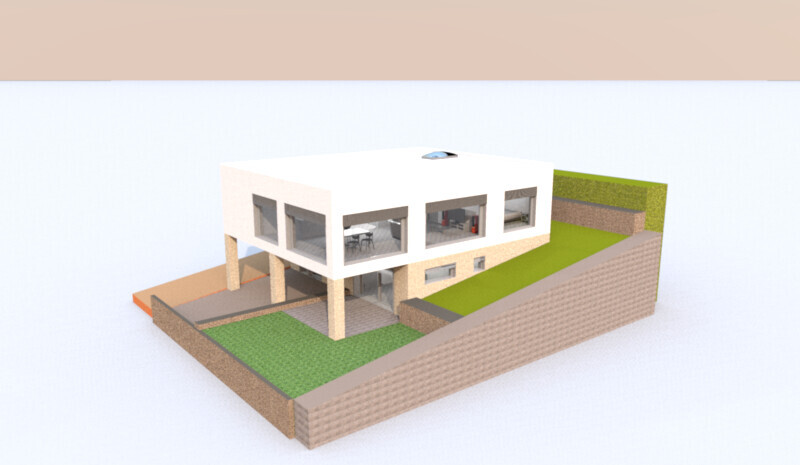
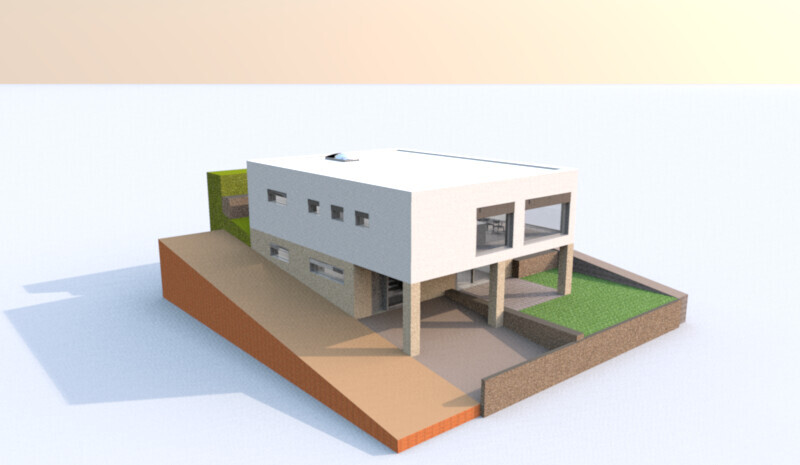
we have now started the first "internal" draft planning and I would be very grateful for any feedback – especially if there are any of our “ideas” that are completely off the mark...
Development Plan / Restrictions:
"Facts"
no development plan, last plot at the edge of a village area
Plot size: 330m² (approx. 21.8m x 14.8m / 71.5ft x 48.5ft)
Slope: about 7°
Clay-loam soil, limestone at shallow depth
Information according to building permit inquiry
Site coverage ratio: 0.6
Floor area ratio: 1.2
Street = building line
2 parking spaces
Number of storeys: max. 2 full storeys
Roof style: any
Eaves height 6m (20ft)
Ridge height 10m (33ft)
Client requirements
Style, roof type, building type: flat roof preferred, but e.g., also “modern barn” style
Basement with daylight from the slope as a lower ground floor, above that a “real” storey
2 persons (35, 36 years old)
Space requirement ground floor and upper floor: approx. 200m² (2,150 sq ft) total
Office: 2x home offices
Guest stays per year: none
Open architecture
Modern construction method
Open kitchen with kitchen island: yes
Number of dining seats: 4
Fireplace: no
Garage, carport: not essential, 2 parking spaces sufficient
Utility garden, greenhouse: as little garden as possible
Other wishes: KNX system, air conditioning for main rooms
House design
Designer: do-it-yourself
What do you like most? Why?: main living areas all on one level
What do you dislike? Why?: bathroom and dressing room borderline “small”
Personal budget for the house, including fixtures: approx. 500,000 to max. 700,000 euros
Preferred heating system: we don’t really care
If you had to cut back, on which details or extensions
- Can be omitted: lounge on ground floor, pantry
- Cannot be omitted: guest WC on upper floor, dressing room, minimum clear ceiling height on upper floor 2.70m (better 3m / 9ft 10in)
Why has the design turned out as it is now?, for example:
“Optimizing” the eaves height while maximizing the use of setback distances
Minimize earthworks as much as possible (considering the soil...)
What is the most important/basic question about the floor plan in 130 characters?
Have I completely misjudged any fundamental aspect? Is any detail of the design “absurdly expensive”?
Note 1: Views are just for a general idea of the plot situation at this stage – windows and so on still look pretty rough…
Note 2: Plan is drawn roughly to scale (5mm grid = 50cm / 20 inches), numbers in () are m²; north is bottom left on ground floor and upper floor plans, the beautiful view to the south is top right :-)
Already now: many thanks for all your feedback!!!
haydee schrieb:
Even in the smallest village, an unusual house is possible.
Avant-garde architecture isn’t just for big cities.But should it be such a block like the OP’s? Bold design can also be harmonious. For example, I would really like an attic floor, since you’re allowed up to 10 m (33 feet) in height. That way you get a nice view over the vineyards to the north and towards the village.
H
hampshire20 Mar 2021 09:42rick2018 schrieb:
200m2 (2150 sq ft) for two people is fine.30m2 (320 sq ft) is also fine. 1500m2 (16,150 sq ft) too. It depends on inclination and resources. It is only not okay if it harms others. I wouldn’t generalize this direct connection.11ant schrieb:
I’d like to cautiously question whether it’s necessary to demonstrate on the village street in Knieritz at the Knatter what is taught as the latest trend at ETH Zurich. Avant-garde only partly belongs in rural areas.That already includes a value judgment. Basically, there is nothing wrong with good architecture. No matter where.icandoit schrieb:
But should it be a blocky shape like the one from the original poster? Bold can also be harmonious.Good architecture can also be polarizing and thought-provoking.I find the design interesting from the outside and can very well imagine that its appearance can work in a conservatively built environment. Whether it is good architecture, I cannot say, because matching it to the residents, their life priorities, habits, and preferences can’t be assessed with the information provided. However, I fear that the engagement with the location and the building itself is more intensive than the engagement with its purpose and actual brief. But good architecture requires this.
The risk that something architecturally at best mediocre will result (unclear brief) definitely exists, and then it really is only “different” and not “excellent.” Good architecture does not have to stand out; it can be very unobtrusive. It’s always a question of the goal and the brief.
hampshire schrieb:
I find the design interesting from the exterior perspective and can well imagine that its appearance works even in a conservatively built environment. Whether it is good architecture, I cannot say, because the fit to the residents, their life priorities, habits, and preferences cannot be assessed with the information provided. However, I fear that the engagement with the location and the building itself is more intense than the engagement with the purpose and actual functional requirements. But this is what good architecture demands. Architecture should reflect what is inside on the outside. Both belong together and are part of what makes good architecture — the style.
And often (actually falsely), meaning rarely, great living spaces are found in good architecture. But not every architectural design suits as a living space. Most houses today can no longer be considered architecture. Simply put, they are just functional buildings. That is not necessarily a problem. Others may live in a house and, even if it is avant-garde, make it feel like home so it fits. Architecture goes beyond what is merely needed. Therefore, I don’t believe (good) architecture must perfectly match its inhabitants. Perhaps one could speak of being a “guest” when one is allowed to live or sleep in good architecture 😉
With a 500,000 to 700,000 budget limit for the desired 200 square meters (2,150 square feet), I also don’t see architecture, but rather functional housing.
Nevertheless, whether provocatively, submissively, or as a symbiosis with the environment, the latter should always be considered. If you want to build extravagantly different, you should ensure you have thought about the surroundings and the intended expression.
A bit of "philosophy" :-)
What I find nice about the village right now is that it has pretty much everything. 300-year-old half-timbered houses, a few mansard roofs, many bungalows from the 1960s in one area, and also very modern houses (for example, a winemaker has a great "glass palace")—not to forget the winemakers’ halls. Overall, it feels much more harmonious to me than almost any new housing development with the typical model home collections. Of course, I understand our budget doesn’t allow for grand architecture, but at least an “interesting” building should be possible. It certainly won’t be a “standard gable roof,” nor a “townhouse gable roof number 5.” This is not a value judgment on those who build and like such houses, but everyone simply has different ideas of what’s beautiful 🙂 (for example, I like brutalist architecture, which many consider “terrible”—including my wife…).
What the whole village has in common is that the plots are all fairly “fully” built-up. So I don’t even feel guilty about building heavily on our plot. Nature starts right at the end of the street in the vineyard, and looking onto the neighbor’s property is not unusual in the village area (and it’s not really conceivable in our condominium in the city either). We consciously chose (!) a small plot that can be built on extensively. Of course, I understand that this is not everyone’s preference. And let’s be honest: a 700m² (8,750 sq ft) plot means you end up looking at your neighbor anyway—just with 4m (13 feet) more lawn ;-). And of course, we have to be realistic (at least we): a plot well over 1500m² (16,150 sq ft) is not available in our region, and if one is on the market, it often costs more than 1 million euros.
So, philosophy over:
I have already considered a “real” upper floor with as high a knee wall as possible, which would have the charm of also enabling a view into the vineyard, possibly with a small southeast-facing terrace.
What I find nice about the village right now is that it has pretty much everything. 300-year-old half-timbered houses, a few mansard roofs, many bungalows from the 1960s in one area, and also very modern houses (for example, a winemaker has a great "glass palace")—not to forget the winemakers’ halls. Overall, it feels much more harmonious to me than almost any new housing development with the typical model home collections. Of course, I understand our budget doesn’t allow for grand architecture, but at least an “interesting” building should be possible. It certainly won’t be a “standard gable roof,” nor a “townhouse gable roof number 5.” This is not a value judgment on those who build and like such houses, but everyone simply has different ideas of what’s beautiful 🙂 (for example, I like brutalist architecture, which many consider “terrible”—including my wife…).
What the whole village has in common is that the plots are all fairly “fully” built-up. So I don’t even feel guilty about building heavily on our plot. Nature starts right at the end of the street in the vineyard, and looking onto the neighbor’s property is not unusual in the village area (and it’s not really conceivable in our condominium in the city either). We consciously chose (!) a small plot that can be built on extensively. Of course, I understand that this is not everyone’s preference. And let’s be honest: a 700m² (8,750 sq ft) plot means you end up looking at your neighbor anyway—just with 4m (13 feet) more lawn ;-). And of course, we have to be realistic (at least we): a plot well over 1500m² (16,150 sq ft) is not available in our region, and if one is on the market, it often costs more than 1 million euros.
So, philosophy over:
I have already considered a “real” upper floor with as high a knee wall as possible, which would have the charm of also enabling a view into the vineyard, possibly with a small southeast-facing terrace.
I would simply take a look at Pinterest and decide whether a Barn House (I would leave out the wood) or Bauhaus style suits better.
Don’t see the ground floor as an add-on or a necessary evil; instead, integrate it more effectively.
With the budget, you can achieve something beyond the city villa on page 17 or the parking garage style.
The proposed house in the vineyards has something special.
Don’t see the ground floor as an add-on or a necessary evil; instead, integrate it more effectively.
With the budget, you can achieve something beyond the city villa on page 17 or the parking garage style.
The proposed house in the vineyards has something special.
Similar topics