
ᐅ Plot of Land – Ideas and Considerations for Orientation and Zoning Plan
Created on: 26 Oct 2020 17:32
_
_Yv_St_
Hello,
we have made it to the final candidates for a plot of land. Since it is not one of the plots we prioritized in the residential area (3 were allowed to be named), we initially did not consider these plots.
We would appreciate suggestions on how to make efficient use of this rather small plot, to help us decide if the plot is suitable for us in case we are awarded the bid. We are laypeople, and our first idea might not be optimal – perhaps someone here has good ideas and arguments, possibly also for a more westerly orientation?
Our idea: as narrow and wide as possible (e.g., 7m x 12m (23 ft x 39 ft)), with large windows facing SSE, positioning the living room and children’s rooms towards the garden, set as far north as possible so there is still some garden left. Is it advantageous (lower cost) to simply build a pitched roof, or is it better to use the space under the roof – for example, as a sleeping loft for the children’s rooms or as a workspace?
It is not yet known how the neighbor on the adjacent western plot will build, but the plot has a comparable shape.
The orientation of the plan view is north-oriented. Access to the plot is from the north via the planned street (6m wide (20 ft), without a sidewalk, serving only as an access road for about 15 adjacent plots); to the south there is a footpath. On the opposite side of the footpath, there is undeveloped green space up to existing buildings.
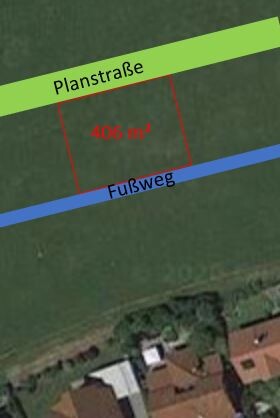
The plot measures 18m x 22m (59 ft x 72 ft) (long side parallel to the street), approx. 406 m² (4,370 sq ft). A 2.5m (8 ft) setback is required on the north and south sides. The development plan allows for two full stories and a pitched roof with a 30–40° slope.
We want to build for a family of four (estimated 130–150 m² (1,400–1,615 sq ft) of living space) and have the following space requirements:
Ground floor:
- Living-cooking-dining: as open as possible with a large kitchen island, separation from hallway possible
- Guest room: should also be usable as a bedroom if needed (at least 12 m² (130 sq ft)), preferably accessible from the hallway
- Guest bathroom: with shower, suitable as a full bathroom
- Entrance area
Upper floor:
- Two children’s rooms: minimum 12 m² (130 sq ft), preferably 13 m² (140 sq ft) or more, as equal in size as possible
- Bedroom: space for a 2.5 m (8 ft) wardrobe, not oversized
- Bathroom: WC integrated or separate, not oversized (currently we have 8 m² (86 sq ft) without WC, but with washer and dryer)
- Study or open workspace
Basement:
- Laundry room
- Hobby room
- Workshop
- Utility/technical room
Garage (two parking spaces are mandatory and we own two cars):
- 1 garage
- 1 carport / parking space
I hope I have covered all the necessary details.
Thank you in advance!
we have made it to the final candidates for a plot of land. Since it is not one of the plots we prioritized in the residential area (3 were allowed to be named), we initially did not consider these plots.
We would appreciate suggestions on how to make efficient use of this rather small plot, to help us decide if the plot is suitable for us in case we are awarded the bid. We are laypeople, and our first idea might not be optimal – perhaps someone here has good ideas and arguments, possibly also for a more westerly orientation?
Our idea: as narrow and wide as possible (e.g., 7m x 12m (23 ft x 39 ft)), with large windows facing SSE, positioning the living room and children’s rooms towards the garden, set as far north as possible so there is still some garden left. Is it advantageous (lower cost) to simply build a pitched roof, or is it better to use the space under the roof – for example, as a sleeping loft for the children’s rooms or as a workspace?
It is not yet known how the neighbor on the adjacent western plot will build, but the plot has a comparable shape.
The orientation of the plan view is north-oriented. Access to the plot is from the north via the planned street (6m wide (20 ft), without a sidewalk, serving only as an access road for about 15 adjacent plots); to the south there is a footpath. On the opposite side of the footpath, there is undeveloped green space up to existing buildings.
The plot measures 18m x 22m (59 ft x 72 ft) (long side parallel to the street), approx. 406 m² (4,370 sq ft). A 2.5m (8 ft) setback is required on the north and south sides. The development plan allows for two full stories and a pitched roof with a 30–40° slope.
We want to build for a family of four (estimated 130–150 m² (1,400–1,615 sq ft) of living space) and have the following space requirements:
Ground floor:
- Living-cooking-dining: as open as possible with a large kitchen island, separation from hallway possible
- Guest room: should also be usable as a bedroom if needed (at least 12 m² (130 sq ft)), preferably accessible from the hallway
- Guest bathroom: with shower, suitable as a full bathroom
- Entrance area
Upper floor:
- Two children’s rooms: minimum 12 m² (130 sq ft), preferably 13 m² (140 sq ft) or more, as equal in size as possible
- Bedroom: space for a 2.5 m (8 ft) wardrobe, not oversized
- Bathroom: WC integrated or separate, not oversized (currently we have 8 m² (86 sq ft) without WC, but with washer and dryer)
- Study or open workspace
Basement:
- Laundry room
- Hobby room
- Workshop
- Utility/technical room
Garage (two parking spaces are mandatory and we own two cars):
- 1 garage
- 1 carport / parking space
I hope I have covered all the necessary details.
Thank you in advance!
Contrary to our original plan, we decided to do away with the guest room on the ground floor and instead create a spacious living and dining area. The office on the upper floor will be a separate, enclosed room rather than a walk-through space. In the basement, there will be a large hobby room that can also be used as a second home office — with a light well facing west and underfloor heating.
We are quite satisfied so far, but we still have many thoughts running through our minds:
The first draft had a wall instead of the beam on the ground floor, which allowed the hallway to be separated. However, the basement access (there was also a planned closet in the hallway) seemed very dark and cramped to us... and actually we prefer open living spaces. Now we are wondering whether it’s okay to always see the basement door from the dining area, or if it would be better to rotate the staircase and have direct access to the basement next to the entrance door, but then have an open flow from the dining area to the upper floor? Would that still be possible? How would the entrance area look then? Coming into the house directly next to the basement door?
We are basically quite happy with the upper floor.
In the bathroom, I am leaning towards a space-saving bathtub along the north wall; the corner bathtub seems small to me. And the access to the shower should still work...
The children’s rooms aren’t large but both will have a 1.40 m (4 ft 7 in) deep mezzanine (the one in child 1’s room extends into the office). This will free up the space below since no bed needs to be placed on the floor...
Oh, and the sofa area is planned for the northwest corner on the ground floor...
Maybe someone has a good idea for the carport and bike shed? We would like the shed to be bigger but are limited in maximum length due to the property boundary setback... Currently, the layout is designed so that the bike shed to the south does not extend beyond the house, to avoid blocking the morning sun. But this pushes the house 40 cm (16 inches) or even 90 cm (35 inches) further south...
Actually, I wanted to position the house as far north as possible to maximize garden space, but I was also willing to accept a 3 m (10 ft) distance from the street... What do you think? Could the storage room be allowed to extend beyond the boundary?
The second parking space is located at the far northwest corner, directly on the neighboring plot boundary and by the street.
We look forward to your feedback :-)
We are quite satisfied so far, but we still have many thoughts running through our minds:
The first draft had a wall instead of the beam on the ground floor, which allowed the hallway to be separated. However, the basement access (there was also a planned closet in the hallway) seemed very dark and cramped to us... and actually we prefer open living spaces. Now we are wondering whether it’s okay to always see the basement door from the dining area, or if it would be better to rotate the staircase and have direct access to the basement next to the entrance door, but then have an open flow from the dining area to the upper floor? Would that still be possible? How would the entrance area look then? Coming into the house directly next to the basement door?
We are basically quite happy with the upper floor.
In the bathroom, I am leaning towards a space-saving bathtub along the north wall; the corner bathtub seems small to me. And the access to the shower should still work...
The children’s rooms aren’t large but both will have a 1.40 m (4 ft 7 in) deep mezzanine (the one in child 1’s room extends into the office). This will free up the space below since no bed needs to be placed on the floor...
Oh, and the sofa area is planned for the northwest corner on the ground floor...
Maybe someone has a good idea for the carport and bike shed? We would like the shed to be bigger but are limited in maximum length due to the property boundary setback... Currently, the layout is designed so that the bike shed to the south does not extend beyond the house, to avoid blocking the morning sun. But this pushes the house 40 cm (16 inches) or even 90 cm (35 inches) further south...
Actually, I wanted to position the house as far north as possible to maximize garden space, but I was also willing to accept a 3 m (10 ft) distance from the street... What do you think? Could the storage room be allowed to extend beyond the boundary?
The second parking space is located at the far northwest corner, directly on the neighboring plot boundary and by the street.
We look forward to your feedback :-)
_Yv_St_ schrieb:
We definitely need a basement, we’re sure about that.You’re planning too small. I see usability dimensions that are too tight.
But first, congratulations on using graph paper – that’s still the best and most effective way to plan. Most people shy away from the small cost for it but spend 50 on software they don’t know how to use.
In general: 2cm (0.8 inch) plaster on every wall, plus tiles in the bathrooms, baseboards in the rooms, furniture placed 5cm (2 inches) away from the wall. Variations in bricks and masonry – all of this should be considered by a layperson. This means you should allow more space in your sketch rather than planning with exact measurements.
If, as an amateur planner, you work with a precision of 10cm (4 inches), you may run into tight spots. For example here: guest WC shower. You’ve sketched about 80cm (31.5 inches) very precisely. If a general contractor takes your idea exactly as drawn, you only have room for a 70cm (27.5 inches) shower. If you think a 1-meter (39 inch) shower is too big, at least sketch it out. Even if you only plan for 80cm, you then have a space of about 90cm (35 inches). The remaining 10cm benefits the room. The size of the sink barely fits hand washing.
Kitchen with a 60cm (24 inch) line. No cabinet is fitted flush to the plastered wall; a countertop is often 62cm (24.5 inches) deep, so use 70cm (28 inches) for your sketch. Two 60cm (24 inch) cabinets need about 150cm (59 inches) in width...
A wardrobe should also be able to hold clothes hangers, so plan it like a closet with a depth of 60cm (24 inches).
The staircase at 4 meters (13 feet) is a good length for planning.
I would turn it (as you already noted) and have it approached from the front on both sides, meaning two flights with a landing.
Try sketching your living room furniture – with a width of 3.30 meters (11 feet) and an open front, it doesn’t look like a nice, cozy room to me.
Leave the beam design to the architect. For narrow houses, you don’t always need one.
Instead of a built-in window seat, simply plan large window fronts that allow space for a flexible armchair.
Basically, the open-plan area is very large, which I personally like, but in my opinion, it isn’t well shaped. There is little opportunity for retreat. Even during a Tupperware party, game night, or a soccer match with friends/guests, the other residents have no place to get away from the event hustle.
On the upper floor: the wall in front of the staircase exit is awkward. This is why I suggested rotating it 90 degrees.
_Yv_St_ schrieb:
In the meantime, we came up with the idea to open the rooms on the upper floor up to the roof pitch, possibly extending this also over the hallway, and create a second level in the kids’ room, which would make for a spacious children’s room despite the small floor area... but these are all just ideas for now...Personally, I wouldn’t do that with a steep roof pitch. But that’s something you need to decide. The space can quickly lose atmosphere instead of gaining it. I find the sleeping area with the wardrobe very awkward. It’s better to place the wardrobe behind the door. For that, you plan about 70cm (28 inches) behind the door accordingly.
The same dimension rules apply to the bathroom here. Apart from that, with four people, you should have two separate wash areas. Also, the bathroom could do with 1–2 square meters (10–20 square feet) more space.
_Yv_St_ schrieb:
Could the storage room be extended beyond the building line?Of course! The problem with the morning sun is only that you either experience it in the office, while shopping, sleeping in, or enjoying it on the terrace.I still see a lot of potential in the design, maybe a meter longer or a meter shorter and half a meter (about 20 inches) wider.
The plot is simply short and not generous… so it’s perfectly fine to plan the terrace near the dense hedge along the sidewalk… or place the kitchen with the terrace on the west side.
I would probably try moving the house forward and the carport much further back…

_Yv_St_ schrieb:
Here are the current plans for now. What kind of planning grid and wall constructions are behind these unusual dimensions?
ypg schrieb:
First of all, I have to congratulate you on using graph paper — it’s still the best and most efficient way to plan. Most people avoid spending a few euros on it but will spend 50 on software they can’t really use. What I like about graph paper is that it “trains” you to think in whole decimeters by using a scale of 1 mm = 10 cm (4 inches) at 1:100. For example, 40 cm (16 inches) for exterior and 20 cm (8 inches) for interior walls (the non-load-bearing ones can still be made thinner later) seem to me to be a practical general standard. Even better, I find classic graph paper with 5 mm (2 inches) squares — it’s clearer and well suited to the 50 cm (20 inch) joint spacing typical in masonry construction. In the past, Rensch-Haus provided planning sheets with 6.25 mm (2.5 inch) squares.
https://www.instagram.com/11antgmxde/
https://www.linkedin.com/company/bauen-jetzt/
Thanks in advance for your feedback!
This floor plan was developed in collaboration with the planner of a timber construction company, inspired by other layouts we liked. It will be a timber frame structure. The wall thicknesses correspond to the finished dimensions for their wall system (KfW55 including installation cavity, façade, and interior cladding).
I will try to take your comments regarding distances and baseboards into account. The planner’s current sketches don’t consider these yet either, but I will point it out here as well.
The issue with the cloakroom is also on my mind... I unfortunately don’t have a good feel for estimating the required space. We want to avoid lift-and-slide doors, so the dining area should have enough room to sit comfortably at the table even with the window open. The position of the wall, resulting in only 40cm (16 inches) cabinet depth, comes partly from the first plan where the wall extended all the way to the dining area. On the other hand, we want a large kitchen island. Some friends have one measuring 1.10 x 2.80m (3 ft 7 in x 9 ft 2 in), and we really enjoy cooking in their kitchen. Ideally, we would also like the island to be freestanding. We are still discussing the pros and cons of having the island against the wall or leaving enough space for a continuous window. We could of course also reduce the island size. Whether the sink is integrated into the island or positioned at the back is still an option. We have even considered rotating the kitchen. At the moment, it’s difficult to just look at many options. When it was still possible, we visited a Baufritz house called Lichtblick where the island was facing the window front. That was nice.
We have also thought about whether the guest bathroom with shower might be better placed as a narrow layout behind the kitchen — basically a corridor with the minimal width for a shower (what would that be? Inside about 1.50m (5 ft)?). The area to the south, which is not needed for the bathroom, could then be used as a small storage room next to the kitchen. The kitchen would shift further west — rotating wouldn’t be possible anymore — and the dining area would move closer to the living room. Since we cannot extend the terrace across the entire width anyway, and I would like to have an outdoor exit between living and dining areas so that the path from living room to outside isn’t too long, this setup might be advantageous in combination with an overhanging shed, especially for morning sun (if you actually get to experience it during breakfast) and for the cloakroom area, which could then be placed in the northwest corner of the house. What is your assessment? Would this be beneficial for the living space layout? What would you change to improve the format?
Regarding the staircase: We were actually happy to be able to have a straight staircase, but when I think about rotating the staircase, it quickly becomes impossible to keep it straight. We are still reluctant to consider spiral or curved flights, as they seem to require much more attention when using them. I only find quarter-turn stairs that have angled steps all the way to the middle. Is there another solution for that?
The recess for the shower makes the bathroom quite tight, so I would prefer not to give that up and allocate the space to the staircase instead. We have not needed a double sink before, and in my parents’ house we had a bathroom with two sinks but mainly used it as a backup bathroom. We usually manage well with one sink for four people in daily life.
Placing the wardrobe behind the wall in the bedroom was always my favorite option. This was also the case in the original floor plan we copied; I’ll attach it here, Alpina Optima 9. However, with realistic wall thicknesses, there was unfortunately not enough space left for that combination.
We plan to leave the rooms open up to the roof, but to make that advantageous for the sense of space we do not have a full floor anymore; instead, the internal wall height is 2.31m (7 ft 7 in) together with a roof pitch of 30°. Also, the mezzanines in the children’s rooms or only the strip above the office. Meanwhile, I have come across a picture where the corridor area has a standard ceiling height — i.e., a ceiling — and above the staircase it remains open. For the mezzanine height, it is beneficial if it is located within the children’s room because then the height there can be between 2m and 2.20m (6 ft 7 in and 7 ft 3 in).
Planning the terrace next to the dense hedge unfortunately won't help in our case: "Boundaries adjacent to public roads, paths, and squares are permitted as free-growing or trimmed hedges, as well as wooden, wire, or metal fences up to a maximum height of 1.20m (4 ft)." Therefore, we plan to have only a fence so that anyone watching would at least feel observed ;-) … and that is why I want to keep the garden strip as wide as possible.
I have not managed to reduce the overall dimensions, since it is our wish that the children’s rooms are equal in size and that the living areas face south.
I am attaching one of the inspiring floor plans and the plan with the kitchen facing the window.
Best regards
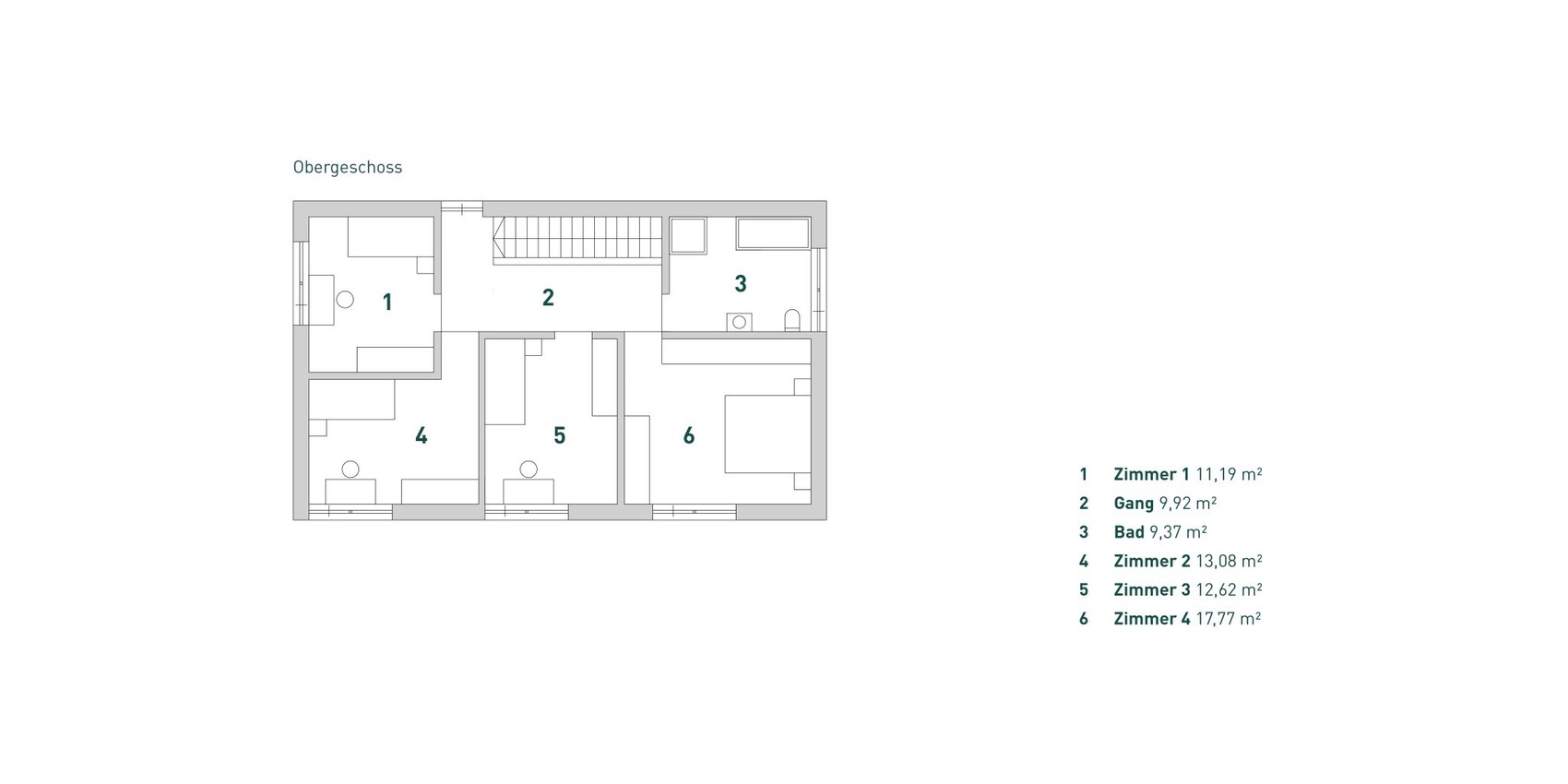

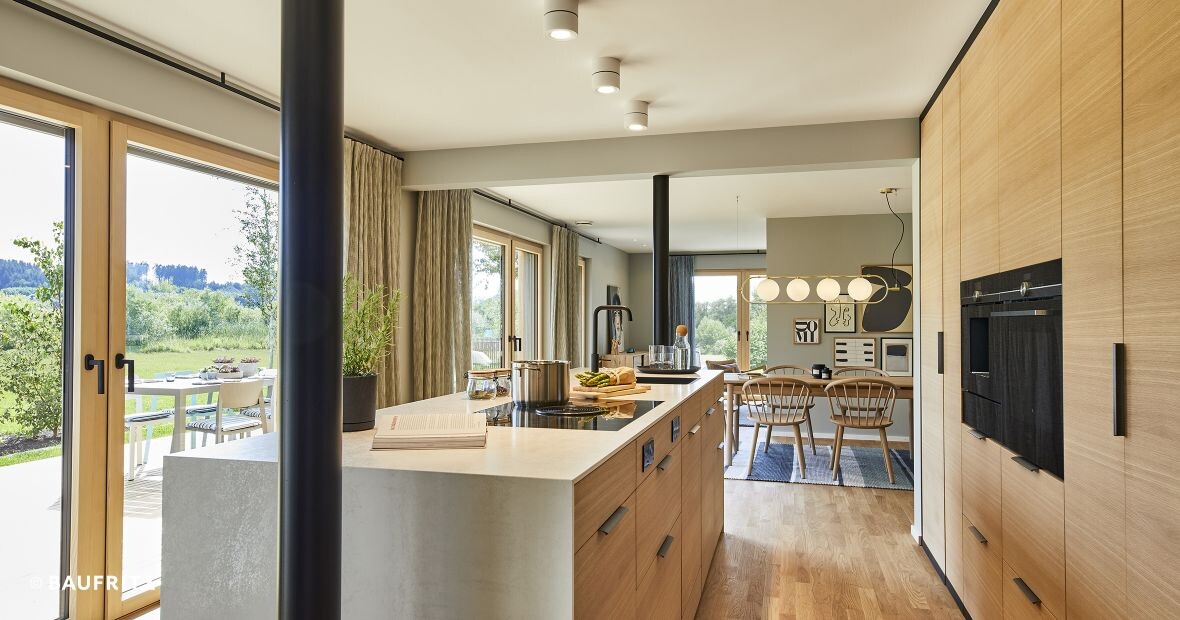
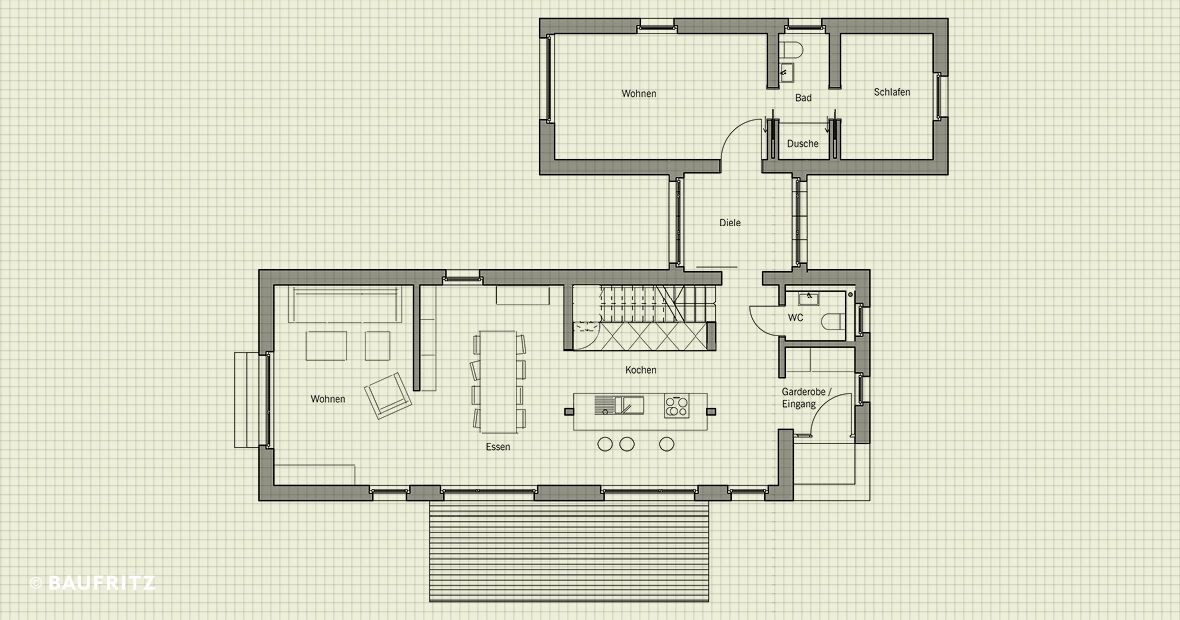
This floor plan was developed in collaboration with the planner of a timber construction company, inspired by other layouts we liked. It will be a timber frame structure. The wall thicknesses correspond to the finished dimensions for their wall system (KfW55 including installation cavity, façade, and interior cladding).
I will try to take your comments regarding distances and baseboards into account. The planner’s current sketches don’t consider these yet either, but I will point it out here as well.
The issue with the cloakroom is also on my mind... I unfortunately don’t have a good feel for estimating the required space. We want to avoid lift-and-slide doors, so the dining area should have enough room to sit comfortably at the table even with the window open. The position of the wall, resulting in only 40cm (16 inches) cabinet depth, comes partly from the first plan where the wall extended all the way to the dining area. On the other hand, we want a large kitchen island. Some friends have one measuring 1.10 x 2.80m (3 ft 7 in x 9 ft 2 in), and we really enjoy cooking in their kitchen. Ideally, we would also like the island to be freestanding. We are still discussing the pros and cons of having the island against the wall or leaving enough space for a continuous window. We could of course also reduce the island size. Whether the sink is integrated into the island or positioned at the back is still an option. We have even considered rotating the kitchen. At the moment, it’s difficult to just look at many options. When it was still possible, we visited a Baufritz house called Lichtblick where the island was facing the window front. That was nice.
We have also thought about whether the guest bathroom with shower might be better placed as a narrow layout behind the kitchen — basically a corridor with the minimal width for a shower (what would that be? Inside about 1.50m (5 ft)?). The area to the south, which is not needed for the bathroom, could then be used as a small storage room next to the kitchen. The kitchen would shift further west — rotating wouldn’t be possible anymore — and the dining area would move closer to the living room. Since we cannot extend the terrace across the entire width anyway, and I would like to have an outdoor exit between living and dining areas so that the path from living room to outside isn’t too long, this setup might be advantageous in combination with an overhanging shed, especially for morning sun (if you actually get to experience it during breakfast) and for the cloakroom area, which could then be placed in the northwest corner of the house. What is your assessment? Would this be beneficial for the living space layout? What would you change to improve the format?
Regarding the staircase: We were actually happy to be able to have a straight staircase, but when I think about rotating the staircase, it quickly becomes impossible to keep it straight. We are still reluctant to consider spiral or curved flights, as they seem to require much more attention when using them. I only find quarter-turn stairs that have angled steps all the way to the middle. Is there another solution for that?
The recess for the shower makes the bathroom quite tight, so I would prefer not to give that up and allocate the space to the staircase instead. We have not needed a double sink before, and in my parents’ house we had a bathroom with two sinks but mainly used it as a backup bathroom. We usually manage well with one sink for four people in daily life.
Placing the wardrobe behind the wall in the bedroom was always my favorite option. This was also the case in the original floor plan we copied; I’ll attach it here, Alpina Optima 9. However, with realistic wall thicknesses, there was unfortunately not enough space left for that combination.
We plan to leave the rooms open up to the roof, but to make that advantageous for the sense of space we do not have a full floor anymore; instead, the internal wall height is 2.31m (7 ft 7 in) together with a roof pitch of 30°. Also, the mezzanines in the children’s rooms or only the strip above the office. Meanwhile, I have come across a picture where the corridor area has a standard ceiling height — i.e., a ceiling — and above the staircase it remains open. For the mezzanine height, it is beneficial if it is located within the children’s room because then the height there can be between 2m and 2.20m (6 ft 7 in and 7 ft 3 in).
Planning the terrace next to the dense hedge unfortunately won't help in our case: "Boundaries adjacent to public roads, paths, and squares are permitted as free-growing or trimmed hedges, as well as wooden, wire, or metal fences up to a maximum height of 1.20m (4 ft)." Therefore, we plan to have only a fence so that anyone watching would at least feel observed ;-) … and that is why I want to keep the garden strip as wide as possible.
I have not managed to reduce the overall dimensions, since it is our wish that the children’s rooms are equal in size and that the living areas face south.
I am attaching one of the inspiring floor plans and the plan with the kitchen facing the window.
Best regards
_Yv_St_ schrieb:
When it was still possible, we visited the Baufritz Lichtblick house, where the island is in front of the windows. That was nice, too... We have ours positioned diagonally—facing both the window and the table. It’s a highlight for every visitor—and for us every day.
_Yv_St_ schrieb:
At the moment, we’re still resisting spiral staircases; it feels like you have to be much more cautious when using them... You get used to it... and if you do fall, it’s not such a long fall.
_Yv_St_ schrieb:
Actually, in everyday life, the four of us have managed well with just one sink... How old are the children? Do they all have to leave early in the morning? Are there girls? (Although: the boys are catching up when it comes to vanity.)
Similar topics