
ᐅ New Construction of a House with a Basement on a Sloped Lot – Construction Costs?
Created on: 3 Oct 2017 09:35
H
hausinformer
Hello,
I’m new here and have a few questions right away.
Slowly, the desire to own my own house is growing.
We have inherited a plot of land (an old house still stands on it and needs to be demolished), which has a steep slope. The dimensions are approximately 30m x 15m (98ft x 49ft) with an elevation difference of about 4-5m (13-16ft) on the shorter side (estimated). In addition, we live in Baden-Württemberg in an earthquake-prone area.
The house is planned to be about 12 x 10m (39ft x 33ft). A basement is essential and probably advisable given the slope.
We are interested in understanding the approximate building costs. Also, whether it makes sense or is even possible to build new houses on such a steep slope. Otherwise, we would have to look for another plot, but land is quite scarce in this area.
Best regards
I’m new here and have a few questions right away.
Slowly, the desire to own my own house is growing.
We have inherited a plot of land (an old house still stands on it and needs to be demolished), which has a steep slope. The dimensions are approximately 30m x 15m (98ft x 49ft) with an elevation difference of about 4-5m (13-16ft) on the shorter side (estimated). In addition, we live in Baden-Württemberg in an earthquake-prone area.
The house is planned to be about 12 x 10m (39ft x 33ft). A basement is essential and probably advisable given the slope.
We are interested in understanding the approximate building costs. Also, whether it makes sense or is even possible to build new houses on such a steep slope. Otherwise, we would have to look for another plot, but land is quite scarce in this area.
Best regards

Slope = inclined ground
If you don’t have a basement, all floors are above ground level, so your foundation slab would be at the height of the upper side of the slope.
Below that, you would have a large empty space that you would need to fill with compacted gravel, support with massive foundations, and reinforce extensively.
It makes sense, therefore, to place the lower floor "into the excavation pit," so that part of this level is below ground. This is what is called a basement.
Having a basement does not necessarily mean everything has to be made of concrete. In our case, all walls that are below ground are built using waterproof concrete (WU concrete), while all walls above ground are masonry.
If my explanation wasn’t clear enough, try this visualization: draw a 45° slope (very exaggerated, yes, but it clearly illustrates the point). Now draw a house on top with a slab foundation and no basement. Either your house must be able to fly, or you have to build a basement underneath.
If you don’t have a basement, all floors are above ground level, so your foundation slab would be at the height of the upper side of the slope.
Below that, you would have a large empty space that you would need to fill with compacted gravel, support with massive foundations, and reinforce extensively.
It makes sense, therefore, to place the lower floor "into the excavation pit," so that part of this level is below ground. This is what is called a basement.
Having a basement does not necessarily mean everything has to be made of concrete. In our case, all walls that are below ground are built using waterproof concrete (WU concrete), while all walls above ground are masonry.
If my explanation wasn’t clear enough, try this visualization: draw a 45° slope (very exaggerated, yes, but it clearly illustrates the point). Now draw a house on top with a slab foundation and no basement. Either your house must be able to fly, or you have to build a basement underneath.

mega2017 schrieb:
How do you determine that? I base it on the rough rule of thumb "200 cm (79 inches) = 100%," meaning how strongly I recommend having a basement or advise against leaving it out.
If the terrain slopes, you basically have to build retaining walls under the house (I don’t think I need to add anything to the illustrative explanation from @Kaspatoo). Once these walls reach the height of a basement, you effectively have a basement. Although it’s backfilled with soil and cannot be used, and it doesn’t have interior walls, it’s not significantly cheaper.
At about one meter (39 inches) in height for these actual “basement exterior walls,” I roughly estimate the cost to be half compared to building with a full basement. In other words, starting at around two meters (79 inches) height, the cost savings of not having a basement are, contrary to the rule of thumb, not zero but so minimal that it’s not worth it. Especially when you consider substitute rooms for a basement, the rule actually makes sense.
Currently, it seems trendy to fill the entire hillside plot up to the highest point with soil and extend these “basement walls” along two or three sides following the property boundaries. In my view, this is about as unwise as it gets.
Sloped plots don’t just have drawbacks—they also have their own unique appeal. Unfortunately, more and more people are taking on hillside plots without appreciating them and only think of “flattening” them.
However, there are alternatives to my view of “the steeper the slope, the more basement you need”: @ypg also has a “slope,” namely the “split-level” design. This was very popular around 1980: dividing floor areas so that the “halves” are offset by half a floor level. In other words, one half of the floor is basically attached to the intermediate landing of the stairs. This works ideally with two equal-length stair runs, which corresponds to a terrain difference (relative to the building footprint) of about 120 to 160 cm (47 to 63 inches).
https://www.instagram.com/11antgmxde/
https://www.linkedin.com/company/bauen-jetzt/
I can share how we approached it.
We had agreements with the neighbors on both the left and right sides regarding the required setback distances. We also consulted with the local municipality to clarify how we wanted to build and what our plans were.
We kept the old retaining wall in place. It is also larger than the new house. The reasons for this were:
- no disposal needed
- no slope support required
- no risk of slope sliding (42° on the undeveloped part of the property)
- attractive natural stone wall in the garden
In the area of the house and garage, the new wall functions as both the ground floor house wall and the retaining wall. We do not have a traditional basement, otherwise the garden on the south and west sides would only be accessible by stairs, and a basement was not really necessary.
Our excavation volume was only 60 cubic meters (78 cubic yards).
@mega2017
I would say it depends on the property whether to have a basement or not. Many sloped properties around us no longer have traditional basements. Oil tanks, firewood, and preserved food jars are rarely needed anymore. Most "basements" are proper living spaces. The days of dark and damp basements are over.
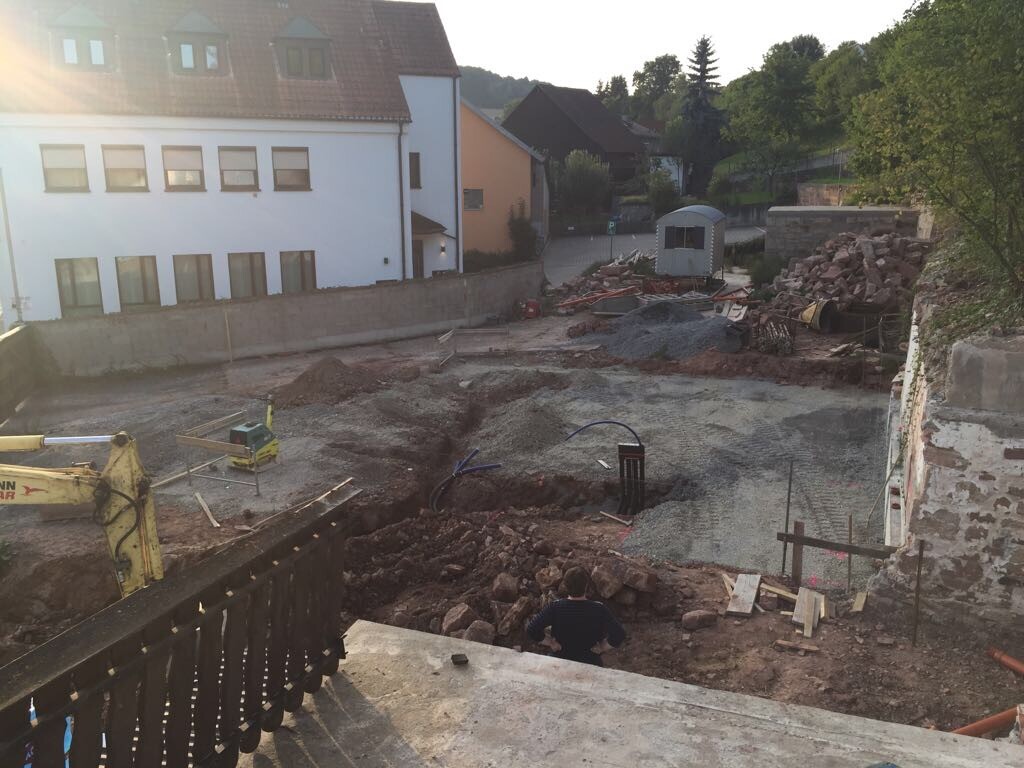
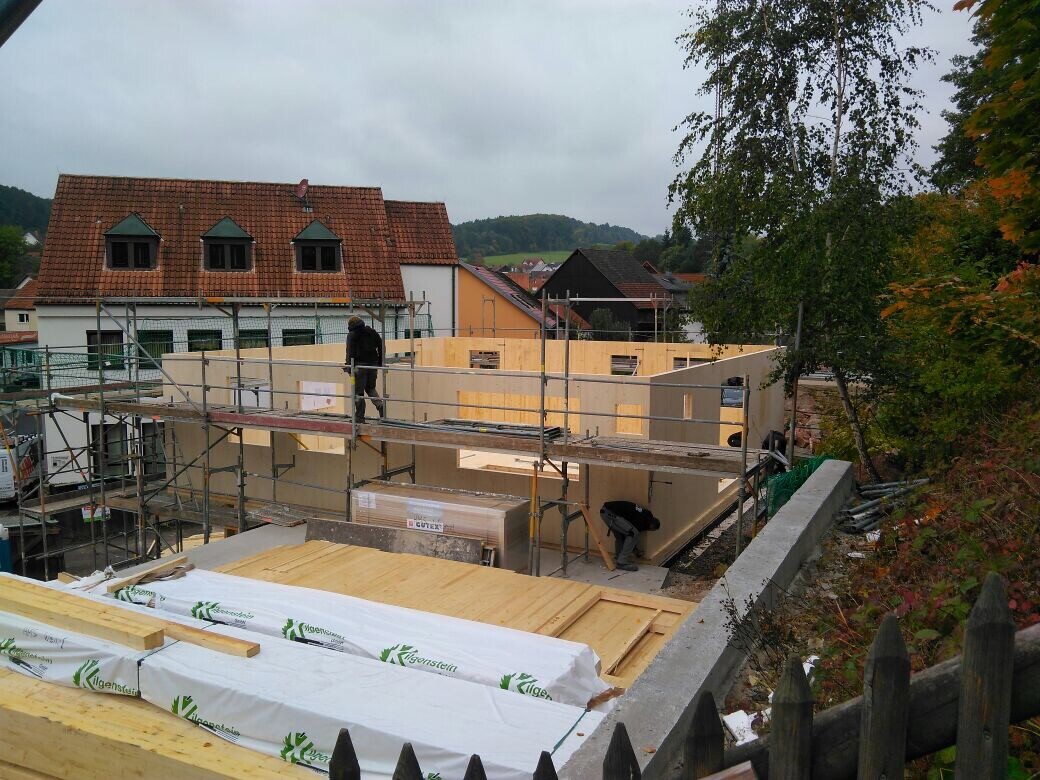
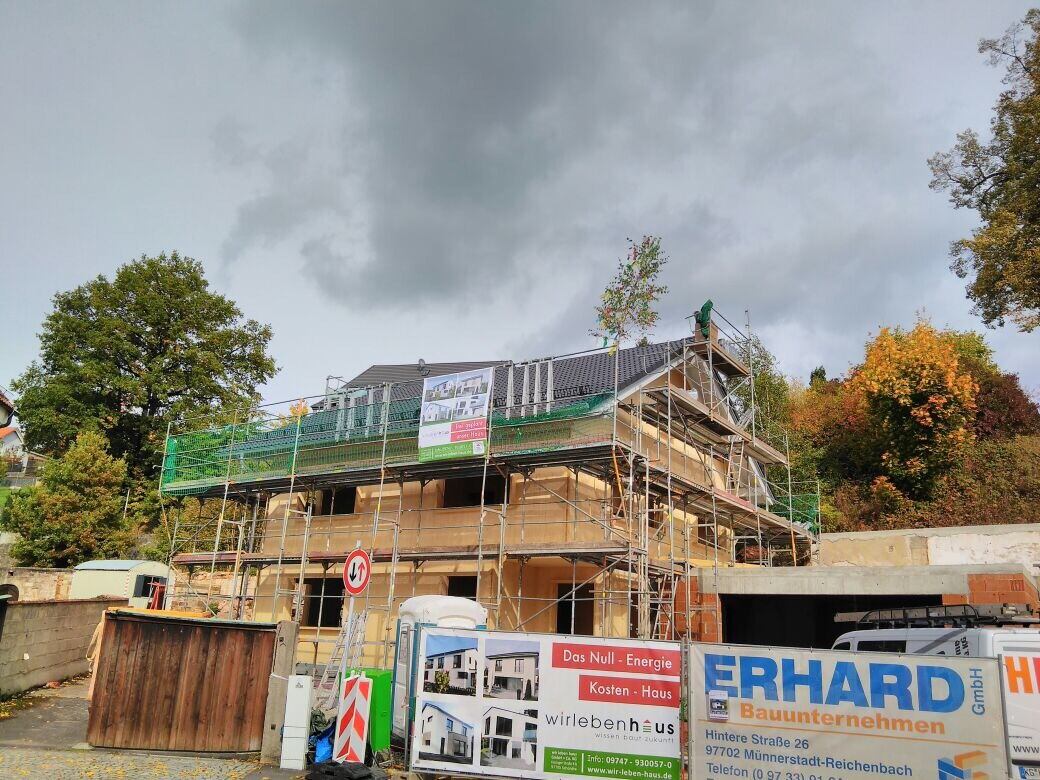
We had agreements with the neighbors on both the left and right sides regarding the required setback distances. We also consulted with the local municipality to clarify how we wanted to build and what our plans were.
We kept the old retaining wall in place. It is also larger than the new house. The reasons for this were:
- no disposal needed
- no slope support required
- no risk of slope sliding (42° on the undeveloped part of the property)
- attractive natural stone wall in the garden
In the area of the house and garage, the new wall functions as both the ground floor house wall and the retaining wall. We do not have a traditional basement, otherwise the garden on the south and west sides would only be accessible by stairs, and a basement was not really necessary.
Our excavation volume was only 60 cubic meters (78 cubic yards).
@mega2017
I would say it depends on the property whether to have a basement or not. Many sloped properties around us no longer have traditional basements. Oil tanks, firewood, and preserved food jars are rarely needed anymore. Most "basements" are proper living spaces. The days of dark and damp basements are over.
Similar topics