
ᐅ Plot Layout & Orientation Single-Family Home with 160 sqm on a South-Facing Slope
Created on: 16 Dec 2024 01:37
B
Bau_Rookie
Hello everyone,
My wife and I are actually about to request quotes for our construction project, but now I’m starting to have doubts about our basic planning.
I thought we had already considered and discussed all aspects and perspectives, and that the current approach was finally the only right one.
However, I am no longer so sure about that. Overall, I find it difficult to make the best use of the plot orientation.
Therefore, I kindly ask for your honest feedback.
How would you arrange the house, main entrance, and double garage?
What do you think is okay about the current plan and what is not?
I’m really curious to hear your thoughts :-). Thank you very much in advance!
Development Plan / Restrictions
Plot size = 650 sqm (7000 sq ft)
Slope = South, approx. 12.5% incline (rising from the street level)
Floor space index (FSI) = 0.4
Plot ratio = not specified
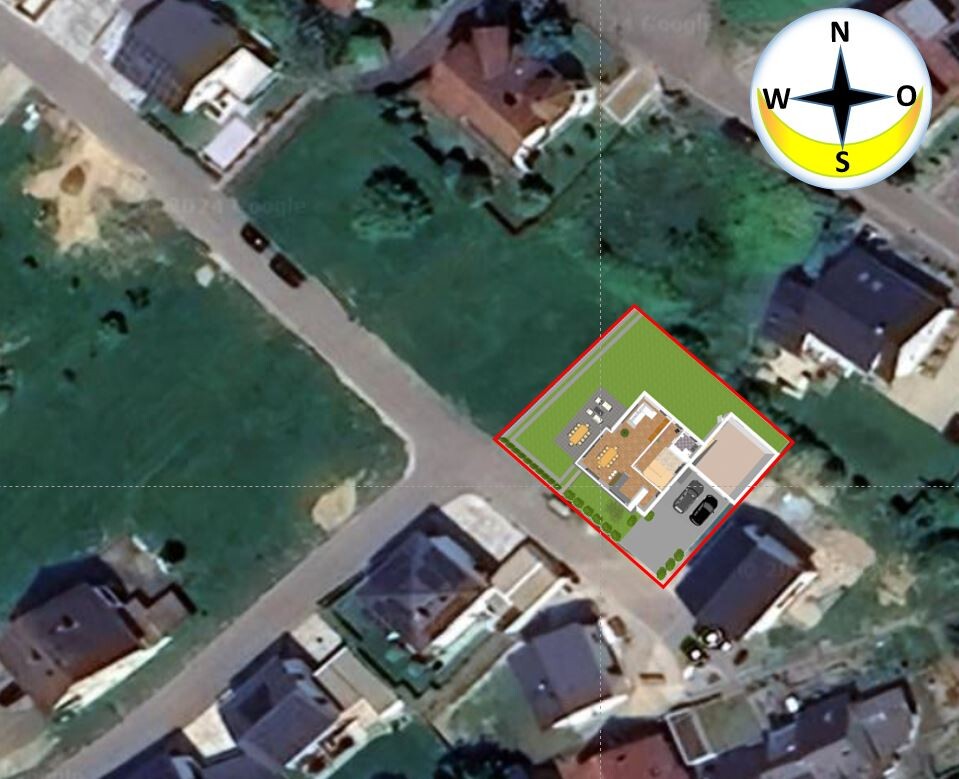
Building envelope, building line, and boundary = the plot is marked in red in the graphic below; the building line is shown with a blue dash-dot line
Edge construction = garage may be built on the property boundary; the house must have a 2.5 m (8 ft) setback
Number of parking spaces = 2
Number of stories = 3 full floors, i.e. basement + ground floor + upper floor
Roof type = tent roof, hipped roof, gable roof, or offset shed roof
Orientation = see plan below
Maximum height limits = street level is zero reference; max. wall height 9 m (30 ft) and max. ridge height 11 m (36 ft)
Homeowners’ Requirements
Style, roof shape, building type = tent or hipped roof, urban villa
Basement, floors = basement, ground floor, and upper floor; all full stories
Number of occupants, ages = 4; 2 adults and two children under 10 years
Space requirements on ground and upper floors = ground floor 88 sqm (947 sq ft), upper floor 78 sqm (840 sq ft)
Office: family use or home office? = both; home office to be located in the basement
Overnight guests per year = occasional, in the office
Open or closed architecture = rather open
Conservative or modern design = modern
Open kitchen, kitchen island = open kitchen with peninsula
Number of dining seats = 6–8
Fireplace = no
Balcony, rooftop terrace = no
Garage, carport = double garage with basement access
Terrace orientation = west, because as working professionals we prefer the evening sun. The terrace should also be as elevated as possible.
Garage orientation = therefore, the garage is placed on the right border of the plot
Garage driveway = we would like a maximum slope of 10% here (which will be challenging)
Neighboring buildings = right side is already built, very close with 2.5 m (8 ft) setback; left side is still undeveloped
House Design
Who designed the plan? Do-it-yourself + building planner
What do you particularly like? Difficult, it’s basically a big compromise.
What don’t you like? It’s a compromise.
Why? If the garage driveway slope should be <10%,
- the house has to be built deeper into the ground. This is not ideal because we would actually prefer a rather raised outdoor area. Also, the slope behind the plot would require more complex reinforcement.
- the garage driveway must be very long. A lot of surface would have to be paved.
Cost estimate from architect/planner: 700,000 EUR
Preferred heating system: air-to-water heat pump

My wife and I are actually about to request quotes for our construction project, but now I’m starting to have doubts about our basic planning.
I thought we had already considered and discussed all aspects and perspectives, and that the current approach was finally the only right one.
However, I am no longer so sure about that. Overall, I find it difficult to make the best use of the plot orientation.
Therefore, I kindly ask for your honest feedback.
How would you arrange the house, main entrance, and double garage?
What do you think is okay about the current plan and what is not?
I’m really curious to hear your thoughts :-). Thank you very much in advance!
Development Plan / Restrictions
Plot size = 650 sqm (7000 sq ft)
Slope = South, approx. 12.5% incline (rising from the street level)
Floor space index (FSI) = 0.4
Plot ratio = not specified
Building envelope, building line, and boundary = the plot is marked in red in the graphic below; the building line is shown with a blue dash-dot line
Edge construction = garage may be built on the property boundary; the house must have a 2.5 m (8 ft) setback
Number of parking spaces = 2
Number of stories = 3 full floors, i.e. basement + ground floor + upper floor
Roof type = tent roof, hipped roof, gable roof, or offset shed roof
Orientation = see plan below
Maximum height limits = street level is zero reference; max. wall height 9 m (30 ft) and max. ridge height 11 m (36 ft)
Homeowners’ Requirements
Style, roof shape, building type = tent or hipped roof, urban villa
Basement, floors = basement, ground floor, and upper floor; all full stories
Number of occupants, ages = 4; 2 adults and two children under 10 years
Space requirements on ground and upper floors = ground floor 88 sqm (947 sq ft), upper floor 78 sqm (840 sq ft)
Office: family use or home office? = both; home office to be located in the basement
Overnight guests per year = occasional, in the office
Open or closed architecture = rather open
Conservative or modern design = modern
Open kitchen, kitchen island = open kitchen with peninsula
Number of dining seats = 6–8
Fireplace = no
Balcony, rooftop terrace = no
Garage, carport = double garage with basement access
Terrace orientation = west, because as working professionals we prefer the evening sun. The terrace should also be as elevated as possible.
Garage orientation = therefore, the garage is placed on the right border of the plot
Garage driveway = we would like a maximum slope of 10% here (which will be challenging)
Neighboring buildings = right side is already built, very close with 2.5 m (8 ft) setback; left side is still undeveloped
House Design
Who designed the plan? Do-it-yourself + building planner
What do you particularly like? Difficult, it’s basically a big compromise.
What don’t you like? It’s a compromise.
Why? If the garage driveway slope should be <10%,
- the house has to be built deeper into the ground. This is not ideal because we would actually prefer a rather raised outdoor area. Also, the slope behind the plot would require more complex reinforcement.
- the garage driveway must be very long. A lot of surface would have to be paved.
Cost estimate from architect/planner: 700,000 EUR
Preferred heating system: air-to-water heat pump
B
Bau_Rookie17 Dec 2024 02:09First of all, I would like to thank everyone for the feedback received so far and the feedback still to come!
I will respond to the individual questions as soon as possible.
By the way: What changes were made to my post by the moderation?
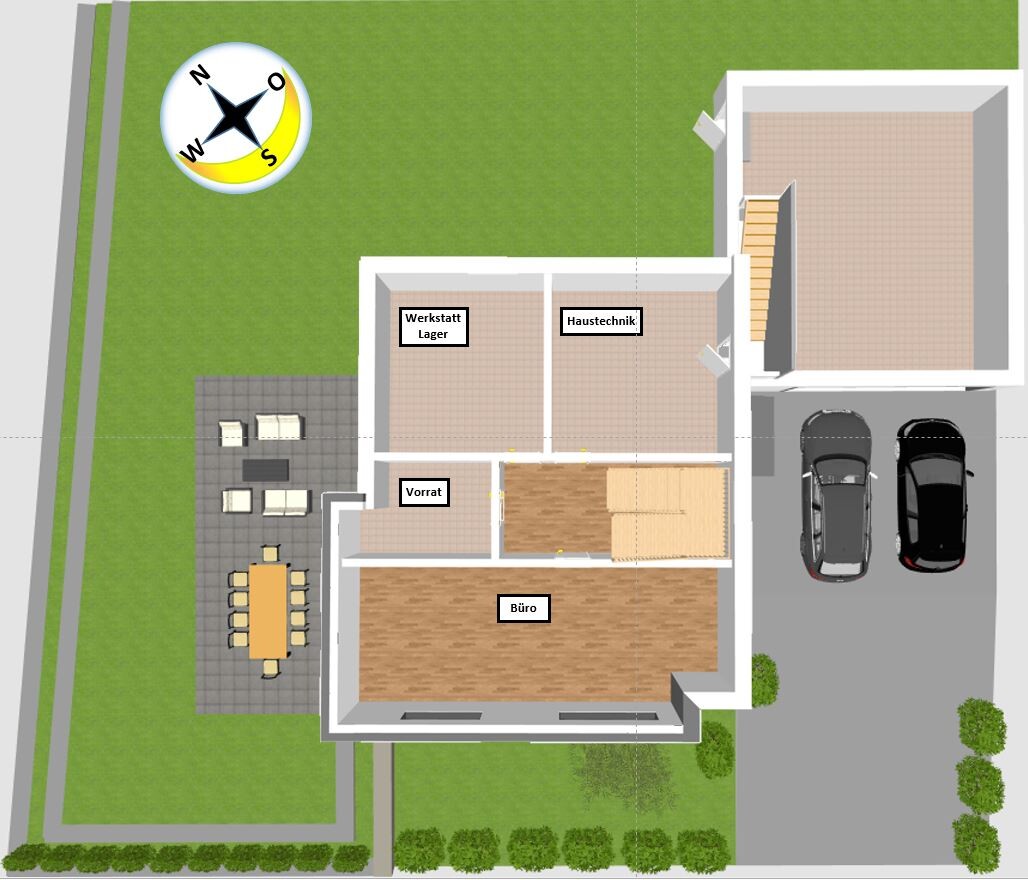
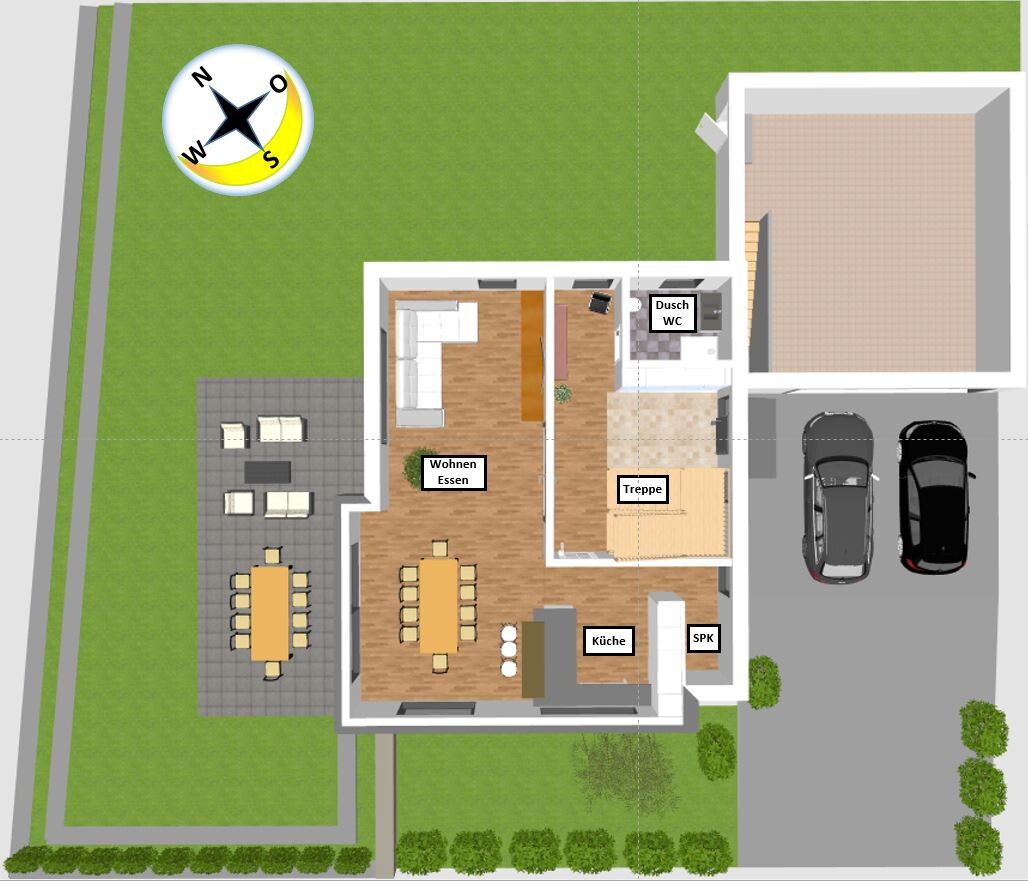
But for now, here are the following illustrations:
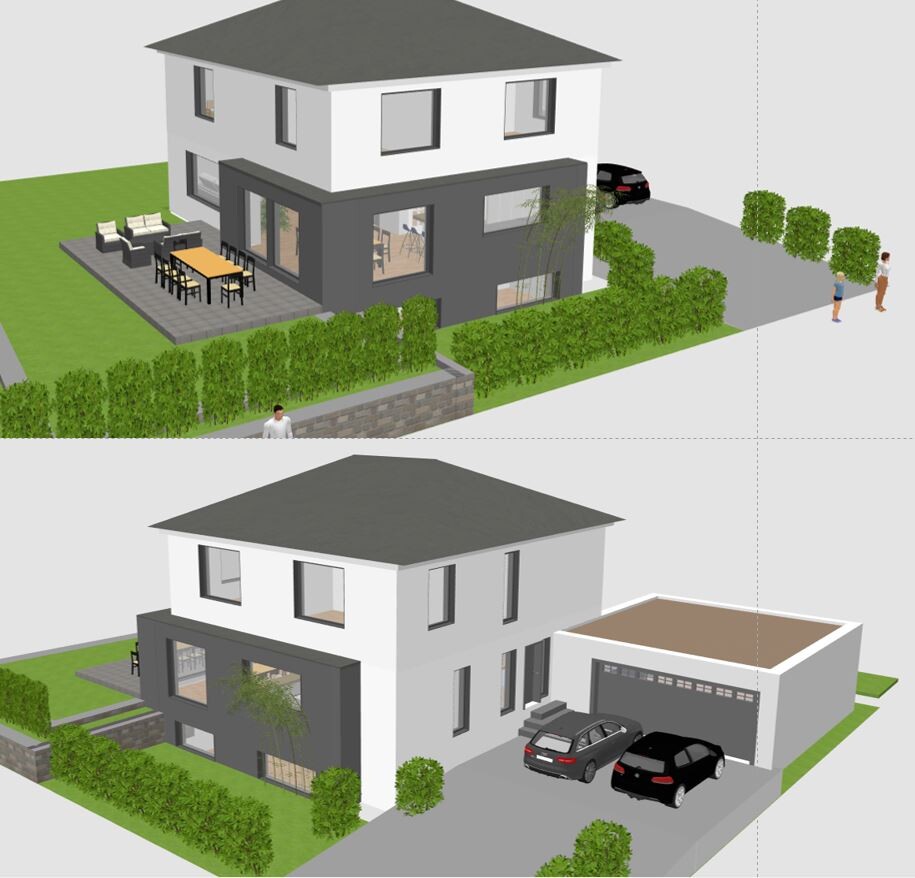
Basement
Ground floor
Upper floor
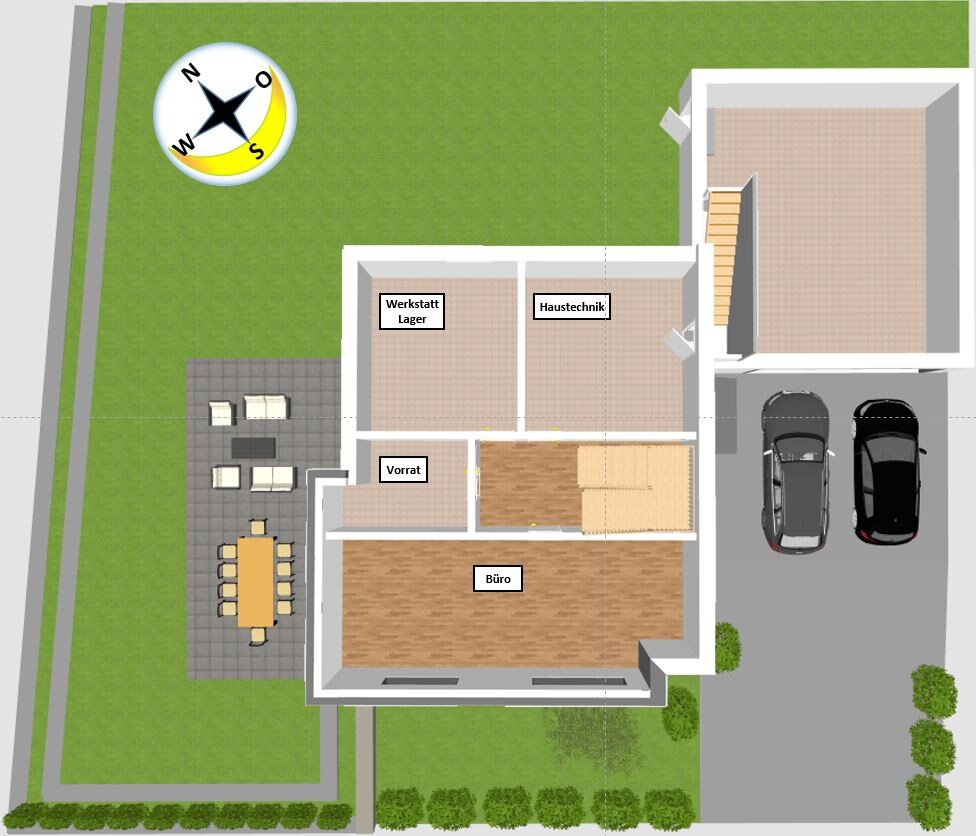
I will respond to the individual questions as soon as possible.
By the way: What changes were made to my post by the moderation?
But for now, here are the following illustrations:
Basement
Ground floor
Upper floor
B
Bau_Rookie17 Dec 2024 02:19This time limit for processing is really quite "interesting."
I realized afterwards that I had uploaded the wrong upper floor image. Here is the correct one.
Upper Floor
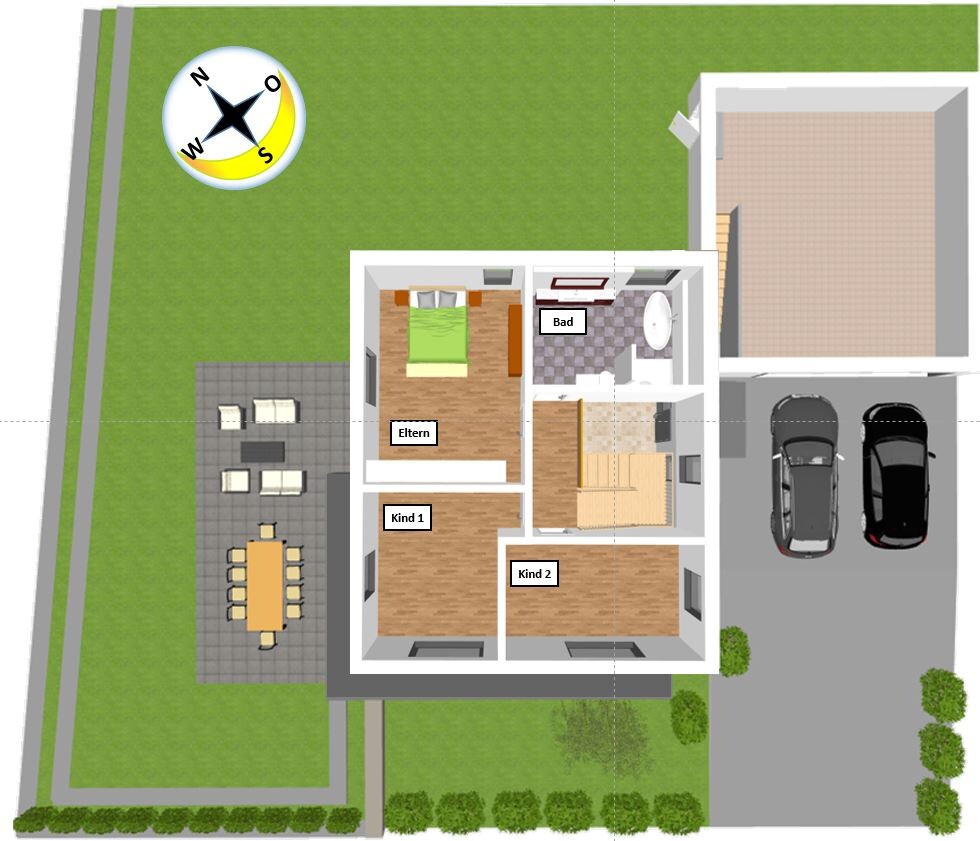
I realized afterwards that I had uploaded the wrong upper floor image. Here is the correct one.
Upper Floor
H
hanghaus202317 Dec 2024 09:25In my opinion, the slope is steeper based on the elevation data. Do you possibly have any photos of the property?
H
hanghaus202317 Dec 2024 09:41At the northern boundary, 187.39m (615.4 ft) - street 182.80m (599.7 ft) = maximum height difference is 4.59m (15.1 ft) / 24m (78.7 ft) * 100% = 19.12% slope.
You can certainly build the house as you have designed it. However, it is very unlikely to be feasible within your budget.
You have over 200m³ (7,062 ft³) of living space + 40m² (430 ft²) usable floor area + an extremely large garage. Then there are the numerous retaining walls on the site as well as along the boundary with the neighbor.
You are already having doubts yourself.
My suggestion is much more efficient, designed to work with the slope. You would build a huge basement that costs at least as much as the living space, just so that the villa fits on top?
What is the purpose of the stairs in the garage anyway?
Let me show you the difference. There you can clearly see how extensive your excavation into the slope is.
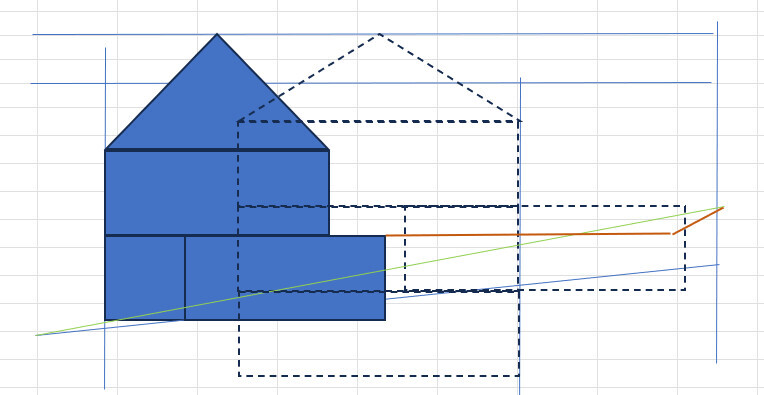
I would prefer to add living space in the roof rather than in the basement.
You can certainly build the house as you have designed it. However, it is very unlikely to be feasible within your budget.
You have over 200m³ (7,062 ft³) of living space + 40m² (430 ft²) usable floor area + an extremely large garage. Then there are the numerous retaining walls on the site as well as along the boundary with the neighbor.
You are already having doubts yourself.
My suggestion is much more efficient, designed to work with the slope. You would build a huge basement that costs at least as much as the living space, just so that the villa fits on top?
What is the purpose of the stairs in the garage anyway?
Let me show you the difference. There you can clearly see how extensive your excavation into the slope is.
I would prefer to add living space in the roof rather than in the basement.

I find sketches with dimension chains much better than colorful 3D models without them. Visually, I suspect the parapet heights on the upper floor are too low.
https://www.instagram.com/11antgmxde/
https://www.linkedin.com/company/bauen-jetzt/
https://www.instagram.com/11antgmxde/
https://www.linkedin.com/company/bauen-jetzt/
Programs are only helpful as guides if you can interpret conditions from them. Otherwise, they do not necessarily reveal the difficulties and costs to a layperson because they allow for possibilities that may not be feasible or achievable in reality.
Regarding the terms building envelope and building boundary and the doubt about whether it is possible to build over these with the garage, something has already been mentioned. The aerial view supports the assumption that the rear boundary was set to protect neighboring buildings and gardens, as well as due to height restrictions, making a garage there impossible.
The displayed height restrictions are sometimes difficult for the viewer to understand. Is there an official site plan?
Similarly, bird’s-eye views without house dimensions are not suitable—floor plans would be more helpful unless you actually do not want to discuss the floor plan but only the location of the house with garage, driveway, etc. In that case, at least the dimensions of the plot and the house would be needed.
Looking at the plan you created with software, the house as positioned appears possible at first glance. However, the property is represented somewhat amateurishly (not a negative judgment, just an objective observation). For example, the slope at the top of the plan is not shown at all. It is not as simple as just cutting away a slope and ending up with a flat lot without additional work. Missing are the extensive earthworks around the property: retaining structures, high walls, etc. A small and rather minor example is the front driveway’s left edge, where there is a height difference between the garden and the driveway ramp that has no retaining structure. A retaining wall and safety measures (also around the terrace) are necessary, as well as access to the garden area on the basement level.
The entrance platform is not secured at all—it is practically a fall hazard directly at the stairs when entering the front door.
You yourself noted the driveway slope is (too) steep. Although you do not want a barrier-free driveway with a maximum 6% slope, you obviously want to be able to walk on it safely and without slipping in wet or snowy conditions. I am deliberately excluding vehicles here because first you need to ensure pedestrian access to the house. Once that is achieved, you can then address parking and vehicle access.
Of course, we could spend days debating in detail what is permitted, what is not, what the zoning plan specifies, how to interpret height contours, how much cut or fill is allowed, and how high retaining walls may be. But without actual data, we cannot make progress here.
I refer to the GaVo (driveway), state building regulations regarding the second emergency exit (basement exit), and your unknown zoning plan.
Regarding the terms building envelope and building boundary and the doubt about whether it is possible to build over these with the garage, something has already been mentioned. The aerial view supports the assumption that the rear boundary was set to protect neighboring buildings and gardens, as well as due to height restrictions, making a garage there impossible.
The displayed height restrictions are sometimes difficult for the viewer to understand. Is there an official site plan?
Similarly, bird’s-eye views without house dimensions are not suitable—floor plans would be more helpful unless you actually do not want to discuss the floor plan but only the location of the house with garage, driveway, etc. In that case, at least the dimensions of the plot and the house would be needed.
Looking at the plan you created with software, the house as positioned appears possible at first glance. However, the property is represented somewhat amateurishly (not a negative judgment, just an objective observation). For example, the slope at the top of the plan is not shown at all. It is not as simple as just cutting away a slope and ending up with a flat lot without additional work. Missing are the extensive earthworks around the property: retaining structures, high walls, etc. A small and rather minor example is the front driveway’s left edge, where there is a height difference between the garden and the driveway ramp that has no retaining structure. A retaining wall and safety measures (also around the terrace) are necessary, as well as access to the garden area on the basement level.
The entrance platform is not secured at all—it is practically a fall hazard directly at the stairs when entering the front door.
You yourself noted the driveway slope is (too) steep. Although you do not want a barrier-free driveway with a maximum 6% slope, you obviously want to be able to walk on it safely and without slipping in wet or snowy conditions. I am deliberately excluding vehicles here because first you need to ensure pedestrian access to the house. Once that is achieved, you can then address parking and vehicle access.
Of course, we could spend days debating in detail what is permitted, what is not, what the zoning plan specifies, how to interpret height contours, how much cut or fill is allowed, and how high retaining walls may be. But without actual data, we cannot make progress here.
I refer to the GaVo (driveway), state building regulations regarding the second emergency exit (basement exit), and your unknown zoning plan.
Similar topics