
Hello everyone,
I’m new here. We have bought a house from 1980 with a rafter roof featuring a ridge beam, a central purlin, and a wall plate still in their original condition. New insulation is currently being installed between the rafters. At that time, large rooms were built under the sloping roof, with a partially horizontal ceiling beneath the collar beams. In fact, all rafters above the room are connected by double collar beams.
My question: Do these collar beams have a structural function, or are they only there to support the ceiling construction? We are now considering the possibility of removing the collar beams and extending the roof slopes all the way up to the ridge beam. This would keep the window openings in the masonry intact and prevent the upper part of the trapezoidal windows from being cut off.
Do the collar beams hold the rafters together and keep them vertically aligned (cross-section 8 x 180mm (0.3 x 7 inches))? Our carpenter told us that "back then, they liked to use a lot of wood"... Is there any risk in doing without these double collar beams?
Thanks for your time and help!
Bruno
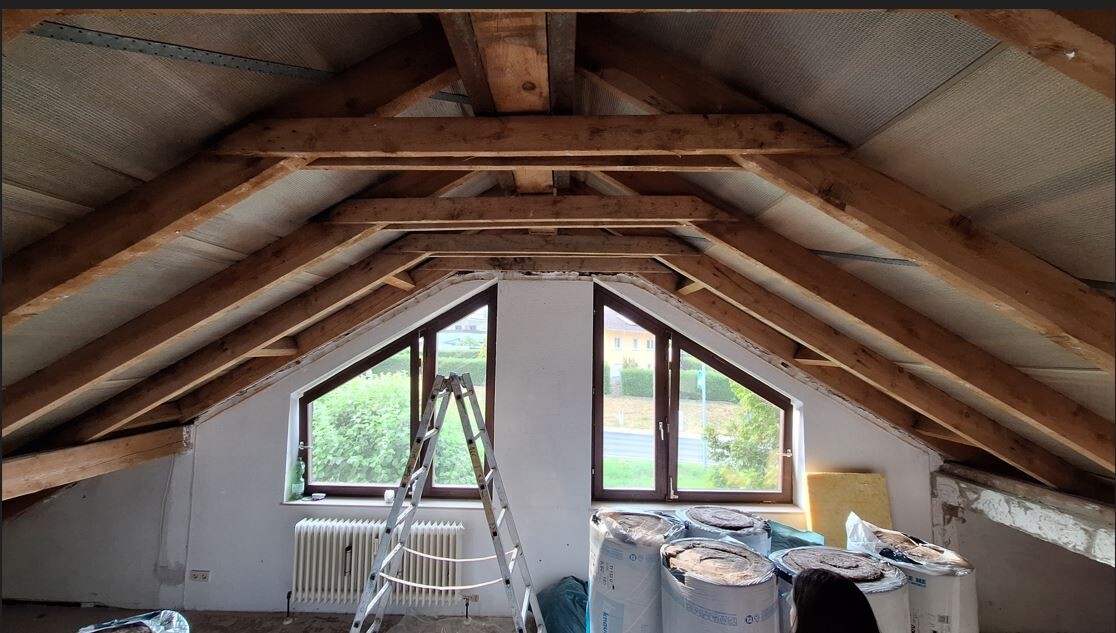
I’m new here. We have bought a house from 1980 with a rafter roof featuring a ridge beam, a central purlin, and a wall plate still in their original condition. New insulation is currently being installed between the rafters. At that time, large rooms were built under the sloping roof, with a partially horizontal ceiling beneath the collar beams. In fact, all rafters above the room are connected by double collar beams.
My question: Do these collar beams have a structural function, or are they only there to support the ceiling construction? We are now considering the possibility of removing the collar beams and extending the roof slopes all the way up to the ridge beam. This would keep the window openings in the masonry intact and prevent the upper part of the trapezoidal windows from being cut off.
Do the collar beams hold the rafters together and keep them vertically aligned (cross-section 8 x 180mm (0.3 x 7 inches))? Our carpenter told us that "back then, they liked to use a lot of wood"... Is there any risk in doing without these double collar beams?
Thanks for your time and help!
Bruno
Ugarlino schrieb:
He said they were only connected like that back then to prevent them from shifting during the roof construction…That might be true, but it does not have to be. It is unfortunate that some tradespeople just say things like that without looking into it more closely or checking reliably.
hanghaus2023 schrieb:
Please do not follow what @Ugarlino is suggesting, and definitely not what is shown in the picture.
A nail plate does not have that many holes just for fun.You mean: not so that you can play "6 out of 49," "Bingo," or "Connect Four" with it?https://www.instagram.com/11antgmxde/
https://www.linkedin.com/company/bauen-jetzt/

In der Ruine schrieb:
Three nails for two rafters. Cute.Not much else fits given the spacing between the beams.@Soaring138
But clamps are not always necessary; it depends on the ring beam. Here, it also looks like there are additional beams resting on the gable? Do you know how the ring beam is constructed? If it’s possibly made of concrete, the roofer might be right. Don’t give up—have it checked.
tomtom79 schrieb:
But clamps are not always necessary,Carpentry is a master-level trade and also includes authorization for plan submissions. I consider the use of clamps without structural necessity to be a myth.tomtom79 schrieb:
It depends on the ring beam.The ring beam would not prevent the collapsing roof structure; its role is to stop the eaves from being blown off (which would be the next step before the house collapses).https://www.instagram.com/11antgmxde/
https://www.linkedin.com/company/bauen-jetzt/
hanghaus2023 schrieb:
Please do not imitate what @Ugarlino is doing there, and especially not what he shows in the picture.
A metal connector plate doesn’t have so many holes for no reason.The plate was attached on both sides in this way and nailed even better. Unfortunately, I don’t have any other photos.
The answer is quite simple: no, you are not allowed to remove the collar ties. A rafter roof is a system with a base support consisting of horizontal and vertical bearings, and a ridge point acting as a hinge— for example, a scarf joint or, as in your case, a floating ridge purlin with double collar ties.
Can you change it? Yes, if you convert your rafter roof into a load-bearing purlin roof, which means purlins supported by vertical posts below.
Whether that makes sense is another matter, since the purlins, given the existing support spans, are unlikely to have sufficient cross-sections, and you will additionally need supports, especially beneath the ridge purlin, which usually get in the way and cause obstructions.
Everything is possible but also very costly.
However, in this case, you will definitely need to consult a qualified structural engineer.
Can you change it? Yes, if you convert your rafter roof into a load-bearing purlin roof, which means purlins supported by vertical posts below.
Whether that makes sense is another matter, since the purlins, given the existing support spans, are unlikely to have sufficient cross-sections, and you will additionally need supports, especially beneath the ridge purlin, which usually get in the way and cause obstructions.
Everything is possible but also very costly.
However, in this case, you will definitely need to consult a qualified structural engineer.
Similar topics