
Hello everyone,
I’m new here. We have bought a house from 1980 with a rafter roof featuring a ridge beam, a central purlin, and a wall plate still in their original condition. New insulation is currently being installed between the rafters. At that time, large rooms were built under the sloping roof, with a partially horizontal ceiling beneath the collar beams. In fact, all rafters above the room are connected by double collar beams.
My question: Do these collar beams have a structural function, or are they only there to support the ceiling construction? We are now considering the possibility of removing the collar beams and extending the roof slopes all the way up to the ridge beam. This would keep the window openings in the masonry intact and prevent the upper part of the trapezoidal windows from being cut off.
Do the collar beams hold the rafters together and keep them vertically aligned (cross-section 8 x 180mm (0.3 x 7 inches))? Our carpenter told us that "back then, they liked to use a lot of wood"... Is there any risk in doing without these double collar beams?
Thanks for your time and help!
Bruno
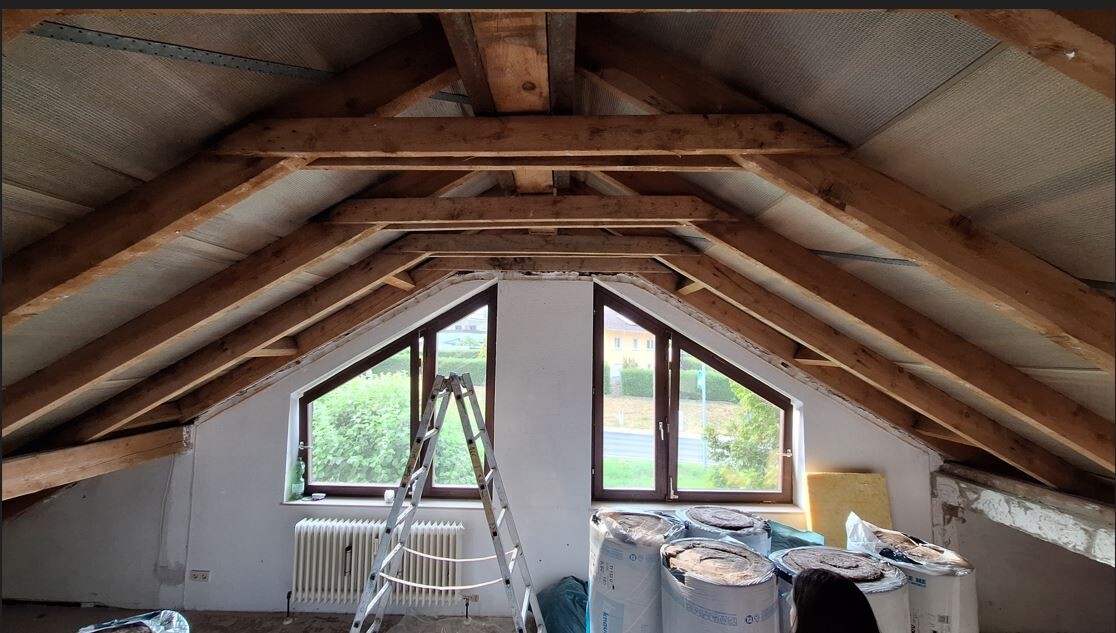
I’m new here. We have bought a house from 1980 with a rafter roof featuring a ridge beam, a central purlin, and a wall plate still in their original condition. New insulation is currently being installed between the rafters. At that time, large rooms were built under the sloping roof, with a partially horizontal ceiling beneath the collar beams. In fact, all rafters above the room are connected by double collar beams.
My question: Do these collar beams have a structural function, or are they only there to support the ceiling construction? We are now considering the possibility of removing the collar beams and extending the roof slopes all the way up to the ridge beam. This would keep the window openings in the masonry intact and prevent the upper part of the trapezoidal windows from being cut off.
Do the collar beams hold the rafters together and keep them vertically aligned (cross-section 8 x 180mm (0.3 x 7 inches))? Our carpenter told us that "back then, they liked to use a lot of wood"... Is there any risk in doing without these double collar beams?
Thanks for your time and help!
Bruno

I am "just" a building consultant, not a structural engineer. And the original poster is already convinced by reason. But for them and other readers, I am happy to explain in more detail:
No, not just any danger – but that the roof structure could collapse.
He should consider retraining; in his profession, he should know better (and even be able to explain it better than I can).
Braces and belt—but in a configuration where both are needed.
Three times correct: 1. there was a reason, 2. structurally necessary, and 3. replaceable. In my opinion, they can be replaced by supports at least under the central purlins, which in turn would need to be connected by (longer) collar ties and transfer the loads onto the ceiling below. Or, translated into your carpenter’s language: even back then, builders liked to work with a lot of wood, but not more than necessary (and therefore not unnecessarily much wood).
If there were a force connection between them and the ridge purlin, that would actually create a structural short circuit.
The purpose of the collar ties here is to prevent the rafters from spreading outwards toward the eaves by forming a stable triangle together with the rafters on both sides. Since they are offset from the rafters’ axis, they must do this with shared strength from both sides. They are, so to speak, an upward-shifted base of the triangle (presumably due to the use of a concrete ceiling). Alternatively, the triangle could have been constructed using the floor joists of the lower floor as the bottom chord. How the forces in a roof structure interact is also a matter of their geometric and physical relationships. In this case, there is obviously a relatively flat gable roof (around 30° or slightly less), which is borderline for this type of roof construction, and the attic space is probably intended as a storage or dry space without intermediate walls to integrate supports for the purlins. Now you can explain this to your carpenter apprentice as well.
If they were only there to assist ceiling construction, squared timber in a similar position (but not in pairs) would have been sufficient. I recommend that you insulate the entire length of the rafters — including beyond the collar ties and behind any knee walls that might still be cut back — because this creates a better thermal seal. The fuss of cladding around the collar ties versus installing a ceiling beneath them is roughly the same effort (choosing between the lesser of two evils, time-consuming and inefficient in relation to the large surfaces either way). But thermally, this avoids a cold air gap between the collar ties and the ridge. Installing a ceiling and insulating it would actually require even more fiddly work time in exchange for barely saving any insulation roll length.
https://www.instagram.com/11antgmxde/
https://www.linkedin.com/company/bauen-jetzt/
Soaring138 schrieb:
Is there any danger in skipping these double collar ties?
No, not just any danger – but that the roof structure could collapse.
Soaring138 schrieb:
Our carpenter tells us that back then, "they liked to work with a lot of wood"...
He should consider retraining; in his profession, he should know better (and even be able to explain it better than I can).
hanghaus2023 schrieb:
whether the braces (Hosenträger) are just a backup to the main belt (Gürtel). What I almost fear.
Braces and belt—but in a configuration where both are needed.
hanghaus2023 schrieb:
There must have been a reason back then to go to the trouble. A structural engineer can verify this through calculations.
Michilo schrieb:
These parts are also called ridge straps and are a structurally necessary element. According to reliable sources, they serve to stiffen the rafters and handle the tension and compression forces in the rafters. There may be alternatives. A structural engineer or carpenter can advise you. I wouldn’t just remove them.
Three times correct: 1. there was a reason, 2. structurally necessary, and 3. replaceable. In my opinion, they can be replaced by supports at least under the central purlins, which in turn would need to be connected by (longer) collar ties and transfer the loads onto the ceiling below. Or, translated into your carpenter’s language: even back then, builders liked to work with a lot of wood, but not more than necessary (and therefore not unnecessarily much wood).
Soaring138 schrieb:
The ridge purlin is not supported on the collar ties at all. The collar ties only connect the rafters in pairs.
If there were a force connection between them and the ridge purlin, that would actually create a structural short circuit.
The purpose of the collar ties here is to prevent the rafters from spreading outwards toward the eaves by forming a stable triangle together with the rafters on both sides. Since they are offset from the rafters’ axis, they must do this with shared strength from both sides. They are, so to speak, an upward-shifted base of the triangle (presumably due to the use of a concrete ceiling). Alternatively, the triangle could have been constructed using the floor joists of the lower floor as the bottom chord. How the forces in a roof structure interact is also a matter of their geometric and physical relationships. In this case, there is obviously a relatively flat gable roof (around 30° or slightly less), which is borderline for this type of roof construction, and the attic space is probably intended as a storage or dry space without intermediate walls to integrate supports for the purlins. Now you can explain this to your carpenter apprentice as well.
Soaring138 schrieb:
Or do they only serve as assistance for the ceiling construction? Today we are wondering whether we can do without the collar ties and extend the roof slopes all the way up to the ridge purlin.
If they were only there to assist ceiling construction, squared timber in a similar position (but not in pairs) would have been sufficient. I recommend that you insulate the entire length of the rafters — including beyond the collar ties and behind any knee walls that might still be cut back — because this creates a better thermal seal. The fuss of cladding around the collar ties versus installing a ceiling beneath them is roughly the same effort (choosing between the lesser of two evils, time-consuming and inefficient in relation to the large surfaces either way). But thermally, this avoids a cold air gap between the collar ties and the ridge. Installing a ceiling and insulating it would actually require even more fiddly work time in exchange for barely saving any insulation roll length.
https://www.instagram.com/11antgmxde/
https://www.linkedin.com/company/bauen-jetzt/
S
Soaring13827 May 2025 11:00Thank you, 11ant, for the detailed summary.
This helps us a lot.
Good luck
Bruno
This helps us a lot.
Good luck
Bruno
Three years ago, our roofer told us these could be removed when we converted the attic into a hobby room. So far, the roof is holding up; hopefully, it stays that way.
He said they were only connected like that back then to prevent them from shifting during the roof construction…
In our lack of knowledge, we then used his information to simply connect them at the top on both sides with a flat metal connector.
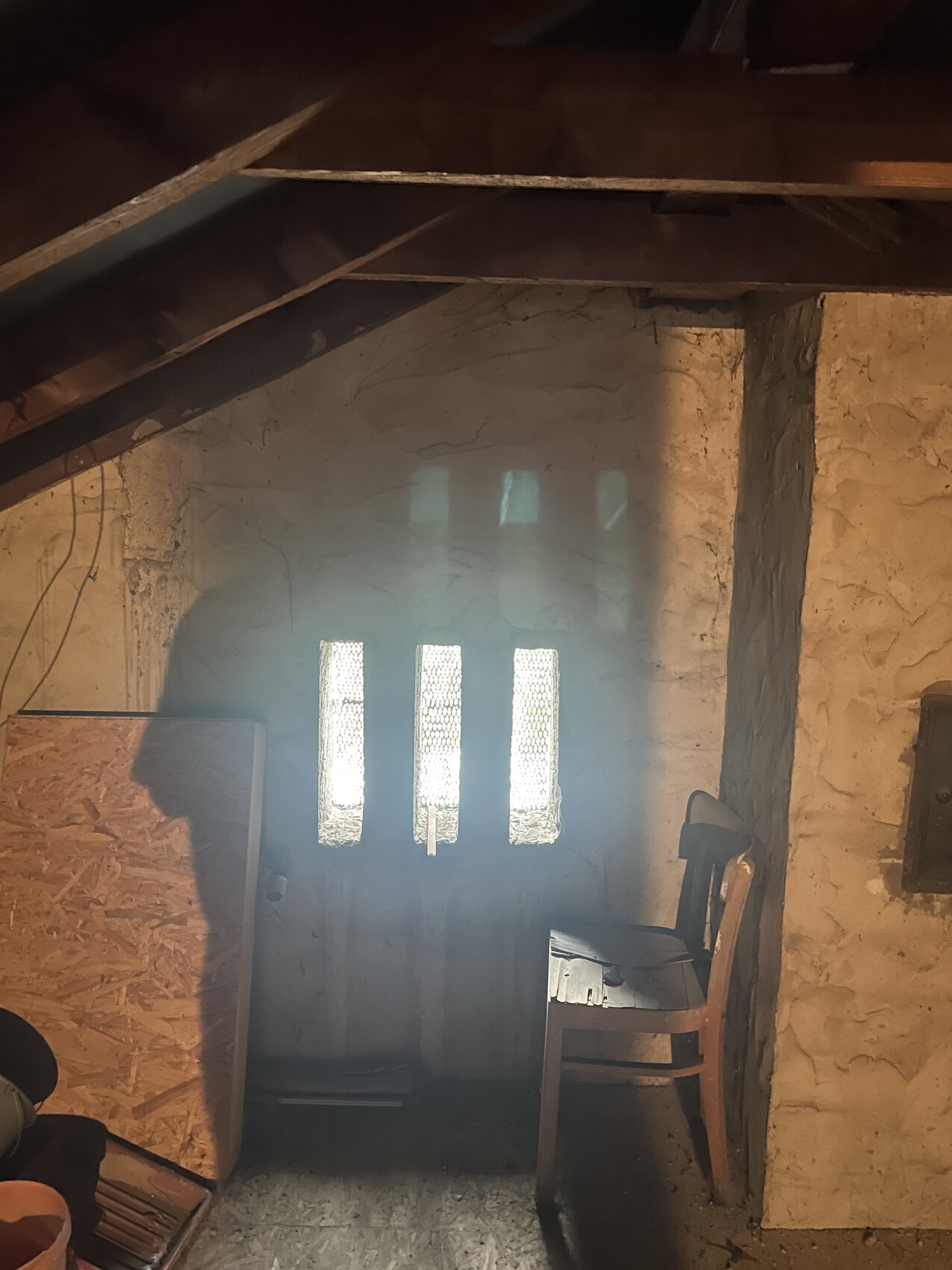

He said they were only connected like that back then to prevent them from shifting during the roof construction…
In our lack of knowledge, we then used his information to simply connect them at the top on both sides with a flat metal connector.
 In der Ruine28 May 2025 15:31
Ugarlino schrieb:
In our ignorance, we then simply connected them on top on both sides using a flat connector, based on his information.Three nails for two rafters. Cute.Ugarlino schrieb:
Our roofer told us three years ago that these could be removed, [...] he said they were only connected like that back then to prevent them from slipping during the roof construction… The roofer is obviously only familiar with the other (upper) side of the roof.
Ugarlino schrieb:
So far the roof is holding up, hopefully it stays that way. [...] out of ignorance, we then connected them just on top with a flat connector on both sides based on his information. Then we’re hoping wind and snow loads remain moderate. Not everything creaks before it breaks.
https://www.instagram.com/11antgmxde/
https://www.linkedin.com/company/bauen-jetzt/
H
hanghaus202328 May 2025 22:16Please do not try to copy what @Ugarlino is doing there, and especially not what is shown in the picture.
A metal connector plate does not have so many holes without a reason.
A metal connector plate does not have so many holes without a reason.
Similar topics