
Hello everyone,
we are currently building a townhouse and are also planning to include a fireplace. To cover everything in the execution planning, we are now focusing on the fireplace design. In our house, between the living and dining rooms (41 m² (440 sq ft)), there is a corner where the masonry chimney will be installed and where the fireplace is supposed to be.
The planned fireplace should:
- fit into our corner (1.00 x 1.27 m (3.3 x 4.2 ft), including the chimney)
- offer a view of the flames through a two-sided glass
- provide gentle radiant heat
- store heat for as long as possible; ≥ 6-10 hours (my parents have a hypocaust system)
- ideally have a modern look, with a stepped design over two levels and an overhang for the chimney to visually integrate it # link removed by moderation; building expert
Now, two fireplace installers have presented us with completely different concepts. One wants to sell us a warm air stove with storage (e.g., a fireplace insert from the company Spartherm Varia 1 V-4S with magnetic storage, possibly also a fireplace insert with storage). The other offered a fireplace with double-chamber storage technology without warm air circulation (e.g., Rüegg Venus). Both concepts are similarly priced around 8,000 EUR plus.
What do you think? Which concept stores heat longer and offers better quality? The installer with the warm air stove said we wouldn’t manage with a closed system within our space and budget and that his system stores heat for a very long time as well. The colleague with the storage fireplace said that the warm air stove alone can only store about 3 hours architecturally, even if fully equipped with storage.
Thanks and best regards, Redsonic
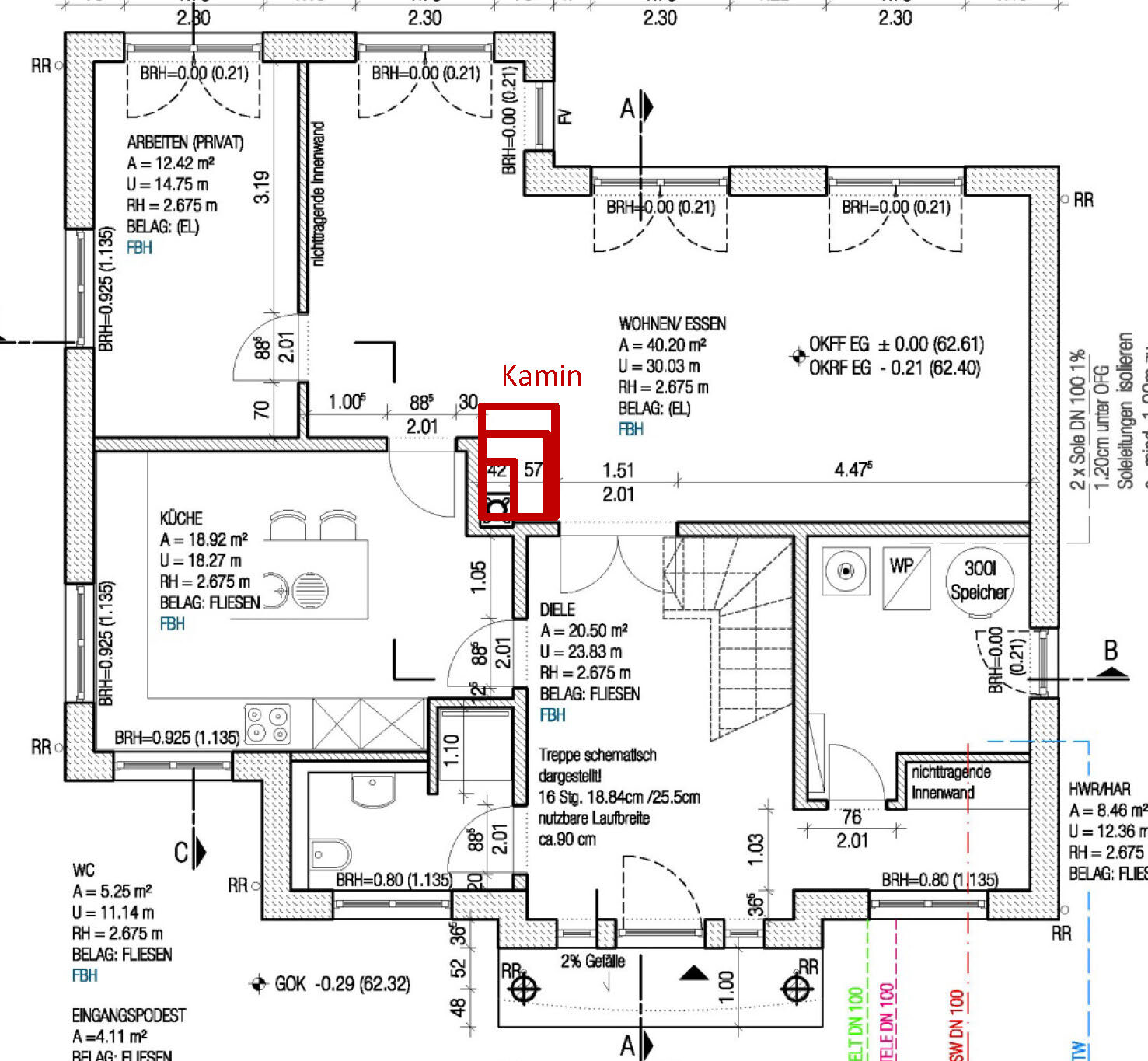
we are currently building a townhouse and are also planning to include a fireplace. To cover everything in the execution planning, we are now focusing on the fireplace design. In our house, between the living and dining rooms (41 m² (440 sq ft)), there is a corner where the masonry chimney will be installed and where the fireplace is supposed to be.
The planned fireplace should:
- fit into our corner (1.00 x 1.27 m (3.3 x 4.2 ft), including the chimney)
- offer a view of the flames through a two-sided glass
- provide gentle radiant heat
- store heat for as long as possible; ≥ 6-10 hours (my parents have a hypocaust system)
- ideally have a modern look, with a stepped design over two levels and an overhang for the chimney to visually integrate it # link removed by moderation; building expert
Now, two fireplace installers have presented us with completely different concepts. One wants to sell us a warm air stove with storage (e.g., a fireplace insert from the company Spartherm Varia 1 V-4S with magnetic storage, possibly also a fireplace insert with storage). The other offered a fireplace with double-chamber storage technology without warm air circulation (e.g., Rüegg Venus). Both concepts are similarly priced around 8,000 EUR plus.
What do you think? Which concept stores heat longer and offers better quality? The installer with the warm air stove said we wouldn’t manage with a closed system within our space and budget and that his system stores heat for a very long time as well. The colleague with the storage fireplace said that the warm air stove alone can only store about 3 hours architecturally, even if fully equipped with storage.
Thanks and best regards, Redsonic
Hi,
I have a masonry heater that, once fully heated, retains warmth for about 16-20 hours. Additionally, it has a water jacket integrated, so I can use it to support the heating system.
A friend of mine has a warm-air stove. Basically, it has a steel firebox surrounded by a heat-retaining layer (in my friend’s case, ceramic tiles) and air vents where the warm air escapes. Once fully heated, it keeps warm for about 4-6 hours. The advantage of the warm-air system is that it releases heat relatively quickly. My heater takes about 2-3 hours to get properly warm. I only need to stoke it twice a day (unless I switch to the water jacket and fill the buffer tank).
Personally, I don’t want a warm-air stove—convective heat isn’t really my preference…
I have a masonry heater that, once fully heated, retains warmth for about 16-20 hours. Additionally, it has a water jacket integrated, so I can use it to support the heating system.
A friend of mine has a warm-air stove. Basically, it has a steel firebox surrounded by a heat-retaining layer (in my friend’s case, ceramic tiles) and air vents where the warm air escapes. Once fully heated, it keeps warm for about 4-6 hours. The advantage of the warm-air system is that it releases heat relatively quickly. My heater takes about 2-3 hours to get properly warm. I only need to stoke it twice a day (unless I switch to the water jacket and fill the buffer tank).
Personally, I don’t want a warm-air stove—convective heat isn’t really my preference…

I completely agree. In my current rental apartment, I have a wood stove that heats both the bedroom and the living room. In the evening, the living room reaches a fairly warm 25°C (77°F), but the air is quite dry. However, the heat dissipates quickly; after 2 to 3 hours, the stove is only lukewarm, and by morning the temperature drops to around 20°C (68°F), which feels almost too cold.
I would prefer a stove that retains heat for a longer period and relies more on radiant heat. My parents have a cookstove located between the kitchen and dining room, and even that provides a more comfortable warmth. It also seems to me that it stays warm for longer.
I would prefer a stove that retains heat for a longer period and relies more on radiant heat. My parents have a cookstove located between the kitchen and dining room, and even that provides a more comfortable warmth. It also seems to me that it stays warm for longer.
Thanks for your responses. I’m quite confused after visiting three different fireplace builders, all offering the same concept: a firebox surrounded by Magnetherm blocks (which act as a heat reservoir), enclosed in a plastered casing made of heat-retaining yet permeable stones with a higher density than standard Ytong. In other words, a convection heating unit enhanced with storage elements for radiant heat.
No one is willing or able to offer a traditional masonry heater. Does anyone have an idea why that might be? Could it be that my available space is too small? We have a maximum depth of 1.00 m (39 inches) and a width of 1.07 m (42 inches), including a 0.42 m (16.5 inches) chimney located in the corner. We could extend about 0.30 m (12 inches) further into the room if needed.
Now our architect is asking for details for the execution plan regarding pipe diameter, chimney foundation, and the position of the floor air intake. But no one wants to provide that information before I’ve signed the fireplace contract. Can I simply have the foundation built with dimensions of 1.00 x 1.30 m (39 x 51 inches), and if the fireplace ends up smaller, that won’t be a big problem?
Good luck, Redsonic
No one is willing or able to offer a traditional masonry heater. Does anyone have an idea why that might be? Could it be that my available space is too small? We have a maximum depth of 1.00 m (39 inches) and a width of 1.07 m (42 inches), including a 0.42 m (16.5 inches) chimney located in the corner. We could extend about 0.30 m (12 inches) further into the room if needed.
Now our architect is asking for details for the execution plan regarding pipe diameter, chimney foundation, and the position of the floor air intake. But no one wants to provide that information before I’ve signed the fireplace contract. Can I simply have the foundation built with dimensions of 1.00 x 1.30 m (39 x 51 inches), and if the fireplace ends up smaller, that won’t be a big problem?
Good luck, Redsonic
Hi,
my masonry heater has a base area of 1.20m by 2m (3.9ft by 6.6ft) with 7 meters (23ft) of flue channels. The foundation is cut out exactly for it. My combustion chamber holds 10kg (22 lbs). The wall penetration for the stove is a 180mm (7 inch) pipe and the fresh air supply is a 150mm (6 inch) pipe. I also have a wood stove in the study (42m² (452ft²)) with 6kW output; it has a fresh air intake of 120mm (5 inch) and a flue pipe of 150mm (6 inch). I searched for a long time until I found a stove builder who did exactly what I wanted and didn’t just try to sell some “mass-produced” unit.
There are several providers nationwide on the internet, but they are about 10% more expensive than my local craftsman.
my masonry heater has a base area of 1.20m by 2m (3.9ft by 6.6ft) with 7 meters (23ft) of flue channels. The foundation is cut out exactly for it. My combustion chamber holds 10kg (22 lbs). The wall penetration for the stove is a 180mm (7 inch) pipe and the fresh air supply is a 150mm (6 inch) pipe. I also have a wood stove in the study (42m² (452ft²)) with 6kW output; it has a fresh air intake of 120mm (5 inch) and a flue pipe of 150mm (6 inch). I searched for a long time until I found a stove builder who did exactly what I wanted and didn’t just try to sell some “mass-produced” unit.
There are several providers nationwide on the internet, but they are about 10% more expensive than my local craftsman.
Similar topics