
Hello everyone,
Attached is a photo of a wall that our neighbor built. Since it looks quite unattractive, we are wondering how to improve its appearance.
Plastering would be an option, but I’m not sure if it would last over time, as the wall or formwork blocks could get damp. The neighbor placed a membrane behind it and poured concrete, but I’m still unsure about this.
Would paint hold on that surface?
Or would it be better to simply spray paint it?
Thanks for any tips and experiences!
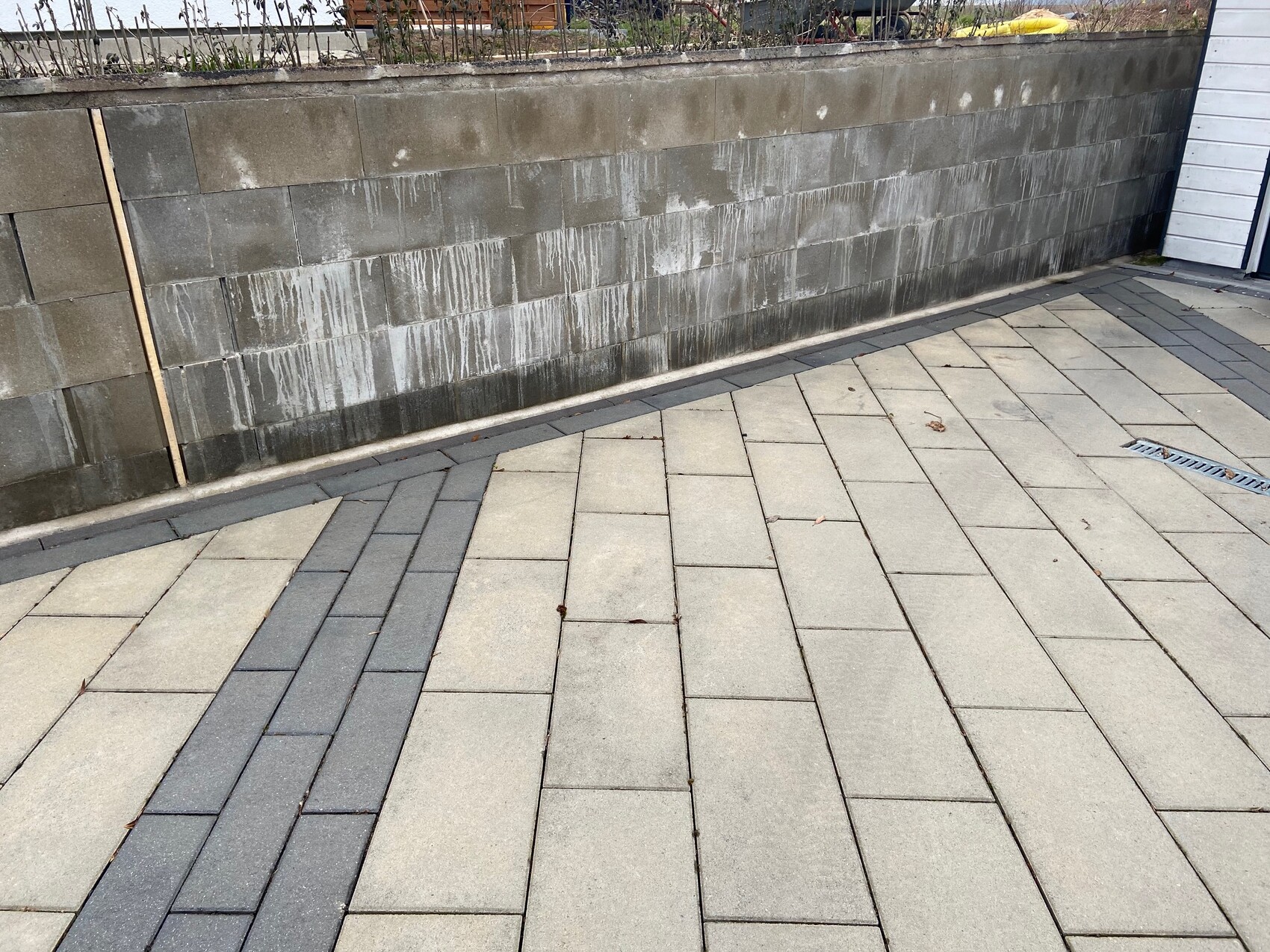
Attached is a photo of a wall that our neighbor built. Since it looks quite unattractive, we are wondering how to improve its appearance.
Plastering would be an option, but I’m not sure if it would last over time, as the wall or formwork blocks could get damp. The neighbor placed a membrane behind it and poured concrete, but I’m still unsure about this.
Would paint hold on that surface?
Or would it be better to simply spray paint it?
Thanks for any tips and experiences!
I wouldn’t use formwork for that, since I’m a bit paranoid and would like to be able to see immediately if something shifts in the wall, for example, if the work wasn’t done properly... I would at most plant something – but for that, you would have to remove your own paving again, because watering plants in pots is difficult to keep up with.
Just a quick note regarding the appearance:
Of course, it depends on what kind of wall is built. A finished garden wall—whether made of split concrete blocks like the Santuro wall, hollow chamber blocks, or a traditional Friesland-style wall—is visually generally accepted without dispute. Naturally, the neighbor has the option to place something on their side in front of it if they don’t like the appearance. A ready-made privacy fence is clearly different from a makeshift fence nailed together from formwork boards that looks more like a construction site barrier on a shopping street 😉
If, however, a wall is built using formwork blocks (also known as basement wall blocks), whose purpose and manufacture are not intended as decorative garden walls but as structural masonry, retaining walls, or even used as manure channels and silage pits, the neighbor may indeed take legal action to require the wall to be plastered or painted to avoid looking at an unfinished structure. Similarly, in house construction, there is usually a deadline by which the exterior of the shell must be completed (in France, for example, some people take a long time with this because certain taxes are only due after the facade is finished).
Of course, it depends on what kind of wall is built. A finished garden wall—whether made of split concrete blocks like the Santuro wall, hollow chamber blocks, or a traditional Friesland-style wall—is visually generally accepted without dispute. Naturally, the neighbor has the option to place something on their side in front of it if they don’t like the appearance. A ready-made privacy fence is clearly different from a makeshift fence nailed together from formwork boards that looks more like a construction site barrier on a shopping street 😉
If, however, a wall is built using formwork blocks (also known as basement wall blocks), whose purpose and manufacture are not intended as decorative garden walls but as structural masonry, retaining walls, or even used as manure channels and silage pits, the neighbor may indeed take legal action to require the wall to be plastered or painted to avoid looking at an unfinished structure. Similarly, in house construction, there is usually a deadline by which the exterior of the shell must be completed (in France, for example, some people take a long time with this because certain taxes are only due after the facade is finished).
Similar topics