
ᐅ Planning a Single-Family Home for a Family of Four, West Münsterland Region, Initial Architect’s Draft
Created on: 20 Oct 2025 12:17
-
-Malte-
Hello everyone,
after some time spent on the selection of our plot in the new development area, we have now started the planning phase. We have found an architect, and a very first draft (without incorporating our feedback yet) has recently been presented to us. We would like to gather ideas and suggestions here.
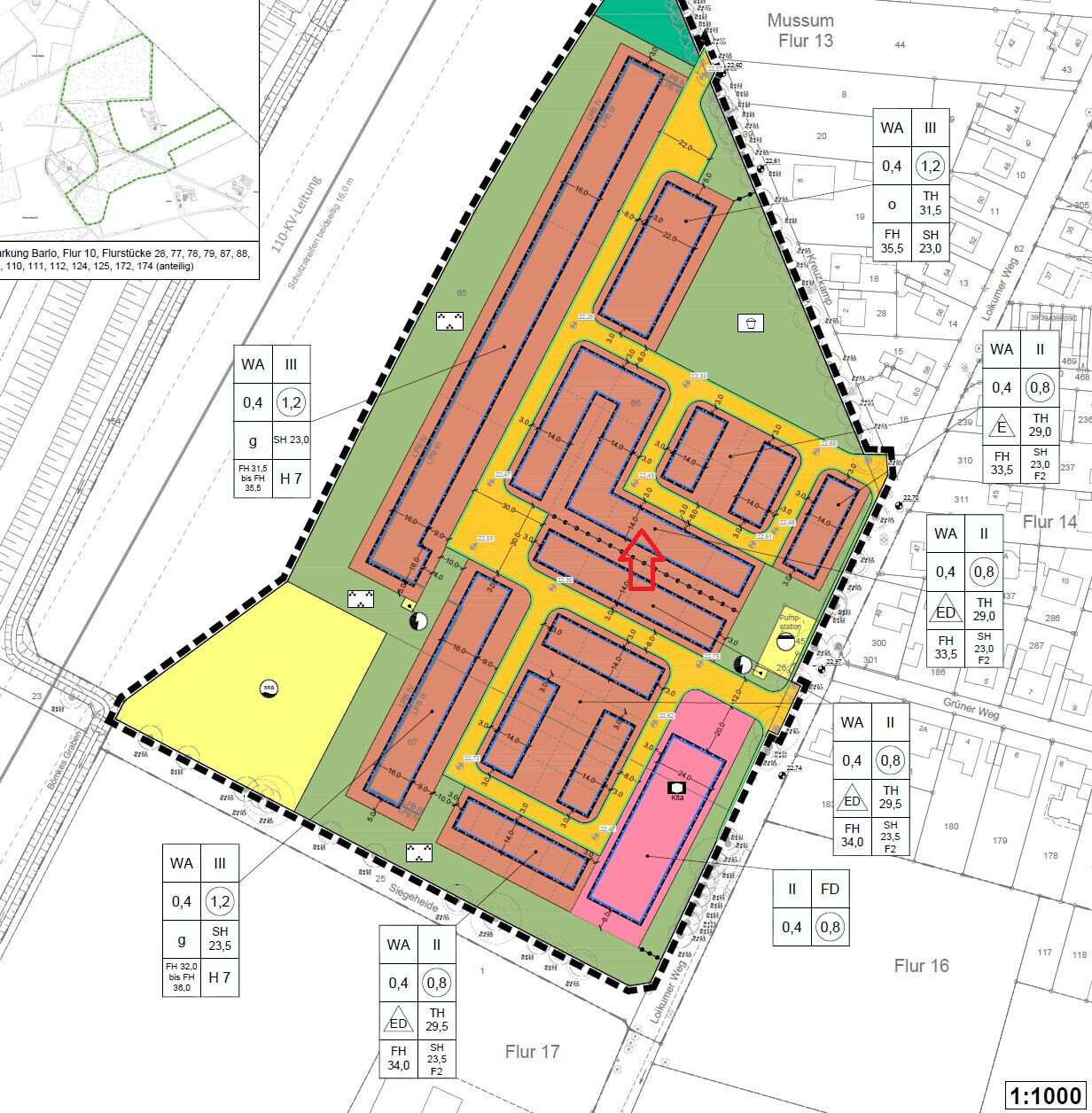
Development Plan / Restrictions
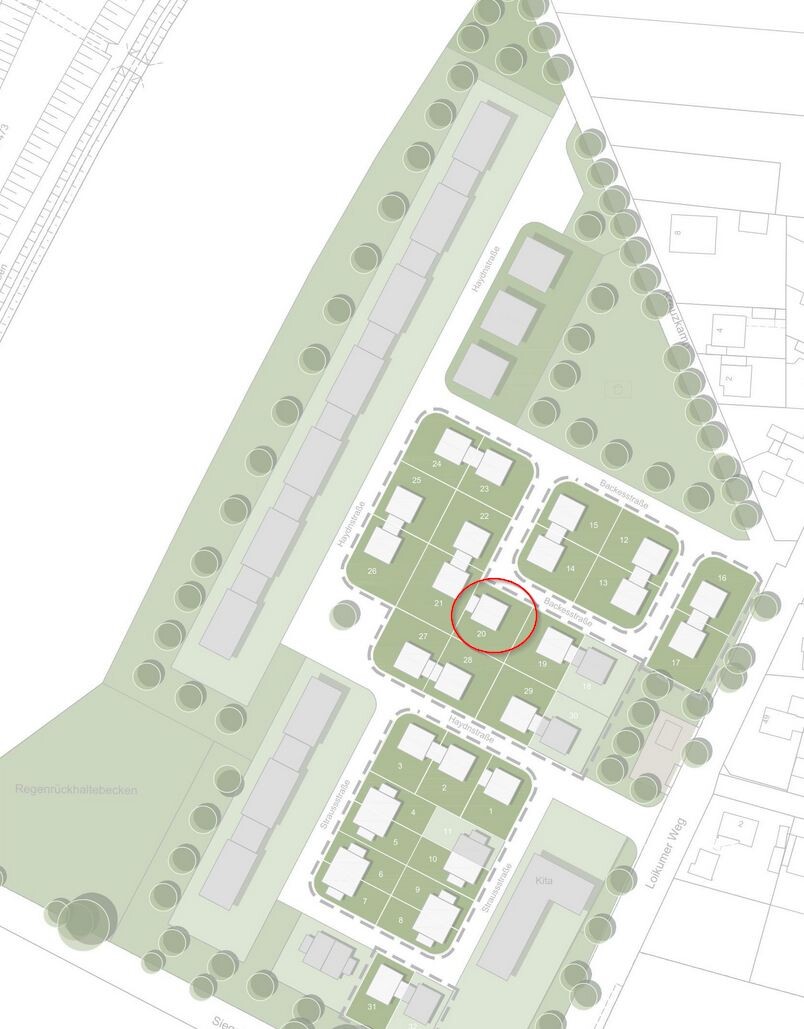
Plot size: 456m² (rectangular, 20.7m wide and 22.0m long)
Slope: no, completely flat
Floor area ratio (FAR) for land use: 0.4
Floor space index (FSI): 0.8
Building envelope, building line, and boundary: 14m (46 feet) deep building envelope across the entire plot width
Edge development: ?
Number of parking spaces: space for 2 cars required
Number of storeys: 2 full storeys allowed (with shed or flat roof)
Roof type: with 2 full storeys a shed or flat roof is mandatory, with 1 full storey no restrictions
Architectural style: no restrictions
Orientation: no restrictions
Maximum heights/limits: base height max 0.5m (1.5 feet); eaves height max 6.5m (21 feet); ridge height max 11.0m (36 feet)
Further specifications: no dormers or roof protrusions allowed according to the development plan
Other: detailed information can easily be found online by searching "Bebauungsplan 8-23 Bocholt"
Homeowners’ Requirements
Style, roof type, building type: desired is a traditional brick-faced gable roof house typical for western Münsterland, with a fairly steep roof pitch. Construction as a solid masonry house.
Basement, storeys: built on a slab foundation without basement; living spaces planned either on ground floor and first floor or ground floor, first floor, and attic
Number of people, ages: 4 persons (38, 35, 5, 3)
Room needs on ground and first floors: living area (kitchen/dining/living), guest WC including small shower, master bedroom without separate dressing room, 2 children’s rooms, 1 office, 1 bathroom, sufficient storage space for everyday family needs
Office (family use or home office): 1 dedicated full-time home office used about 4 days/week
Overnight guests per year: very few, no guest room needed
Open or closed layout: middle ground
Conservative or modern design: middle ground
Open kitchen, kitchen island: kitchen tends to be open, possibly with slight visual separation
Number of dining seats: table for 6 persons
Fireplace: no
Music/sound system wall: TV to be located in the living area
Balcony, roof terrace: no
Garage, carport: garage desired for numerous bicycles, children’s vehicles, and other outdoor gear
Utility garden, greenhouse: no
Other wishes / special features / daily routine, also reasons why some things should or should not be included: the wish is for a classic single-family house for a family of four with fixed home office space. Not a "palace," but a house that functions well in everyday family life. The house should be realized as a "climate-friendly new build" (KFW300 without QNG).
About the House Design
Who created the design?
First draft by an independent architect (initial version, no details adjusted or feedback incorporated yet)
What do you particularly like? Why?
What do you not like? Why?
Price estimate from the architect/designer: none yet
Personal price limit for the house including fittings: 650,000€ (house including ancillary costs, kitchen, garage, driveway/terrace)
Preferred heating technology: heat pump (possibly ground-source heat pump if trench collector is feasible, otherwise air-to-water heat pump)
What can you do without?
- can do without: excessive hallway areas, possibly the small gable projections (dormers)
- cannot do without: our room program including sufficient storage, window areas for plenty of natural light
Why does the design look the way it does now?
The design is based on our wishes/room program and generally meets them. The staircase could be extended up to the attic in the draft, but for this layout, a finished attic would not be needed for space or cost reasons. It would likely remain as an unfinished attic accessed by a folding ladder.
Final comments
After some further consideration, we see two options:
We look forward to your thoughts and input.
Best regards,
Malte
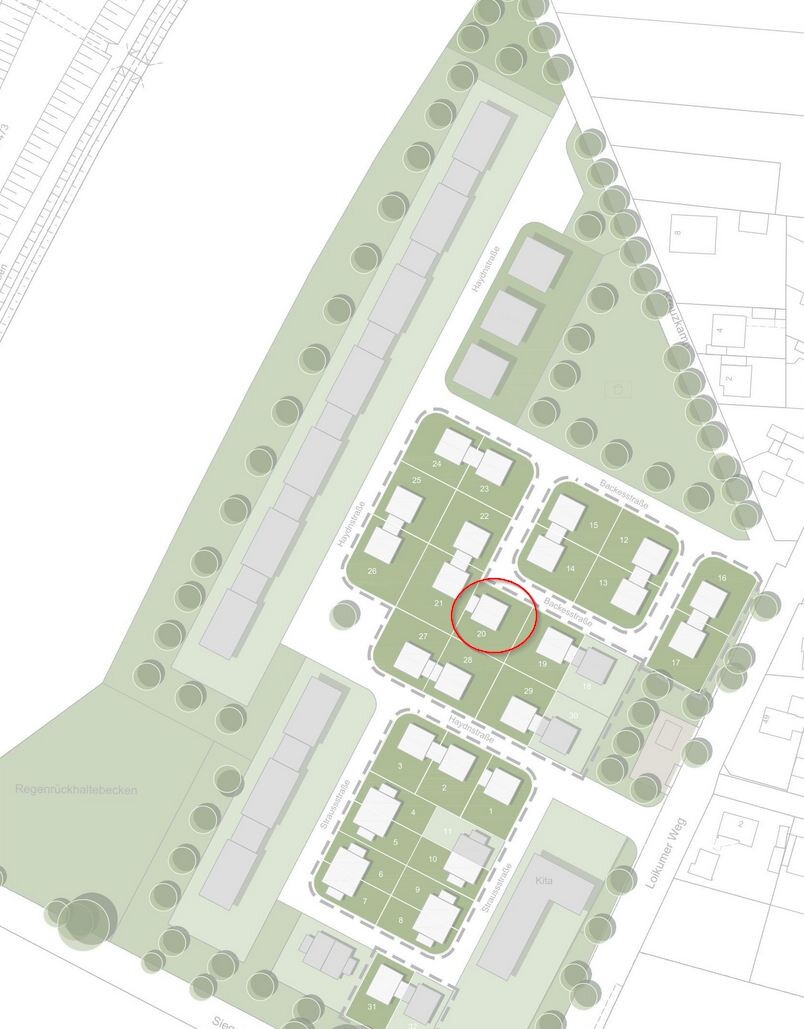
after some time spent on the selection of our plot in the new development area, we have now started the planning phase. We have found an architect, and a very first draft (without incorporating our feedback yet) has recently been presented to us. We would like to gather ideas and suggestions here.
Development Plan / Restrictions
Plot size: 456m² (rectangular, 20.7m wide and 22.0m long)
Slope: no, completely flat
Floor area ratio (FAR) for land use: 0.4
Floor space index (FSI): 0.8
Building envelope, building line, and boundary: 14m (46 feet) deep building envelope across the entire plot width
Edge development: ?
Number of parking spaces: space for 2 cars required
Number of storeys: 2 full storeys allowed (with shed or flat roof)
Roof type: with 2 full storeys a shed or flat roof is mandatory, with 1 full storey no restrictions
Architectural style: no restrictions
Orientation: no restrictions
Maximum heights/limits: base height max 0.5m (1.5 feet); eaves height max 6.5m (21 feet); ridge height max 11.0m (36 feet)
Further specifications: no dormers or roof protrusions allowed according to the development plan
Other: detailed information can easily be found online by searching "Bebauungsplan 8-23 Bocholt"
Homeowners’ Requirements
Style, roof type, building type: desired is a traditional brick-faced gable roof house typical for western Münsterland, with a fairly steep roof pitch. Construction as a solid masonry house.
Basement, storeys: built on a slab foundation without basement; living spaces planned either on ground floor and first floor or ground floor, first floor, and attic
Number of people, ages: 4 persons (38, 35, 5, 3)
Room needs on ground and first floors: living area (kitchen/dining/living), guest WC including small shower, master bedroom without separate dressing room, 2 children’s rooms, 1 office, 1 bathroom, sufficient storage space for everyday family needs
Office (family use or home office): 1 dedicated full-time home office used about 4 days/week
Overnight guests per year: very few, no guest room needed
Open or closed layout: middle ground
Conservative or modern design: middle ground
Open kitchen, kitchen island: kitchen tends to be open, possibly with slight visual separation
Number of dining seats: table for 6 persons
Fireplace: no
Music/sound system wall: TV to be located in the living area
Balcony, roof terrace: no
Garage, carport: garage desired for numerous bicycles, children’s vehicles, and other outdoor gear
Utility garden, greenhouse: no
Other wishes / special features / daily routine, also reasons why some things should or should not be included: the wish is for a classic single-family house for a family of four with fixed home office space. Not a "palace," but a house that functions well in everyday family life. The house should be realized as a "climate-friendly new build" (KFW300 without QNG).
About the House Design
Who created the design?
First draft by an independent architect (initial version, no details adjusted or feedback incorporated yet)
What do you particularly like? Why?
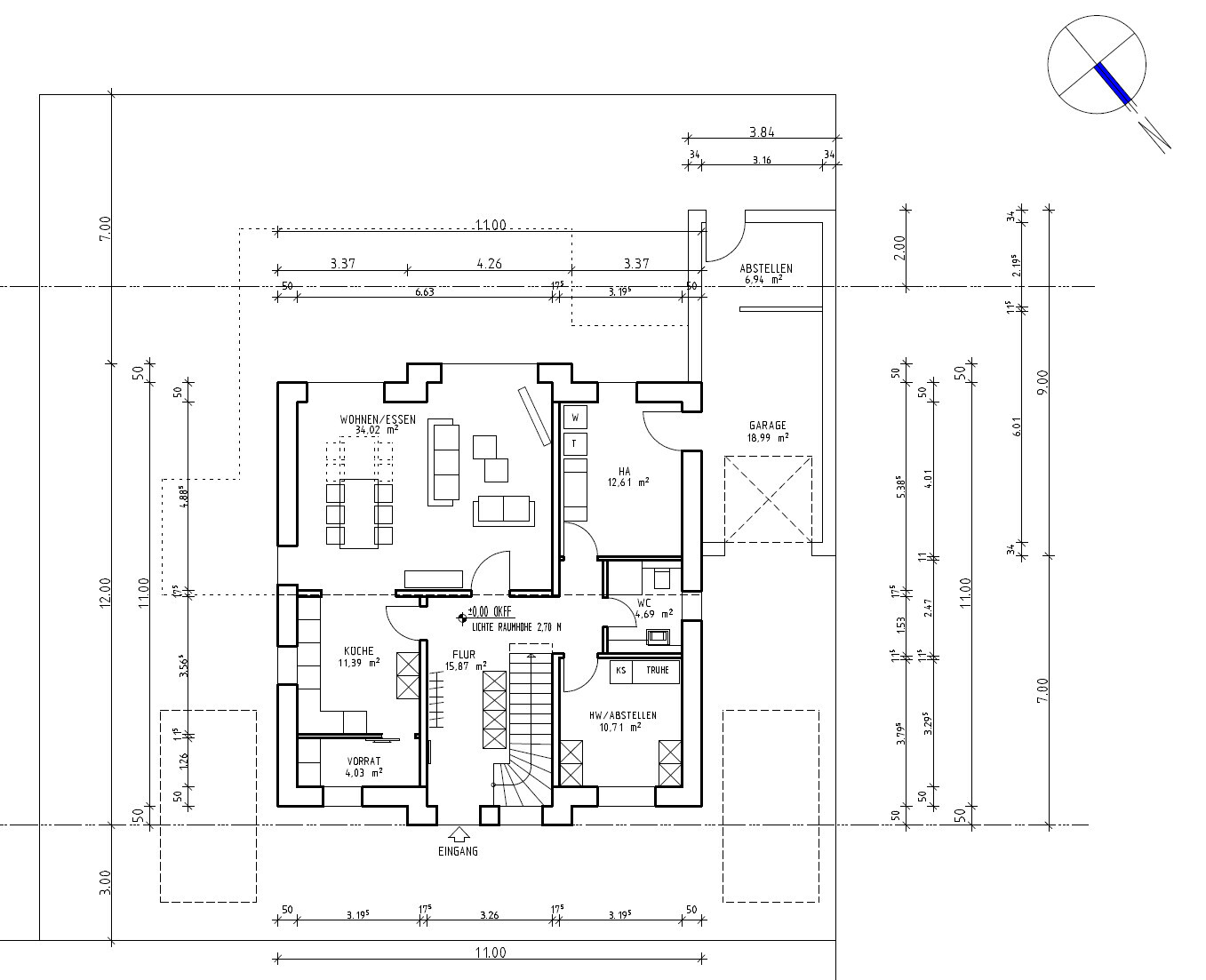
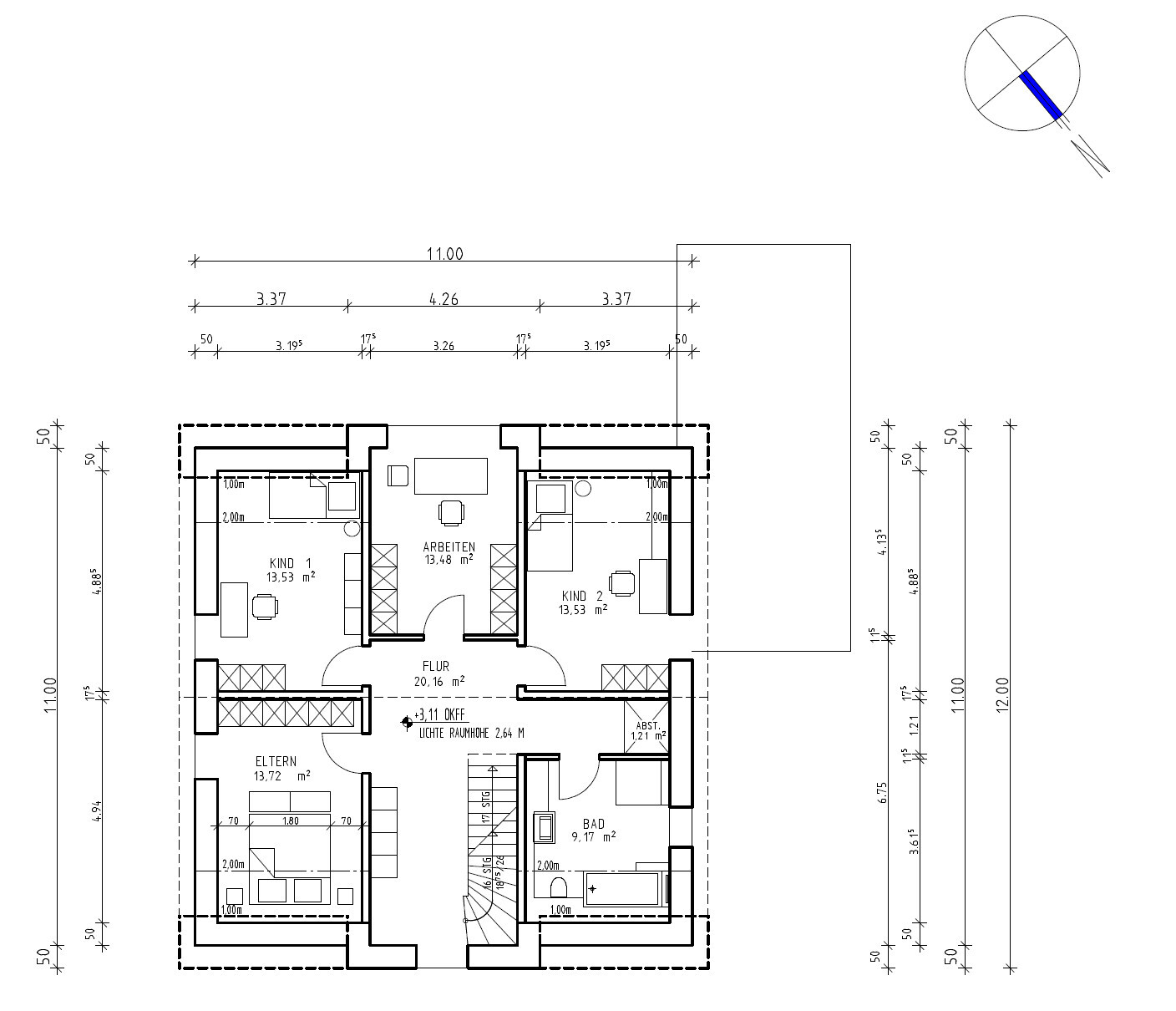
- The design fully covers our room program/specifications; all necessary rooms and sufficient storage space are included.
- Preferences such as the arrangement of kitchen/dining/living “around the corner” and similarly sized children’s rooms are included.
- The design as a gable roof house with two small gable projections (dormers/gables) is visually very appealing to us.
What do you not like? Why?
- Overall, the floor plan—especially the upper floor—does not appear efficient to us. The hallway area is clearly too large. The total living area is about 179m² (ground floor 94m² and upper floor 85m²), but it does not feel like that. For cost reasons alone, we aim for around 160m².
- The house is currently designed as 11m by 11m (36 by 36 feet) square, but we feel it should be stretched somewhat (e.g., 12m by 10m or similar) to better separate the kitchen and master bedroom. Probably the square shape was chosen to make the roof easier to develop.
- We suspect the current draft does not reach one full storey height yet (North Rhine-Westphalia: 3/4 rule) — adjustments to knee wall height and roof pitch may be necessary.
- Details need adjustment (e.g., remove pantry in kitchen to enlarge kitchen; doors; possibly add more roof windows; etc.).
Price estimate from the architect/designer: none yet
Personal price limit for the house including fittings: 650,000€ (house including ancillary costs, kitchen, garage, driveway/terrace)
Preferred heating technology: heat pump (possibly ground-source heat pump if trench collector is feasible, otherwise air-to-water heat pump)
What can you do without?
- can do without: excessive hallway areas, possibly the small gable projections (dormers)
- cannot do without: our room program including sufficient storage, window areas for plenty of natural light
Why does the design look the way it does now?
The design is based on our wishes/room program and generally meets them. The staircase could be extended up to the attic in the draft, but for this layout, a finished attic would not be needed for space or cost reasons. It would likely remain as an unfinished attic accessed by a folding ladder.
Final comments
After some further consideration, we see two options:
- Make the current design with the small dormers and room program on two floors more efficient and reduce it to about 160m². The attic would not be developed.
- Request an alternative design where the house is overall more compact and the attic is fully integrated (ground floor kitchen/dining/living, guest WC, utility room; first floor 2 children’s rooms, master bedroom, and bathroom; attic office and storage).
We look forward to your thoughts and input.
Best regards,
Malte
The Tolentino house, or the stair layout, is a sort of transverse design for a house where the plot width must allow the entrance next to the staircase and two rooms on the left and right gable sides. The stair layout defines the two rooms on the upper floor, which ideally should be a bit over 300cm (120 inches) wide to accommodate a wardrobe placed widthwise. This quickly leads to a house width of nearly 12 meters (39 feet). This is exactly what I am seeing with the Alto 650 right now. I must admit, there are certainly still many houses that manage with just under 11 meters (36 feet). Another issue is that with two stories, the staircase offers more flexibility because it can be rotated.
Yes, having a mudroom in front of the stairs should be avoided. Still, there are other limiting factors or preferences to consider, and some elements naturally conflict during planning. Just because 50% of people build differently doesn’t mean that having the stair entrance at the front door makes the house less functional. A well- and “simply” planned duplex with the staircase at the door can function better and appear more spacious than a house crammed with space-consuming “nice-to-haves.”
Yes, having a mudroom in front of the stairs should be avoided. Still, there are other limiting factors or preferences to consider, and some elements naturally conflict during planning. Just because 50% of people build differently doesn’t mean that having the stair entrance at the front door makes the house less functional. A well- and “simply” planned duplex with the staircase at the door can function better and appear more spacious than a house crammed with space-consuming “nice-to-haves.”
These are exactly the topics where we expected the architect to provide appropriate input and guidance, since we cannot oversee them ourselves. However, it seems we are not receiving this kind of support. If we were clearly told what consequences a stated wish or comment would have, we could consider giving certain things up. Without this input, it just doesn’t work, and the result ends up being nonsense.
To keep it brief, our main requirements are, from our perspective, not too complicated:
- A family of four with a dedicated home office
- One-and-a-half stories with a pitched roof, no basement, on a flat and nearly square plot (21m wide/22m long; street on the northeast side)
- No elaborate architecture (no gallery, no numerous projections, etc.)
- Living, dining, and kitchen areas not completely open and directly next to each other; some separation desired
- Reasonable storage space on the ground floor to accommodate wardrobes, laundry, etc., for everyday family life
- Staircase preferably not located in the dirty/entry zone
From your last post, should we seriously reconsider the wish to “avoid having the staircase near the front door” in order not to overly restrict many sensible design options here?
To keep it brief, our main requirements are, from our perspective, not too complicated:
- A family of four with a dedicated home office
- One-and-a-half stories with a pitched roof, no basement, on a flat and nearly square plot (21m wide/22m long; street on the northeast side)
- No elaborate architecture (no gallery, no numerous projections, etc.)
- Living, dining, and kitchen areas not completely open and directly next to each other; some separation desired
- Reasonable storage space on the ground floor to accommodate wardrobes, laundry, etc., for everyday family life
- Staircase preferably not located in the dirty/entry zone
From your last post, should we seriously reconsider the wish to “avoid having the staircase near the front door” in order not to overly restrict many sensible design options here?
Hello everyone,
We have spent the past two weeks reviewing standard floor plans to develop an idea that we can then discuss with the architect and use as a basis. We would really like to get your feedback in advance to see if this is generally heading in a sensible direction.
Important
Thoughts on the Design
Ground Floor – Option 1: Kitchen/Dining/Living in a Row
Ground Floor – Option 2: Kitchen/Dining/Living L-shaped
Questions for You
Best regards,
Malte
We have spent the past two weeks reviewing standard floor plans to develop an idea that we can then discuss with the architect and use as a basis. We would really like to get your feedback in advance to see if this is generally heading in a sensible direction.
Important
- This is not a finished floor plan, but a rough draft focused primarily on feasibility and practical arrangement/division of the rooms. Windows, doors, grid dimensions, and other details have not been fully considered and are not the main focus of our request.
- Complete questionnaire in post #1
- Four-person family with a dedicated home office
- One full story with a pitched roof without a basement on a flat and nearly square plot (21m wide/22m long (69 feet/72 feet); street located to the northeast)
- No elaborate architecture (no gallery, multiple projections, etc.)
- Living/dining/kitchen areas not completely open and directly adjacent; some separation preferred
- Adequate storage space on the ground floor for coats, laundry, and everyday family needs
- Staircase preferably not located in the entrance/mudroom area
Thoughts on the Design
- The floor plan is based on numerous very similar standard plans
- Rectangular house approximately 12.00m by 9.15m (39 feet by 30 feet) positioned parallel to the street to maximize the garden on the south side.
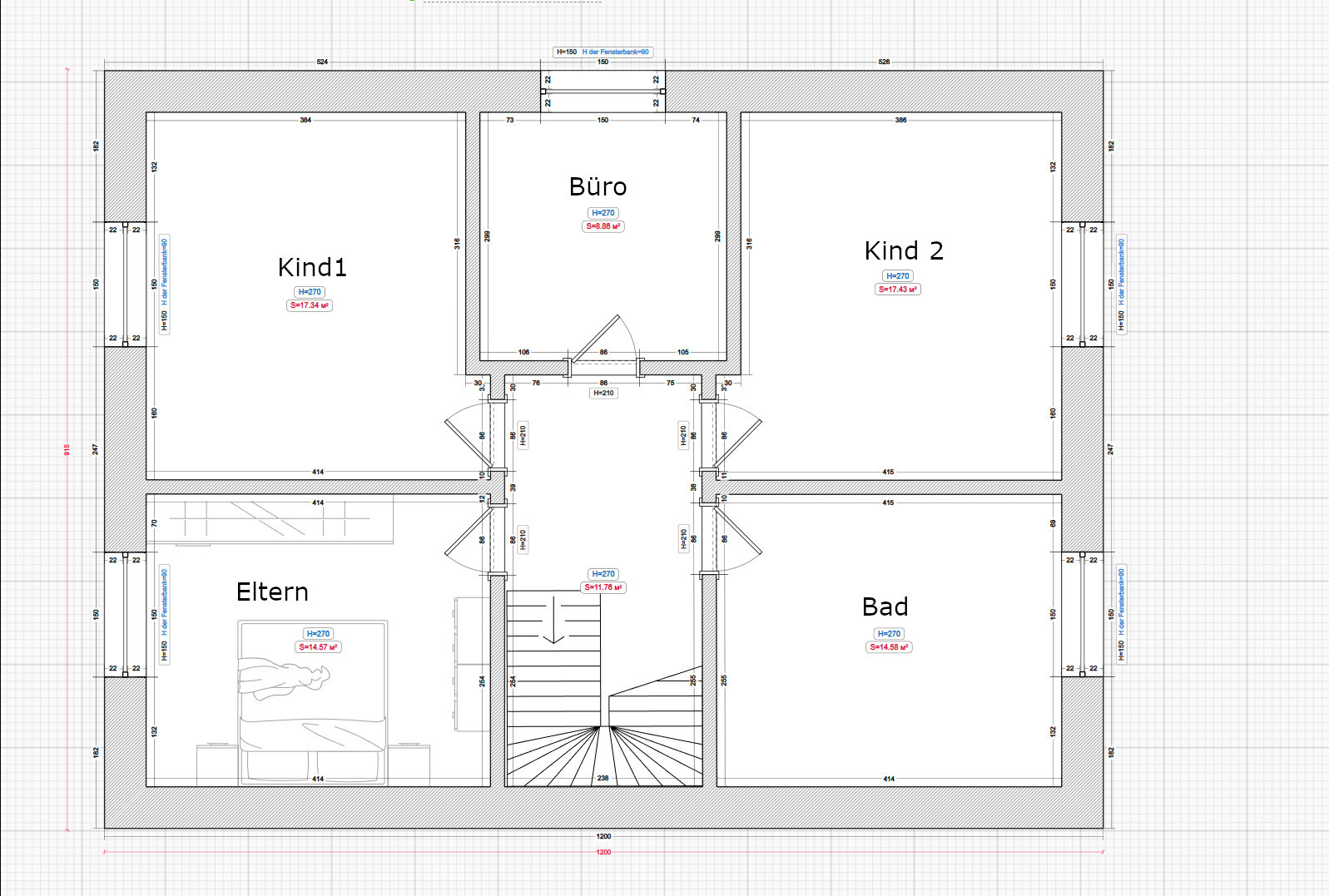
- Efficient upper floor with minimal hallway space and all rooms arranged in sizes that make sense for us
- Due to the requirement of one full story, a steep pitched roof with about 40% slope and about 1m (3 feet) knee wall (cannot be displayed in the software). Use of a dormer in the office to make the space usable without roof slopes.
- 12m (39 feet) house width necessary to fit a 3m (10 feet) wardrobe in the master bedroom
- Window placement is not finalized; it is clear that roof windows may be needed for sufficient light.
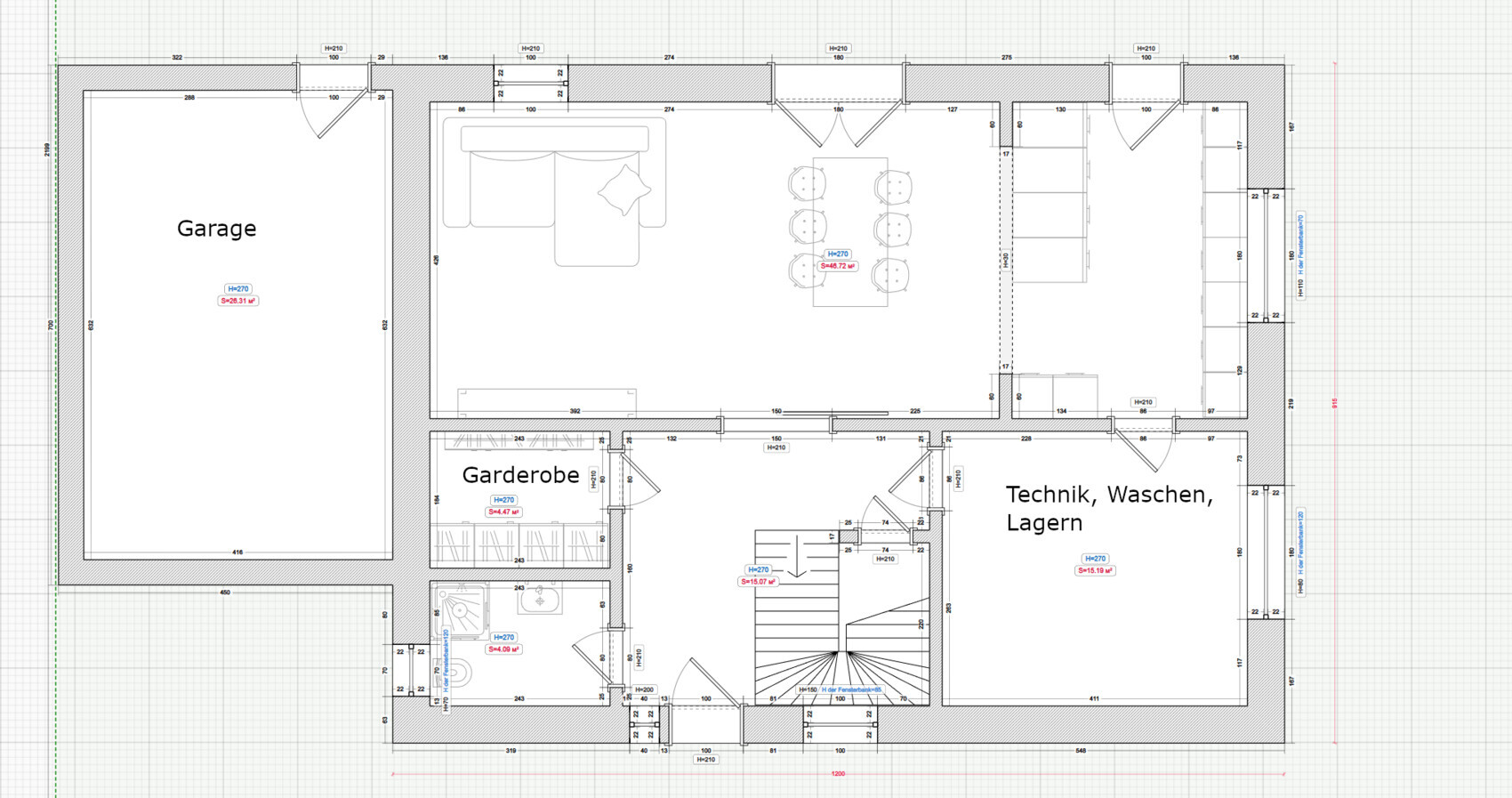
Ground Floor – Option 1: Kitchen/Dining/Living in a Row
- Kitchen/dining/living arranged in a row, all facing the garden (challenge: the kitchen should be somewhat separated to avoid the feel of a narrow, tunnel-like open-plan space)
- Large utility/technical room (HTR), as this is where equipment, pantry, as well as laundry including drying will take place
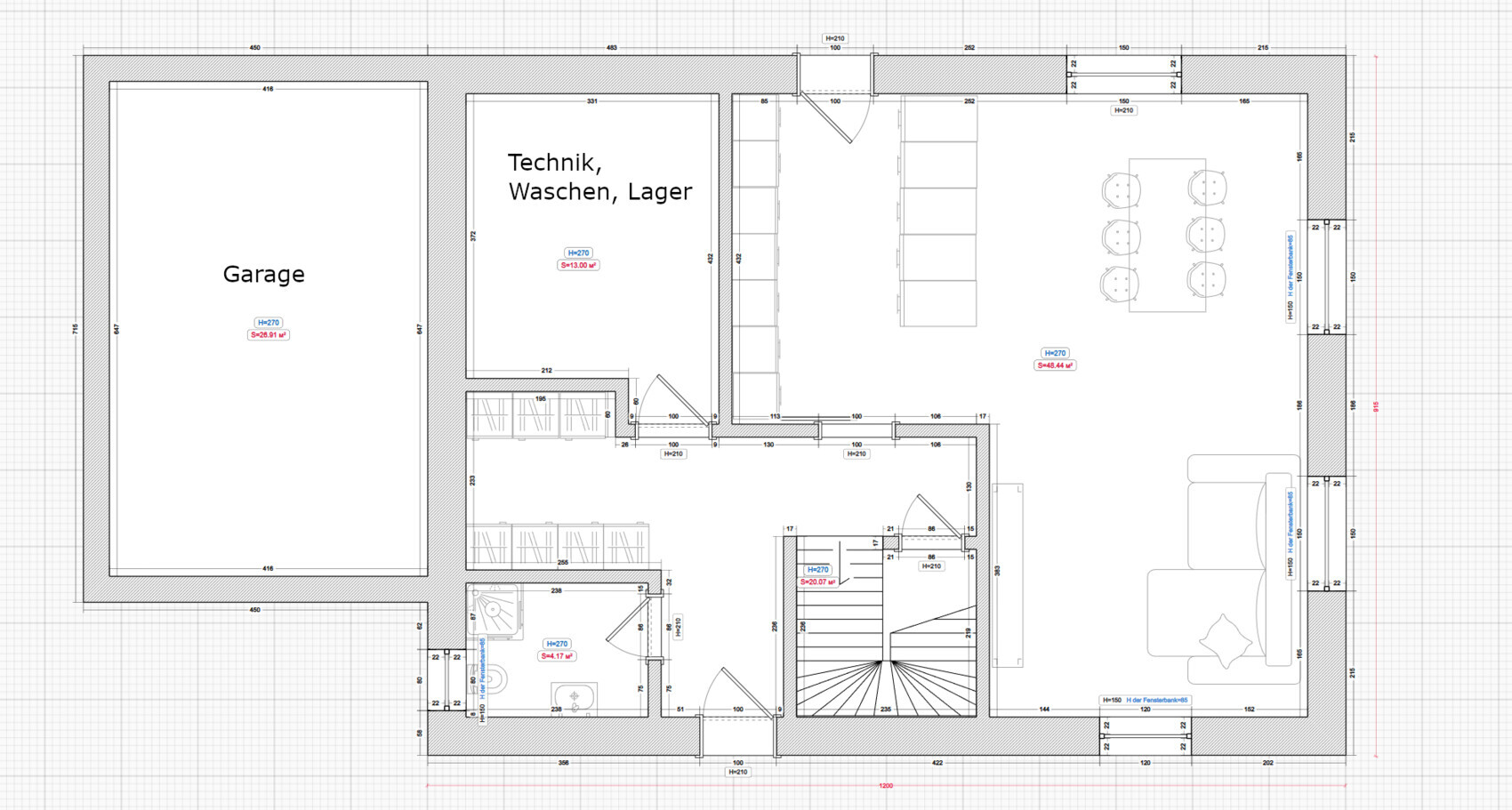
Ground Floor – Option 2: Kitchen/Dining/Living L-shaped
- Kitchen/dining/living in an L-shape. Kitchen facing the garden seems logical to us but could also be swapped with the living area.
- Utility room facing the garden is not ideal (e.g., connections), but cannot be placed sensibly elsewhere.
Questions for You
- Do you consider these floor plan ideas generally sensible, or are there absolute deal-breakers?
- We notice that many standard floor plans of similar size include a home office on the ground floor but design a very small utility/technical room and coat area. Without a basement, we believe it is necessary to have space on the ground floor for technology, laundry, drying, coat storage for the whole family, as well as storage space for the kitchen. Therefore, it seems more reasonable to invest in this space on the ground floor, skip a separate dressing room on the upper floor, and accommodate the office there. Are we completely off base here because apparently, no one does it this way in standard plans?
- Are there strong reasons to prefer one of the two layouts (open-plan in a row vs. L-shaped)? We are quite uncertain whether everything should face the garden (challenge: visually separating the different areas and avoiding a tunnel-like feel) or deliberately place either the living area or kitchen over to the front/street side.
Best regards,
Malte
M
MachsSelbst5 Dec 2025 19:10It’s always the same somehow. The pantry is pointless, with plenty of space for just two cabinets at the end. The utility storage room and the laundry room are way too large, leaving open floor space in the middle. In contrast, the kitchen and living room are rather small.
Upstairs, the children’s rooms are too small, the office is too big, the storage niche in front of the bathroom should be removed to enlarge either the bathroom or the children’s room… and the upper hallway. Twenty square meters (215 square feet) is ridiculously large for my taste, that huge area next to the stairs… what is it for?
Make the bedroom wider but not so “tall,” and enlarge the second children’s room as well.
This might look like great design, but in everyday life no one needs that. You do need large children’s rooms, a large living room, and a large kitchen, though.
Upstairs, the children’s rooms are too small, the office is too big, the storage niche in front of the bathroom should be removed to enlarge either the bathroom or the children’s room… and the upper hallway. Twenty square meters (215 square feet) is ridiculously large for my taste, that huge area next to the stairs… what is it for?
Make the bedroom wider but not so “tall,” and enlarge the second children’s room as well.
This might look like great design, but in everyday life no one needs that. You do need large children’s rooms, a large living room, and a large kitchen, though.
 Papierturm5 Dec 2025 19:14
-Malte- schrieb:
Questions for you
- [1]Do you consider the floor plan ideas generally practical, or are there clear deal-breakers?
- [2]We’ve noticed that many standard floor plans of a similar size include a home office on the ground floor but make the utility and cloakroom areas very small. Without a basement, we believe that the ground floor needs space for technical equipment, laundry (washing and drying), a cloakroom for the whole family, and storage space for the kitchen. We therefore think it makes more sense to invest the space here, skip a separate walk-in closet upstairs, and place the office there. Are we completely off track here because apparently nobody follows this approach in standard designs?
- [3]Are there clear reasons to prefer one of the two layouts (open living area in a row versus L-shaped)? We’re quite unsure whether to orient everything toward the garden (challenge: visually separating the different areas and avoiding a “corridor feel”) or to deliberately position either the living room or kitchen around the corner facing the street.
We would appreciate further input from you.
Best regards,
Malte I have a major issue regarding the orientation of the technical room. In many housing developments, the technical room must face the street. This strongly affects the floor plan.
So, regarding the questions:
1.
What comes to mind for me about option 2 (ignoring the windows):
-> I would place the entrance to the guest bathroom at the “top” (away from the dirty zone) and create a small cloakroom directly next to the door. I’m not entirely happy with the end of the hallway in front of the stairs, but I can’t think of a good solution offhand.
What comes to mind about option 1:
-> I like it less. The technical/storage room has too much unusable open space in the middle. The cloakroom is separated by a door (which I wouldn’t do). The guest bathroom access through the dirty zone can’t be changed.
What comes to mind about the upper floor:
-> The key question here is how the house is oriented! I would put the children’s bedrooms facing south (both of them). Bathroom and master bedroom facing north.
-> The office between the children’s rooms is something you have to be okay with.
2. Many floor plans include a home office or guest room on the ground floor because many people want that. Individual needs > general needs. According to your questionnaires, you don’t need an office or guest room downstairs, so why build one?
3. Yes, there is a reason: personal preference!
I’m not joking. Some people prefer linear layouts. Others want separate rooms. Others like an L-shape.
Of course, all of this affects the rest of the floor plan. But... hey, personal preference! Visit some model homes with these different layouts and see what appeals to you more.
Similar topics