
ᐅ Planning a Single-Family Home for a Family of Four, West Münsterland Region, Initial Architect’s Draft
Created on: 20 Oct 2025 12:17
-
-Malte-
Hello everyone,
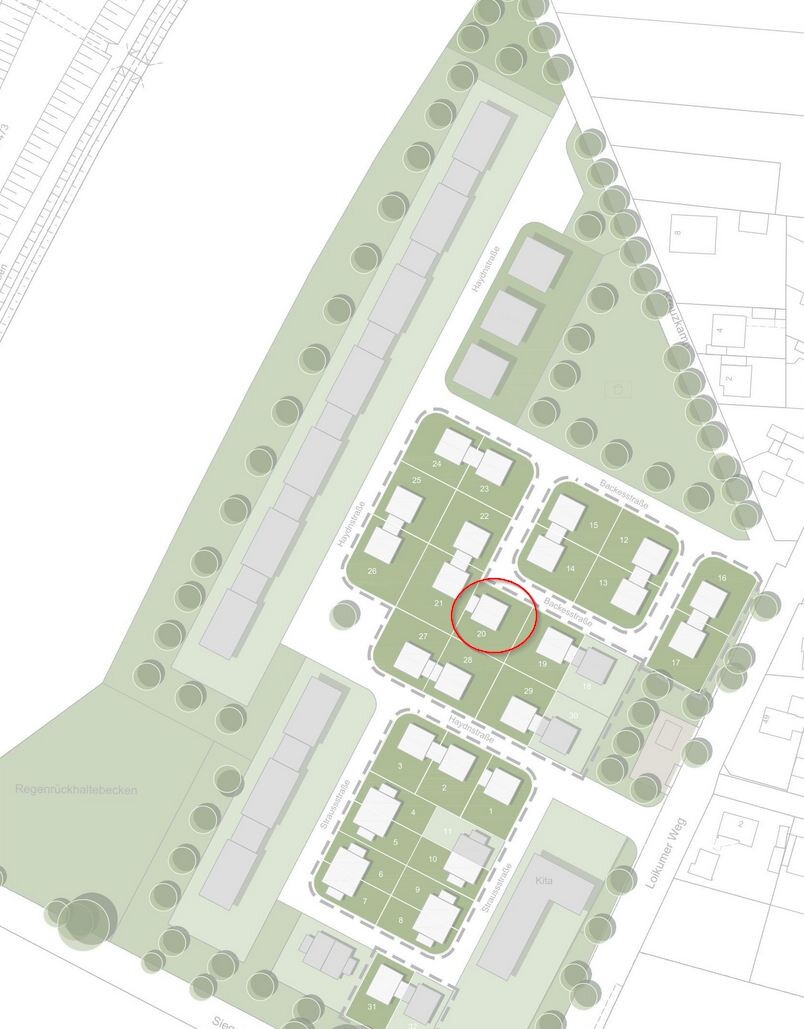
after some time spent on the selection of our plot in the new development area, we have now started the planning phase. We have found an architect, and a very first draft (without incorporating our feedback yet) has recently been presented to us. We would like to gather ideas and suggestions here.
Development Plan / Restrictions
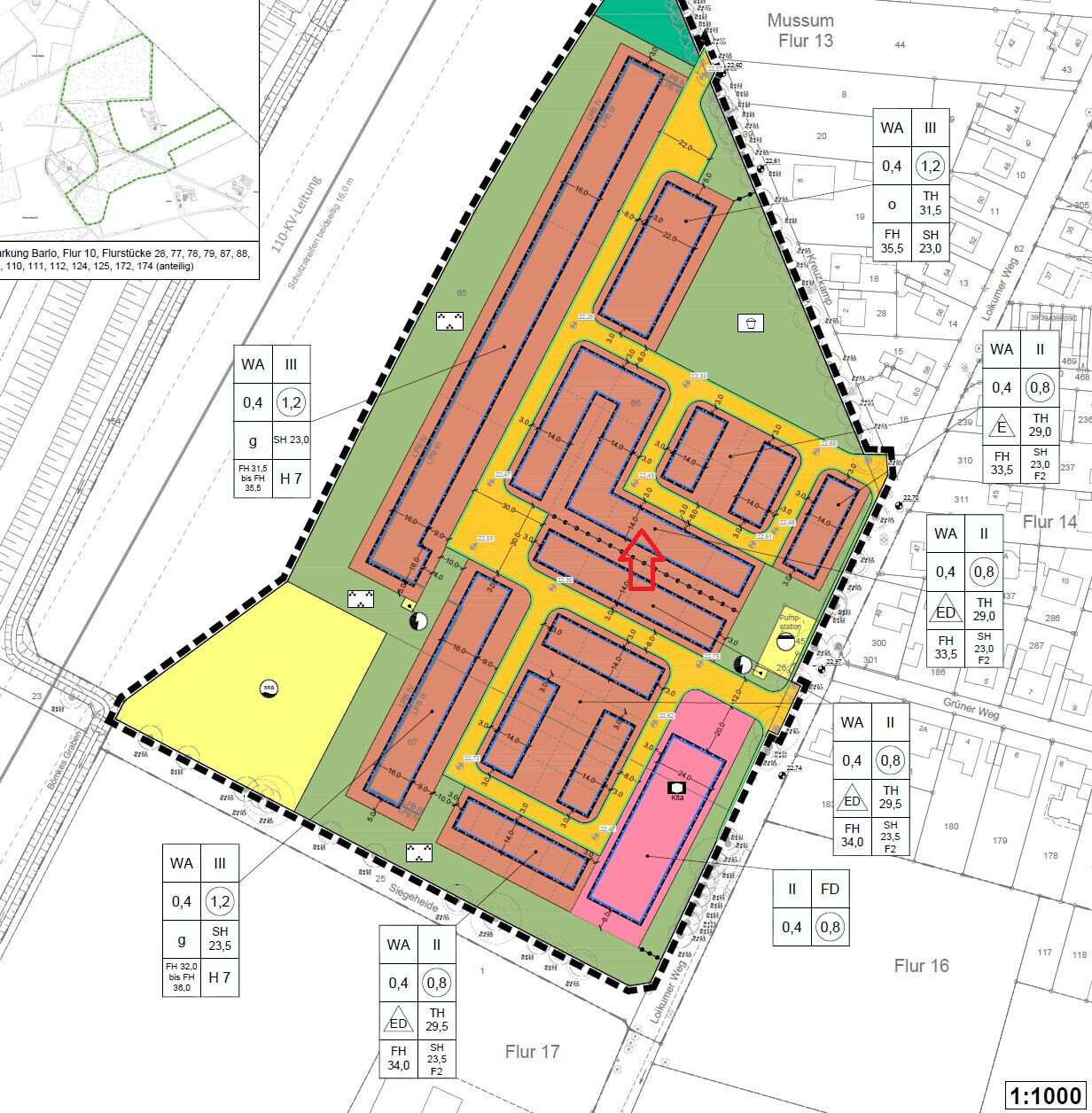
Plot size: 456m² (rectangular, 20.7m wide and 22.0m long)
Slope: no, completely flat
Floor area ratio (FAR) for land use: 0.4
Floor space index (FSI): 0.8
Building envelope, building line, and boundary: 14m (46 feet) deep building envelope across the entire plot width
Edge development: ?
Number of parking spaces: space for 2 cars required
Number of storeys: 2 full storeys allowed (with shed or flat roof)
Roof type: with 2 full storeys a shed or flat roof is mandatory, with 1 full storey no restrictions
Architectural style: no restrictions
Orientation: no restrictions
Maximum heights/limits: base height max 0.5m (1.5 feet); eaves height max 6.5m (21 feet); ridge height max 11.0m (36 feet)
Further specifications: no dormers or roof protrusions allowed according to the development plan
Other: detailed information can easily be found online by searching "Bebauungsplan 8-23 Bocholt"
Homeowners’ Requirements
Style, roof type, building type: desired is a traditional brick-faced gable roof house typical for western Münsterland, with a fairly steep roof pitch. Construction as a solid masonry house.
Basement, storeys: built on a slab foundation without basement; living spaces planned either on ground floor and first floor or ground floor, first floor, and attic
Number of people, ages: 4 persons (38, 35, 5, 3)
Room needs on ground and first floors: living area (kitchen/dining/living), guest WC including small shower, master bedroom without separate dressing room, 2 children’s rooms, 1 office, 1 bathroom, sufficient storage space for everyday family needs
Office (family use or home office): 1 dedicated full-time home office used about 4 days/week
Overnight guests per year: very few, no guest room needed
Open or closed layout: middle ground
Conservative or modern design: middle ground
Open kitchen, kitchen island: kitchen tends to be open, possibly with slight visual separation
Number of dining seats: table for 6 persons
Fireplace: no
Music/sound system wall: TV to be located in the living area
Balcony, roof terrace: no
Garage, carport: garage desired for numerous bicycles, children’s vehicles, and other outdoor gear
Utility garden, greenhouse: no
Other wishes / special features / daily routine, also reasons why some things should or should not be included: the wish is for a classic single-family house for a family of four with fixed home office space. Not a "palace," but a house that functions well in everyday family life. The house should be realized as a "climate-friendly new build" (KFW300 without QNG).
About the House Design
Who created the design?
First draft by an independent architect (initial version, no details adjusted or feedback incorporated yet)
What do you particularly like? Why?
What do you not like? Why?
Price estimate from the architect/designer: none yet
Personal price limit for the house including fittings: 650,000€ (house including ancillary costs, kitchen, garage, driveway/terrace)
Preferred heating technology: heat pump (possibly ground-source heat pump if trench collector is feasible, otherwise air-to-water heat pump)
What can you do without?
- can do without: excessive hallway areas, possibly the small gable projections (dormers)
- cannot do without: our room program including sufficient storage, window areas for plenty of natural light
Why does the design look the way it does now?
The design is based on our wishes/room program and generally meets them. The staircase could be extended up to the attic in the draft, but for this layout, a finished attic would not be needed for space or cost reasons. It would likely remain as an unfinished attic accessed by a folding ladder.
Final comments
After some further consideration, we see two options:
We look forward to your thoughts and input.
Best regards,
Malte
after some time spent on the selection of our plot in the new development area, we have now started the planning phase. We have found an architect, and a very first draft (without incorporating our feedback yet) has recently been presented to us. We would like to gather ideas and suggestions here.
Development Plan / Restrictions
Plot size: 456m² (rectangular, 20.7m wide and 22.0m long)
Slope: no, completely flat
Floor area ratio (FAR) for land use: 0.4
Floor space index (FSI): 0.8
Building envelope, building line, and boundary: 14m (46 feet) deep building envelope across the entire plot width
Edge development: ?
Number of parking spaces: space for 2 cars required
Number of storeys: 2 full storeys allowed (with shed or flat roof)
Roof type: with 2 full storeys a shed or flat roof is mandatory, with 1 full storey no restrictions
Architectural style: no restrictions
Orientation: no restrictions
Maximum heights/limits: base height max 0.5m (1.5 feet); eaves height max 6.5m (21 feet); ridge height max 11.0m (36 feet)
Further specifications: no dormers or roof protrusions allowed according to the development plan
Other: detailed information can easily be found online by searching "Bebauungsplan 8-23 Bocholt"
Homeowners’ Requirements
Style, roof type, building type: desired is a traditional brick-faced gable roof house typical for western Münsterland, with a fairly steep roof pitch. Construction as a solid masonry house.
Basement, storeys: built on a slab foundation without basement; living spaces planned either on ground floor and first floor or ground floor, first floor, and attic
Number of people, ages: 4 persons (38, 35, 5, 3)
Room needs on ground and first floors: living area (kitchen/dining/living), guest WC including small shower, master bedroom without separate dressing room, 2 children’s rooms, 1 office, 1 bathroom, sufficient storage space for everyday family needs
Office (family use or home office): 1 dedicated full-time home office used about 4 days/week
Overnight guests per year: very few, no guest room needed
Open or closed layout: middle ground
Conservative or modern design: middle ground
Open kitchen, kitchen island: kitchen tends to be open, possibly with slight visual separation
Number of dining seats: table for 6 persons
Fireplace: no
Music/sound system wall: TV to be located in the living area
Balcony, roof terrace: no
Garage, carport: garage desired for numerous bicycles, children’s vehicles, and other outdoor gear
Utility garden, greenhouse: no
Other wishes / special features / daily routine, also reasons why some things should or should not be included: the wish is for a classic single-family house for a family of four with fixed home office space. Not a "palace," but a house that functions well in everyday family life. The house should be realized as a "climate-friendly new build" (KFW300 without QNG).
About the House Design
Who created the design?
First draft by an independent architect (initial version, no details adjusted or feedback incorporated yet)
What do you particularly like? Why?
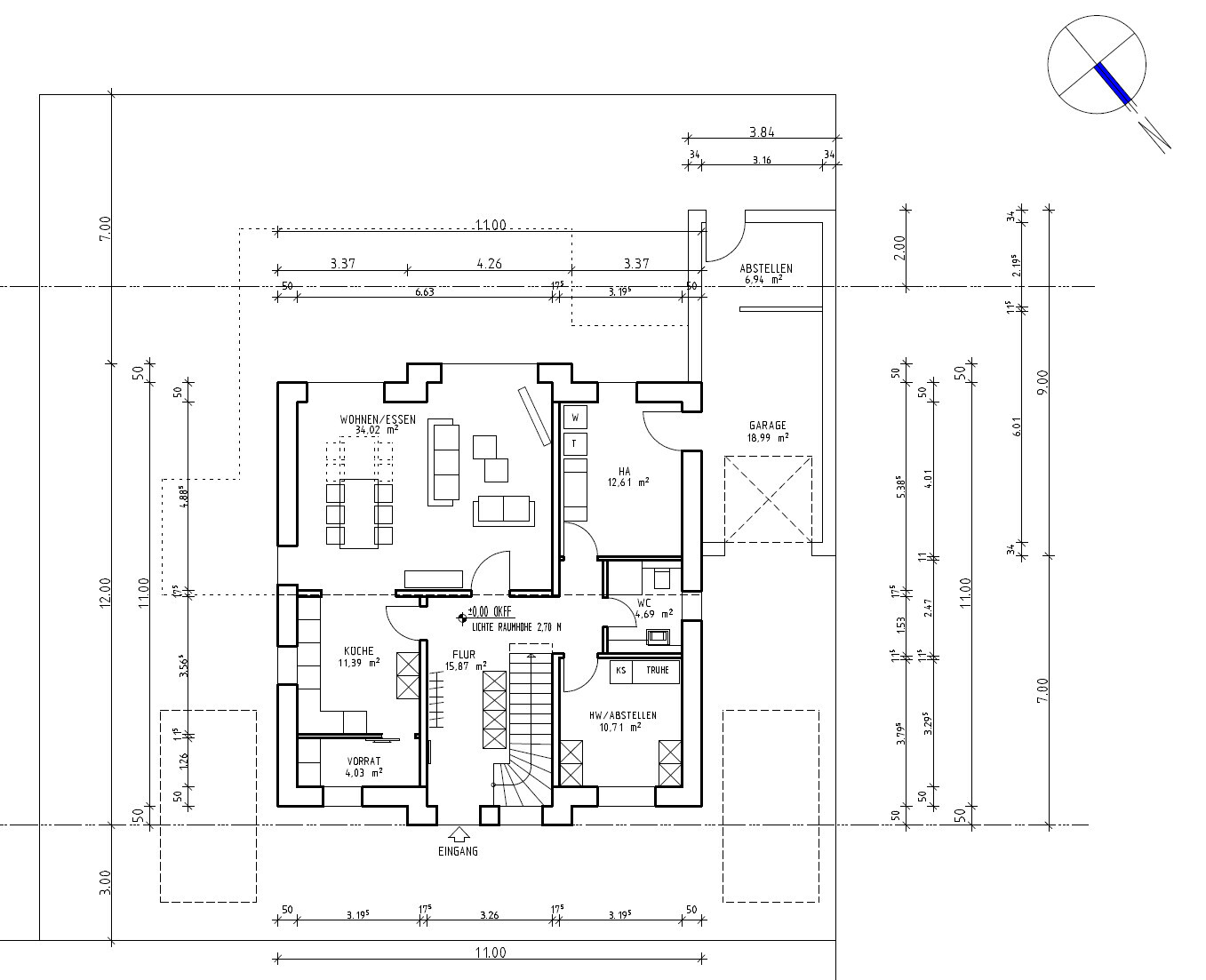
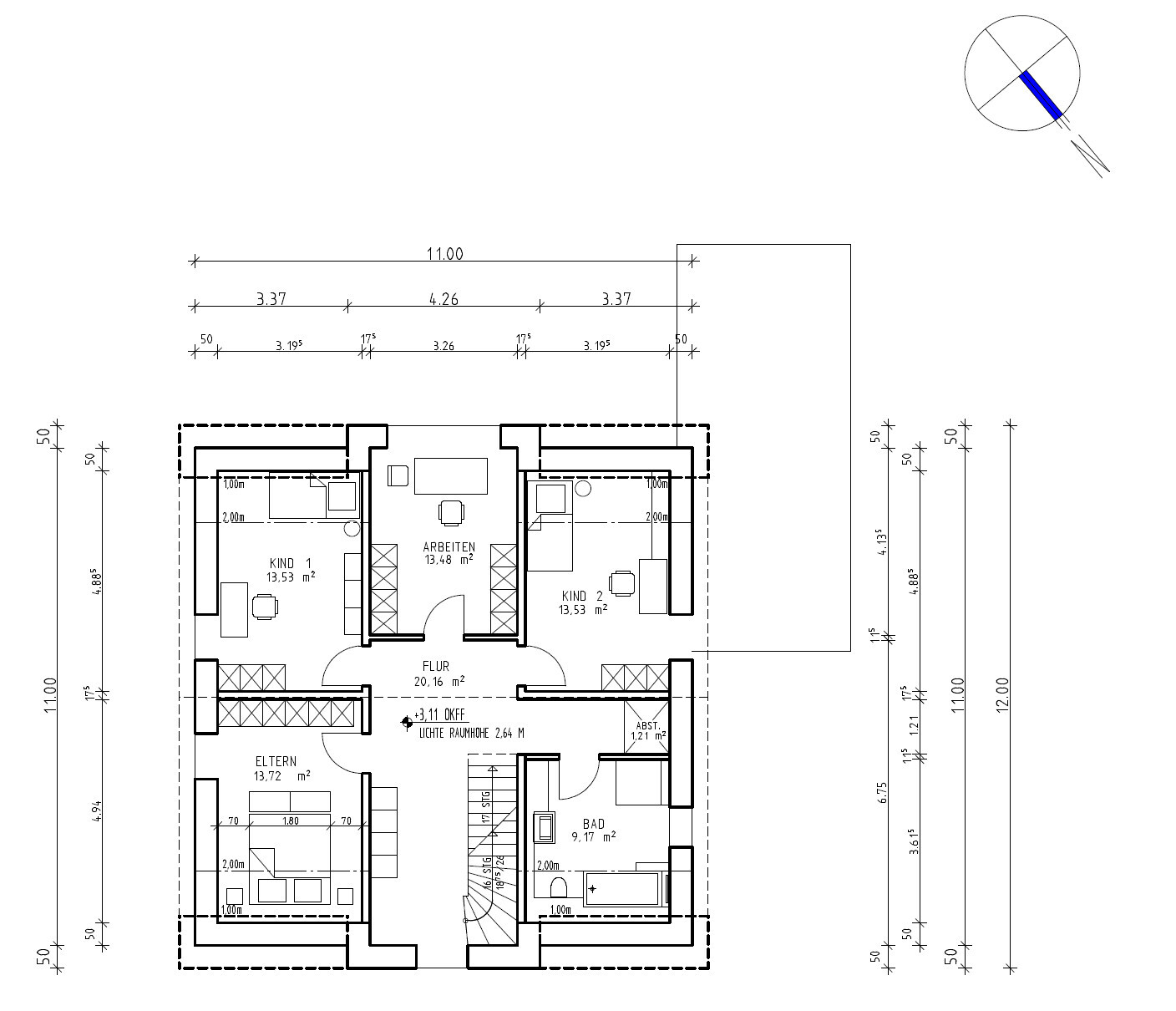
- The design fully covers our room program/specifications; all necessary rooms and sufficient storage space are included.
- Preferences such as the arrangement of kitchen/dining/living “around the corner” and similarly sized children’s rooms are included.
- The design as a gable roof house with two small gable projections (dormers/gables) is visually very appealing to us.
What do you not like? Why?
- Overall, the floor plan—especially the upper floor—does not appear efficient to us. The hallway area is clearly too large. The total living area is about 179m² (ground floor 94m² and upper floor 85m²), but it does not feel like that. For cost reasons alone, we aim for around 160m².
- The house is currently designed as 11m by 11m (36 by 36 feet) square, but we feel it should be stretched somewhat (e.g., 12m by 10m or similar) to better separate the kitchen and master bedroom. Probably the square shape was chosen to make the roof easier to develop.
- We suspect the current draft does not reach one full storey height yet (North Rhine-Westphalia: 3/4 rule) — adjustments to knee wall height and roof pitch may be necessary.
- Details need adjustment (e.g., remove pantry in kitchen to enlarge kitchen; doors; possibly add more roof windows; etc.).
Price estimate from the architect/designer: none yet
Personal price limit for the house including fittings: 650,000€ (house including ancillary costs, kitchen, garage, driveway/terrace)
Preferred heating technology: heat pump (possibly ground-source heat pump if trench collector is feasible, otherwise air-to-water heat pump)
What can you do without?
- can do without: excessive hallway areas, possibly the small gable projections (dormers)
- cannot do without: our room program including sufficient storage, window areas for plenty of natural light
Why does the design look the way it does now?
The design is based on our wishes/room program and generally meets them. The staircase could be extended up to the attic in the draft, but for this layout, a finished attic would not be needed for space or cost reasons. It would likely remain as an unfinished attic accessed by a folding ladder.
Final comments
After some further consideration, we see two options:
- Make the current design with the small dormers and room program on two floors more efficient and reduce it to about 160m². The attic would not be developed.
- Request an alternative design where the house is overall more compact and the attic is fully integrated (ground floor kitchen/dining/living, guest WC, utility room; first floor 2 children’s rooms, master bedroom, and bathroom; attic office and storage).
We look forward to your thoughts and input.
Best regards,
Malte

ypg schrieb:
I also prefer two wings of different widths, for example a loft door style. Does the sliding door trend still really exist? Although a loft door essentially needs the loft environment to work, and an asymmetrical split would be unusual.
https://www.instagram.com/11antgmxde/
https://www.linkedin.com/company/bauen-jetzt/
Hello everyone,
Several weeks have passed, and we are now facing a new question for which we would appreciate feedback and ideas from the forum.
Unfortunately, our building application was not approved as submitted because we tried to plan two parking spaces with separate access paths. So far, we had planned to get approval for one parking space in front of the garage on the east side and another parking space on the west side next to the house. This is not allowed, as the building authority requires parking spaces to have access to the public street via a single access path.
We would like to have two outdoor parking spaces because we expect the garage to be used at least temporarily for numerous bicycles, strollers, gardening equipment, and so on, but we need to accommodate two cars. Please, no lectures—we are aware that this is generally not permitted; however, as in many new housing developments, this will probably be the reality in our home at times.
An obvious alternative is marked with a red rectangle in the attached plan. This would probably just work for the small car (3m (10 feet) to the street, minus splash protection on the house), but from an exterior perspective, it likely won’t look very appealing. Alternatively, we could move the garage further back so that two parking spaces can be arranged in tandem on the driveway. So far, 8.25m (27 feet) are planned up to the street. For two cars (a small car and a mid-sized station wagon), it would probably need to be at least 10m (33 feet). Moving the garage back by two meters (6.5 feet) would theoretically work (the building boundary may be exceeded by 2m (6.5 feet) to the rear). Currently, the garage ends at the terrace—the garage would no longer do so, and the garden area behind the garage would be reduced. Alternatively, we could consider extending the garage by 1m (3 feet) to the maximum allowed 9m (30 feet) and then ensure that there is always space for one car.
Any ideas or suggestions?
Best regards,
-Malte-
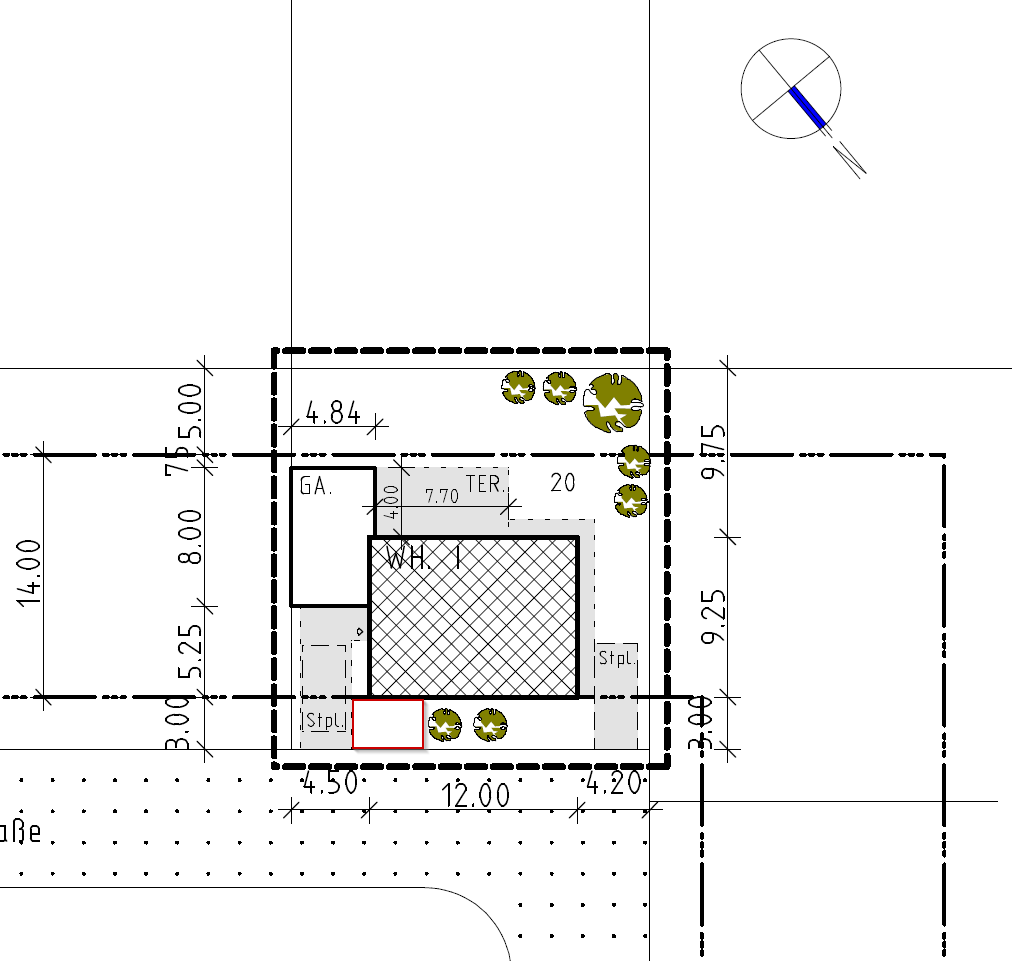
Several weeks have passed, and we are now facing a new question for which we would appreciate feedback and ideas from the forum.
Unfortunately, our building application was not approved as submitted because we tried to plan two parking spaces with separate access paths. So far, we had planned to get approval for one parking space in front of the garage on the east side and another parking space on the west side next to the house. This is not allowed, as the building authority requires parking spaces to have access to the public street via a single access path.
We would like to have two outdoor parking spaces because we expect the garage to be used at least temporarily for numerous bicycles, strollers, gardening equipment, and so on, but we need to accommodate two cars. Please, no lectures—we are aware that this is generally not permitted; however, as in many new housing developments, this will probably be the reality in our home at times.
An obvious alternative is marked with a red rectangle in the attached plan. This would probably just work for the small car (3m (10 feet) to the street, minus splash protection on the house), but from an exterior perspective, it likely won’t look very appealing. Alternatively, we could move the garage further back so that two parking spaces can be arranged in tandem on the driveway. So far, 8.25m (27 feet) are planned up to the street. For two cars (a small car and a mid-sized station wagon), it would probably need to be at least 10m (33 feet). Moving the garage back by two meters (6.5 feet) would theoretically work (the building boundary may be exceeded by 2m (6.5 feet) to the rear). Currently, the garage ends at the terrace—the garage would no longer do so, and the garden area behind the garage would be reduced. Alternatively, we could consider extending the garage by 1m (3 feet) to the maximum allowed 9m (30 feet) and then ensure that there is always space for one car.
Any ideas or suggestions?
Best regards,
-Malte-
-Malte- schrieb:
So far, we had planned to get approval for one parking space in front of the garage on the east side and another parking space on the west side next to the house. This is not allowed because, according to the building authority, parking spaces must be accessed via a driveway connected to the public road. However, such a requirement is usually already apparent before submitting the preliminary building inquiry, since if the municipality limits access points to the properties, this is typically specified in the local development plan (text section). If it is not included there, it cannot be a valid reason for refusal. A rejection of a building application is also an administrative act and must be based on a legal foundation.
https://www.instagram.com/11antgmxde/
https://www.linkedin.com/company/bauen-jetzt/
There was no preliminary building inquiry. A newly established legally binding zoning plan exists (zoning plan 8-23 in Bocholt, if of interest), and neither the text nor the justification mentions any limitation on access points. We are located in North Rhine-Westphalia (NRW) and submitted the building application as part of a permit-exempt procedure. Today, we only received verbal information that a “rejection” is expected, with the parking spaces being the reason. For small plots (in our case 456m² (4900 sq ft)) and only one residential unit, the parking spaces must be accessed via a driveway connected to the public road. I can understand this in principle because if every property planned two access points, there would be very little space left for gardens, streetlights, and public parking in front of the properties.
So, I still have to wait for the formal written rejection. I assume that if we want to “appeal,” it wouldn’t be possible within the permit-exempt procedure, and we would have to proceed with a regular building application instead. If that is the case, we would need to carefully consider this option as it would involve, firstly, a significant amount of time and, secondly, fees.
So, I still have to wait for the formal written rejection. I assume that if we want to “appeal,” it wouldn’t be possible within the permit-exempt procedure, and we would have to proceed with a regular building application instead. If that is the case, we would need to carefully consider this option as it would involve, firstly, a significant amount of time and, secondly, fees.
-Malte- schrieb:
Currently, the garage ends at the back with the terrace That’s not really relevant, nor is there any reason why it has to be that way.
-Malte- schrieb:
and the garden area behind the garage would become smaller. By how many square meters? By 9? That’s not a big deal if you gain something valuable in the front.
-Malte- schrieb:
I suppose if we want to “take action against this” You don’t have to oppose it: submit an application for a second driveway according to §§18, 20 StrWG NRW. Don’t forget to include your justification.
Where there is no application, it cannot be rejected, and without a rejection, there are no legal remedies. However, with the exemption, you would have to be absolutely certain that there are no grounds for refusal. If the development plan (or another local ordinance) truly imposes no restrictions, then none exist or apply. Still, the unofficial information indicates a tendency toward rejection – unchanged, this means that even a preliminary building inquiry could be expected to be denied. Discuss this with your architect and specialized lawyer if you want to insist on a second parking space with separate access. I would personally prefer to reach it via a single driveway. There are good reasons why I recommend local architects. Your project is already quite advanced, so such surprises should not occur – what has your architect done so far?
https://www.instagram.com/11antgmxde/
https://www.linkedin.com/company/bauen-jetzt/
https://www.instagram.com/11antgmxde/
https://www.linkedin.com/company/bauen-jetzt/
Similar topics