
Hello!
Now that the construction of our semi-detached house has progressed up to the plastering stage, we are starting to plan the exterior. Unfortunately, this is proving to be more difficult than expected. We have so many questions.
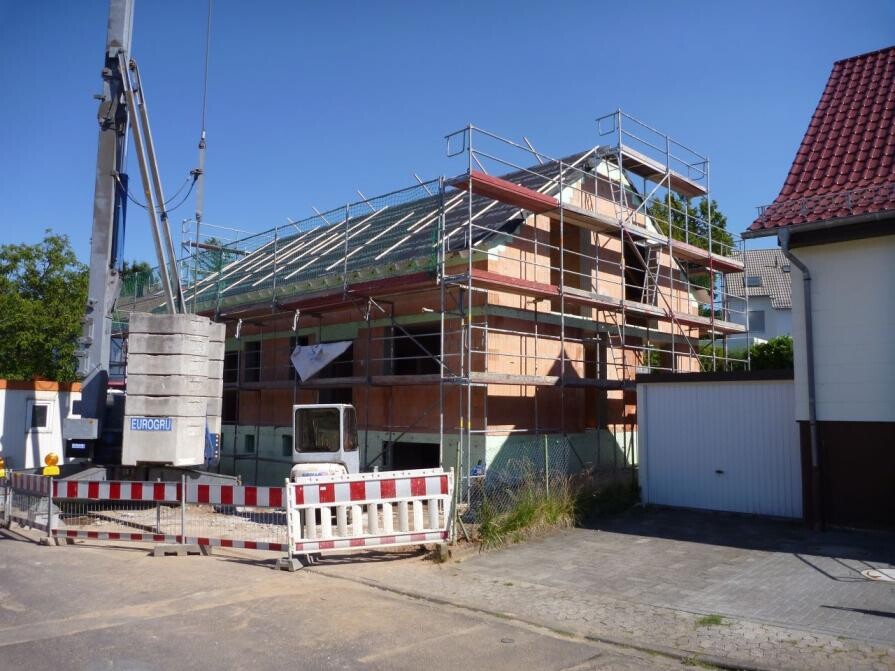
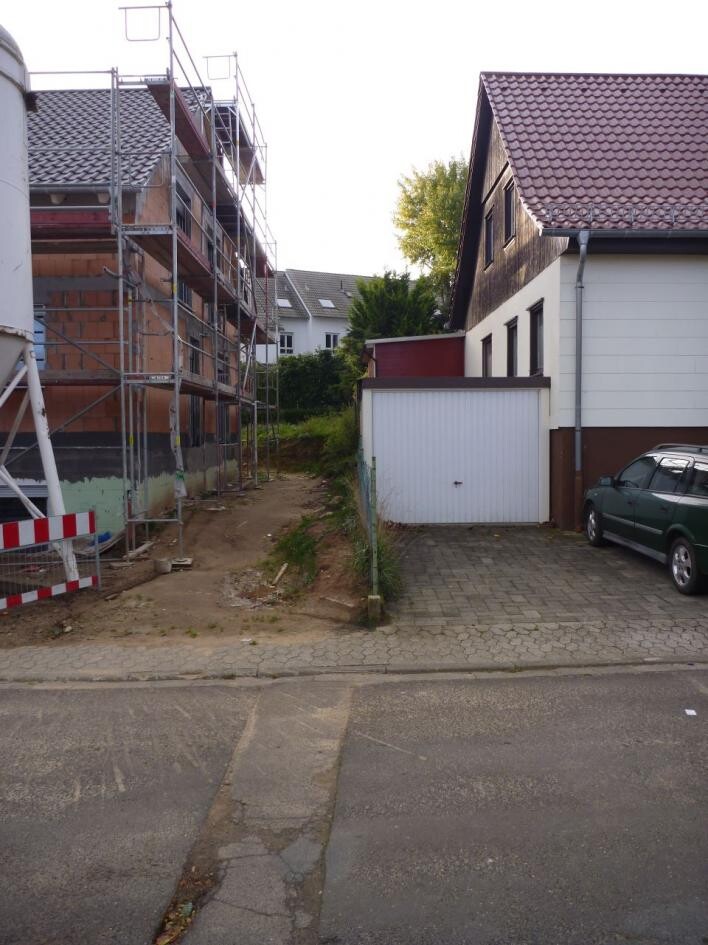
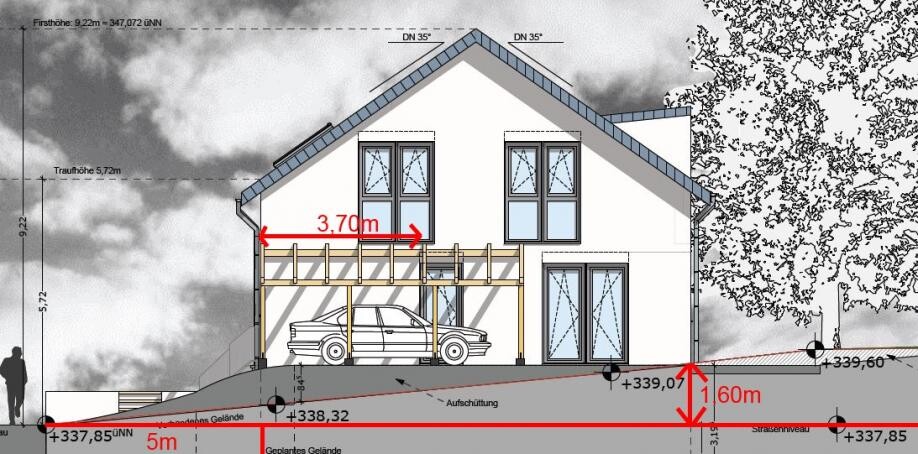
First, a few details about the plot. There is nearly a 1.60m (5.25 ft) difference in height between the street level and the terrace level. Our neighbor on the right has a garage right on the boundary (unfortunately made of metal sheets, not brick). We want to slope the driveway up until it reaches terrace level. On the garage side, we also have the kitchen with a small floor-to-ceiling window, through which we want to access the driveway.


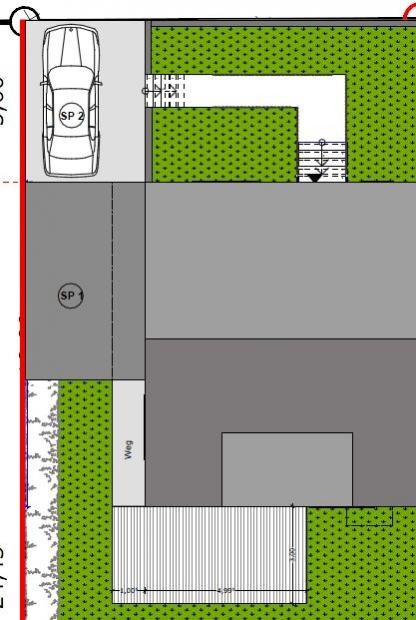
This is our rough plan. A light well made of L-shaped concrete blocks will be installed at the front right basement window, then a 1m (3.3 ft) high wall will be built along the entire width of the house facing the street. After that, we want to raise the ground in front of the house. So far, so good. The driveway is the interesting part.
We want to install a carport on the right side next to our house, about 3.5m (11.5 ft) wide and 6.5m (21.3 ft) long. Directly adjacent to that is the neighbor’s garage, where we want to put L-blocks. The shell builder could probably do this while installing the inspection shaft. But... what about the carport? Can the posts be placed directly on top of the L-blocks at the garage? Or do foundations have to be installed? How should we best prepare for this now, so the carport builder won’t have to remove all the L-blocks later on?
Also, the architect’s solution for the driveway probably won’t work as planned. He was maybe a bit too optimistic. We will probably need a sloped driveway instead. What would be the best way to do this so that we can enter the house without many steps in front of the kitchen door?
It’s all not so easy...
Now that the construction of our semi-detached house has progressed up to the plastering stage, we are starting to plan the exterior. Unfortunately, this is proving to be more difficult than expected. We have so many questions.
First, a few details about the plot. There is nearly a 1.60m (5.25 ft) difference in height between the street level and the terrace level. Our neighbor on the right has a garage right on the boundary (unfortunately made of metal sheets, not brick). We want to slope the driveway up until it reaches terrace level. On the garage side, we also have the kitchen with a small floor-to-ceiling window, through which we want to access the driveway.
This is our rough plan. A light well made of L-shaped concrete blocks will be installed at the front right basement window, then a 1m (3.3 ft) high wall will be built along the entire width of the house facing the street. After that, we want to raise the ground in front of the house. So far, so good. The driveway is the interesting part.
We want to install a carport on the right side next to our house, about 3.5m (11.5 ft) wide and 6.5m (21.3 ft) long. Directly adjacent to that is the neighbor’s garage, where we want to put L-blocks. The shell builder could probably do this while installing the inspection shaft. But... what about the carport? Can the posts be placed directly on top of the L-blocks at the garage? Or do foundations have to be installed? How should we best prepare for this now, so the carport builder won’t have to remove all the L-blocks later on?
Also, the architect’s solution for the driveway probably won’t work as planned. He was maybe a bit too optimistic. We will probably need a sloped driveway instead. What would be the best way to do this so that we can enter the house without many steps in front of the kitchen door?
It’s all not so easy...

A
AallRounder7 Nov 2013 08:03Hello,
sorry for sharing my very personal opinion without supporting the proposed scenario:
Do you really want to cover up the poor house at the front? Then all the hassle with the expensive L-shaped concrete elements, the light wells, the earthworks, and not least the effort with the driveway. You still have more or less fully usable living space in the basement (I don’t know how it looks inside), but once everything is covered, you’re facing darkening and moisture risks. Whenever rooms are located – even partially – underground, the indoor climate always shifts toward a “bunker” feeling. This starts already with a basement level, even if the rooms are only 1 meter (3 feet) below ground and have fully above-ground windows. I know this from my own living experience. Everything was insulated and sealed there, yet it was still not a fully comfortable living space.
The street level doesn’t seem problematic from the photos; a solid plinth 30-50cm (12-20 inches) high with a wrought-iron fence on top would, in my opinion, sufficiently separate the property from the street. Behind that, the front garden could be a bit lower than street level, perhaps arranged in 1 or 2 shallow terraces as a so-called sunken garden. This was very popular among our affluent ancestors, as sunken gardens were always appreciated for their own microclimate. Then from the large basement windows you could enjoy a great view of the flowers and plants there instead of having light wells covered all around.
The garage could be built at ground level too, like the neighbor’s, with a slope toward the street as steep as possible without requiring large L-shaped supports or extensive fill work. However, this would mean having to accept that access through the unwanted steps inside the garage would have to be through the kitchen window. But is it worth going through all that effort just to avoid the steps...?
Just a thought, feel free to ignore if you don’t like it...
Best regards
sorry for sharing my very personal opinion without supporting the proposed scenario:
Do you really want to cover up the poor house at the front? Then all the hassle with the expensive L-shaped concrete elements, the light wells, the earthworks, and not least the effort with the driveway. You still have more or less fully usable living space in the basement (I don’t know how it looks inside), but once everything is covered, you’re facing darkening and moisture risks. Whenever rooms are located – even partially – underground, the indoor climate always shifts toward a “bunker” feeling. This starts already with a basement level, even if the rooms are only 1 meter (3 feet) below ground and have fully above-ground windows. I know this from my own living experience. Everything was insulated and sealed there, yet it was still not a fully comfortable living space.
The street level doesn’t seem problematic from the photos; a solid plinth 30-50cm (12-20 inches) high with a wrought-iron fence on top would, in my opinion, sufficiently separate the property from the street. Behind that, the front garden could be a bit lower than street level, perhaps arranged in 1 or 2 shallow terraces as a so-called sunken garden. This was very popular among our affluent ancestors, as sunken gardens were always appreciated for their own microclimate. Then from the large basement windows you could enjoy a great view of the flowers and plants there instead of having light wells covered all around.
The garage could be built at ground level too, like the neighbor’s, with a slope toward the street as steep as possible without requiring large L-shaped supports or extensive fill work. However, this would mean having to accept that access through the unwanted steps inside the garage would have to be through the kitchen window. But is it worth going through all that effort just to avoid the steps...?
Just a thought, feel free to ignore if you don’t like it...
Best regards
Similar topics