
ᐅ Planning Central Mechanical Ventilation in a KfW-55 House – Is Routing Ductwork from the Attic Practical?
Created on: 15 Dec 2025 20:56
M
MaxMai25Hello,
I do not intend to replace a full planning process here, as I am aware that this wouldn’t be feasible.
However, the contractor who has been promising for weeks to take a look and support me with planning and execution has not followed up.
Therefore, my goal is ideally to at least pre-install the ductwork from the attic floor (DG) since we might be able to roughly close off the construction work there. The main unit, core drillings, and connections could possibly be done later.
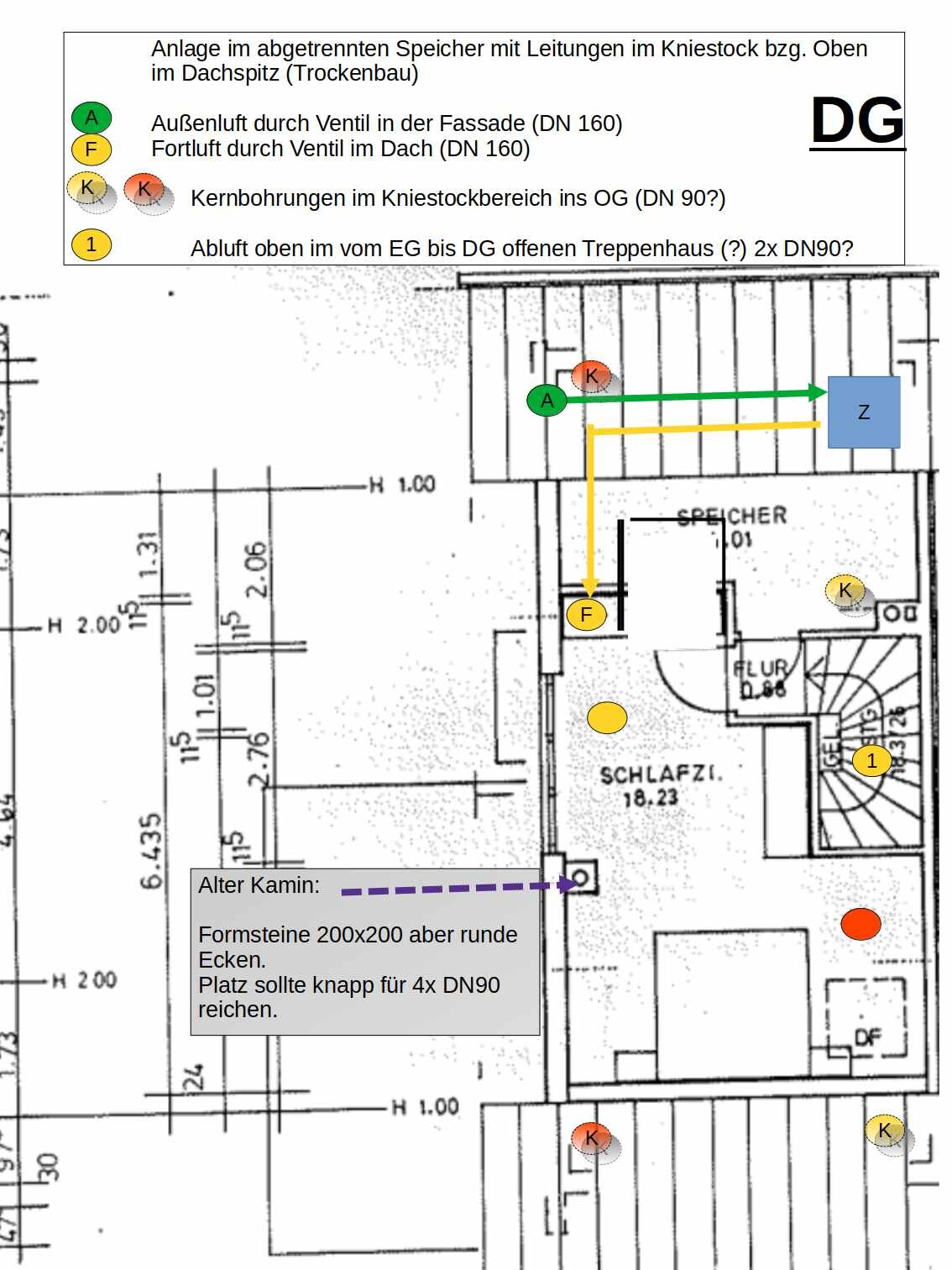
The plan is for a central ventilation unit in the attic, placed in the storage room. From there, there is already a DN160 (6 inch) duct for fresh air intake through the façade and an exhaust duct through the roof.
The aim is not necessarily to fulfill the existing ventilation concept but to make the best possible use of the given conditions without having to open up or box in half the house.
Currently, we have no mechanical ventilation and rely on traditional window airing without any issues. We would not mind supplementing this with ventilation, for example, in the kitchen or WC on the ground floor, where it probably won’t be possible otherwise. Slow and thus quiet air movement is more important than large air volumes.
Here are my thoughts:
From the location of the ventilation unit in the attic, the following can be achieved within the drywall ceiling:
The stairwell is open, meaning there are no doors from the ground floor living room to the attic door.
My current plan:
Since the chimney can be most efficiently used with 4x DN90 ducts in this setup, I would use DN90 for all ducts except number 7).
Attached are the floor plans I put together with the corresponding markings (sorry for the poor quality). Also included is a list of the ducts, their approximate lengths, and air volumes/speeds. The latter is more for plausibility, and I would ideally like someone experienced to finalize this who can also install and commission the unit.
Questions:
My main goal is ideally to lay the DN90 ducts from the attic and feel confident that there is more than a 70% chance that this is not all wasted effort 😉
I appreciate constructive feedback.

I do not intend to replace a full planning process here, as I am aware that this wouldn’t be feasible.
However, the contractor who has been promising for weeks to take a look and support me with planning and execution has not followed up.
Therefore, my goal is ideally to at least pre-install the ductwork from the attic floor (DG) since we might be able to roughly close off the construction work there. The main unit, core drillings, and connections could possibly be done later.
- It is an end-unit row house renovated to KfW Efficiency House 55 standard.
- Four people live here with about 120 sqm (1290 sq ft) of living space plus nearly 40 sqm (430 sq ft) in the basement, which includes a very rarely used guest room with a bathroom.
- There are only unused chimneys, all removed at the top, so no longer connected to the outside.
- No stoves, fireplaces, or similar.
The plan is for a central ventilation unit in the attic, placed in the storage room. From there, there is already a DN160 (6 inch) duct for fresh air intake through the façade and an exhaust duct through the roof.
The aim is not necessarily to fulfill the existing ventilation concept but to make the best possible use of the given conditions without having to open up or box in half the house.
Currently, we have no mechanical ventilation and rely on traditional window airing without any issues. We would not mind supplementing this with ventilation, for example, in the kitchen or WC on the ground floor, where it probably won’t be possible otherwise. Slow and thus quiet air movement is more important than large air volumes.
Here are my thoughts:
From the location of the ventilation unit in the attic, the following can be achieved within the drywall ceiling:
- The knee wall on the opposite side of the roof. Below that is the south-facing room on the upper floor.
- The north-facing upper floor room just below the storage room (requires core drilling).
- The west chimney (unused) with an internal dimension of 200x200mm (8x8 inches) made of shaped bricks.
- The attic living space, through the drywall ceiling.
- The attic stairwell in front of the living area, also through the drywall ceiling.
The stairwell is open, meaning there are no doors from the ground floor living room to the attic door.
My current plan:
- Directly connect the attic room with one supply and one exhaust vent at opposite ends of the room.
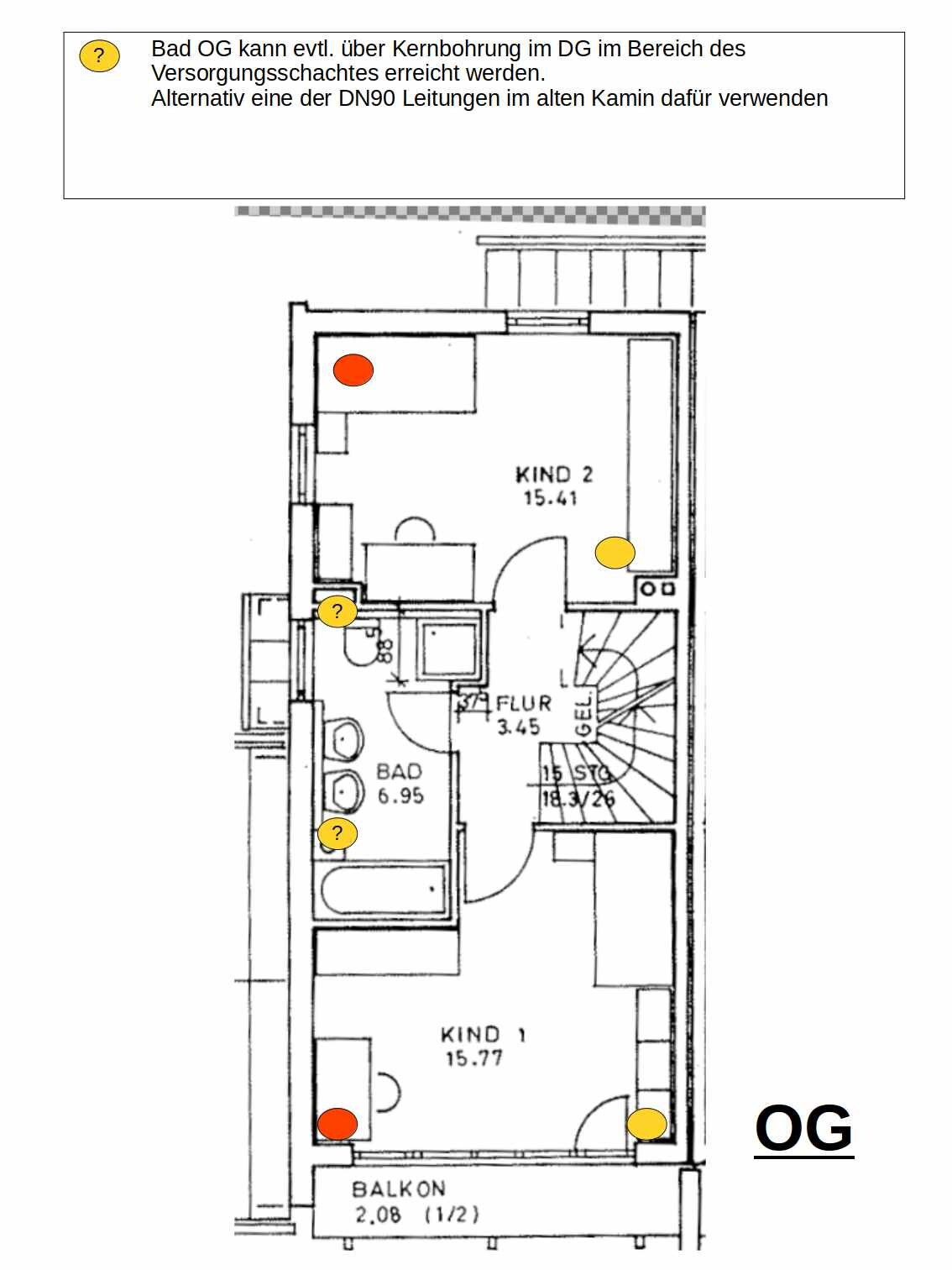
- If possible, connect the upper floor bathroom via core drilling into the service shaft directly from the upper floor.
- Use the chimney to install 4x DN90 (3.5 inch) flexible ducts for:
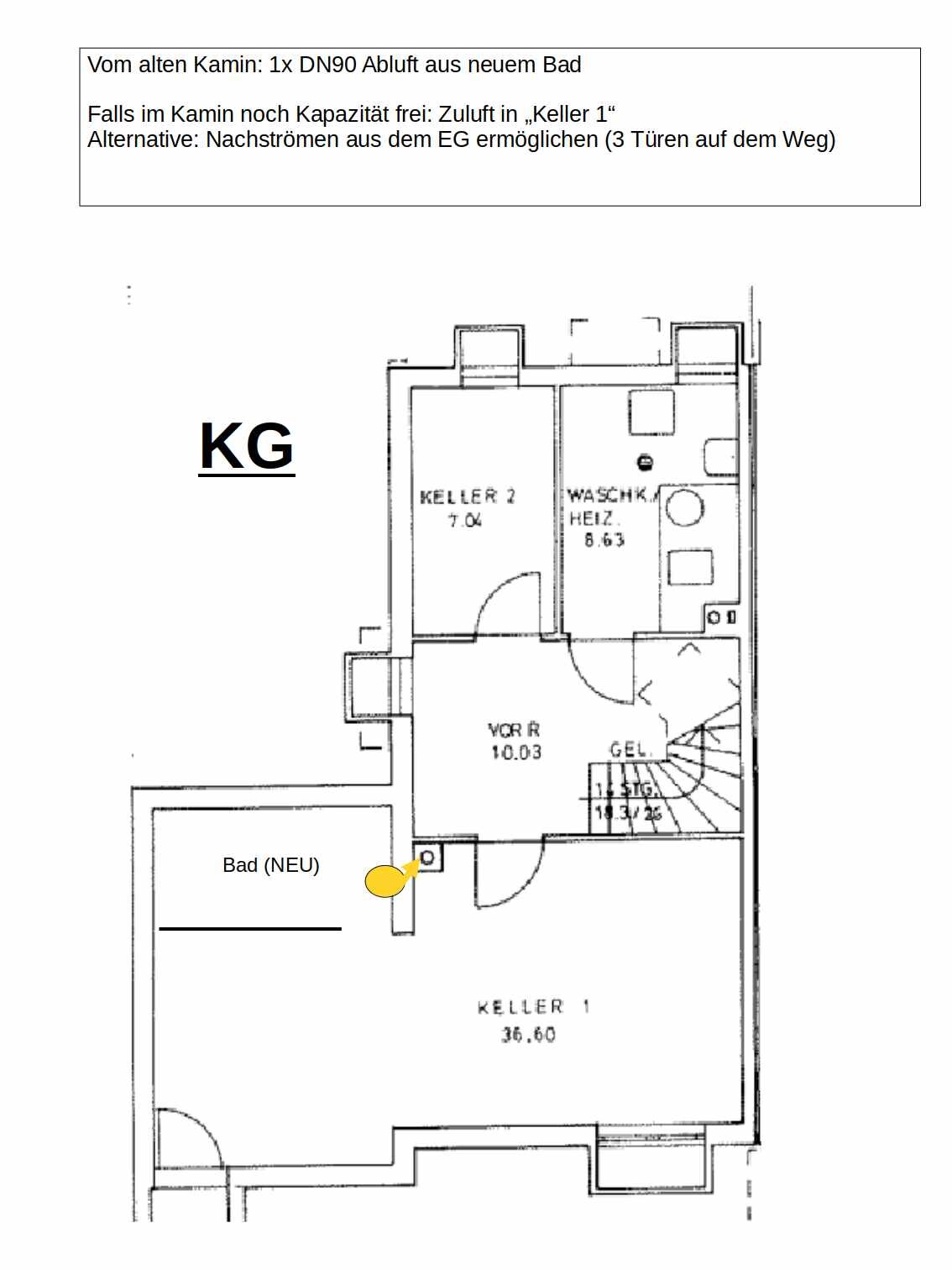
- 1x exhaust from basement bathroom
- 1x supply air for basement hobby room OR, if the second option above fails,
- 1x exhaust from upper floor bathroom
- 2x supply ducts to the ground floor living room (located at the open stairwell).
- In the open stairwell at the top attic floor, 1x (or possibly 2x) exhaust ducts. This allows creating a chimney effect from the ground floor living room up to under the roof.
- With 2 core drillings to the north-facing upper floor room: 1x supply and 1x exhaust on opposite ends of the room.
- The same for the south-facing upper floor room.
- If possible, 1x exhaust through the second chimney (east) possibly to the ground floor WC. It will almost certainly be limited to DN75 (3 inch) or possibly impossible since heating pipes already run through there.
Since the chimney can be most efficiently used with 4x DN90 ducts in this setup, I would use DN90 for all ducts except number 7).
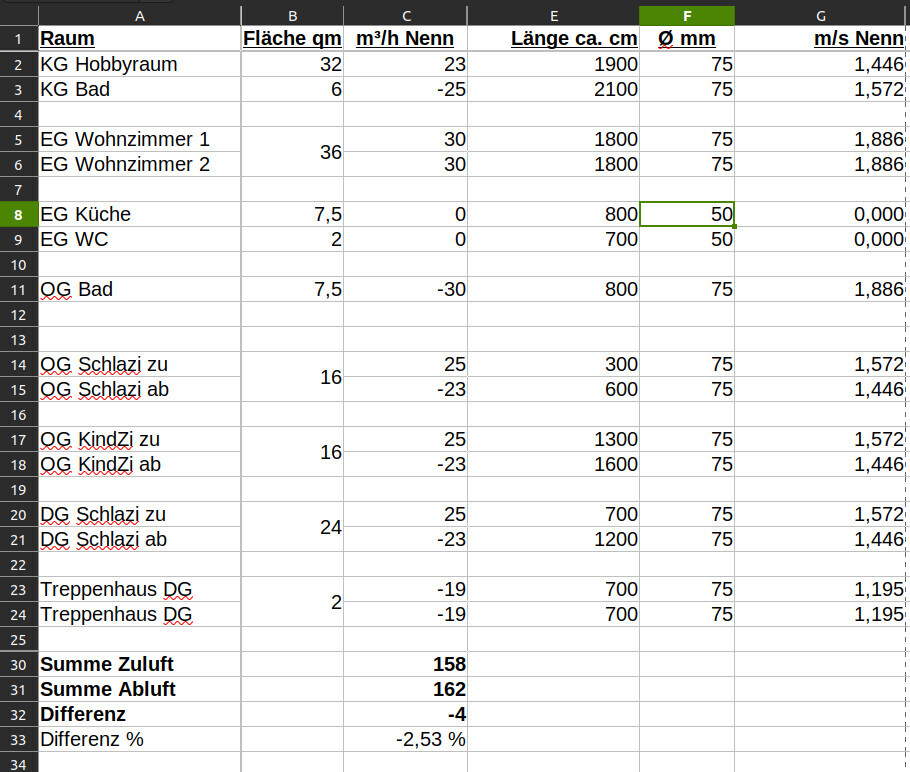
Attached are the floor plans I put together with the corresponding markings (sorry for the poor quality). Also included is a list of the ducts, their approximate lengths, and air volumes/speeds. The latter is more for plausibility, and I would ideally like someone experienced to finalize this who can also install and commission the unit.
Questions:
- How sensible is it to supply the mentioned rooms with both supply and exhaust ducts?
- I particularly want to avoid having to fit all room doors with transfer grilles.
- How problematic are the proposed core drillings regarding noise?
- Is the branching from probably DN160 from the unit to DN90 with multiple splitters done right near the unit?
- For core drillings 6 and 7: 130mm (5 inch) to install a DN125 (5 inch) valve flush with the ceiling, which is connected with DN90 ducting?
My main goal is ideally to lay the DN90 ducts from the attic and feel confident that there is more than a 70% chance that this is not all wasted effort 😉
I appreciate constructive feedback.
For hose systems, they should be at least 5m (16 feet) long to prevent noise transmission from the silencer.
Usually, the chimney is completely removed to provide sufficient space.
Having supply and exhaust air in the same room is unusual.
Typically, a slight positive pressure is created on the upper floor, while the ground floor has a negative pressure. The basement is usually more "neutral."
Bedrooms generally require around 60m³/h (35 CFM).
Usually, the chimney is completely removed to provide sufficient space.
Having supply and exhaust air in the same room is unusual.
Typically, a slight positive pressure is created on the upper floor, while the ground floor has a negative pressure. The basement is usually more "neutral."
Bedrooms generally require around 60m³/h (35 CFM).
Similar topics