
Hello everyone,
Due to bad weather, we didn’t make as much progress on the landscaping as planned, but now we are moving forward and are currently planning the automatic irrigation system.
We have tried several planners for this, and the one from DVS worked best for us. However, some aspects are still unclear, so I hope to get some feedback on our plan and clarify a few open questions.
Here is our current plan:
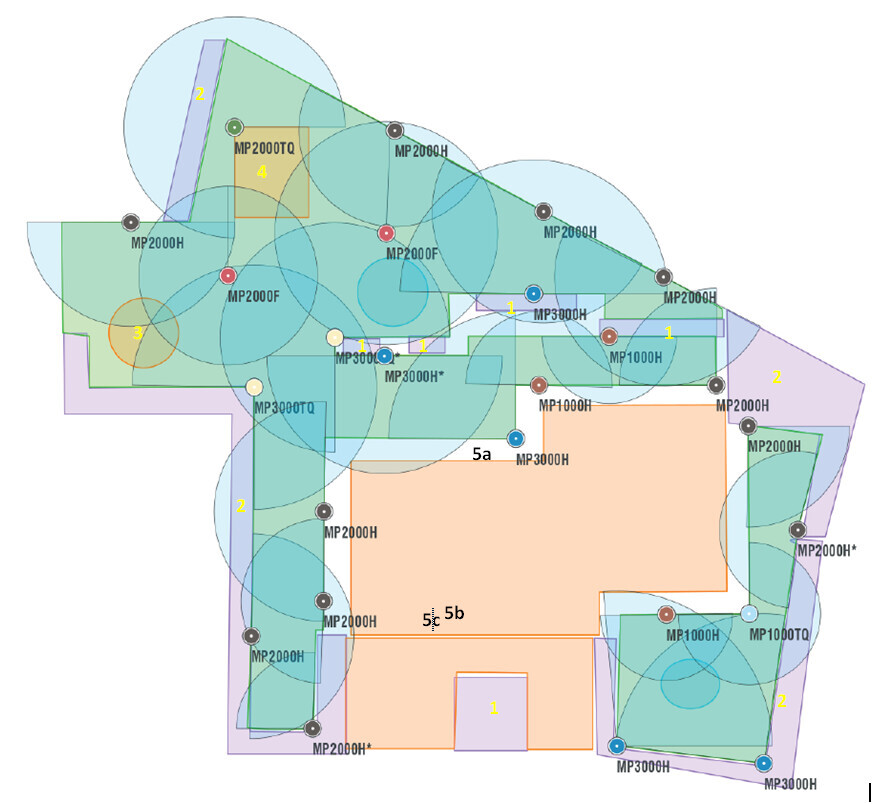
Legend:
Orange: house, terrace at the house, paved areas in front of the house
Green: lawn
White areas: paths/stairs/terrace
1: raised garden beds
2: hedges
3: trampoline (in-ground)
4: terrace
5a-c: potential water faucets (a: outside, b: roof terrace on garage, c: inside the garage)
General information:
Currently, we have planned the entire supply through faucet 5a. More on this below in the questions.
The plot slopes about 7m (23 ft) from top to bottom towards the street.
Especially in the upper bottom left area, there are zones with less-than-optimal irrigation. This area is not used much, and perfect irrigation would be too expensive due to the many angles and "obstacles" (trampoline, terrace).
The following questions came up during the planning:
1. Multiple water sources: I assume that if I want to use multiple water sources, I will need to purchase as many irrigation controllers, valve manifolds, etc., as there are sources, correct?
2. Considering the slope: Do I need to take the slope into account during the planning? I couldn’t enter this in the planner. I imagine it might affect the pressure, so irrigation zones going uphill should have fewer sprinklers planned accordingly.
3. Quality levels of components: For many parts, you can choose between Eco, Expert, and Premium. These usually have a significant impact on price, but I don’t see a clear benefit from the descriptions.
Currently, we plan to use Expert quality for the irrigation controller and valve manifold, and Eco for the rest.
Is the upgrade to better materials worth the extra cost (for example, the installation unit for Hunter MP Rotators is about €12 (about $13); with 21 rotators that’s roughly €250 (about $275))?
4. Drip irrigation: Neither the manual nor the planner showed how much water demand to calculate per square meter, so I’m unsure if one connection is enough for a raised bed or hedge, or if several should be planned.
Related to this: Does each raised bed need a separate irrigation line, or can one line branch off to supply several raised beds?
Thanks in advance for all your answers 🙂
Due to bad weather, we didn’t make as much progress on the landscaping as planned, but now we are moving forward and are currently planning the automatic irrigation system.
We have tried several planners for this, and the one from DVS worked best for us. However, some aspects are still unclear, so I hope to get some feedback on our plan and clarify a few open questions.
Here is our current plan:
Legend:
Orange: house, terrace at the house, paved areas in front of the house
Green: lawn
White areas: paths/stairs/terrace
1: raised garden beds
2: hedges
3: trampoline (in-ground)
4: terrace
5a-c: potential water faucets (a: outside, b: roof terrace on garage, c: inside the garage)
General information:
Currently, we have planned the entire supply through faucet 5a. More on this below in the questions.
The plot slopes about 7m (23 ft) from top to bottom towards the street.
Especially in the upper bottom left area, there are zones with less-than-optimal irrigation. This area is not used much, and perfect irrigation would be too expensive due to the many angles and "obstacles" (trampoline, terrace).
The following questions came up during the planning:
1. Multiple water sources: I assume that if I want to use multiple water sources, I will need to purchase as many irrigation controllers, valve manifolds, etc., as there are sources, correct?
2. Considering the slope: Do I need to take the slope into account during the planning? I couldn’t enter this in the planner. I imagine it might affect the pressure, so irrigation zones going uphill should have fewer sprinklers planned accordingly.
3. Quality levels of components: For many parts, you can choose between Eco, Expert, and Premium. These usually have a significant impact on price, but I don’t see a clear benefit from the descriptions.
Currently, we plan to use Expert quality for the irrigation controller and valve manifold, and Eco for the rest.
Is the upgrade to better materials worth the extra cost (for example, the installation unit for Hunter MP Rotators is about €12 (about $13); with 21 rotators that’s roughly €250 (about $275))?
4. Drip irrigation: Neither the manual nor the planner showed how much water demand to calculate per square meter, so I’m unsure if one connection is enough for a raised bed or hedge, or if several should be planned.
Related to this: Does each raised bed need a separate irrigation line, or can one line branch off to supply several raised beds?
Thanks in advance for all your answers 🙂
Can anyone say something about the planning?
The plot is quite challenging due to the slope, several terraces or children's play equipment, and the unusual layout, so I am still very uncertain about the design.
Additionally, the costs are already borderline high, but it is, of course, not a small plot.
However, if it could possibly be more cost-effective through a more efficient positioning, that would of course be very nice.
The plot is quite challenging due to the slope, several terraces or children's play equipment, and the unusual layout, so I am still very uncertain about the design.
Additionally, the costs are already borderline high, but it is, of course, not a small plot.
However, if it could possibly be more cost-effective through a more efficient positioning, that would of course be very nice.
O
Osnabruecker3 Aug 2021 14:15Unfortunately, I have no expertise on the subject...
Is this supposed to be done by a company or as a DIY project? Your preliminary planning should be a good starting point for discussing things with companies.
If you are doing it yourself, I would contact the manufacturer to see if they can support you. After all, you do want to buy something from them.
Is this supposed to be done by a company or as a DIY project? Your preliminary planning should be a good starting point for discussing things with companies.
If you are doing it yourself, I would contact the manufacturer to see if they can support you. After all, you do want to buy something from them.
H
hampshire3 Aug 2021 16:541.: With multiple water sources, you will need increased control management—depending on whether you feed different sources into the same system or build multiple systems.
2.: Of course, you need to consider the slope—by the way, it’s also important to know where the water will flow. You must also factor in the planned vegetation, as large plants can disrupt the theoretically ideal water circulation.
3.: I cannot assess the quality of the product lines. Sorry.
4.: Water demand depends not only on the area but also on what you plan to grow there. For a few raised beds, one water source is definitely sufficient; branching off is no problem if you consider the pipe lengths and use pressure-compensating drip emitters.
Without a garden and planting plan, no meaningful irrigation plan can be made.
2.: Of course, you need to consider the slope—by the way, it’s also important to know where the water will flow. You must also factor in the planned vegetation, as large plants can disrupt the theoretically ideal water circulation.
3.: I cannot assess the quality of the product lines. Sorry.
4.: Water demand depends not only on the area but also on what you plan to grow there. For a few raised beds, one water source is definitely sufficient; branching off is no problem if you consider the pipe lengths and use pressure-compensating drip emitters.
Without a garden and planting plan, no meaningful irrigation plan can be made.

@Crossy
Feeding an automatic irrigation system from a tap is the worst option. It depends on the size (diameter) of your water meter and how the pipes to the tap are configured.
It makes no sense to feed from multiple taps since you only have one main line. However, one controller is sufficient either way. The number of valves needed depends on the number of zones. Whether the valves are all in one box or spread over several is initially irrelevant.
First, you should find out how much pressure and flow you actually have available.
On a steep slope, irrigation is done in a cascade from top to bottom. Otherwise, install sprinklers at an angle.
Choose quality products, expert grade. Order the components individually. Prices have increased significantly. For the controller, use a Hunter Hydrawise. But you will need many zones (and therefore many valves). Do you have a rainwater tank you could use?
You have many areas where strip sprinklers would make more sense. Unfortunately, no dimensions are given. How large is the property?
Hedges and flower beds should be on separate zones.
The flower beds could be served by one zone. The water volume can then be controlled by the length of the drip line (loops). Drip lines have a water consumption ranging from 1.7 liters/hour per 33cm (13 inches) up to 2.3 liters/hour depending on the type.
Overall, your sprinkler placement is not optimal (head-to-head coverage).
For a new installation, irrigation can be laid out very easily. No contractor is required for this... We are talking about HDPE pipes, fittings, sprinklers, valve boxes, and control wiring...
Do it right now and you will enjoy it for a long time.
Feeding an automatic irrigation system from a tap is the worst option. It depends on the size (diameter) of your water meter and how the pipes to the tap are configured.
It makes no sense to feed from multiple taps since you only have one main line. However, one controller is sufficient either way. The number of valves needed depends on the number of zones. Whether the valves are all in one box or spread over several is initially irrelevant.
First, you should find out how much pressure and flow you actually have available.
On a steep slope, irrigation is done in a cascade from top to bottom. Otherwise, install sprinklers at an angle.
Choose quality products, expert grade. Order the components individually. Prices have increased significantly. For the controller, use a Hunter Hydrawise. But you will need many zones (and therefore many valves). Do you have a rainwater tank you could use?
You have many areas where strip sprinklers would make more sense. Unfortunately, no dimensions are given. How large is the property?
Hedges and flower beds should be on separate zones.
The flower beds could be served by one zone. The water volume can then be controlled by the length of the drip line (loops). Drip lines have a water consumption ranging from 1.7 liters/hour per 33cm (13 inches) up to 2.3 liters/hour depending on the type.
Overall, your sprinkler placement is not optimal (head-to-head coverage).
For a new installation, irrigation can be laid out very easily. No contractor is required for this... We are talking about HDPE pipes, fittings, sprinklers, valve boxes, and control wiring...
Do it right now and you will enjoy it for a long time.
Similar topics