
ᐅ Planning a Single-Family Home with Four Children’s Bedrooms
Created on: 27 Mar 2024 21:02
B
Blaupause250
Hello dear forum,
We are a family with currently 3 children, with a 4th on the way, and we want to build a house in Brandenburg (near Berlin).
We are complete beginners in the field of house building and often find it hard to make decisions simply because we lack deeper knowledge.
Maybe you can help us or give some tips—we would be very grateful.
Now, some basic information:
We have been promised a plot of land; the notary appointment is expected to take place in about 2 months.
The plot is approximately 1000 sqm (10,764 sq ft) and according to the development plan, has a floor area ratio of 0.2. Construction is allowed with one full storey, with an additional full storey permitted if it is built within a roof space.
A gable, hip, or half-hipped roof is mandatory, with a pitch between 30° and 50°.
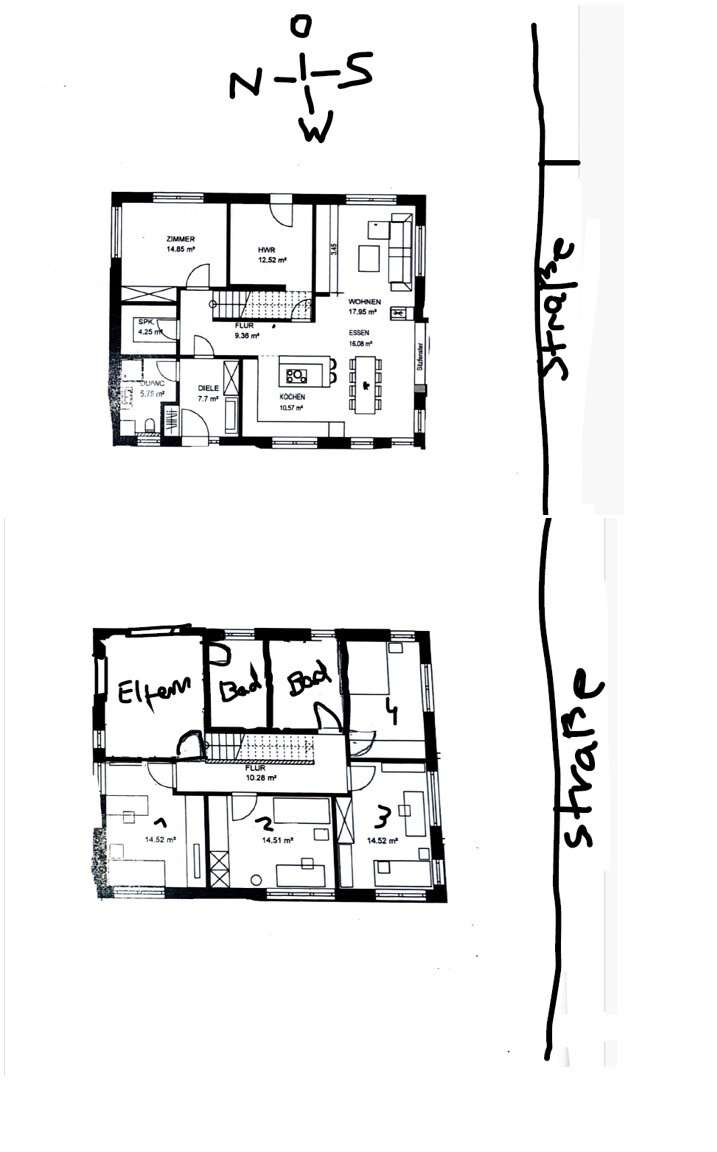
Our “dream floor plan,” which we have designed, is attached. The footprint here would be 12.85 x 9.89 m (42.2 x 32.4 ft) with a gable roof on top. Knee wall height (dwarf wall) is 1.80 m (5.9 ft).
Unfortunately, a townhouse-style villa is not possible due to the above restrictions, as the roof would then not be integrated into the second storey.
What is important to us:
The living area should be no less than 160 sqm (1,722 sq ft), ideally around 180–190 sqm (1,938–2,045 sq ft).
At least 3 children’s bedrooms should be available.
A home office must also be included (on the ground floor).
A knee wall height of at least 1.80 m (5.9 ft) is important because we have some very tall men in the family.
Windows on all four sides on the upper floor (no need for floor-to-ceiling windows).
A second bathroom upstairs. (We would supply sanitary fittings and tiles/floor coverings at our own cost.)
We have planned a budget of 450,000 € (excluding additional construction costs like fees and permits).
Since this is a very tight budget for such a house, our question is: is it even possible?
What can we cut to save money?
Basically, we see two possibilities: Either keep our floor plan and wishes and cut back on many things (insulation, ventilation system, etc.) or simply choose a smaller prefabricated house as specified, built to KfW standard. What would be the pros and cons of that?
A few related questions:
Should one build with a prefab house company or contract the trades separately? Which is cheaper or better?
Because we have some custom wishes (floor plan, knee wall, additional windows), prices from prefab companies quickly became notably more expensive. Also, they include many things that we might want to remove in order to fulfill our wishes (see below regarding heating, insulation, etc.).
We have already talked to several home builders and are now completely confused, as everyone insists their construction method is the best.
Solid construction or timber frame? If solid, which brick/block size? 24 cm, 36 cm?
EPS (expanded polystyrene) insulation, lime-based, or possibly no insulation at all?
Which is more prone to mold or algae? What costs the least?
Centralized/decentralized ventilation system or none at all (I like to ventilate myself)?
I tend towards none, my husband leans towards ventilation.
My purely subjective and absolutely non-professional opinion: I fear the ventilation noise might annoy me, the air might become too dry and overly “clean,” and the ducts might eventually develop mold or get damaged over the years, requiring opening walls and replacing parts.
Additionally, it is a significant cost item that we could save a lot on if we leave it out.
My husband says this technology has been around for a long time, there won’t be any mold or damage. On the contrary, the house would be reliably mold-free with perfectly filtered air, humidity, and temperature.
What would be your expert opinion on this?
We tend to choose underfloor heating because I always feel cold without it, so air/water heat pump rather than air/air.
Is it possible to save costs with the floor plan? Should we aim for as many straight walls as possible and avoid corners to make construction cheaper?
Is the house less expensive if the roof pitch is only 30° instead of, for example, 45°?
If you build according to KfW standard, can you save money by building without it?
We would only apply for KfW funding if we build a timber frame house with a prefab company, because the additional costs for analyses on solid houses are unfortunately too high for our wishes.
We would have liked to use ILB funding as well, but our plot is just outside the eligible zone.
Two companies told us that this means no chance, but two others said it would not be a problem and the architect could simply apply for an extension of the zone. It would just be a letter that the city would have to sign, so it wouldn’t be a problem.
Are some companies just too lazy to handle the applications, or are the others exaggerating?
So many questions—hopefully, they were at least somewhat understandable?
Thank you very much in advance and have a nice evening!
We are a family with currently 3 children, with a 4th on the way, and we want to build a house in Brandenburg (near Berlin).
We are complete beginners in the field of house building and often find it hard to make decisions simply because we lack deeper knowledge.
Maybe you can help us or give some tips—we would be very grateful.
Now, some basic information:
We have been promised a plot of land; the notary appointment is expected to take place in about 2 months.
The plot is approximately 1000 sqm (10,764 sq ft) and according to the development plan, has a floor area ratio of 0.2. Construction is allowed with one full storey, with an additional full storey permitted if it is built within a roof space.
A gable, hip, or half-hipped roof is mandatory, with a pitch between 30° and 50°.
Our “dream floor plan,” which we have designed, is attached. The footprint here would be 12.85 x 9.89 m (42.2 x 32.4 ft) with a gable roof on top. Knee wall height (dwarf wall) is 1.80 m (5.9 ft).
Unfortunately, a townhouse-style villa is not possible due to the above restrictions, as the roof would then not be integrated into the second storey.
What is important to us:
The living area should be no less than 160 sqm (1,722 sq ft), ideally around 180–190 sqm (1,938–2,045 sq ft).
At least 3 children’s bedrooms should be available.
A home office must also be included (on the ground floor).
A knee wall height of at least 1.80 m (5.9 ft) is important because we have some very tall men in the family.
Windows on all four sides on the upper floor (no need for floor-to-ceiling windows).
A second bathroom upstairs. (We would supply sanitary fittings and tiles/floor coverings at our own cost.)
We have planned a budget of 450,000 € (excluding additional construction costs like fees and permits).
Since this is a very tight budget for such a house, our question is: is it even possible?
What can we cut to save money?
Basically, we see two possibilities: Either keep our floor plan and wishes and cut back on many things (insulation, ventilation system, etc.) or simply choose a smaller prefabricated house as specified, built to KfW standard. What would be the pros and cons of that?
A few related questions:
Should one build with a prefab house company or contract the trades separately? Which is cheaper or better?
Because we have some custom wishes (floor plan, knee wall, additional windows), prices from prefab companies quickly became notably more expensive. Also, they include many things that we might want to remove in order to fulfill our wishes (see below regarding heating, insulation, etc.).
We have already talked to several home builders and are now completely confused, as everyone insists their construction method is the best.
Solid construction or timber frame? If solid, which brick/block size? 24 cm, 36 cm?
EPS (expanded polystyrene) insulation, lime-based, or possibly no insulation at all?
Which is more prone to mold or algae? What costs the least?
Centralized/decentralized ventilation system or none at all (I like to ventilate myself)?
I tend towards none, my husband leans towards ventilation.
My purely subjective and absolutely non-professional opinion: I fear the ventilation noise might annoy me, the air might become too dry and overly “clean,” and the ducts might eventually develop mold or get damaged over the years, requiring opening walls and replacing parts.
Additionally, it is a significant cost item that we could save a lot on if we leave it out.
My husband says this technology has been around for a long time, there won’t be any mold or damage. On the contrary, the house would be reliably mold-free with perfectly filtered air, humidity, and temperature.
What would be your expert opinion on this?
We tend to choose underfloor heating because I always feel cold without it, so air/water heat pump rather than air/air.
Is it possible to save costs with the floor plan? Should we aim for as many straight walls as possible and avoid corners to make construction cheaper?
Is the house less expensive if the roof pitch is only 30° instead of, for example, 45°?
If you build according to KfW standard, can you save money by building without it?
We would only apply for KfW funding if we build a timber frame house with a prefab company, because the additional costs for analyses on solid houses are unfortunately too high for our wishes.
We would have liked to use ILB funding as well, but our plot is just outside the eligible zone.
Two companies told us that this means no chance, but two others said it would not be a problem and the architect could simply apply for an extension of the zone. It would just be a letter that the city would have to sign, so it wouldn’t be a problem.
Are some companies just too lazy to handle the applications, or are the others exaggerating?
So many questions—hopefully, they were at least somewhat understandable?
Thank you very much in advance and have a nice evening!
The wall builder doesn’t really mind. What costs money are other things: a third bathroom, many windows, sliding elements, and so on. Even these small "nooks" are always complex to build. You have to ask yourself whether they really need to be there.
Besides, not everywhere is in the south of the country; you don’t always have to assume 3,000. Level eleven 40 (QNG) can also work with 2,500 if you’re careful.
Besides, not everywhere is in the south of the country; you don’t always have to assume 3,000. Level eleven 40 (QNG) can also work with 2,500 if you’re careful.

Good gracious. I’ll start with the second biggest challenge (the biggest being your lack of knowledge, which makes you easy prey for misconceptions and nonsense), namely the need for a floor plan suitable for four children. This automatically rules out adopting standard catalog house designs or model homes without significant modifications. You will either have to expand such plans with professional support or design a custom one. First, name the development plan / zoning plan — careful, not as a link! — because I strongly suspect that you are reading it too superficially and barely understand it. As I explained, among other things, in “How the knee wall affects the window question in the attic,” the desired standing height is a poor guide for determining a knee wall height (and I seriously doubt the development plan grants unlimited freedom here).
You can forget that right away, keyword “development plan.” First clarify your budget and the house size that is actually feasible within it. From that, you must subtract about 40 square meters (not for the house itself, but for the search for suitable catalog house base models). I have also explained this in “Changing a floor plan in this size.” You choose the appropriate building method (“setting the course”) during the “resting phase” of planning, and the selection of a suitable construction company comes much later. For detailed explanations, search the forum for my “house building roadmap,” and later “self-contracting” / “individual contracting” as well as “Gerddieter.”
Forget hip roofs including half-hip roofs, too, as you will need gable walls. And due to the need for living space in the attic, you will also not stray too far from the maximum roof pitch.
https://www.instagram.com/11antgmxde/
https://www.linkedin.com/company/bauen-jetzt/
Blaupause250 schrieb:
Our “dream floor plan” that we came up with is attached. The footprint would be 12.85 x 9.89 meters (42.2 x 32.4 feet) with a gable roof on top. Knee wall at 1.80 meters (5 ft 11 in).
You can forget that right away, keyword “development plan.” First clarify your budget and the house size that is actually feasible within it. From that, you must subtract about 40 square meters (not for the house itself, but for the search for suitable catalog house base models). I have also explained this in “Changing a floor plan in this size.” You choose the appropriate building method (“setting the course”) during the “resting phase” of planning, and the selection of a suitable construction company comes much later. For detailed explanations, search the forum for my “house building roadmap,” and later “self-contracting” / “individual contracting” as well as “Gerddieter.”
Forget hip roofs including half-hip roofs, too, as you will need gable walls. And due to the need for living space in the attic, you will also not stray too far from the maximum roof pitch.
https://www.instagram.com/11antgmxde/
https://www.linkedin.com/company/bauen-jetzt/

Blaupause250 schrieb:
The plot is about 1000sqm (10760 sq ft) and has a floor area ratio of 0.2 according to the development plan. You should go to the building authority and ask what is actually tolerated and approved.
In our case (Berlin), even with a floor area ratio of 0.2, 0.2099 was approved but 0.2100 was not.
With a good justification, we got approval for 0.2099 plus 4sqm (43 sq ft).
H
hanghaus202328 Mar 2024 14:15The budget is not sufficient. You should limit yourselves to a smaller house.
Where is the zoning plan / building plan?
Is there a slope / hillside?
Where is the zoning plan / building plan?
Is there a slope / hillside?
Blaupause250 schrieb:
The planned budget for the house is 450,000 € excluding additional construction costs. Blaupause250 schrieb:
185 sqm (1,990 sqft) .., calculated at 550,000 €.
.
We could, of course, debate endlessly about quality, external thermal insulation composite systems (ETICS), quality assurance systems (QNG), and KfW40 standards (the best and most expensive options offered at house and building exhibitions). The fact is: you hardly have the choice to avoid or dismiss standard quality.
Right now, you’re approaching this from the wrong angle, focusing on phrases rather than practical solutions. Make sure you find someone who can work with you, your budget, and the local development plan to get the most out of your design. Then you may still have possibilities to make some adjustments. But in my opinion, you won’t be able to avoid average standard materials altogether.
Similar topics