
ᐅ Planning a Single-Family Home on a Sloped Site – Making Optimal Use of the Land
Created on: 24 May 2019 22:20
F
Fuchsbauer
Hello dear forum,
we currently live in Vienna and have purchased a beautiful (and unfortunately very expensive) sloped plot west of Vienna. We already had an approved building permit plan (!) prepared by an architect, but in February we decided to stop the process. Through discussions with builders as well as other trades (window manufacturers, plumbers, electricians), we realized that this plan would exceed our initially agreed budget by approximately 30-40% in execution costs. Hence, we put on the brakes and started over: this time with an independent planner recommended to us by a builder who – in our opinion – is doing a good job and has developed the current plan together with us.
However, before we proceed towards the building permit plan, we would like to have your feedback to “challenge” the plan. As you can imagine, we have already invested a lot of time and nerves in this process with the architect, the restart, and back and forth, and if possible, we want to start building still in 2019… especially since one of the future residents of the two children’s bedrooms has already been born, and we want to move out of our small apartment as soon as possible.
Here is our questionnaire, which we hope gives you a good overview of our project:
Development plan / Restrictions
Plot size: 690 m² (19.5 m x 35.4 m) (7,432 sq ft (64 ft x 116 ft))
Slope: yes, approx. 5 m (16 ft) gradient over 35 m (115 ft) length
Site coverage ratio: not applicable in Austria, buildable area is 199 m² (2,141 sq ft)
Floor area ratio: not applicable in Austria
Building setback lines and boundaries: front and side setbacks each 3 m (10 ft) or half the eaves height of the adjacent house front, whichever is greater; rear setback 3 m (10 ft)
Edge construction: within the setback area up to a max height of 3 m (10 ft); higher height downhill allowed following terrain
Number of parking spaces: 1 unenclosed parking space required
Number of storeys: no restrictions in the development plan; currently 2 floors planned
Roof type: flat roof
Architectural style: Bauhaus
Orientation: southeast
Maximum heights / limits: 6.5 m (21 ft) on slope side / 8.5 m (28 ft) on valley side
Additional regulations:
Owners’ requirements
Architectural style, roof type, building type: Bauhaus, flat roof, single-family house
Basement, floors: 2 floors (for cost reasons), with the upper floor at street level and the ground floor partially built into the slope
Number of occupants, ages: 4, two adults (mid/late 30s) and two small children; medium-term expectation of adding an elderly person (grandmother)
Room requirements on ground floor and upper floor:
Ground floor (essentially basement level): large living area with living room, dining area and spacious kitchen, guest WC with hand basin, hobby room and storage rooms as well as technical room
Upper floor (at street level): office/guest room, guest bathroom, wardrobe, large bathroom, walk-in closet (spatially separated from master bedroom), utility room plus 3 bedrooms (master bedroom, 2 children's rooms)
Office: family use or home office? Both
Number of guest stays per year: currently about 6 weekends per year, but potential for permanent guest room use
Open or closed architecture: open but focused on reducing noise transfer from the living area to the bedrooms
Conservative or modern construction: modern but timeless
Open kitchen, kitchen island: open kitchen with large kitchen island (peninsula) and direct view contact to dining table
Number of dining seats: regularly 6 with possibility to expand to 10 for occasions
Fireplace: yes, on the ground floor in the living area – also to serve as room divider
Music / stereo wall: wall for large TV and floor-standing speakers
Balcony, roof terrace: no
Garage, carport: garage
Utility garden, greenhouse: raised beds for vegetables, preferably flat area for children’s play area (sandbox, swing, …), shrubs such as elderberry bush and butterfly bush along the property boundary
It is planned to raise the original ground level by up to 1.5 m (5 ft) to create a level area, which means a retaining wall will be necessary in the lower garden area.
Additional wishes / special features / daily routine, including reasons why some things should or should not be included:
Controlled ventilation system, thermal building activation for cooling, heating via geothermal energy (horizontal trench collector)
The walk-in closet should be spatially separated (at least by a door) from the master bedroom (since one of us gets up earlier than the other and the second person should not be disturbed).
The bedroom windows are oriented directly to the garden to prevent views from neighbors.
Guest room / office and guest bathroom should be on the same level so guests can easily find their way at night.
Large, open space combining living room, dining room, and kitchen, with the area around the sofa and TV somewhat separated (niche).
House design
Origin of the planning:
We initially worked with an architect and already had an approved building permit plan. Unfortunately, based on quotes from builders, it became clear that the architect’s cost estimates were far too low and would have significantly exceeded our budget. Therefore, we have now created a new design together with a planner, which has also been roughly discussed with a builder and should be within our budget.
- Planner affiliated with a construction company: yes
- Architect: no
- Do-it-yourself: no
What do you like most? Why?
The large open living area on the ground floor with direct access to the garden.
What do you dislike? Why?
Basically, we like the layout on the ground floor very much and it fits our needs. However, we are concerned about the long staircase (17 steps) – we fear it might be too dark there. We are also worried about noise transmission from the large living area to the bedrooms. Skylights would be possible, but we’d prefer to avoid them to keep the roof design as simple as possible.
@Regarding darkness: The positioning and size of windows is not yet final – we welcome feedback here. As mentioned, we are concerned that the hallway areas, and perhaps also the large living room on the ground floor, could be too dark. Please share your ideas.
Also, there is a lot of hallway space in front of the toilet on the ground floor (along the stairs) – perhaps there is a better layout with less circulation space required?
Location and size of the utility room on the upper floor – it is located away from the bathroom and is too small to fit a drying rack.
Estimated cost according to architect/planner:
Shell construction approx. 300,000 EUR
Personal maximum budget for the house, including fittings:
600,000 EUR
Preferred heating technology:
Geothermal energy (horizontal trench collector)
If you had to give up something, which details or expansions
- can you do without: garage (can be built later), garden fence, full build-out of the retaining wall, interior finishing of some rooms (guest bathroom, one children’s room, storage rooms), fireplace (can be built later)
- cannot do without: covered terrace, storage rooms and technical room
Why is the design the way it is?
Standard design from the planner?
Which wishes were implemented by the architect?
A mixture of many examples from various magazines...
What do you think is particularly good or bad about it?
The plot resulted from subdividing a large meadow. Neighboring plots are currently undeveloped (no buyers yet), so future development can only be guessed at. Therefore, we orient the bedrooms towards the garden. The plot southwest of ours is only 17 m (56 ft) wide. It is therefore likely that a future house there will be oriented roughly northeast-southwest (meaning it will extend further downslope than ours) and will potentially use the 8.5 m max building height.
Basically, the current plan is based on our experience with the architect’s design and the insights gained from many conversations with different trades to balance costs with our ideas.
What is the most important / fundamental question about the floor plan in 130 characters
How can I optimally use the sloped site to implement the spatial concept and keep costs under control? What could be improved?
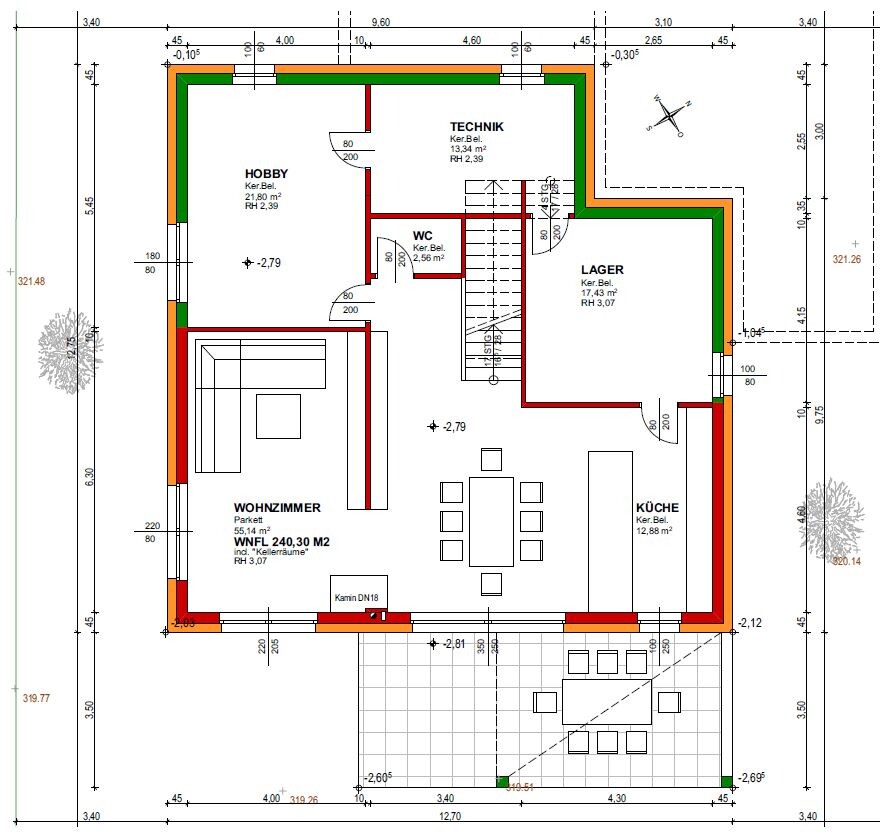

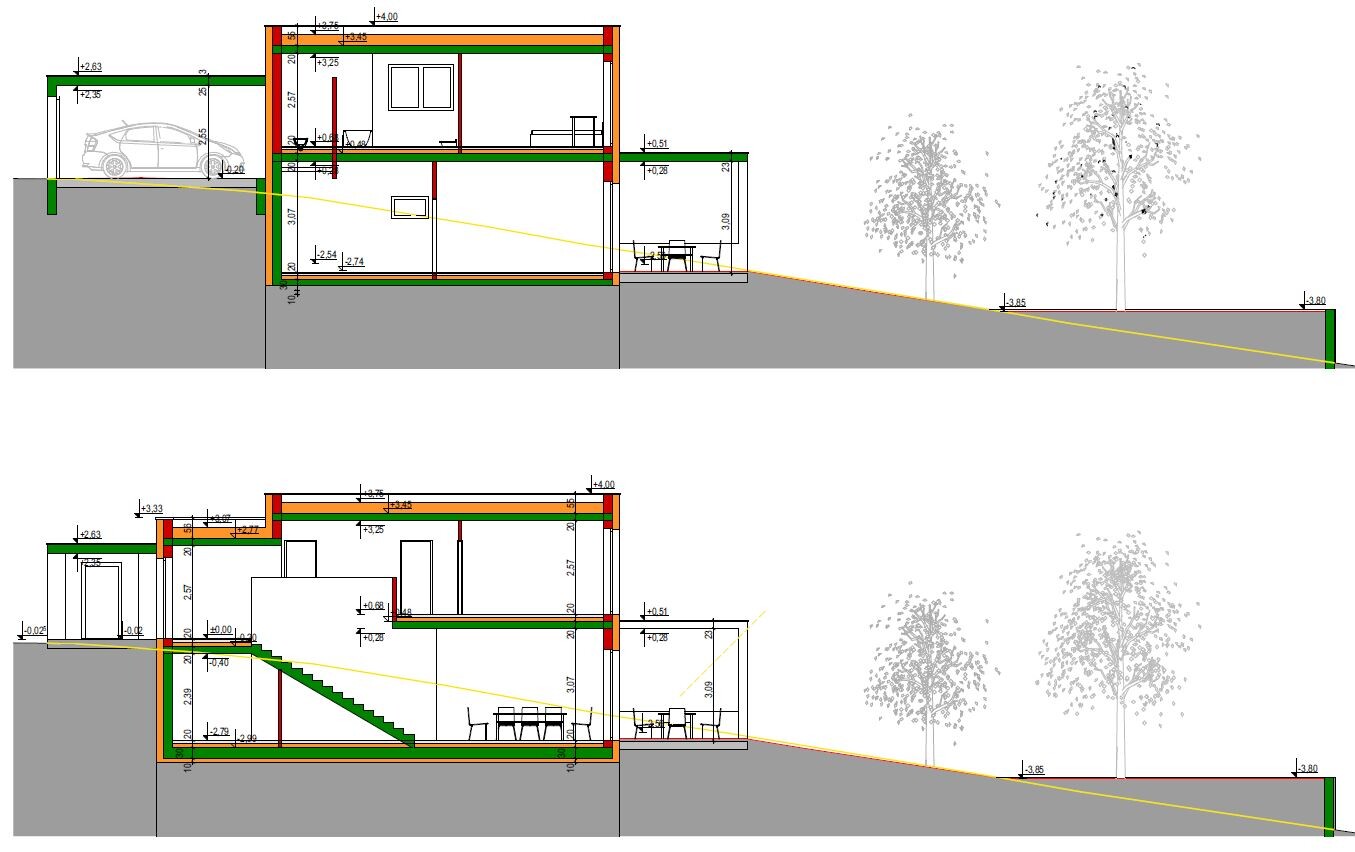
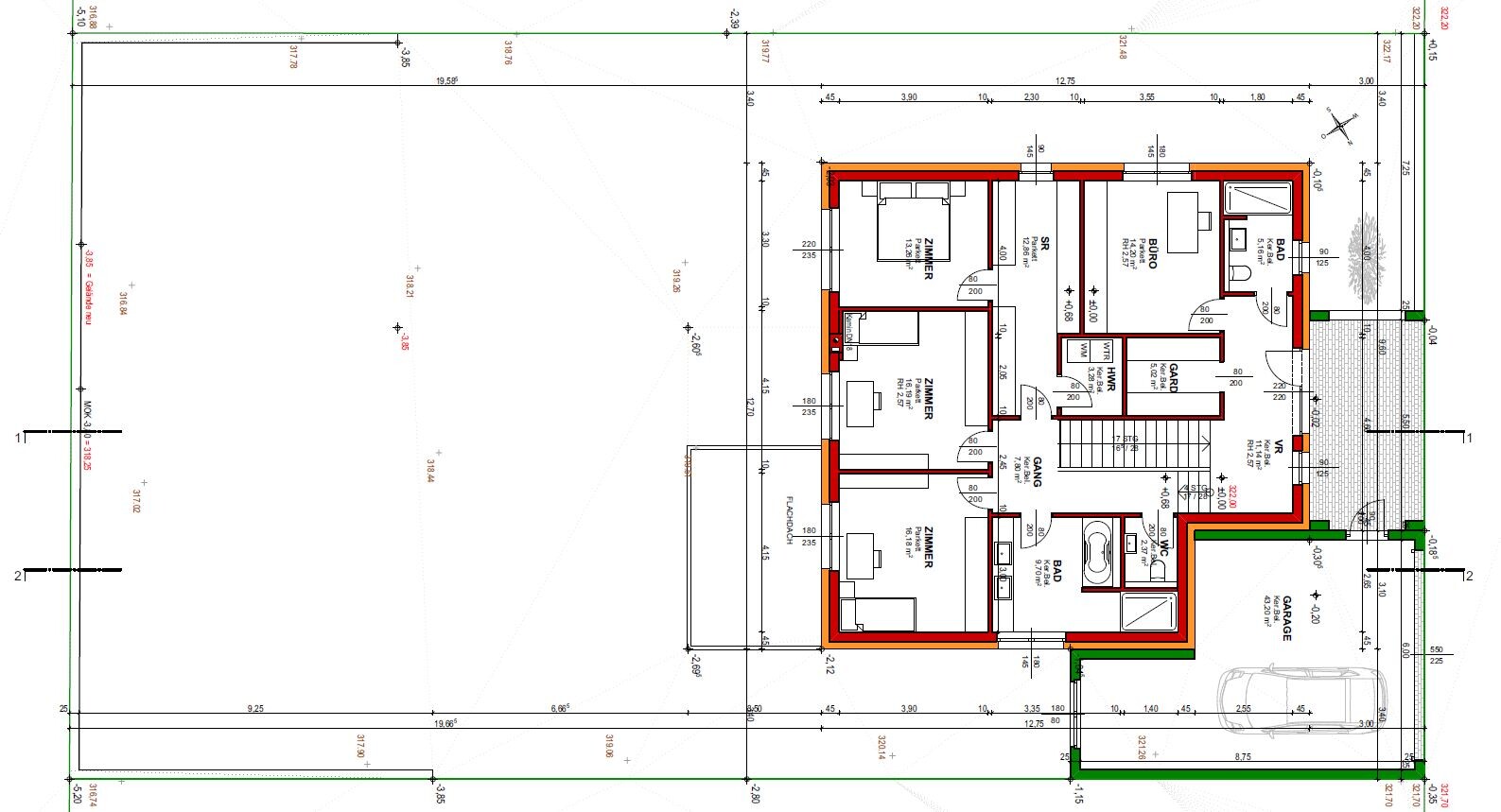
we currently live in Vienna and have purchased a beautiful (and unfortunately very expensive) sloped plot west of Vienna. We already had an approved building permit plan (!) prepared by an architect, but in February we decided to stop the process. Through discussions with builders as well as other trades (window manufacturers, plumbers, electricians), we realized that this plan would exceed our initially agreed budget by approximately 30-40% in execution costs. Hence, we put on the brakes and started over: this time with an independent planner recommended to us by a builder who – in our opinion – is doing a good job and has developed the current plan together with us.
However, before we proceed towards the building permit plan, we would like to have your feedback to “challenge” the plan. As you can imagine, we have already invested a lot of time and nerves in this process with the architect, the restart, and back and forth, and if possible, we want to start building still in 2019… especially since one of the future residents of the two children’s bedrooms has already been born, and we want to move out of our small apartment as soon as possible.
Here is our questionnaire, which we hope gives you a good overview of our project:
Development plan / Restrictions
Plot size: 690 m² (19.5 m x 35.4 m) (7,432 sq ft (64 ft x 116 ft))
Slope: yes, approx. 5 m (16 ft) gradient over 35 m (115 ft) length
Site coverage ratio: not applicable in Austria, buildable area is 199 m² (2,141 sq ft)
Floor area ratio: not applicable in Austria
Building setback lines and boundaries: front and side setbacks each 3 m (10 ft) or half the eaves height of the adjacent house front, whichever is greater; rear setback 3 m (10 ft)
Edge construction: within the setback area up to a max height of 3 m (10 ft); higher height downhill allowed following terrain
Number of parking spaces: 1 unenclosed parking space required
Number of storeys: no restrictions in the development plan; currently 2 floors planned
Roof type: flat roof
Architectural style: Bauhaus
Orientation: southeast
Maximum heights / limits: 6.5 m (21 ft) on slope side / 8.5 m (28 ft) on valley side
Additional regulations:
Owners’ requirements
Architectural style, roof type, building type: Bauhaus, flat roof, single-family house
Basement, floors: 2 floors (for cost reasons), with the upper floor at street level and the ground floor partially built into the slope
Number of occupants, ages: 4, two adults (mid/late 30s) and two small children; medium-term expectation of adding an elderly person (grandmother)
Room requirements on ground floor and upper floor:
Ground floor (essentially basement level): large living area with living room, dining area and spacious kitchen, guest WC with hand basin, hobby room and storage rooms as well as technical room
Upper floor (at street level): office/guest room, guest bathroom, wardrobe, large bathroom, walk-in closet (spatially separated from master bedroom), utility room plus 3 bedrooms (master bedroom, 2 children's rooms)
Office: family use or home office? Both
Number of guest stays per year: currently about 6 weekends per year, but potential for permanent guest room use
Open or closed architecture: open but focused on reducing noise transfer from the living area to the bedrooms
Conservative or modern construction: modern but timeless
Open kitchen, kitchen island: open kitchen with large kitchen island (peninsula) and direct view contact to dining table
Number of dining seats: regularly 6 with possibility to expand to 10 for occasions
Fireplace: yes, on the ground floor in the living area – also to serve as room divider
Music / stereo wall: wall for large TV and floor-standing speakers
Balcony, roof terrace: no
Garage, carport: garage
Utility garden, greenhouse: raised beds for vegetables, preferably flat area for children’s play area (sandbox, swing, …), shrubs such as elderberry bush and butterfly bush along the property boundary
It is planned to raise the original ground level by up to 1.5 m (5 ft) to create a level area, which means a retaining wall will be necessary in the lower garden area.
Additional wishes / special features / daily routine, including reasons why some things should or should not be included:
Controlled ventilation system, thermal building activation for cooling, heating via geothermal energy (horizontal trench collector)
The walk-in closet should be spatially separated (at least by a door) from the master bedroom (since one of us gets up earlier than the other and the second person should not be disturbed).
The bedroom windows are oriented directly to the garden to prevent views from neighbors.
Guest room / office and guest bathroom should be on the same level so guests can easily find their way at night.
Large, open space combining living room, dining room, and kitchen, with the area around the sofa and TV somewhat separated (niche).
House design
Origin of the planning:
We initially worked with an architect and already had an approved building permit plan. Unfortunately, based on quotes from builders, it became clear that the architect’s cost estimates were far too low and would have significantly exceeded our budget. Therefore, we have now created a new design together with a planner, which has also been roughly discussed with a builder and should be within our budget.
- Planner affiliated with a construction company: yes
- Architect: no
- Do-it-yourself: no
What do you like most? Why?
The large open living area on the ground floor with direct access to the garden.
What do you dislike? Why?
Basically, we like the layout on the ground floor very much and it fits our needs. However, we are concerned about the long staircase (17 steps) – we fear it might be too dark there. We are also worried about noise transmission from the large living area to the bedrooms. Skylights would be possible, but we’d prefer to avoid them to keep the roof design as simple as possible.
@Regarding darkness: The positioning and size of windows is not yet final – we welcome feedback here. As mentioned, we are concerned that the hallway areas, and perhaps also the large living room on the ground floor, could be too dark. Please share your ideas.
Also, there is a lot of hallway space in front of the toilet on the ground floor (along the stairs) – perhaps there is a better layout with less circulation space required?
Location and size of the utility room on the upper floor – it is located away from the bathroom and is too small to fit a drying rack.
Estimated cost according to architect/planner:
Shell construction approx. 300,000 EUR
Personal maximum budget for the house, including fittings:
600,000 EUR
Preferred heating technology:
Geothermal energy (horizontal trench collector)
If you had to give up something, which details or expansions
- can you do without: garage (can be built later), garden fence, full build-out of the retaining wall, interior finishing of some rooms (guest bathroom, one children’s room, storage rooms), fireplace (can be built later)
- cannot do without: covered terrace, storage rooms and technical room
Why is the design the way it is?
Standard design from the planner?
Which wishes were implemented by the architect?
A mixture of many examples from various magazines...
What do you think is particularly good or bad about it?
The plot resulted from subdividing a large meadow. Neighboring plots are currently undeveloped (no buyers yet), so future development can only be guessed at. Therefore, we orient the bedrooms towards the garden. The plot southwest of ours is only 17 m (56 ft) wide. It is therefore likely that a future house there will be oriented roughly northeast-southwest (meaning it will extend further downslope than ours) and will potentially use the 8.5 m max building height.
Basically, the current plan is based on our experience with the architect’s design and the insights gained from many conversations with different trades to balance costs with our ideas.
What is the most important / fundamental question about the floor plan in 130 characters
How can I optimally use the sloped site to implement the spatial concept and keep costs under control? What could be improved?
F
Fuchsbauer26 May 2019 20:15Thank you very much for your feedback. There are already some good tips and food for thought included. Here are our responses:
You are right, the wall thicknesses are not correct yet. The planner’s initial approach was to first put the room concept on paper. We will address this once the room layout is more or less finalized. Whether this is the right or usual approach can be questioned. The planner said he usually works this way.
We have since abandoned that plan because through many discussions with the builders and trades, we realized that it did not meet our expectations in many areas. For example, the old plan had three floors, with mainly storage and technical rooms in the basement. The living area with the terrace was on the ground floor and about 2 meters (6.5 feet) above the garden. There was also a terrace on the upper floor (in front of the children’s rooms), which we did not want (it resulted from the upper floor being planned smaller than the ground floor) and probably would not have been used for years. The house was relatively narrow and quite long downhill (15 meters (50 feet)), limiting room heights. For instance, in the large open living area, we had only 2.60 meters (8.5 feet) ceiling height! In retrospect, we think we let the architect “lull” us for too long before realizing that it was no longer “our” house. Additionally, we saw that despite many compromises, the house was significantly over budget, which led us to pull the emergency brake and start over. Therefore, it no longer makes much sense for us to discuss the old plan.
We honestly don’t understand that. This large living-kitchen-dining area was very important to us because it will be the heart of the house. Storage and hobby rooms can still be subdivided if necessary or useful. Initially, however, we prefer fewer large rooms rather than multiple small ones. Could you please clarify your concerns here?
We agree with you — therefore, our request: what and especially how could this layout be optimized?
We will consider the glass wall option. In the worst case, such a glass wall could probably be retrofitted if noise from the dining area really proves disturbing. We like the idea of a wall with a window opening less.
Good point. We will look into that.
Our thinking was that we will also store groceries here, so direct access from the kitchen area would be very practical. Especially in everyday life, purchases will probably first be placed on the kitchen island and then put into the fridge, cabinets, or storage from there. What would you change here and why?
Thanks for the tip. Indeed, this is still an open topic for us where our opinions differ somewhat.
The planner already tried such an approach but did not find a good solution. The main limitation on the right side is the lack of possibility for “proper” windows along the garage. We will discuss this again with him.
Our approach was to possibly accommodate grandma in the office/guest room. There would be barrier-free access from the street. The room should also be pleasantly bright and thus suitable for longer stays. We will widen the doors to 90 cm (35 inches). In principle, repurposing the hobby room and expanding the toilet to a full bathroom is also conceivable. However, the staircase would then definitely be a barrier. The "better" solution will ultimately depend on how mobile grandma still is.
Then we will inevitably have to consider a stairlift. The main staircase should definitely be wide enough for that.
This solution arose for two reasons:
1.) Initially, we did not like the idea of having the bedrooms on the entrance level. The steps create at least a “small barrier” (even if only mentally) to the private sleeping area.
2.) By using the ceiling offset, we achieve higher ceiling heights in the living area without unnecessarily raising the part of the house underground where higher ceiling heights are not needed. This reduces the required excavation somewhat.
In principle, we liked the idea of a real split-level house (single-story entrance level with guest room and guest bathroom at street level, followed by a two-story section each half a floor staggered – with living areas in the lower floor and private bedrooms in the upper floor). However, the planner felt the terrain slope was not ideal for this, and the builder warned about costs, so we abandoned this idea.
We both grew up in households where the toilet was inside the bathroom. Especially in the morning, when everyone needs to use the bathroom at the same time, separate rooms reduce stress. This is a conscious decision, and we are willing to accept possible disadvantages here.
We could take a few centimeters from both sides of the room to increase the width from the current 107 cm (230 – 2 x 1.5 cm plaster – 2 x 60 cm cabinets) to about 120 cm (47 inches). Would this significantly improve the situation? Any better ideas?
11ant schrieb:
Apparently, there are no load-bearing interior walls in this house.
You are right, the wall thicknesses are not correct yet. The planner’s initial approach was to first put the room concept on paper. We will address this once the room layout is more or less finalized. Whether this is the right or usual approach can be questioned. The planner said he usually works this way.
11ant schrieb:
Then show us the plan that was canceled. If I understand correctly, it was already for this plot; maybe we can find a better reinterpretation.
We have since abandoned that plan because through many discussions with the builders and trades, we realized that it did not meet our expectations in many areas. For example, the old plan had three floors, with mainly storage and technical rooms in the basement. The living area with the terrace was on the ground floor and about 2 meters (6.5 feet) above the garden. There was also a terrace on the upper floor (in front of the children’s rooms), which we did not want (it resulted from the upper floor being planned smaller than the ground floor) and probably would not have been used for years. The house was relatively narrow and quite long downhill (15 meters (50 feet)), limiting room heights. For instance, in the large open living area, we had only 2.60 meters (8.5 feet) ceiling height! In retrospect, we think we let the architect “lull” us for too long before realizing that it was no longer “our” house. Additionally, we saw that despite many compromises, the house was significantly over budget, which led us to pull the emergency brake and start over. Therefore, it no longer makes much sense for us to discuss the old plan.
11ant schrieb:
The few rooms get lost on the garden level.
We honestly don’t understand that. This large living-kitchen-dining area was very important to us because it will be the heart of the house. Storage and hobby rooms can still be subdivided if necessary or useful. Initially, however, we prefer fewer large rooms rather than multiple small ones. Could you please clarify your concerns here?
11ant schrieb:
The street level itself seems like a labyrinth clogged with small storerooms.
We agree with you — therefore, our request: what and especially how could this layout be optimized?
kbt09 schrieb:
Now there is a half-height railing planned on the upper floor… Maybe glass up to the ceiling there, but that would be expensive. Perhaps try to have the staircase on the ground floor end with a curve to the left as per the plan and then put up a room-height wall with a window opening towards the dining area.
We will consider the glass wall option. In the worst case, such a glass wall could probably be retrofitted if noise from the dining area really proves disturbing. We like the idea of a wall with a window opening less.
kbt09 schrieb:
In general, I would set door widths to at least 90 cm (35 inches) everywhere in the shell construction (except for toilets). The toilet doors should also open outwards, especially on the ground floor, where space is tight.
Good point. We will look into that.
kbt09 schrieb:
I would reconsider the kitchen and storage access.
Our thinking was that we will also store groceries here, so direct access from the kitchen area would be very practical. Especially in everyday life, purchases will probably first be placed on the kitchen island and then put into the fridge, cabinets, or storage from there. What would you change here and why?
kbt09 schrieb:
It would also be desirable to have a window in the right-hand wall.
Thanks for the tip. Indeed, this is still an open topic for us where our opinions differ somewhat.
ypg schrieb:
If you place the cloakroom and utility room, which are the core of the labyrinth, on the right side of the plan, everything should be somewhat less confusing and simpler.
The planner already tried such an approach but did not find a good solution. The main limitation on the right side is the lack of possibility for “proper” windows along the garage. We will discuss this again with him.
ypg schrieb:
In the medium term, grandma is supposed to move in. Which room is assigned to her?
Our approach was to possibly accommodate grandma in the office/guest room. There would be barrier-free access from the street. The room should also be pleasantly bright and thus suitable for longer stays. We will widen the doors to 90 cm (35 inches). In principle, repurposing the hobby room and expanding the toilet to a full bathroom is also conceivable. However, the staircase would then definitely be a barrier. The "better" solution will ultimately depend on how mobile grandma still is.
haydee schrieb:
What if grandma can’t manage stairs or needs a walker?
Then we will inevitably have to consider a stairlift. The main staircase should definitely be wide enough for that.
Yosan schrieb:
Why not make the upper floor really level without any additional steps within that floor?
RomeoZwo schrieb:
If separating the office/guest room from the private rooms is important, I think the solution is not bad at all.
This solution arose for two reasons:
1.) Initially, we did not like the idea of having the bedrooms on the entrance level. The steps create at least a “small barrier” (even if only mentally) to the private sleeping area.
2.) By using the ceiling offset, we achieve higher ceiling heights in the living area without unnecessarily raising the part of the house underground where higher ceiling heights are not needed. This reduces the required excavation somewhat.
In principle, we liked the idea of a real split-level house (single-story entrance level with guest room and guest bathroom at street level, followed by a two-story section each half a floor staggered – with living areas in the lower floor and private bedrooms in the upper floor). However, the planner felt the terrain slope was not ideal for this, and the builder warned about costs, so we abandoned this idea.
haydee schrieb:
I find separate toilets more than suboptimal with small children. Especially since there is a second full bathroom on that floor.
We both grew up in households where the toilet was inside the bathroom. Especially in the morning, when everyone needs to use the bathroom at the same time, separate rooms reduce stress. This is a conscious decision, and we are willing to accept possible disadvantages here.
11ant schrieb:
The narrow passage between the row of cabinets should indeed be solved more elegantly.
We could take a few centimeters from both sides of the room to increase the width from the current 107 cm (230 – 2 x 1.5 cm plaster – 2 x 60 cm cabinets) to about 120 cm (47 inches). Would this significantly improve the situation? Any better ideas?
H
hampshire26 May 2019 20:23I think the design fits your requirements well.
The many rooms on the upper level reduce the feeling of spaciousness, but they do match the forum name "Fuchsbauer." Compared to common "German-speaking" standards, the walk-in closet, utility room, cloakroom, and office are quite small. However, from my experience with English houses, this size can work very well for living.
Hopefully, you’re not the type of people who have a lot of stuff and find it hard to throw things away, because otherwise the house will quickly become a challenge to keep organized.
Whether you are making optimal use of the slope depends on the soil conditions and the foundation support required by the structure. It’s good that the slope isn’t too steep and that you can access it from the top. It looks quite cost-effective to me.
The house has a clear shape and a flat roof from an aesthetic point of view. Bauhaus houses also have flat roofs. However, the Bauhaus style is something quite different. There is nothing “Bauhaus” about the interior. After all, not every drink made with barley is a beer.
The many rooms on the upper level reduce the feeling of spaciousness, but they do match the forum name "Fuchsbauer." Compared to common "German-speaking" standards, the walk-in closet, utility room, cloakroom, and office are quite small. However, from my experience with English houses, this size can work very well for living.
Hopefully, you’re not the type of people who have a lot of stuff and find it hard to throw things away, because otherwise the house will quickly become a challenge to keep organized.
Whether you are making optimal use of the slope depends on the soil conditions and the foundation support required by the structure. It’s good that the slope isn’t too steep and that you can access it from the top. It looks quite cost-effective to me.
The house has a clear shape and a flat roof from an aesthetic point of view. Bauhaus houses also have flat roofs. However, the Bauhaus style is something quite different. There is nothing “Bauhaus” about the interior. After all, not every drink made with barley is a beer.
Is there a possibility to accommodate grandma/office downstairs? Maybe swap the hobby room and grandma’s room?
I like the office access, especially if there is public traffic. For a grandma who might have limited mobility, the location is not ideal. Make sure the bathroom for grandma is fully accessible, with space for a walker and a caregiver. Also, have a toilet downstairs. Doors should be at least 90 cm (35 inches), preferably 100 cm (39 inches) wide. When building, specify that the wall by the stairs should be able to support a lift (not sure if this is an issue with solid masonry construction). Also, ensure that the in-wall installations behind the toilet have solid wood backing on the sides to allow for the installation of grab bars.
Plan a garden access route that is drivable—not for grandma, but for transporting sand, garden waste, etc.
You have plenty of space downstairs for storage, building services, and hobbies, but there is a lack of space upstairs.
@hampshire is right that in the UK there are often small rooms and cupboards, and yes, that works, but not in a new build of this size. Space is available, and the narrow corridor of the walk-in closet is about the size of a “princess dressing room” from TV.
I like the office access, especially if there is public traffic. For a grandma who might have limited mobility, the location is not ideal. Make sure the bathroom for grandma is fully accessible, with space for a walker and a caregiver. Also, have a toilet downstairs. Doors should be at least 90 cm (35 inches), preferably 100 cm (39 inches) wide. When building, specify that the wall by the stairs should be able to support a lift (not sure if this is an issue with solid masonry construction). Also, ensure that the in-wall installations behind the toilet have solid wood backing on the sides to allow for the installation of grab bars.
Plan a garden access route that is drivable—not for grandma, but for transporting sand, garden waste, etc.
You have plenty of space downstairs for storage, building services, and hobbies, but there is a lack of space upstairs.
@hampshire is right that in the UK there are often small rooms and cupboards, and yes, that works, but not in a new build of this size. Space is available, and the narrow corridor of the walk-in closet is about the size of a “princess dressing room” from TV.
H
hampshire26 May 2019 22:53haydee schrieb:
Is it possible to place the granny/office downstairs? Maybe swap the hobby room and the granny’s room? The hobby room doesn’t have good natural light. The garage seems to be planned for 2 cars. If you have children older than 3 years, you usually also have children’s vehicles. This often results in one car being excluded from the garage to avoid damage from kids and their vehicles. So you could make one part of the garage a bit smaller, use the space for the wardrobe inside the house, and allocate the current wardrobe space to the age-appropriate granny-office area.
The seating area downstairs seems tight to me once the partition wall is added. For large-screen TV fans, a hidden, retractable window-sized screen with a quality projector is a good solution. If it doesn’t have to be a giant screen, a Samsung Serif works well – it stands on its own legs and even when turned off, it looks quite attractive as a TV.

I would not allocate anything specifically for the "grandmother": a mother or mother-in-law is already "there" — that is, she can be realistically planned for at least "in principle," even if her moving in and the timing cannot yet be predicted. In my personal opinion, the question of whether you want to live under one roof with your mother or mother-in-law should be answered with a clear "yes" or "no" — not influenced by their increasing frailty. The idea of "grandma living with us" should appeal to you even without a walker, or else you should leave it.
Regarding split-level designs, I see it clearly this way: the terrain either supports it or it doesn’t. A height difference within the building plot of about half a story (approximately 120 to 160 cm (47 to 63 inches)) is a strong argument in favor — conversely, a height difference close to a full story is a strong argument against. The same principle applies to differences of one and a half or two story heights: half steps correspond to split-levels, full steps correspond to uninterrupted floor levels.
https://www.instagram.com/11antgmxde/
https://www.linkedin.com/company/bauen-jetzt/
Regarding split-level designs, I see it clearly this way: the terrain either supports it or it doesn’t. A height difference within the building plot of about half a story (approximately 120 to 160 cm (47 to 63 inches)) is a strong argument in favor — conversely, a height difference close to a full story is a strong argument against. The same principle applies to differences of one and a half or two story heights: half steps correspond to split-levels, full steps correspond to uninterrupted floor levels.
Fuchsbauer schrieb:I also do it this way—first assigning a layer to the walls and only later setting their exact dimensions (along with deciding which materials to use for each). In single-family home construction, this approach is rather uncommon.
The planner said he usually does it this way.
Fuchsbauer schrieb:With a more balanced distribution of rooms across the levels.
How and especially what could be optimized in this design?
https://www.instagram.com/11antgmxde/
https://www.linkedin.com/company/bauen-jetzt/
Fuchsbauer schrieb:
You are right, the wall thicknesses are not correct yet; the planner’s approach was to first put the room layout on paper. That is basically fine, but the planner should initially design the walls with a thickness of 20 cm (8 inches). With correct planning, the rooms will generally end up slightly larger rather than smaller. For example, in your calculation for the walk-in closet... Also, you should usually allow a depth of about 62 cm (24.5 inches) for wardrobes with hinged doors. With sliding doors, 66 cm (26 inches) is more appropriate.
Similar topics