
ᐅ Planning a Modern Single-Family Home with Accessible Design, Ground-Floor Bedroom, Fireplace, and Photovoltaic System
Created on: 3 Dec 2025 12:55
D
Darbo19
Development Plan/Restrictions
Plot size: approx. 1000m² (0.25 acres)
Slope: no
Site occupancy index: Paragraph 34
Floor area ratio: Paragraph 34
Building window, building line and boundary
Edge development: not applicable
Number of parking spaces: 2
Number of floors: Paragraph 34
Roof style: Paragraph 34
Architectural style: Paragraph 34
Orientation: Paragraph 34
Maximum heights/limits
Additional requirements: none
Clients’ Requirements
Architectural style, roof form, building type
Basement, floors: rather modern, gable roof, no basement, 2 full floors, attic not developed.
Number of persons, age: 33, 29, and 1 year old, possibly another child in the future.
Space requirements on ground floor and upper floor
Office: family use or home office? Family use.
Number of overnight guests per year: none
Open or closed architecture: open
Conservative or modern design: rather modern
Open kitchen, cooking island: open with peninsula
Number of dining seats: 6–8
Fireplace: yes, with water jacket as firewood is regularly sourced from own forest.
Music/stereo wall: no
Balcony, roof terrace: no
Garage, carport: garage already existing.
Utility garden, greenhouse: yes
Additional wishes/special features/daily routine, including reasons why certain things should or should not be included:
An important point for us when we get older is to have the possibility to live only on the ground floor.
House Design
Who created the design
- Planner from a construction company
- Architect: friendly architect
- Do-it-yourself
What do you like most? Why? The possibility to have a bedroom in the open-plan area for later in life.
What do you like least? Why? Staircase located at the front door.
Cost estimate according to architect/planner: 620,000 including demolition of existing outbuilding and all additional costs.
Personal price limit for the house, including fittings: 700,000
Preferred heating system: heat pump + photovoltaic system with battery storage and fireplace with water jacket.
If you have to give up something, which details/extra features
- Can you do without: lift-and-slide door, a few floor-to-ceiling windows.
- Cannot do without: bathroom with shower on the ground floor, possibility to set up an additional bedroom on the ground floor.
Why is the design like it is now? For example:
Standard design from the planner?
Which wishes were implemented by the architect?
A mix of many examples from various magazines: exactly this.
What makes it particularly good or bad in your opinion? The hallway feels quite large yet also narrow to me, but maybe I am mistaken.
Here is the first draft, partly with pencil markings for changes.
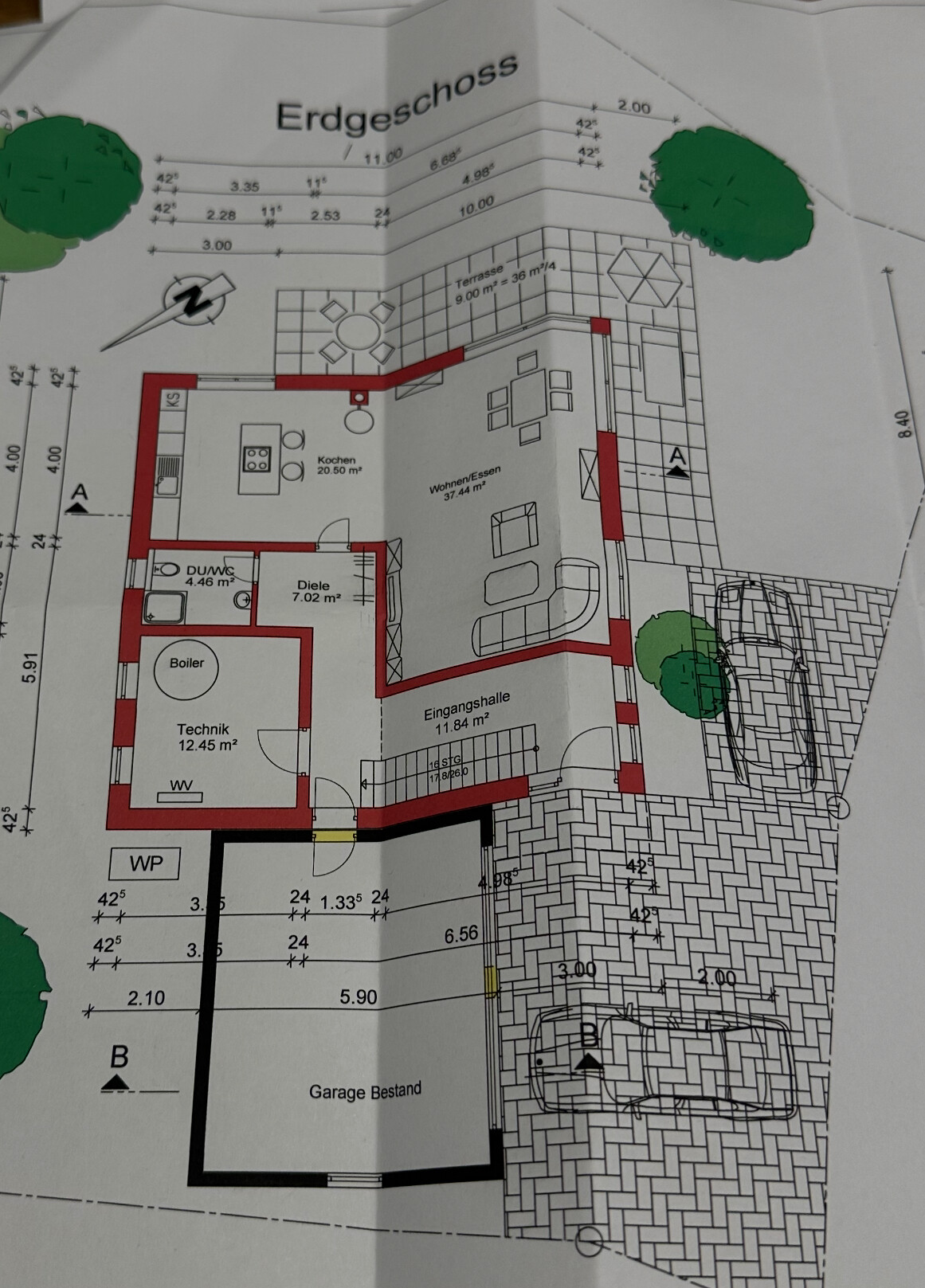
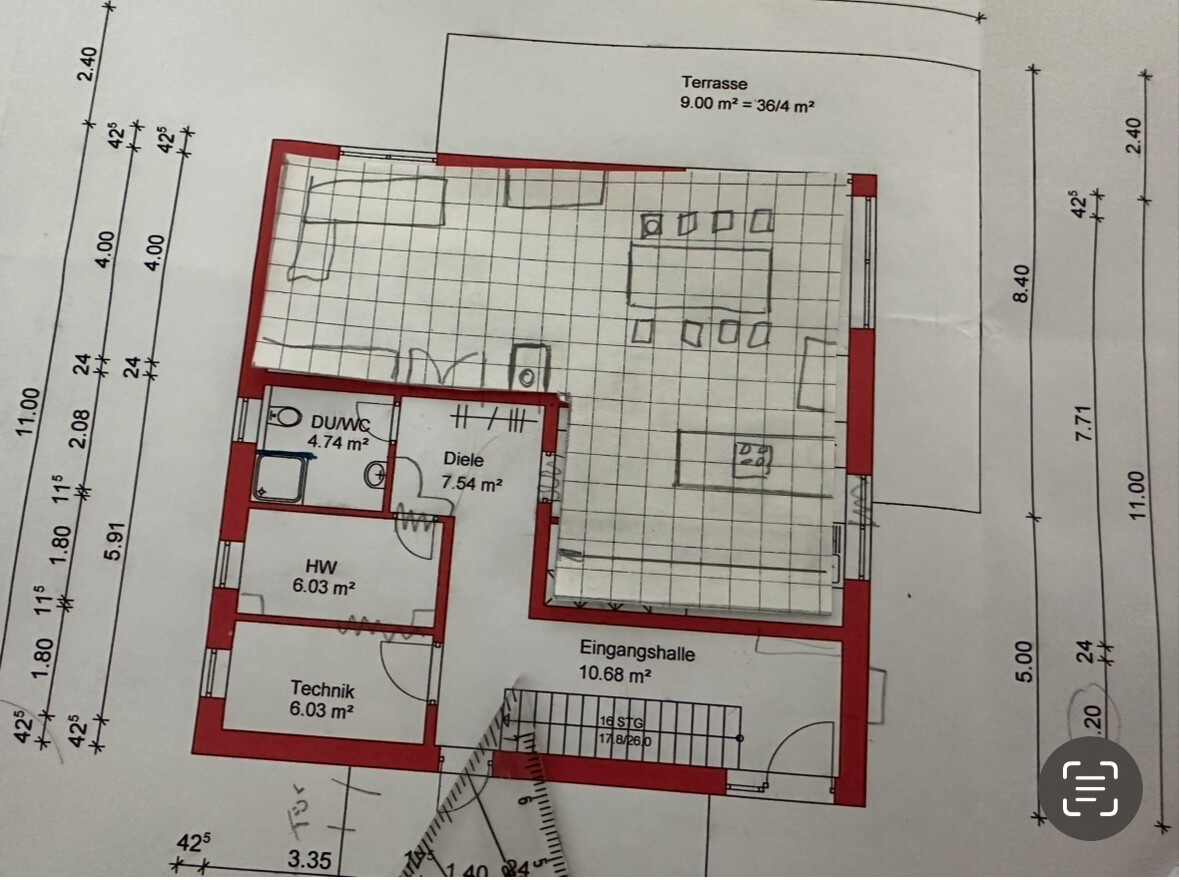
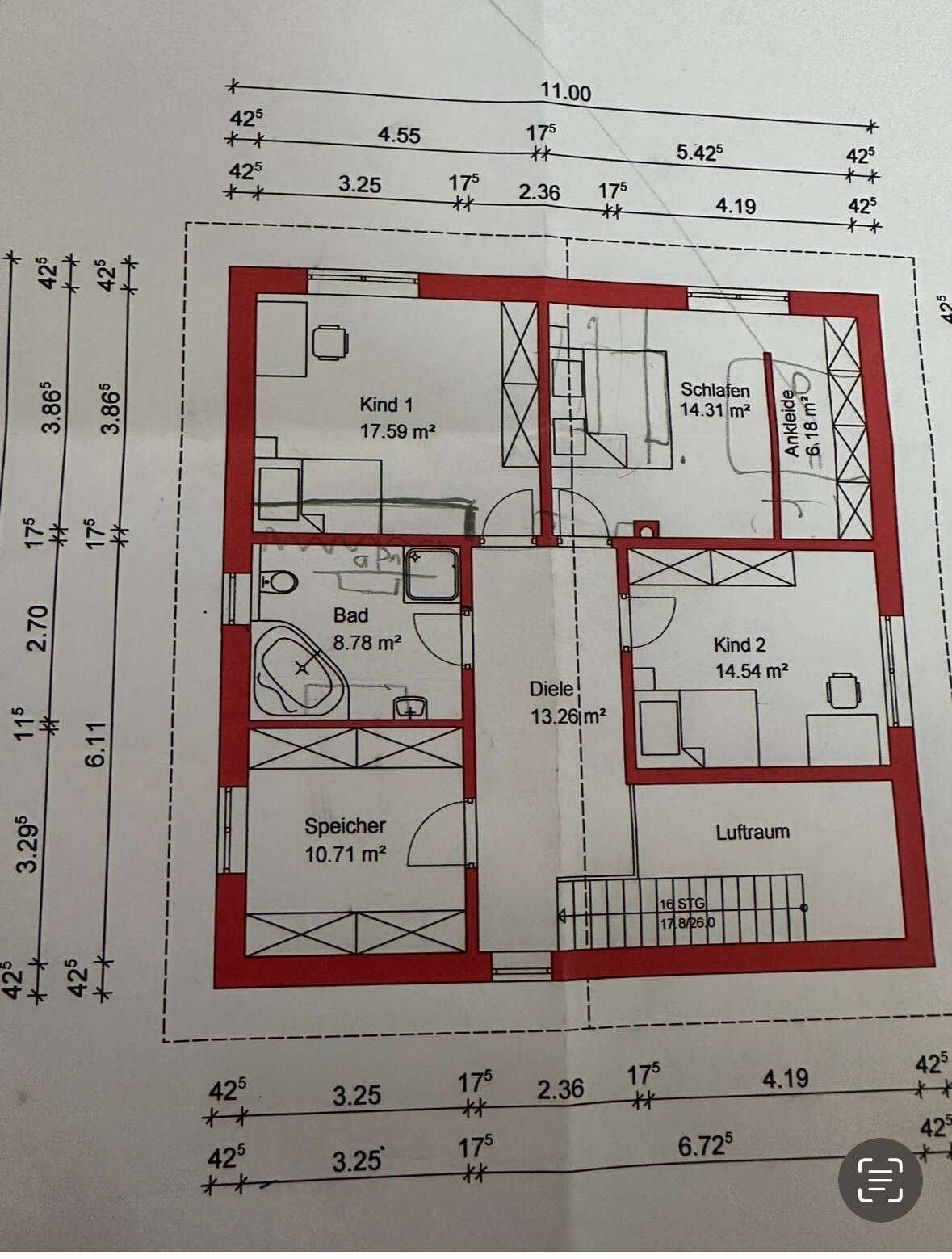
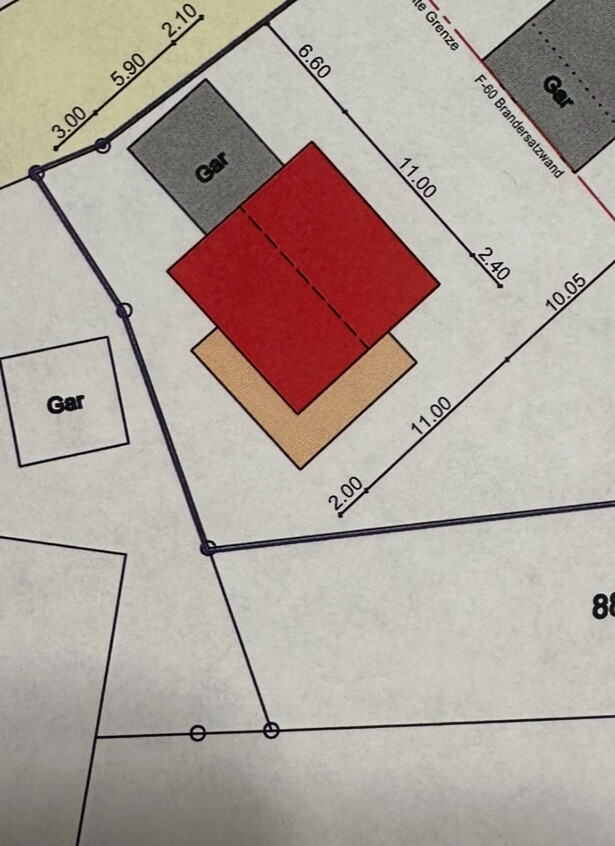
Plot size: approx. 1000m² (0.25 acres)
Slope: no
Site occupancy index: Paragraph 34
Floor area ratio: Paragraph 34
Building window, building line and boundary
Edge development: not applicable
Number of parking spaces: 2
Number of floors: Paragraph 34
Roof style: Paragraph 34
Architectural style: Paragraph 34
Orientation: Paragraph 34
Maximum heights/limits
Additional requirements: none
Clients’ Requirements
Architectural style, roof form, building type
Basement, floors: rather modern, gable roof, no basement, 2 full floors, attic not developed.
Number of persons, age: 33, 29, and 1 year old, possibly another child in the future.
Space requirements on ground floor and upper floor
Office: family use or home office? Family use.
Number of overnight guests per year: none
Open or closed architecture: open
Conservative or modern design: rather modern
Open kitchen, cooking island: open with peninsula
Number of dining seats: 6–8
Fireplace: yes, with water jacket as firewood is regularly sourced from own forest.
Music/stereo wall: no
Balcony, roof terrace: no
Garage, carport: garage already existing.
Utility garden, greenhouse: yes
Additional wishes/special features/daily routine, including reasons why certain things should or should not be included:
An important point for us when we get older is to have the possibility to live only on the ground floor.
House Design
Who created the design
- Planner from a construction company
- Architect: friendly architect
- Do-it-yourself
What do you like most? Why? The possibility to have a bedroom in the open-plan area for later in life.
What do you like least? Why? Staircase located at the front door.
Cost estimate according to architect/planner: 620,000 including demolition of existing outbuilding and all additional costs.
Personal price limit for the house, including fittings: 700,000
Preferred heating system: heat pump + photovoltaic system with battery storage and fireplace with water jacket.
If you have to give up something, which details/extra features
- Can you do without: lift-and-slide door, a few floor-to-ceiling windows.
- Cannot do without: bathroom with shower on the ground floor, possibility to set up an additional bedroom on the ground floor.
Why is the design like it is now? For example:
Standard design from the planner?
Which wishes were implemented by the architect?
A mix of many examples from various magazines: exactly this.
What makes it particularly good or bad in your opinion? The hallway feels quite large yet also narrow to me, but maybe I am mistaken.
Here is the first draft, partly with pencil markings for changes.
 Papierturm3 Dec 2025 14:40
Arauki11 schrieb:
For example, I read about a garage but nothing about controlled residential ventilation or usually expensive patio covers, even though the car is supposed to have a roof already.Cars require more living comfort than people.So what....?
Of course, no one likes that, especially when you feel you’re close to the goal. I know that feeling very well, but I prefer to remember how we were happy—and still are—after finding a better solution for us. We have a whole drawer full of such plans (mostly painstakingly modified by ourselves), and our current house ended up completely different. Even if it costs money, I would never want to build a poor compromise.I can’t draw and I’m out when it comes to major changes. So, “aaargs.”Basically yes: it should be done, and I think it has to be done as well.
Our house is currently in the screed drying phase. When I look at the initial plans and the final floor plan, only one room stayed roughly as originally planned. And the final plan was and still is vastly better than what we started with.
You are being inconsistent, as previous commenters already mentioned. Either plan consistently for old age or for the present. I don’t see planning for old age reflected in the floor plan. If possible, it would be better to have a fully accessible bungalow with an attic space reserved for expansion, in case a second child arrives.
I strongly advise against a water jacket in the chimney. Apart from the fact that the buffer tank and the associated equipment take up a lot of space, the control system combined with the heat pump is also a nightmare that many heating engineers can’t manage. You have conflicting principles here. If you plan the heat pump well, it’s better to sell the wood and cover heating costs with that income. Alternatively, be consistent and go for an air-to-air heat pump (split air conditioning units) combined with a masonry heater or wood stove for the coldest temperatures.
I strongly advise against a water jacket in the chimney. Apart from the fact that the buffer tank and the associated equipment take up a lot of space, the control system combined with the heat pump is also a nightmare that many heating engineers can’t manage. You have conflicting principles here. If you plan the heat pump well, it’s better to sell the wood and cover heating costs with that income. Alternatively, be consistent and go for an air-to-air heat pump (split air conditioning units) combined with a masonry heater or wood stove for the coldest temperatures.
Joedreck schrieb:
Then rather (if possible) a fully accessible bungalow with potential to expand the attic if a second child is expected. On the other hand, Paragraph 34 could apply. The plot size allows it, though. You could extend towards the back, that is east, and nicely plan the bedrooms there. Add a gable roof with attic expansion potential or simply include this storage space. It’s just one extra room anyway.
The plot seems to have potential, but you should check the neighboring buildings, for example via Google Maps or the official site plan, to see what Paragraph 34 would permit.
A
Allthewayup3 Dec 2025 18:02I can only advise against using a water-based fireplace in an energy-efficient new build. Just the chimney draft and the additional costs for the piping and integration into the heating system amount to around 10,000 euros (about 10k).
We also convinced ourselves back then and pre-installed everything. Today, I would rather invest the 10,000 euros (about 10k) in, for example, better windows or home technology.
The fireplace would provide far too much heat for the house, even on cold days and nights.
We also convinced ourselves back then and pre-installed everything. Today, I would rather invest the 10,000 euros (about 10k) in, for example, better windows or home technology.
The fireplace would provide far too much heat for the house, even on cold days and nights.
M
MachsSelbst3 Dec 2025 22:33I know it’s getting boring by now... but just take a look at standard floor plans from companies like Town & Country, Heinz von Heiden, Viebrockhaus, Helma, and whoever else is out there. These layouts for the classic family of four exist for a reason. They have been built hundreds of times, optimized for maximum efficiency with minimal living space, refined over years or even decades.
What you see here is beyond saving. You come home, open the door, and face a wall. I come home, look straight into the living room, and through the living room into the garden. To get to the living room, you have to walk through a dark corridor.
The kids’ rooms are noticeably asymmetrical, which doesn’t have to be the case. A walk-in closet in the bedroom is complete nonsense—just remove the wall and use a sofa, an ottoman, or a sideboard as a room divider.
And the attic? 10m² (108 sq ft) for two rows of closets 50cm (20 inches) deep with a dance floor in between?
Then there’s a small bathroom, a 13m² (140 sq ft) hallway, and an open void... without windows... an open void... without windows... wastefulness 2.0.
What you see here is beyond saving. You come home, open the door, and face a wall. I come home, look straight into the living room, and through the living room into the garden. To get to the living room, you have to walk through a dark corridor.
The kids’ rooms are noticeably asymmetrical, which doesn’t have to be the case. A walk-in closet in the bedroom is complete nonsense—just remove the wall and use a sofa, an ottoman, or a sideboard as a room divider.
And the attic? 10m² (108 sq ft) for two rows of closets 50cm (20 inches) deep with a dance floor in between?
Then there’s a small bathroom, a 13m² (140 sq ft) hallway, and an open void... without windows... an open void... without windows... wastefulness 2.0.
Similar topics