
Hello,
I would appreciate some good input and collective knowledge, as we are currently stuck with the planning of our parking spaces and carport, but we need some kind of concept if we want to create a somewhat solid cost estimate.
Attached you will hopefully find all the necessary documents needed for brainstorming.
As you can see in the elevation plan, the house as well as (in the original version) the placement of the carport are already planned. The depicted carport is 4 x 8 m (including storage room). The distance from the house to the right property boundary is 6.5 m (minimum distance 6 m due to building easement, but we didn’t want more so that enough garden space remains). Originally, a 4 m wide carport with one parking space in front was planned, but the municipality requires 2 separately drivable parking spaces, each 2.5 x 5 m. There are no exceptions to this rule. Therefore, for the permit, a second parking space was initially placed between the sidewalk and driveway (which fit well with the 6.5 m distance), but as you can see on the elevation plan, there is a slope there. The carport at the boundary may have a maximum average height of 3 m, so the plan includes a ramp there. In the original plan, it would not have been a problem to plant on the neighbor side and between the sidewalk and driveway. Now this is no longer possible. In addition, the slope goes downward and there is no planting strip between the parking spaces and the sidewalk. However, the house is at street level, so a slope or wall will form there. You would almost have to install a railing, as planting is not even possible.
This is all not optimal and also not attractive. We have been thinking all the time about how to solve this.
For example, we could place a 5 x 5 m carport directly at the boundary, but we don’t like this regarding the main entrance. Also, it would be very tight in front of the door. We could also place a parking space crosswise in front of the house, but I don’t find that ideal either since the car would be openly visible from the street. I believe fencing it is not allowed because otherwise, there wouldn’t be enough maneuvering space at the rear?
Alternatively, the carport could be placed in the far northeast, but the problem is that soil will be filled up for the house and the fill slopes out 1 to 2 m sideways. The carport would have to be almost at the original ground level to be allowed on the boundary (because of the 3 m height limit).
So... now it gets difficult. Actually, we like the first plan best, but we have no good idea how to design it nicely if the sidewalk and driveway are not at the same height… and you’re not even allowed to put a plant there.
I look forward to ideas, and if anything is missing... I can hopefully provide most of it later.
Thank you very much.
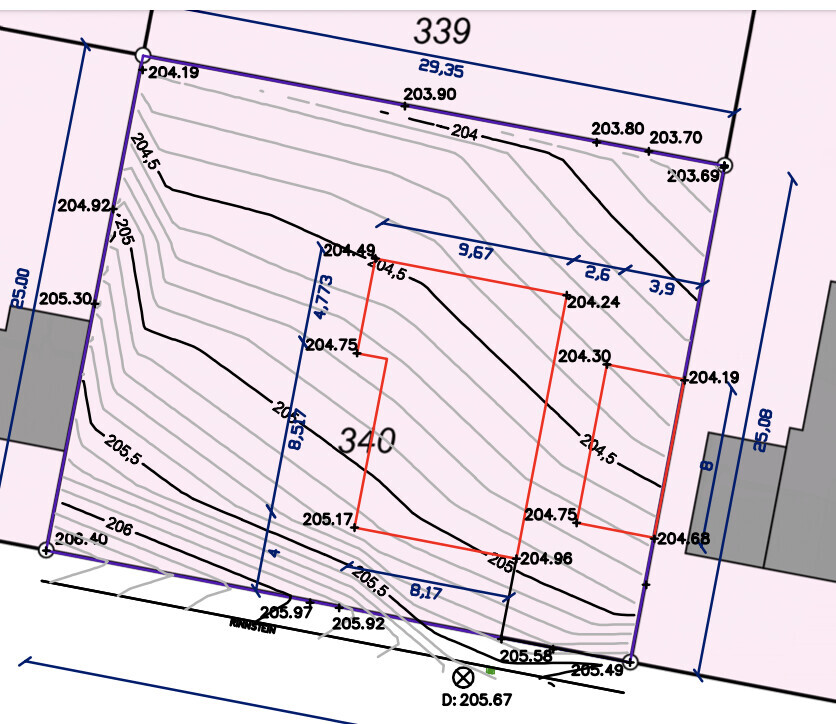
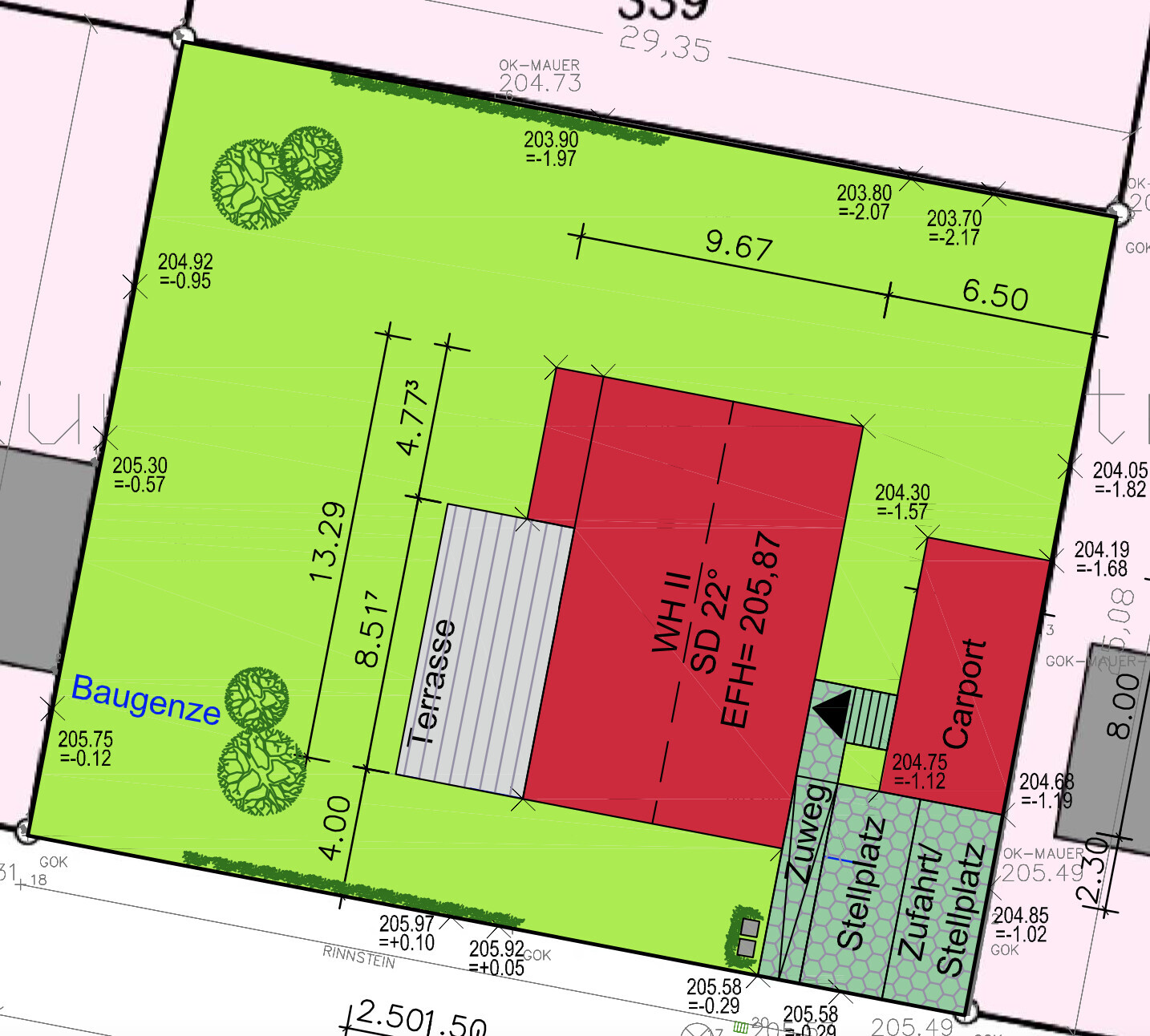
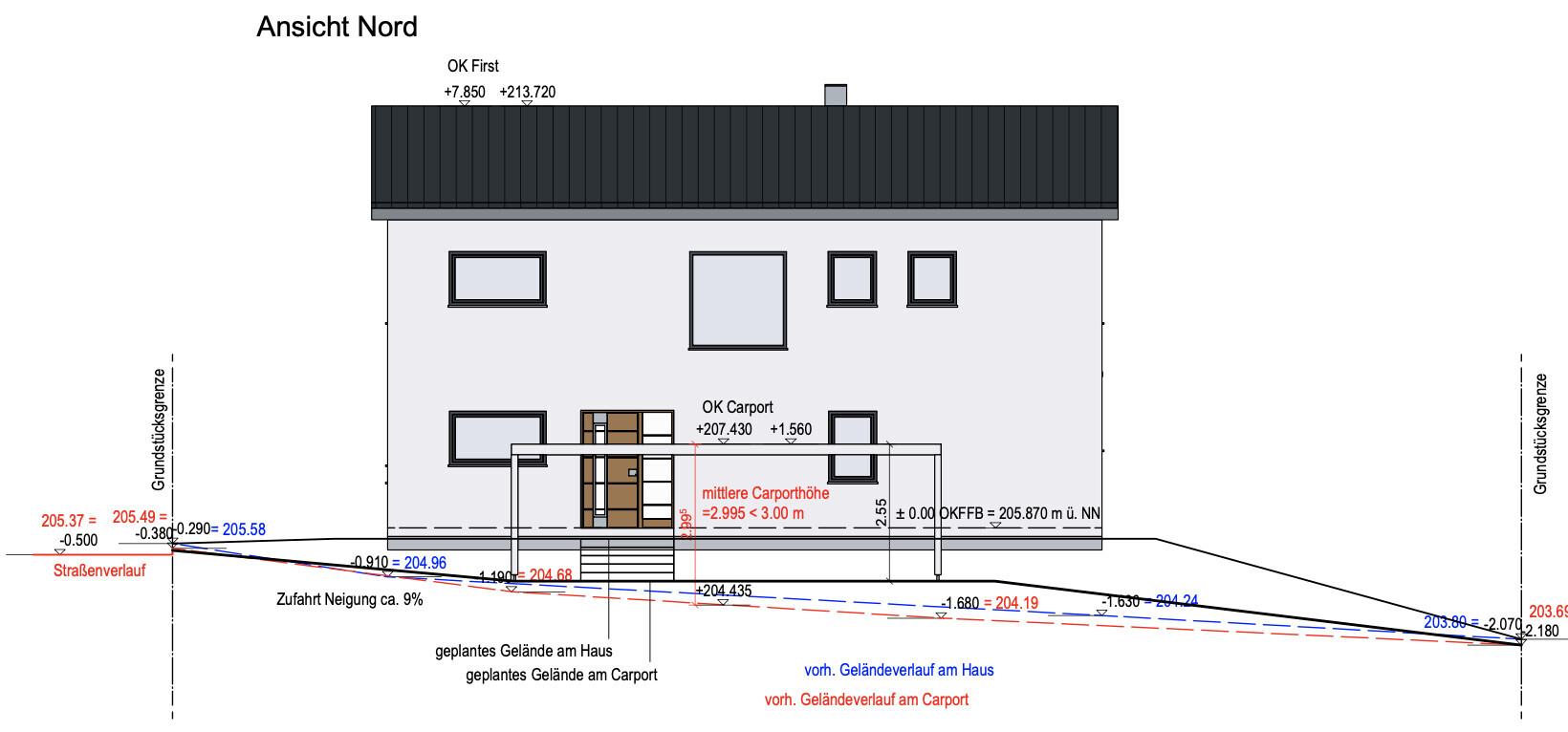
I would appreciate some good input and collective knowledge, as we are currently stuck with the planning of our parking spaces and carport, but we need some kind of concept if we want to create a somewhat solid cost estimate.
Attached you will hopefully find all the necessary documents needed for brainstorming.
As you can see in the elevation plan, the house as well as (in the original version) the placement of the carport are already planned. The depicted carport is 4 x 8 m (including storage room). The distance from the house to the right property boundary is 6.5 m (minimum distance 6 m due to building easement, but we didn’t want more so that enough garden space remains). Originally, a 4 m wide carport with one parking space in front was planned, but the municipality requires 2 separately drivable parking spaces, each 2.5 x 5 m. There are no exceptions to this rule. Therefore, for the permit, a second parking space was initially placed between the sidewalk and driveway (which fit well with the 6.5 m distance), but as you can see on the elevation plan, there is a slope there. The carport at the boundary may have a maximum average height of 3 m, so the plan includes a ramp there. In the original plan, it would not have been a problem to plant on the neighbor side and between the sidewalk and driveway. Now this is no longer possible. In addition, the slope goes downward and there is no planting strip between the parking spaces and the sidewalk. However, the house is at street level, so a slope or wall will form there. You would almost have to install a railing, as planting is not even possible.
This is all not optimal and also not attractive. We have been thinking all the time about how to solve this.
For example, we could place a 5 x 5 m carport directly at the boundary, but we don’t like this regarding the main entrance. Also, it would be very tight in front of the door. We could also place a parking space crosswise in front of the house, but I don’t find that ideal either since the car would be openly visible from the street. I believe fencing it is not allowed because otherwise, there wouldn’t be enough maneuvering space at the rear?
Alternatively, the carport could be placed in the far northeast, but the problem is that soil will be filled up for the house and the fill slopes out 1 to 2 m sideways. The carport would have to be almost at the original ground level to be allowed on the boundary (because of the 3 m height limit).
So... now it gets difficult. Actually, we like the first plan best, but we have no good idea how to design it nicely if the sidewalk and driveway are not at the same height… and you’re not even allowed to put a plant there.
I look forward to ideas, and if anything is missing... I can hopefully provide most of it later.
Thank you very much.

Hangman schrieb:
Sort of, I mean the house itself. So not somewhere 1.5–2m (5–6.5 feet) away. The rest would then be landscaping and garden work, which can also be done afterward.Hmm... that was one of my earlier questions, whether it’s possible to place a house directly on a foundation base. I thought something like that would be very expensive. I liked the idea of having 1.5–2m (5–6.5 feet) of space around it in the north, because then you can simply plant at about 80cm (31.5 inches) height, and it looks nice. You have to clarify with the earthworks contractor how to make that frost-proof… it’s basically a large frost skirt.
So....
I’ve made another drawing and took a look at access routes today.
An access driveway to the garage/carport of 3–3.5 m (10–11.5 ft) is, in my opinion, completely sufficient. Most driveways are 2.5–3 m (8–10 ft) wide. Of course, it’s more comfortable if it’s 5 m (16.5 ft), but in the end, it’s just a car.
In the attached version, I moved the house 1.5 m (5 ft), so we would have 5.5 m (18 ft) to the street. This should allow for a parking spot including bins with a proper enclosure, for example, wood (which we also use for the bay window and porch roof), and there would still be enough green space in front of the kitchen window (southwest corner of the house, about 2.5 m (8 ft) wide) without looking directly onto a parked car.
In the attached plan, the garage would now be 5 m (16.5 ft) wide and 6 m (20 ft) long, so suitable for only one car. The reason is simple: If it were 6 m (20 ft) long, the driveway would also have to be wider to make it work, but then the front door would be in the way.
The advantage here is that the wider garage offers not only parking space but also plenty of room for bikes, etc. At the end of the garage, I would install a door so you can walk through to the garden. There would still be 6.3 m (21 ft) behind the garage, so a shed could be placed there.
Another option would be to move the garage 1.5 m (5 ft) further back, but that would make the space behind very tight. However, it would create a straight line if you want to contain the north side of the house with a wall or L-shaped blocks after 1.5 m.
In my calculations, the foundation height of the garage/carport, with a garage/carport height of 2.6 m (8.5 ft), would be at 204.3–204.4 m (671 ft), meaning about a 1.1–1.2 m (3.5–4 ft) elevation difference to be bridged to the street. Since 2.5–3 m (8–10 ft) space remains for the footpath/entryway, a slope can be easily planned there. Possibly, the first 1–3 m (3–10 ft) in the yard could be flat with the rest of the yard before it slopes down. This will need to be modeled or discussed with the landscaper. It’s feasible.
With a planned driveway width of 3.5–4 m (11.5–13 ft), a 0.5 m (20 inch) planting strip for some greenery towards the neighbor (e.g., hornbeam) could also be created. I think that would be doable to avoid a narrow “tunnel” effect. Or simply a nice privacy fence.
Advantages of the garage: The garage could have a reinforced wall and act as a retaining structure.
In both versions, about 1.5 m (5 ft) would remain between the house wall and garage/carport. The garage would exceed the finished floor height by 1.5 m (5 ft). There are no windows there anyway, except for the guest bathroom window. Otherwise, it’s the utility room with no windows.
On those 1.5 m (5 ft), some plants could easily be grown.
So that’s my idea...
What do you think?
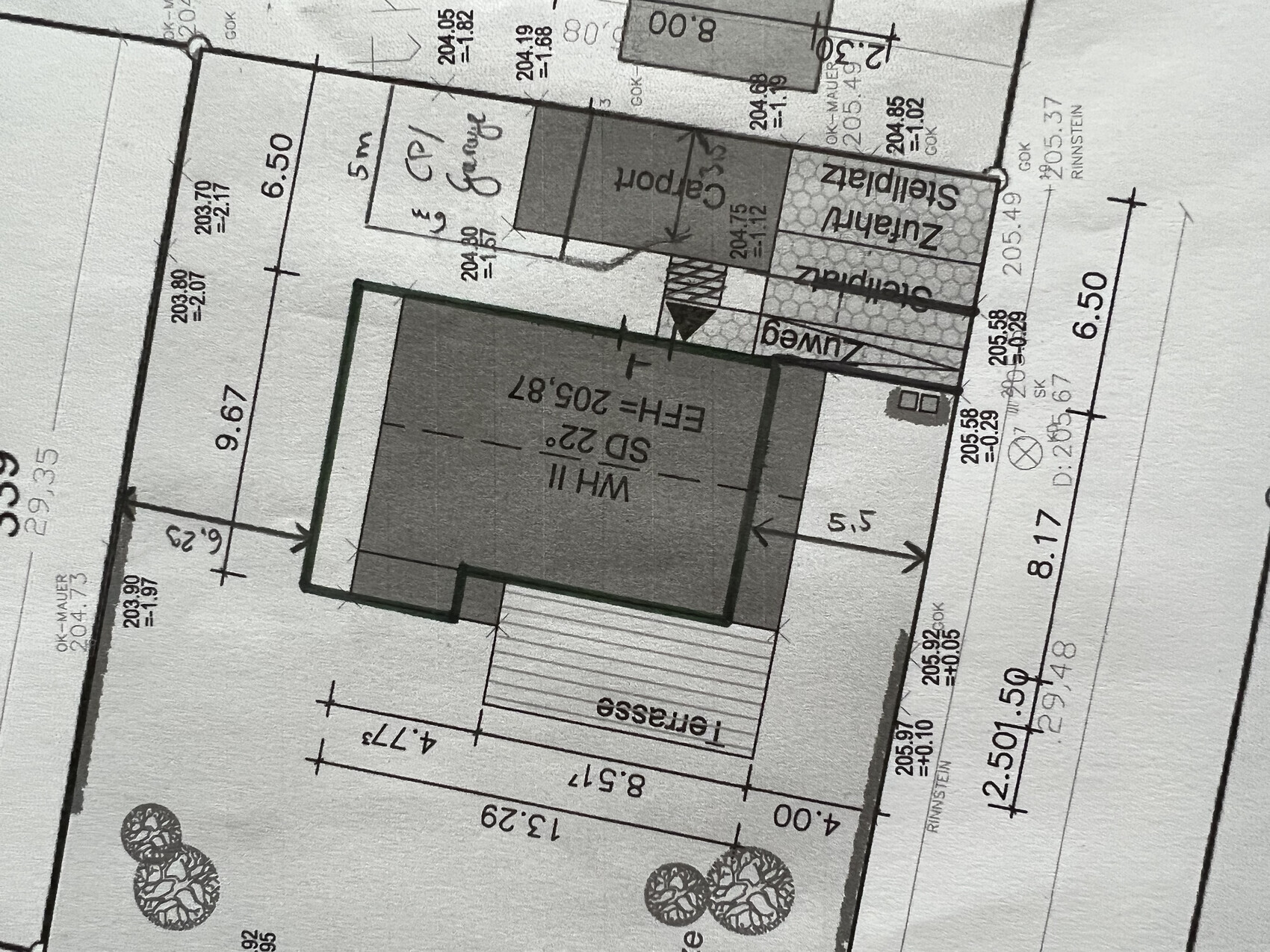
I’ve made another drawing and took a look at access routes today.
An access driveway to the garage/carport of 3–3.5 m (10–11.5 ft) is, in my opinion, completely sufficient. Most driveways are 2.5–3 m (8–10 ft) wide. Of course, it’s more comfortable if it’s 5 m (16.5 ft), but in the end, it’s just a car.
In the attached version, I moved the house 1.5 m (5 ft), so we would have 5.5 m (18 ft) to the street. This should allow for a parking spot including bins with a proper enclosure, for example, wood (which we also use for the bay window and porch roof), and there would still be enough green space in front of the kitchen window (southwest corner of the house, about 2.5 m (8 ft) wide) without looking directly onto a parked car.
In the attached plan, the garage would now be 5 m (16.5 ft) wide and 6 m (20 ft) long, so suitable for only one car. The reason is simple: If it were 6 m (20 ft) long, the driveway would also have to be wider to make it work, but then the front door would be in the way.
The advantage here is that the wider garage offers not only parking space but also plenty of room for bikes, etc. At the end of the garage, I would install a door so you can walk through to the garden. There would still be 6.3 m (21 ft) behind the garage, so a shed could be placed there.
Another option would be to move the garage 1.5 m (5 ft) further back, but that would make the space behind very tight. However, it would create a straight line if you want to contain the north side of the house with a wall or L-shaped blocks after 1.5 m.
In my calculations, the foundation height of the garage/carport, with a garage/carport height of 2.6 m (8.5 ft), would be at 204.3–204.4 m (671 ft), meaning about a 1.1–1.2 m (3.5–4 ft) elevation difference to be bridged to the street. Since 2.5–3 m (8–10 ft) space remains for the footpath/entryway, a slope can be easily planned there. Possibly, the first 1–3 m (3–10 ft) in the yard could be flat with the rest of the yard before it slopes down. This will need to be modeled or discussed with the landscaper. It’s feasible.
With a planned driveway width of 3.5–4 m (11.5–13 ft), a 0.5 m (20 inch) planting strip for some greenery towards the neighbor (e.g., hornbeam) could also be created. I think that would be doable to avoid a narrow “tunnel” effect. Or simply a nice privacy fence.
Advantages of the garage: The garage could have a reinforced wall and act as a retaining structure.
In both versions, about 1.5 m (5 ft) would remain between the house wall and garage/carport. The garage would exceed the finished floor height by 1.5 m (5 ft). There are no windows there anyway, except for the guest bathroom window. Otherwise, it’s the utility room with no windows.
On those 1.5 m (5 ft), some plants could easily be grown.
So that’s my idea...
What do you think?
M
Marvinius201631 Dec 2021 13:56This may not be directly related to the topic, but given the slope of the land on your property, I would choose a house with a basement. There have already been various questions about how stable it is to support a house without a basement with retaining walls about 1.5 to 2 meters (5 to 6.5 feet) high. I would say it is definitely stable within the warranty period, but what about after that?
We had the requirement for retaining walls 1 meter (3 feet) high as well. But is the spacing between the retaining walls also regulated in your case? For example, we built a 2-meter (6.5 feet) high retaining wall and directly in front of it a 1-meter (3 feet) high retaining wall, meeting the requirement without losing more than one brick’s width of land 🙂
We had the requirement for retaining walls 1 meter (3 feet) high as well. But is the spacing between the retaining walls also regulated in your case? For example, we built a 2-meter (6.5 feet) high retaining wall and directly in front of it a 1-meter (3 feet) high retaining wall, meeting the requirement without losing more than one brick’s width of land 🙂
Marvinius2016 schrieb:
This might not be directly related to the topic, but given the elevation profile on the plot, I would choose a house with a basement. There have already been some questions about how stable it is to support a house without a basement at 1.5 to 2 meters (5 to 6.5 feet) height with L-shaped retaining blocks. I would say it’s definitely stable during the warranty period, but what about afterward?
We were also given a requirement for retaining walls 1 meter (3 feet) high. But is the spacing between your retaining walls regulated as well? For example, we built a 2-meter (6.5 feet) high retaining wall and directly in front of it a 1-meter (3 feet) high retaining wall, which met the requirement without losing more than one block width of the plot. 🙂So the basement is no longer an option and simply too expensive now. That won’t change. But we would have wanted it 🙂 Anyway, no point in dwelling on it.
We need to compensate for 1 meter (3 feet) at the back of the house. That should be doable with a wall. 🙂
Hangman schrieb:
Yes and no, I mean the house itself. Not somewhere about 1.5-2m (5-6.5 feet) away. The rest would then be garden and landscaping work, which can also be done afterwards. So.. I just had the idea.. by shifting the house further north (I would now plan 5.5m, maybe rather 6m (18-20 feet)) this creates a completely new possibility: a double carport directly in front of the house facing the street. That way the neighbor is happy, and there is enough space in the yard for greenery, paths, trash bins, and a path to the back northeast.
The only catch: the carport can only be 5m (16.5 feet) wide directly next to the house, otherwise it would block the kitchen window, but ideally it should be 6m (20 feet) wide, which would then stand somewhat in the yard (see sketch). My idea would be to create a planted bed along it and cover it with greenery. Then it would basically disappear. What do you think? 6x6m (20x20 feet) is quite a large structure... but you would have both parking spaces covered right there.
Similar topics