
Hello,
I would appreciate some good input and collective knowledge, as we are currently stuck with the planning of our parking spaces and carport, but we need some kind of concept if we want to create a somewhat solid cost estimate.
Attached you will hopefully find all the necessary documents needed for brainstorming.
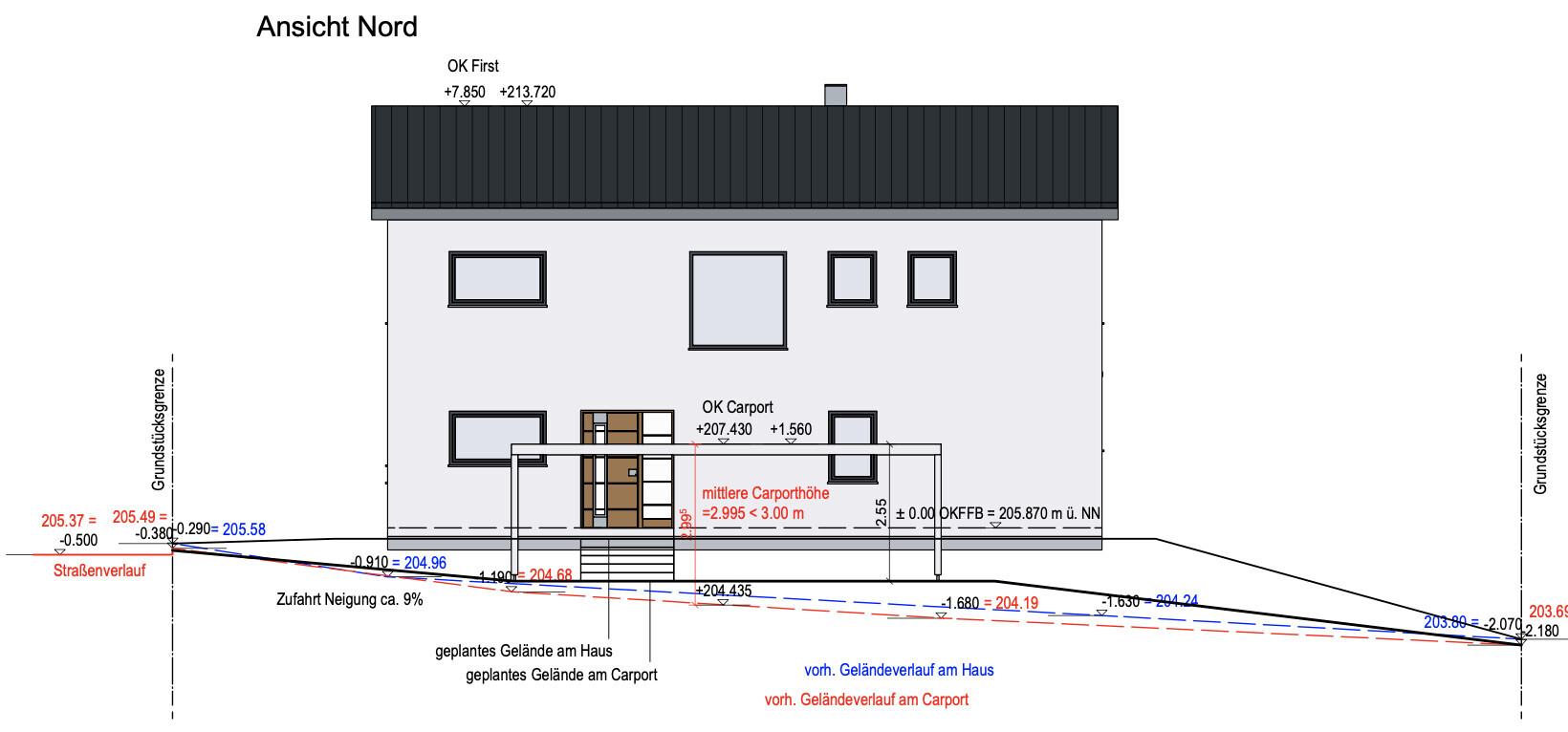
As you can see in the elevation plan, the house as well as (in the original version) the placement of the carport are already planned. The depicted carport is 4 x 8 m (including storage room). The distance from the house to the right property boundary is 6.5 m (minimum distance 6 m due to building easement, but we didn’t want more so that enough garden space remains). Originally, a 4 m wide carport with one parking space in front was planned, but the municipality requires 2 separately drivable parking spaces, each 2.5 x 5 m. There are no exceptions to this rule. Therefore, for the permit, a second parking space was initially placed between the sidewalk and driveway (which fit well with the 6.5 m distance), but as you can see on the elevation plan, there is a slope there. The carport at the boundary may have a maximum average height of 3 m, so the plan includes a ramp there. In the original plan, it would not have been a problem to plant on the neighbor side and between the sidewalk and driveway. Now this is no longer possible. In addition, the slope goes downward and there is no planting strip between the parking spaces and the sidewalk. However, the house is at street level, so a slope or wall will form there. You would almost have to install a railing, as planting is not even possible.
This is all not optimal and also not attractive. We have been thinking all the time about how to solve this.
For example, we could place a 5 x 5 m carport directly at the boundary, but we don’t like this regarding the main entrance. Also, it would be very tight in front of the door. We could also place a parking space crosswise in front of the house, but I don’t find that ideal either since the car would be openly visible from the street. I believe fencing it is not allowed because otherwise, there wouldn’t be enough maneuvering space at the rear?
Alternatively, the carport could be placed in the far northeast, but the problem is that soil will be filled up for the house and the fill slopes out 1 to 2 m sideways. The carport would have to be almost at the original ground level to be allowed on the boundary (because of the 3 m height limit).
So... now it gets difficult. Actually, we like the first plan best, but we have no good idea how to design it nicely if the sidewalk and driveway are not at the same height… and you’re not even allowed to put a plant there.
I look forward to ideas, and if anything is missing... I can hopefully provide most of it later.
Thank you very much.
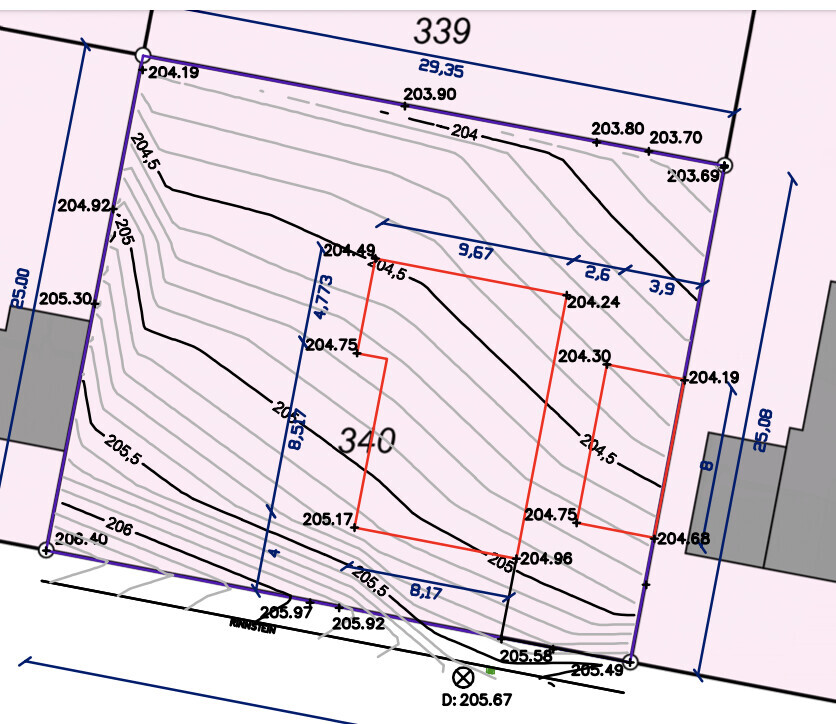
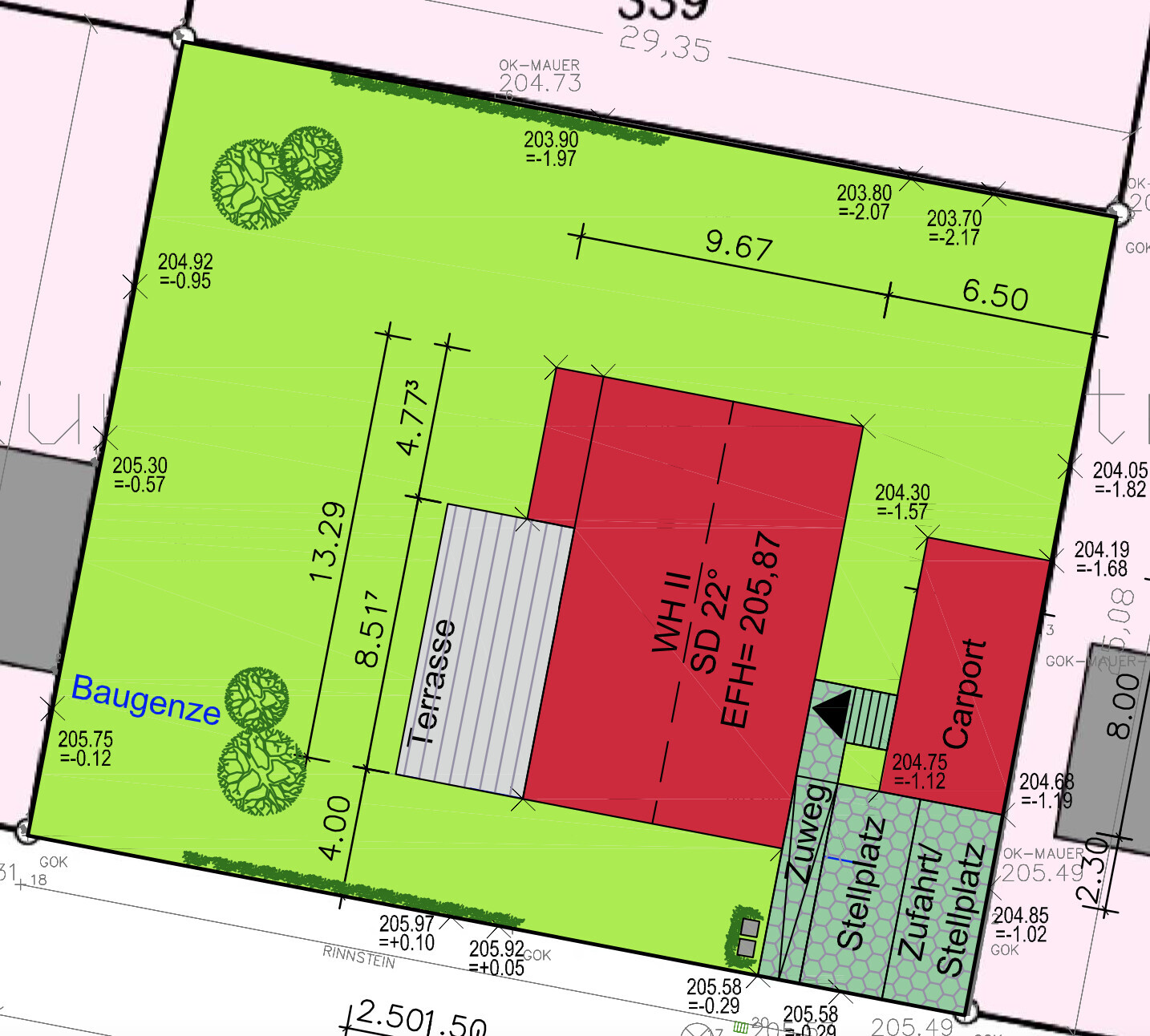
I would appreciate some good input and collective knowledge, as we are currently stuck with the planning of our parking spaces and carport, but we need some kind of concept if we want to create a somewhat solid cost estimate.
Attached you will hopefully find all the necessary documents needed for brainstorming.
As you can see in the elevation plan, the house as well as (in the original version) the placement of the carport are already planned. The depicted carport is 4 x 8 m (including storage room). The distance from the house to the right property boundary is 6.5 m (minimum distance 6 m due to building easement, but we didn’t want more so that enough garden space remains). Originally, a 4 m wide carport with one parking space in front was planned, but the municipality requires 2 separately drivable parking spaces, each 2.5 x 5 m. There are no exceptions to this rule. Therefore, for the permit, a second parking space was initially placed between the sidewalk and driveway (which fit well with the 6.5 m distance), but as you can see on the elevation plan, there is a slope there. The carport at the boundary may have a maximum average height of 3 m, so the plan includes a ramp there. In the original plan, it would not have been a problem to plant on the neighbor side and between the sidewalk and driveway. Now this is no longer possible. In addition, the slope goes downward and there is no planting strip between the parking spaces and the sidewalk. However, the house is at street level, so a slope or wall will form there. You would almost have to install a railing, as planting is not even possible.
This is all not optimal and also not attractive. We have been thinking all the time about how to solve this.
For example, we could place a 5 x 5 m carport directly at the boundary, but we don’t like this regarding the main entrance. Also, it would be very tight in front of the door. We could also place a parking space crosswise in front of the house, but I don’t find that ideal either since the car would be openly visible from the street. I believe fencing it is not allowed because otherwise, there wouldn’t be enough maneuvering space at the rear?
Alternatively, the carport could be placed in the far northeast, but the problem is that soil will be filled up for the house and the fill slopes out 1 to 2 m sideways. The carport would have to be almost at the original ground level to be allowed on the boundary (because of the 3 m height limit).
So... now it gets difficult. Actually, we like the first plan best, but we have no good idea how to design it nicely if the sidewalk and driveway are not at the same height… and you’re not even allowed to put a plant there.
I look forward to ideas, and if anything is missing... I can hopefully provide most of it later.
Thank you very much.

wullewuu schrieb:
Regarding the garage option: You’re right. There is too much paving, but realistically this area, especially the northeast corner, is hardly used. It will probably just grow moss anyway. The garage would be well placed there, but two things are troubling me: the width of the driveway and how wide it needs to be in front of the garage. How to figure this out... we’ll see. Ideally, you can drive in forwards and when leaving, turn, maneuver, and drive out forwards again. I’m not sure if a width of 6 m (20 feet) is enough for this. Who tells you these things? If necessary, you can also back out, but in the long run... well... somehow it’s not so great. Among other reasons, exactly these two concerns make the garage idea not so great. Forget about turning and maneuvering there, that won’t work. If you don’t believe it, find a large parking lot and set up the situation with empty beer cans as boundaries... unfortunately, the beer will not survive your maneuvering attempts. Even worse are the third and fourth concerns: first, the protruding northeast corner of the house and the resulting drop-off edge to the garage driveway — that will be expensive and ugly. Second, the completely wasted space on the east side — especially since you need storage space, it doesn’t make sense to sacrifice 50 m² (540 ft²) solely for the driveway and another 40 m² (430 ft²) for the garage.
After you described the situation on site in more detail, I would try to move the carport/parking space to the southeast corner of the plot, directly adjacent to the road. Specifically, shift the house 2–2.5 m (6.5–8 feet) to the north and pave the entire area up to approximately the ridge line at an as uniform height as possible. What you choose to cover (carport, possibly extending into a covered entrance area) and what remains open (parking space) should be decided based on the actual site conditions. The same applies for possible planting areas or a “house tree” 🙂. The goal should be to reach the front door at roughly the same elevation (although a few percent longitudinal or cross slope really won’t be a problem). On the east side of the house, I would plan a separate storage area (garden shed, or similar), completely independent from this arrangement. This could also be split into two sheds, one near the front door and another in the far northeast corner. If that area is lower, a small ramp or similar should be installed toward the front door for wheeled items, etc. It might even be possible to adjust the house height once again if it is moved.
OK, the neighboring ground level at the front door is listed at 204.435 m (671 ft). This should work well with a 1 m (3 ft) retaining wall made of L-shaped stones on the east boundary, giving you the entire southeast corner at about the same height.
Two more questions: Is your planned floor construction really 38 cm (15 inches)? And do you have an elevation view of the street side of the house?

driver55 schrieb:
You don’t just build the house and then do everything else afterwards. In terms of a "side table" for the outdoor area, definitely not, but in the sense of "America first" (meaning the house comes first, the wooden parts have priority over the metal parts), absolutely.
https://www.instagram.com/11antgmxde/
https://www.linkedin.com/company/bauen-jetzt/
The message is: the house and its occupants are more important than the garage and metal box.
It sounds simple, but @11ant and I regularly get frustrated with plans that prioritize garages or cars, forcing the house and people to fit around them.
Or put another way: by initially focusing "only" on your house, you’ve done everything right so far. We’ll figure out the rest as well 😎
It sounds simple, but @11ant and I regularly get frustrated with plans that prioritize garages or cars, forcing the house and people to fit around them.
Or put another way: by initially focusing "only" on your house, you’ve done everything right so far. We’ll figure out the rest as well 😎
Hangman schrieb:
Among other things, it’s precisely those two tricky points that make the garage idea really not so great. Forget about turning in and reversing out—that won’t work. If you don’t believe me, find a large parking lot and recreate the situation using beer cans as boundaries... of course it’s a shame to waste good beer which won’t survive your maneuvering attempts. Even worse, I see tricky points three and four: first, the protruding northeast corner of the house and the resulting fall edge to the garage driveway—that will be expensive and ugly. Second, the completely wasted area on the east side—especially since you need storage space, it doesn’t make sense to sacrifice 50sqm (540sqft) just for the driveway and another 40sqm (430sqft) for the garage.
After you described the situation on site in more detail, I would try to move the carport/parking space to the southeast corner of the plot, directly by the street. Specifically: shift the house about 2 to 2.5m (6.5 to 8 feet) north and pave the entire area up to approximately the ridge line at as consistent a level as possible. Which parts you cover (carport, possibly continuing into a covered entrance area) and which remain open (parking space) you’ll have to decide based on the actual situation on site. The same goes for possible planting areas or a "feature tree" for the house 🙂 The goal should be to reach the main entrance at roughly the same elevation (a slight slope of a few percent lengthwise or crosswise is really no problem). On the east side of the house, I would plan a separate storage area for garden sheds or similar. This could even be split into two sheds: one near the main entrance and another at the far northeast corner. If that area is at a lower level, you’ll need a small ramp or equivalent leading toward the main entrance for wheeled items, etc. If necessary, you can also adjust the house height again when shifting it.
OK, the neighboring ground level at the front door side is given as 204.435m. That should work well with a 1m (3.3ft) retaining wall at the eastern boundary, and you’d have the entire southeast corner at roughly the same elevation.
Two more questions: Is your planned floor construction really 38cm (15 inches) thick? And do you have an elevation drawing of the street-facing side of the house?Hello,
thanks for the explanation regarding "sheet metal children" and "meat children"… now I get it. At first, I assumed it was a negative comment, but at least there was support for the house location and the approach :-) So, some understanding at least! 😀
Regarding changing the house position: a simple and quick change would only be a sideways shift. Changing the levels is not easy to implement. Our building authority was very relaxed about moving the house; according to them, I don't even need an architect for this, just sketch the changes on the existing plans and submit a change application. I found that very sympathetic and surprisingly straightforward. The only important thing is not to get too close to the boundary, but we are moving away from it anyway 🙂
Regarding the carport in front: We definitely don’t want that. It would be a nightmare for the neighbors (I understand that), and it would take up the whole yard. Although the municipality allows placing a carport right by the street, you can’t close off any walls; otherwise, it would essentially become a garage.
The entire street slopes downhill (see attachment). At the neighbor boundary, the street level is 205.49m. It shouldn’t be higher than that or it wouldn’t make sense. If I build up to this level, I can only extend about 9m (30 feet) inward before exceeding a 1m (3.3ft) height difference.
Regarding the floor construction: see attachment.
Indeed, the slab including screed and insulation is quite thick. Then the finished floor adds another 16 mm (0.6 inches) 🙂
Currently, we favor the variant with the house moved 1 to 1.5m (3 to 5 feet) north, then the parking space in front of the house, the trash bins nearby (in a neat enclosure), and the carport set back flush with the house’s rear. As far as I have calculated, this is feasible.
One thing I’m unsure about: Is it possible to support or retain the house or terrain "without problems" with a 2m (6.5ft) retaining wall? That should work, right? I would simply clad the carport side facing the house with wood-look panels or similar, so I wouldn’t have to look at the retaining walls.
wullewuu schrieb:
Thanks for the explanation regarding metal kids and flesh kids... now I get it. At first, I suspected a negative comment, but at least there was support for the house placement and the approach. I didn’t go into detail about the house placement itself, I only expressed my qualitative approval of the approach—the family should clearly take priority over the cars in the hierarchy:
11ant schrieb:
I generally plan according to the principle "America first," meaning the house for the family (including any unborn flesh kids) is placed first and may only be shifted slightly to arrange the overall layout more cleverly. Under no circumstances do I plan the space for the metal kids as equals. If what's left over happens to be more presentable than a shabby remainder, fine, the parking spaces can have it—but they won’t get a royal box. A problem nowadays is that the first child is often born after the second car, and traditionally cars are granted "senior rights."
wullewuu schrieb:
One thing I’m unsure about: Is it possible to easily support a house or stabilize the terrain from 2m (6.5 ft) with L-shaped retaining walls? That should be possible, right? With emphasis on “easily,” in my opinion “probably not” is the correct answer. I believe L-shaped retaining walls are generally overrated, or the assumptions about soil viscosity come from times when heavy rainfall events were rare and people could “rely” on recovery phases in between. In the case of a three-day monsoon period, you’d already need rhizome-strong shrubs and similar measures to keep the soil stable. For basement-free houses on slopes, allowing the terrain to step down in this way is already risky if you rely solely on such simple solutions for “stabilization.”
https://www.instagram.com/11antgmxde/
https://www.linkedin.com/company/bauen-jetzt/
11ant schrieb:
I didn’t go into detail about the house placement, I only expressed general approval of the approach, emphasizing that the family should clearly take priority over the cars:
A problem nowadays is that the first child is often born “after the second car,” and traditionally, cars are given “older rights.”
With the emphasis on “without problems,” I believe “or” is the right answer. In my opinion, L-shaped retaining walls are generally greatly overrated, or the assumptions about soil viscosity date back to times when heavy rain events were rare and one could rely on “rest periods” in between. In the case of a monsoon period lasting only three days, you really need strong-rooted shrubs and similar measures to hold the “pudding” in place. For houses without basements on slopes, allowing the terrain to shift is, in my view, quite risky if you rely only on temporary or superficial supports.Yes, the question is who can say this for sure. Ideally, there shouldn’t be any soft or unstable material below the house, because at least 100cm (40 inches) of frost-protected soil or fill is placed underneath. So the water drains downward anyway. In case of doubt, this wouldn’t be any different for a house with a basement on a slope, or for any house on a slope in general. These typically don’t just slide downhill. We simply have the situation with sloping terrain, and placing the house in the hollow was not an option for us. At least this way, we have a nice view 🙂
Similar topics