
Hello,
I would appreciate some good input and collective knowledge, as we are currently stuck with the planning of our parking spaces and carport, but we need some kind of concept if we want to create a somewhat solid cost estimate.
Attached you will hopefully find all the necessary documents needed for brainstorming.
As you can see in the elevation plan, the house as well as (in the original version) the placement of the carport are already planned. The depicted carport is 4 x 8 m (including storage room). The distance from the house to the right property boundary is 6.5 m (minimum distance 6 m due to building easement, but we didn’t want more so that enough garden space remains). Originally, a 4 m wide carport with one parking space in front was planned, but the municipality requires 2 separately drivable parking spaces, each 2.5 x 5 m. There are no exceptions to this rule. Therefore, for the permit, a second parking space was initially placed between the sidewalk and driveway (which fit well with the 6.5 m distance), but as you can see on the elevation plan, there is a slope there. The carport at the boundary may have a maximum average height of 3 m, so the plan includes a ramp there. In the original plan, it would not have been a problem to plant on the neighbor side and between the sidewalk and driveway. Now this is no longer possible. In addition, the slope goes downward and there is no planting strip between the parking spaces and the sidewalk. However, the house is at street level, so a slope or wall will form there. You would almost have to install a railing, as planting is not even possible.
This is all not optimal and also not attractive. We have been thinking all the time about how to solve this.
For example, we could place a 5 x 5 m carport directly at the boundary, but we don’t like this regarding the main entrance. Also, it would be very tight in front of the door. We could also place a parking space crosswise in front of the house, but I don’t find that ideal either since the car would be openly visible from the street. I believe fencing it is not allowed because otherwise, there wouldn’t be enough maneuvering space at the rear?
Alternatively, the carport could be placed in the far northeast, but the problem is that soil will be filled up for the house and the fill slopes out 1 to 2 m sideways. The carport would have to be almost at the original ground level to be allowed on the boundary (because of the 3 m height limit).
So... now it gets difficult. Actually, we like the first plan best, but we have no good idea how to design it nicely if the sidewalk and driveway are not at the same height… and you’re not even allowed to put a plant there.
I look forward to ideas, and if anything is missing... I can hopefully provide most of it later.
Thank you very much.
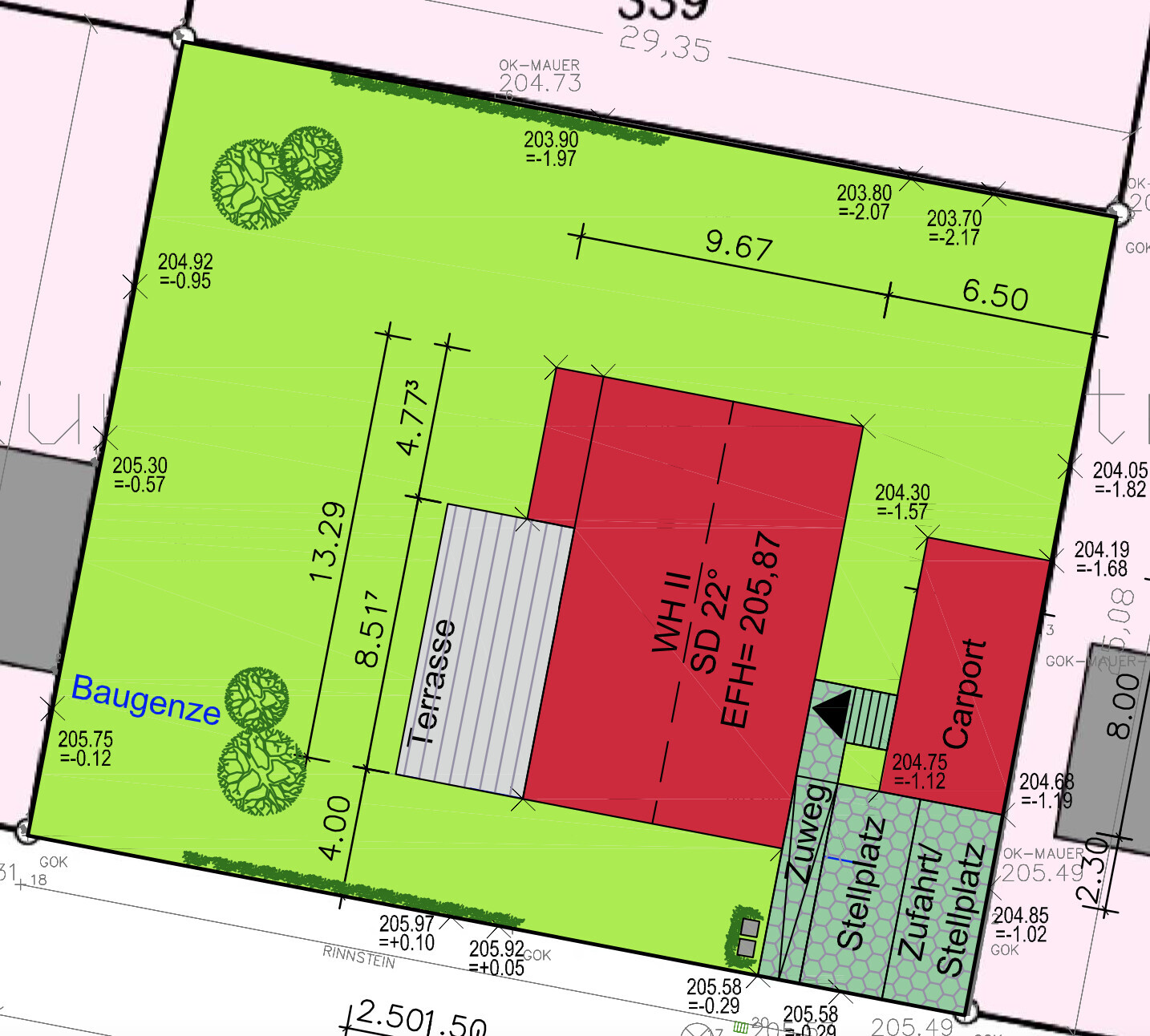
I would appreciate some good input and collective knowledge, as we are currently stuck with the planning of our parking spaces and carport, but we need some kind of concept if we want to create a somewhat solid cost estimate.
Attached you will hopefully find all the necessary documents needed for brainstorming.
As you can see in the elevation plan, the house as well as (in the original version) the placement of the carport are already planned. The depicted carport is 4 x 8 m (including storage room). The distance from the house to the right property boundary is 6.5 m (minimum distance 6 m due to building easement, but we didn’t want more so that enough garden space remains). Originally, a 4 m wide carport with one parking space in front was planned, but the municipality requires 2 separately drivable parking spaces, each 2.5 x 5 m. There are no exceptions to this rule. Therefore, for the permit, a second parking space was initially placed between the sidewalk and driveway (which fit well with the 6.5 m distance), but as you can see on the elevation plan, there is a slope there. The carport at the boundary may have a maximum average height of 3 m, so the plan includes a ramp there. In the original plan, it would not have been a problem to plant on the neighbor side and between the sidewalk and driveway. Now this is no longer possible. In addition, the slope goes downward and there is no planting strip between the parking spaces and the sidewalk. However, the house is at street level, so a slope or wall will form there. You would almost have to install a railing, as planting is not even possible.
This is all not optimal and also not attractive. We have been thinking all the time about how to solve this.
For example, we could place a 5 x 5 m carport directly at the boundary, but we don’t like this regarding the main entrance. Also, it would be very tight in front of the door. We could also place a parking space crosswise in front of the house, but I don’t find that ideal either since the car would be openly visible from the street. I believe fencing it is not allowed because otherwise, there wouldn’t be enough maneuvering space at the rear?
Alternatively, the carport could be placed in the far northeast, but the problem is that soil will be filled up for the house and the fill slopes out 1 to 2 m sideways. The carport would have to be almost at the original ground level to be allowed on the boundary (because of the 3 m height limit).
So... now it gets difficult. Actually, we like the first plan best, but we have no good idea how to design it nicely if the sidewalk and driveway are not at the same height… and you’re not even allowed to put a plant there.
I look forward to ideas, and if anything is missing... I can hopefully provide most of it later.
Thank you very much.
Hangman schrieb:
A 4m (13 feet) distance from the house is more than enough. You don’t need to install the common gravel strip as a splash guard (unless you have a wooden house); you can just have soil there. That leaves about 1 to 1.5m (3 to 5 feet) of space next to the house, which you can nicely plant.
Here’s how I would do it:
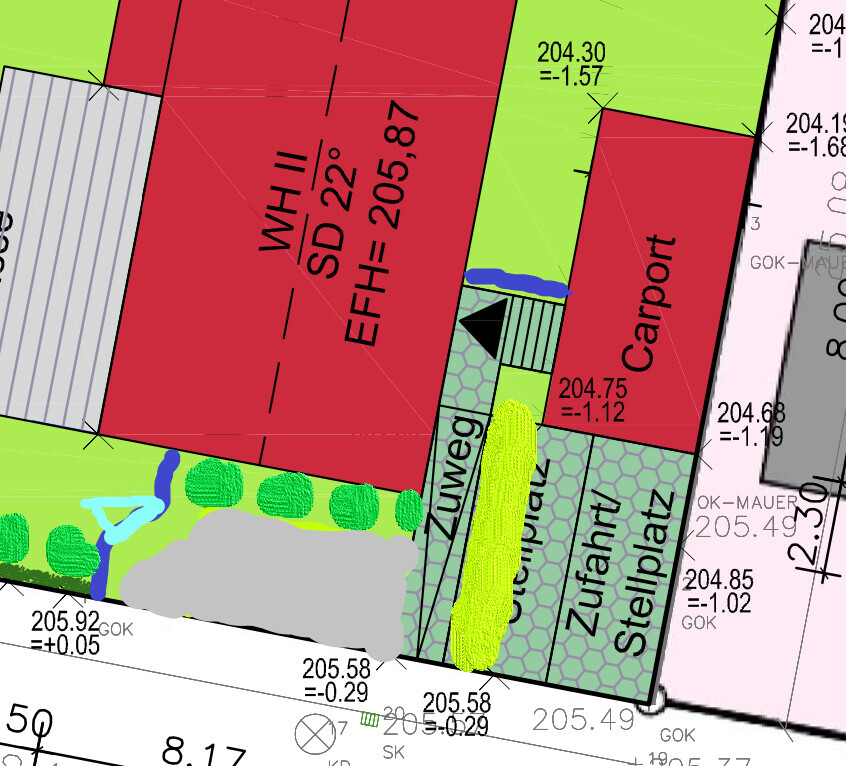
Light gray is the new parking space (like a parking bay), dark blue marks the fence, light blue is a small gate, and the medium green dots represent planting (bushes, shrubs, perennials, hedges, etc.). So no fence along the street border—neither at the parking space nor at the access path. Instead, fences only in front of the new parking space and behind the house entrance (plus possibly to the right of the driveway for a carport—but that depends on the on-site situation).
Advantages: The carport and driveway remain as originally planned, and maneuvering in the parking bay is hassle-free. Plus, you still have a direct path to the property/terrace, and you can walk all around the house.Months later, I came across your drawing again and thought: This is the best solution!
We spent many months figuring this out, even relocated and reapplied for the carport at considerable cost, and yet we weren’t satisfied (see image), because while there is a parking spot near the house, the access past the right side of the house to the garden is missing. We are building without a basement, so we need storage space (garden shed, large garage, etc.). Without the carport on the right, there’s no “ramp” to go down, meaning you can’t place trash bins, bicycles, etc. on the right upper side of the house without carrying everything down stairs. At the end of the day, your solution is probably the cheapest and easiest. I still find the idea of placing the house directly on the sidewalk uncomfortable, but we have anyway abandoned the idea of “closing off” the courtyard. This would only have been possible with a rolling gate, which would have been almost unaffordable.
With the attached variant, parking out of the carport would also have been “complicated” because you would have to back onto the courtyard...
Currently, there is a second option that I’d like to share here, which seems feasible for us, but I need help regarding the driveway:
This option means placing a garage up in the northern corner of the plot (which doesn’t get much sun anyway), about 6m (20 feet) wide and possibly 6-7m (20-23 feet) deep. This garage offers more than enough space for everything and provides 2 parking spaces. The advantage is that the courtyard up top stays free and spacious; you don’t need the parking spot in front of the house and can plant greenery there. I roughly sketched how I would design the driveway. Ideally, it would start after the front door (black triangle), about 9m (30 feet) to the garage if it were 7m (23 feet) deep. The elevation difference to overcome would be 1.2m (4 feet), resulting in about a 14% slope. However, I’m unsure how wide the driveway needs to be at the bottom over what distance so that 1) you can easily drive in and out even if another car is parked inside and 2) it’s comfortable to back out the 9m (30 feet) most of the time.
The second issue, visible in the image, is that the garage would be close to the house. The house (with a slab foundation) sits about 1.2m (4 feet) higher than the garage foundation. Where the garage and house come very close, I would need to support the house or the ground beneath it. Is it sufficient to stabilize this with L-shaped steel brackets? After all, I need to maintain access to the garage driveway here...
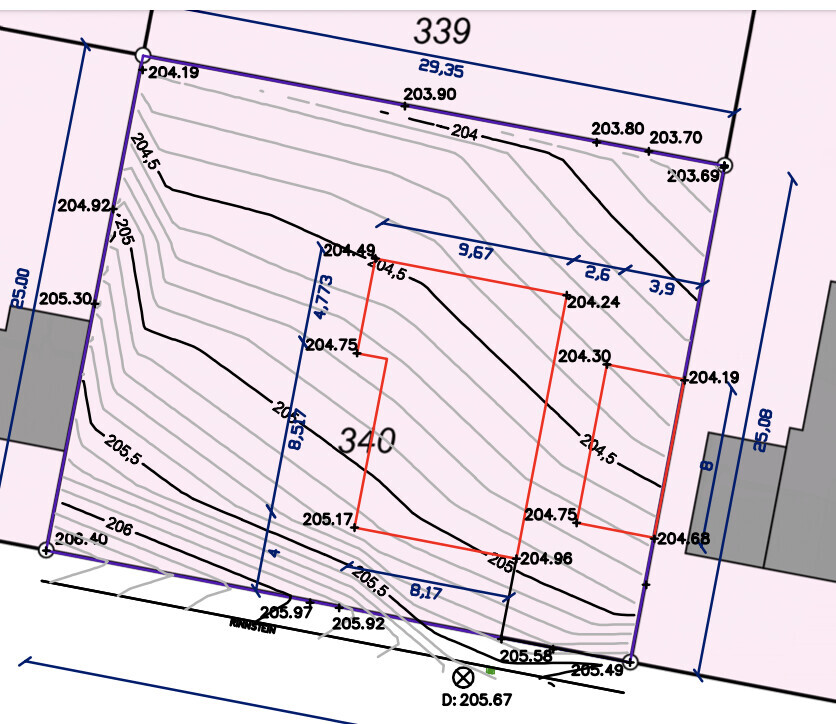
Worst-case scenario, which I think is excessive: Amend the building permit/planning permission, move the house 1m (3 feet) further inward, then place the parking spot perpendicular in front of the house and/or move the house 1m (3 feet) to the left—enough space for everything but less garden. And all this just for parking spaces... it can’t be right. I’m also attaching the survey so it’s easier to visualize. The slab elevation is at 205.49.
The survey also clarifies why placing the carport/garage next to the house isn’t possible; the slope doesn’t allow it. The house entrance and related elements are fixed and cannot be changed; the house is definitely built as planned.
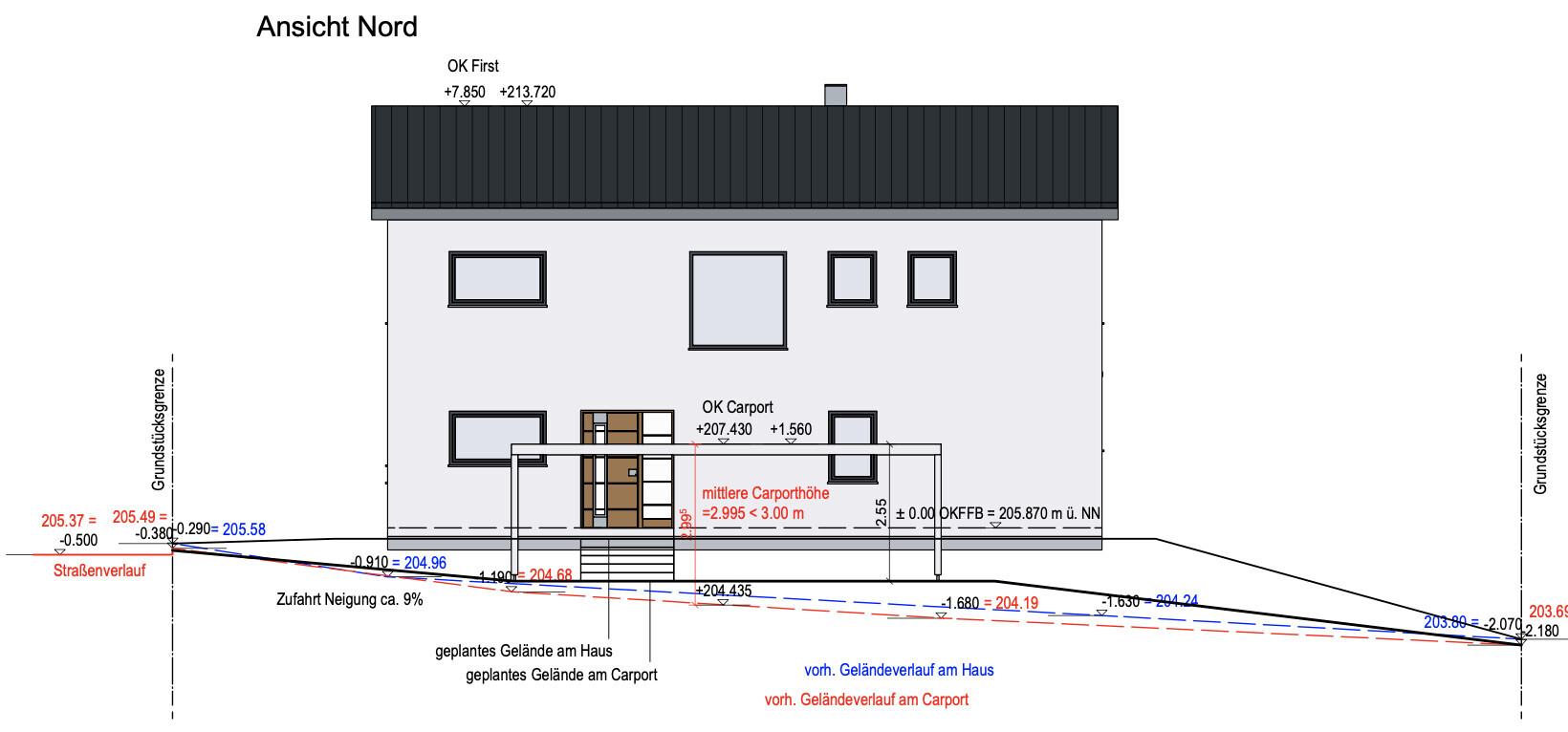
Also included is a side view of the originally planned carport showing why it isn’t straightforward—the terrain slope complicates things.
In the end, we keep coming back to the original option because it 1) allows passage to the back 2) provides lockable storage space 3) is at least somewhat feasible.
It’s frustrating that we only planned 4m (13 feet) instead of 5m (16 feet) distance from the street. The original idea was to simply have planting there, until it suddenly became necessary to have two separate parking spots. With 5m (16 feet), the parking spot could have been placed perpendicular to the street and that would be it. Now it takes up a long stretch.
Any other good ideas? Especially regarding the garage driveway?
Hangman schrieb:
A 4m (13 ft) distance from the house is more than enough. The commonly used gravel strip as a splash guard isn’t necessary (unless you have a wooden house); you can use soil there instead. That leaves about 1–1.5m (3–5 ft) of space next to the house that can be nicely planted.
I would do it like this:
[ATTACH alt="Carport und Stellplatz.png"]63847[/ATTACH]
Light gray is the new parking space (like a parking bay), dark blue is the fence, light blue is a small gate, and the medium green dots represent planting (bushes, shrubs, perennials, hedges, etc.). So no fence along the street boundary—neither at the parking space nor at the access path. Instead, only in front of the new parking space and behind the house entrance (plus possibly to the right of the driveway/carport—this depends on the exact onsite situation).
Advantage: The carport and access path remain as originally planned, and parking bay maneuvering is problem-free. Also, you still have a direct path to the property/terrace, and you can walk all around the house. Specifically regarding this image: Are there any regulations about how much space must be left in front of and behind the parking space? You need enough room for maneuvering.

Thanks for the feedback, and it’s a shame that you’re still stuck there. I’ll try to approach the whole thing from a different angle: originally, you wanted to be able to walk around the house, maximize greenery, only have one car, and actually only need the second free parking space due to regulatory requirements... now you’re looking at a version with a fully sealed east side plus a sunken double garage whose driveway is neither practical nor attractive. So, to be blunt upfront, forget the garage option (sorry). If you need storage space, it’s better to build a nice garden shed in the northeast corner.
I would still do it the way I suggested. I would make the parking bay wider towards the street as drawn so it can be used without maneuvering. The green planting strip I marked between the walkway and the driveway could also be paved to the width of the parking bay (2.5–3m (8–10 feet))—then anyone could really get in and out easily. The problem with the whole carport, access path, driveway, and parking bay setup is the height differences. Without knowing the on-site conditions, it’s difficult to judge despite the height profile and side view, but I would try to keep the entire driveway/entrance/parking/courtyard area at as little height difference to each other and to the street as possible, and check the following:
The goal of all the above points is to raise the carport as much as possible so that the entire entrance area is at similar heights. If you are above the required top edge of the floor slab minus 15cm (6 inches) for timber frame construction in any areas, there is a solution for that too. Just Google “Stabile Air” by Richard Brink. It’s a suitable and affordable system—we installed it at 4.5m (15 feet) in the entrance area, allowing completely threshold-free access into the house.
One more question for my understanding: you mentioned in your post that the top edge of the floor slab is 205.49, but the plans show the top edge of the finished floor as 205.87. Do you really have a 38cm (15 inches) floor buildup, or is one of these heights incorrect (if so, which one)?
I would still do it the way I suggested. I would make the parking bay wider towards the street as drawn so it can be used without maneuvering. The green planting strip I marked between the walkway and the driveway could also be paved to the width of the parking bay (2.5–3m (8–10 feet))—then anyone could really get in and out easily. The problem with the whole carport, access path, driveway, and parking bay setup is the height differences. Without knowing the on-site conditions, it’s difficult to judge despite the height profile and side view, but I would try to keep the entire driveway/entrance/parking/courtyard area at as little height difference to each other and to the street as possible, and check the following:
- It would, of course, be much easier and better if you could raise the carport. That means using L-bricks (concrete blocks) directly at the eastern property line. Can this be approved by the building authorities and possibly with the neighbor’s consent? The neighbor shouldn’t mind since their carport/garage is also there. Also, the maximum boundary construction limit is reportedly 9m (29.5 feet)... since you’re only planning 8m (26 feet), maybe you could negotiate a 3.2m (10.5 feet) average wall height?
- If you keep the courtyard area open (i.e., no fence) and also have a “real” second parking space (parking bay), you can move the carport closer to the street. Even if this area is occasionally used as an additional parking spot, 5.5m (18 feet) is enough (currently planned 6.3m (20.5 feet)).
- You can shorten the actual carport to 6m (20 feet) and lower the (planned for later) storage room opposite the carport, with the entrance from the side.
- You don’t necessarily have to overcome height differences up to the carport driveway, but can continue the slope within the carport.
- Small note: we have a 6m (20 feet) carport with a 4% slope and directly adjacent a 2.5m (8 feet) storage room that is 50cm (20 inches) lower. That achieves a total height difference of 75cm (30 inches) that follows the terrain and neither the building authorities nor neighbors mind.
- Worst case: move the house 1m (3 feet) to the north (and possibly adjust height accordingly).
The goal of all the above points is to raise the carport as much as possible so that the entire entrance area is at similar heights. If you are above the required top edge of the floor slab minus 15cm (6 inches) for timber frame construction in any areas, there is a solution for that too. Just Google “Stabile Air” by Richard Brink. It’s a suitable and affordable system—we installed it at 4.5m (15 feet) in the entrance area, allowing completely threshold-free access into the house.
One more question for my understanding: you mentioned in your post that the top edge of the floor slab is 205.49, but the plans show the top edge of the finished floor as 205.87. Do you really have a 38cm (15 inches) floor buildup, or is one of these heights incorrect (if so, which one)?
Hangman schrieb:
Thanks for the feedback, and it’s a pity you’re still stuck with this. I’ll try to approach the whole thing from the ground up: originally you wanted to be able to walk around the house, to have as much greenery as possible, you only have one car and basically need the second parking space only because of the building permit/planning permission... now you’re looking at a version with a fully paved east side, plus a lowered double garage whose driveway is neither practical nor attractive. So, bluntly upfront, forget the garage option (sorry). If you need storage space, it’s better to build a nice garden shed in the northeast corner.
I would still do it as I suggested. I would widen the parking bay as drawn toward the street so it can be used without maneuvering. The planting strip I marked in green between the walkway and driveway you can also pave to the width of the parking bay (2.5–3 m (8–10 feet))—then anyone can really get in and out easily. The problem with the whole carport, access path, driveway, parking bay issue is the height differences. Without knowing the local site conditions, it’s hard to judge despite the height profile and side elevation, but I would try to get the entire driveway/entrance/parking/courtyard area to have as little height difference as possible between each other and the street, and check the following:
- It would of course be much easier and better if you could raise the carport. For example, concrete L-blocks directly at the eastern property boundary. Can this be arranged with the building authority and possibly with the neighbor’s approval? It probably wouldn’t bother the neighbor, since there’s only their own carport/garage there. Also, the maximum boundary construction is, as far as I know, 9 m (30 feet)... since you’re only planning 8 m (26 feet), maybe you can negotiate a 3.2 m (10.5 feet) average wall height?
- If you leave the courtyard area open (no fence) and also have a “real” second parking space (parking bay), you can move the carport closer to the street. Even if that area is occasionally used as an extra parking space, 5.5 m (18 feet) (currently planned 6.3 m (21 feet)) is sufficient.
- You can shorten the actual carport to 6 m (20 feet) and lower the (planned later) storage room across from the carport. Then, enter from the side.
- You don’t necessarily have to bridge height differences up to the carport driveway but can follow the slope within the carport.
- Small note: we have a 6 m (20 feet) carport with 4% slope and directly adjoining a 2.5 m (8 feet) storage room that is 50 cm (20 inches) lower. That gives about 75 cm (30 inches) height difference that follows the site without bothering the building authority or neighbors.
- Worst case: move the house 1 m (3 feet) north (and possibly adjust the height).
The goal of all the above points is to raise the carport as much as possible in order to bring the entire entrance area to a similar height. If you are anywhere above the top of the foundation slab required for timber frame construction by about 15 cm (6 inches), there is a solution for that as well. Google “Stabile Air” by Richard Brink as a precaution. It’s a suitable and affordable system that we have over 4.5 m (15 feet) in the entrance area, allowing barrier-free access to the house.
One more question for clarification: You mention in the post that the top of the foundation slab is 205.49 m (674 feet), but the plans show finished floor level at 205.87 m (676 feet). Do you really have a 38 cm (15 inches) floor build-up, or is one of those two heights incorrect (if yes, which one)? Dear Hangman,
first of all, thank you very much for your efforts and commitment! That is not always a given. I realize that it is very difficult to visualize the situation, especially when the site has height differences and slopes. I will try to respond to your points or give my opinion on them.
Regarding your first paragraph: Yes, you summed it up well, we wanted minimal paving and more greenery than hard surfaces, but there are a few things to mention. First, the plot is quite large overall, and life mainly takes place on the other side—that is the entrance side. This should be visually appealing but not cramped and hard to drive on due to excessive planting. Additionally, we have three children, so a large yard is never a bad thing—whether for playing or kicking a ball around. Naturally, it needs to be reasonably level. Also, in recent months, wishful thinking and reality—or what is practical—have changed. We have to accept that we are a family of five with three kids and no basement, so we need space elsewhere. At least 5–8 bikes, a bike trailer, table tennis tables, and other stuff… all must be stored somewhere and be easily accessible. In hindsight, I admit we made a planning mistake by not saying from the start: big garage. For the reasons above, we just planned two parking spaces in a row... well, that can’t be changed now. Moving the house further to the left (west) is not an option; I won’t shrink the garden for a parking space. 🙂
Regarding the garage option: You’re right. One paves too much, but realistically this side, especially the northeast corner, will rarely be used—probably only moss will grow there. The garage would be well placed there, but two things worry me: the width of the driveway and how wide it has to be in front of the garage. How to figure that out... we will see. Ideally, one can drive in forwards and when exiting turn and drive out forwards. I don’t know whether 6 m (20 feet) width is enough for that. Someone should tell us. You can back out if necessary, but over time... well, not so great. But it would offer lots of storage space and a large door, etc.
Regarding your parking bay: Two things bother me. 1. Somehow I find the car, whatever it is, too prominent when parked sideways. It extends over more than half the driveway. It catches your eye right away, also because you can’t plant in front of it toward the street. That’s why we went for the carport option. Problem 2: The site slopes downhill from west to east. That must also be considered. And I find it difficult to park sideways there given the sidewalk. You basically have to drive fully onto the sidewalk and then turn in, overcoming the curb, etc. It’s not comfortable. Anyone who has ever parked sideways over a curb knows this.
The goal is and will be: minimal height difference to the entrance. That’s clear, but the site naturally rises slightly toward the house. This is unavoidable but no problem for the landscaper.
Regarding the neighbor: It’s not a garage but a conservatory... and here the problem starts. The neighbor placed a conservatory there because the plot had been empty forever. They even have a building encumbrance agreement (4 m (13 feet) on our property), but it does not apply to garages/carports, etc. It would definitely cause bad blood if I put a garage or carport directly in front of that. So no option to go higher than 3 m (10 feet) either 🙂 I understand, it would be that way, but the carport at the front door is also not an option. That would make the yard unnecessarily small. In the drawing, the carport is already at its maximum height, as you can see “height 2.995 m (9.8 feet).” It doesn’t get any tighter 😀
- If you leave the courtyard open (no fence) and also have a “real” second parking space (parking bay), you can move the carport closer to the street. Even if that area is occasionally used as an extra parking space, 5.5 m (18 feet) is enough (currently planned 6.3 m (21 feet)).
Sort of, because if the carport moves closer, that means a driveway in that area. So the first 2–3 meters (6–10 feet) in the yard slope downward anyway, so I can’t reverse out further than the sidewalk from your bay; otherwise, it slopes down. So that doesn’t work.
- You can shorten the actual carport to 6 m (20 feet) and lower the planned storage room opposite the carport. The entrance then from the side.
Related to that, look at my attachment and my “latest idea.” I shortened the carport and calculated how high the foundation can be maximum (see scribbles). In my calculation, the top of the carport floor slab would be at 204.6 m (672 feet), and you could fill the property behind to that height (maximum 204.7 m (672.3 feet) possible, as the lowest point is at 203.7 m (669 feet)). The 5–10 cm (2–4 inches) slope doesn’t matter at the end. Then you would have a 2.51 m (8.2 feet) high carport (clearance around 2.2 m (7.2 feet)). The driveway would have approximately 9% slope and would only start after the front door, since only 90 cm (35 inches) must be bridged. Then there would be room behind for a garden shed, etc. What needs to be said here: This option means bicycles, trash bins, etc., must be transported out through the carport. With a 4 m (13 feet) width and a car inside... scratches are almost 100% guaranteed... but okay, the passage would be narrow. Advantage: the carport could be nicely designed visually. Disadvantage: the side facing the house must also be retained—i.e., concrete L-blocks... This solution would also shift the house 1 m (3 feet) north so there is a parking space in front.
See attachment...
So... I’ll keep drawing... 😀
Thank you for your comment, which unfortunately, as often happens, doesn’t help anyone move forward. Many things have been planned over the past few months, and there was also an initial plan. Some things you adjust or only realize during the process that they can or should be changed, for example, when opinions change. If you are always immediately correct and satisfied with every decision in the long run, then congratulations to you. This is our first time building, and everything else is going smoothly, but some things only become apparent because 1. we talk to several landscapers and 2. our own needs change.
There are various “professionals” involved who see some things differently than we do, but as I said: needs change.
There are various “professionals” involved who see some things differently than we do, but as I said: needs change.
Similar topics