
ᐅ Placing Pier Foundations -> Garden Shed 3.8 x 2.5 Meters
Created on: 8 Jan 2026 12:55
S
SpaziergängerS
Spaziergänger8 Jan 2026 12:55Hello everyone,
I am planning to build a 3800 x 2500 (150 x 98 inches) garden shed this spring and am currently working on the detailed design.
The garden shed will rest on 7 beams, measuring 2500 x 50 x 70 (98 x 2 x 3 inches). These beams will be supported on 3 rows of bearing points. For the front support, I already constructed a 3800 mm (150 inches) wide strip foundation in November, using 240 mm (9.5 inches) thick shuttering blocks. The timber beams are meant to sit flush both at the front and on the sides.
For the middle and rear rows, I have obtained two wooden beams. At the back, KVH timber 160 x 100 (6 x 4 inches, height x width), and in the middle, BSH timber 80 x 120 (3 x 5 inches, height x width). I had to adjust this somewhat to the terrain.
I would like to continue the appearance with the flush-fitting shuttering blocks on the other four outer edges. At the hardware store, there were 500 mm (20 inches) shuttering block end pieces plus half a 250 mm (10 inches) end block sold as sets; I bought 4 of these sets. This way, I want to avoid creating formwork for the six foundations and achieve a nicer look.
For the two middle foundations, I plan to cast concrete foundations sized 400 x 500 x 600 (length x width x height in mm) (16 x 20 x 24 inches) and place the 500 mm (20 inches) shuttering block end pieces on top. The isolated footings will all be 400 x 500 x 600 mm (16 x 20 x 24 inches) in size.
The main load will likely be transferred through the walls into the foundations. In this case, the flush-fitting design I want might not be optimal.
My question is: Are these dimensions still sufficient to build this without any problems? Or, in other words, do the top edges need to have an overhang?
I have created two drawings to illustrate this. I look forward to your feedback! 🙂
Best regards,
Spaziergänger
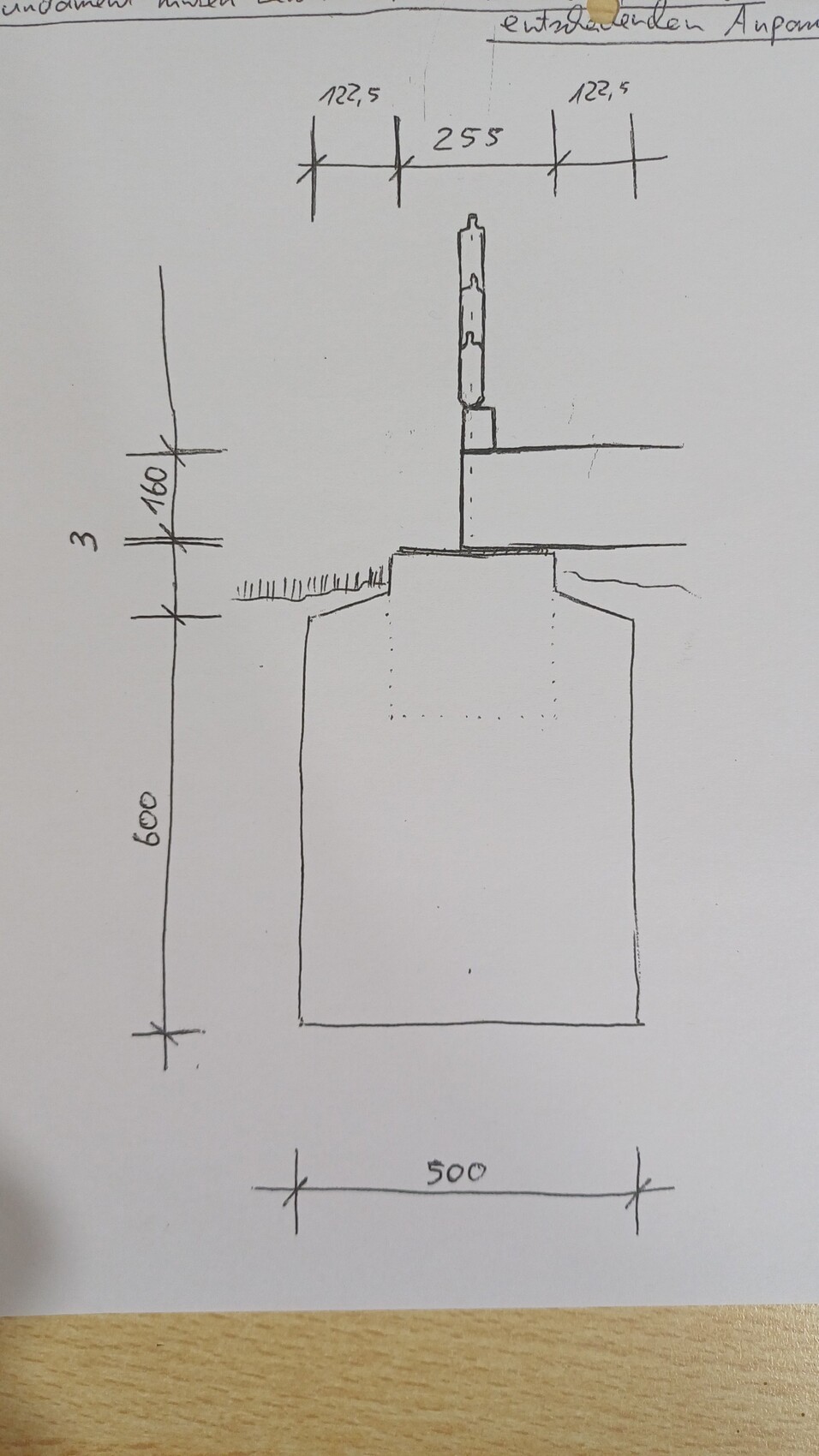
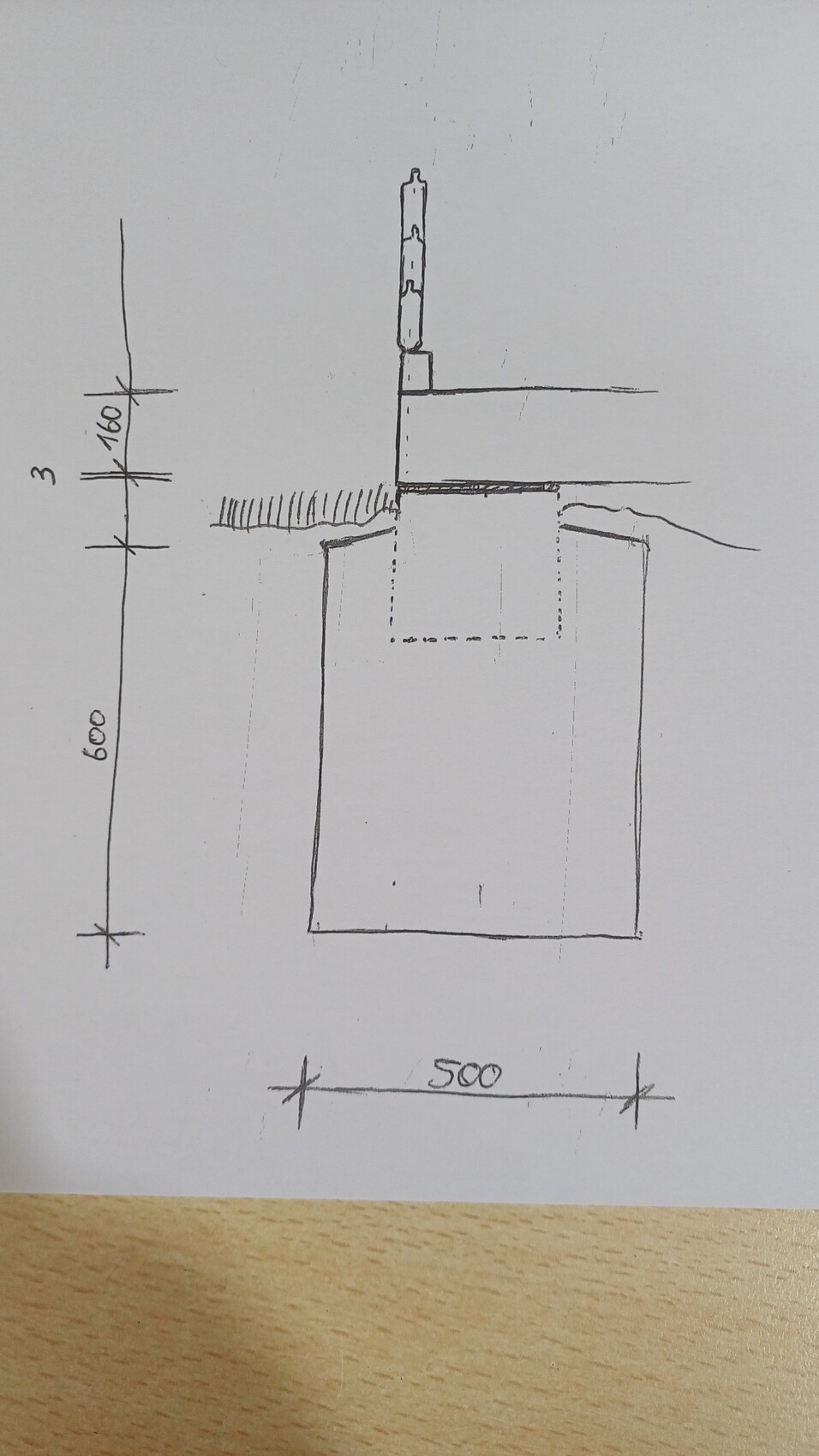
I am planning to build a 3800 x 2500 (150 x 98 inches) garden shed this spring and am currently working on the detailed design.
The garden shed will rest on 7 beams, measuring 2500 x 50 x 70 (98 x 2 x 3 inches). These beams will be supported on 3 rows of bearing points. For the front support, I already constructed a 3800 mm (150 inches) wide strip foundation in November, using 240 mm (9.5 inches) thick shuttering blocks. The timber beams are meant to sit flush both at the front and on the sides.
For the middle and rear rows, I have obtained two wooden beams. At the back, KVH timber 160 x 100 (6 x 4 inches, height x width), and in the middle, BSH timber 80 x 120 (3 x 5 inches, height x width). I had to adjust this somewhat to the terrain.
I would like to continue the appearance with the flush-fitting shuttering blocks on the other four outer edges. At the hardware store, there were 500 mm (20 inches) shuttering block end pieces plus half a 250 mm (10 inches) end block sold as sets; I bought 4 of these sets. This way, I want to avoid creating formwork for the six foundations and achieve a nicer look.
For the two middle foundations, I plan to cast concrete foundations sized 400 x 500 x 600 (length x width x height in mm) (16 x 20 x 24 inches) and place the 500 mm (20 inches) shuttering block end pieces on top. The isolated footings will all be 400 x 500 x 600 mm (16 x 20 x 24 inches) in size.
The main load will likely be transferred through the walls into the foundations. In this case, the flush-fitting design I want might not be optimal.
My question is: Are these dimensions still sufficient to build this without any problems? Or, in other words, do the top edges need to have an overhang?
I have created two drawings to illustrate this. I look forward to your feedback! 🙂
Best regards,
Spaziergänger
S
Spaziergänger11 Jan 2026 07:49Ok, since there was no objection, I’ll assume that the flush version is fine! :-D
It’s supposed to get a bit warmer again starting Tuesday, so I want to get started and gradually complete the foundations.
It’s supposed to get a bit warmer again starting Tuesday, so I want to get started and gradually complete the foundations.

I think most people are surprised by the amount of effort you’re putting into such a small house. Will it be permanently occupied, or are you planning to store a year’s supply of fuel there?
For typical garden tools, a few post anchors set in concrete would probably be sufficient. I’ve also seen similar structures on driven ground sleeves... That might not comply with Eurocode standards, but it will hold.
For typical garden tools, a few post anchors set in concrete would probably be sufficient. I’ve also seen similar structures on driven ground sleeves... That might not comply with Eurocode standards, but it will hold.
I can only agree with @Tolentino.
My former construction supervisor already said that most self-builders use far more material than necessary to "play it safe," which ends up costing more time and money than if they had everything done by a professional.
My carport, measuring 6x9 meters (20x30 feet), required significantly less effort, and I even partitioned a "shed" inside it measuring 3x6 meters (10x20 feet).
I haven’t looked at the details of what you’ve done so far, but from now on, I would drastically reduce the amount of material and work.
We once built a really nice shed ourselves, I believe it was 6x4 meters (20x13 feet) with roof tiles, etc., and even that involved considerably less effort. We set post anchors into the ground, then installed 10x10 cm (4x4 inch) vertical posts, with wood cladding between them.
My friend built a shed where he dug out about 10-15 cm (4-6 inches) of soil, then filled it with concrete and inserted two steel reinforcement meshes. Before that, he set post anchors at the corners and then raised and clad it using standard beams.
All of these sheds are still standing and are larger than your project.
How are you planning to do the formwork and the roof?
Basically, you could lay railroad ties or sturdy beams on the ground (or set them on a few paving stones) and then build upwards from there using a simple beam structure.
My former construction supervisor already said that most self-builders use far more material than necessary to "play it safe," which ends up costing more time and money than if they had everything done by a professional.
My carport, measuring 6x9 meters (20x30 feet), required significantly less effort, and I even partitioned a "shed" inside it measuring 3x6 meters (10x20 feet).
I haven’t looked at the details of what you’ve done so far, but from now on, I would drastically reduce the amount of material and work.
We once built a really nice shed ourselves, I believe it was 6x4 meters (20x13 feet) with roof tiles, etc., and even that involved considerably less effort. We set post anchors into the ground, then installed 10x10 cm (4x4 inch) vertical posts, with wood cladding between them.
My friend built a shed where he dug out about 10-15 cm (4-6 inches) of soil, then filled it with concrete and inserted two steel reinforcement meshes. Before that, he set post anchors at the corners and then raised and clad it using standard beams.
All of these sheds are still standing and are larger than your project.
How are you planning to do the formwork and the roof?
Basically, you could lay railroad ties or sturdy beams on the ground (or set them on a few paving stones) and then build upwards from there using a simple beam structure.
S
Spaziergänger11 Jan 2026 12:42Thank you all for your feedback, it really helps me move forward. I’ll make sure to build it flush and won’t worry about it anymore.
Basically, it will just be a garden shed for now, a ready-made kit, with a sealed roof.
But I can already picture my kids clearing out the shed later to squeeze in as many people as possible for weekend parties 😀.
If I’m going to put in the effort, I want the result to be both technically sound and visually good.
And yes, if you’re not a professional, it can sometimes be hard to judge what is really necessary, what’s nice to have, or what’s completely over the top.
You end up overthinking things and getting stuck, especially when you have time to plan in winter but can’t actually start building yet :-D.
But I don’t see that as a problem.
You learn as you go when you engage deeply with the process.
Basically, it will just be a garden shed for now, a ready-made kit, with a sealed roof.
But I can already picture my kids clearing out the shed later to squeeze in as many people as possible for weekend parties 😀.
If I’m going to put in the effort, I want the result to be both technically sound and visually good.
And yes, if you’re not a professional, it can sometimes be hard to judge what is really necessary, what’s nice to have, or what’s completely over the top.
You end up overthinking things and getting stuck, especially when you have time to plan in winter but can’t actually start building yet :-D.
But I don’t see that as a problem.
You learn as you go when you engage deeply with the process.
Similar topics