
Hello everyone,
Here is the shown basement floor plan. White tank waterproofing.
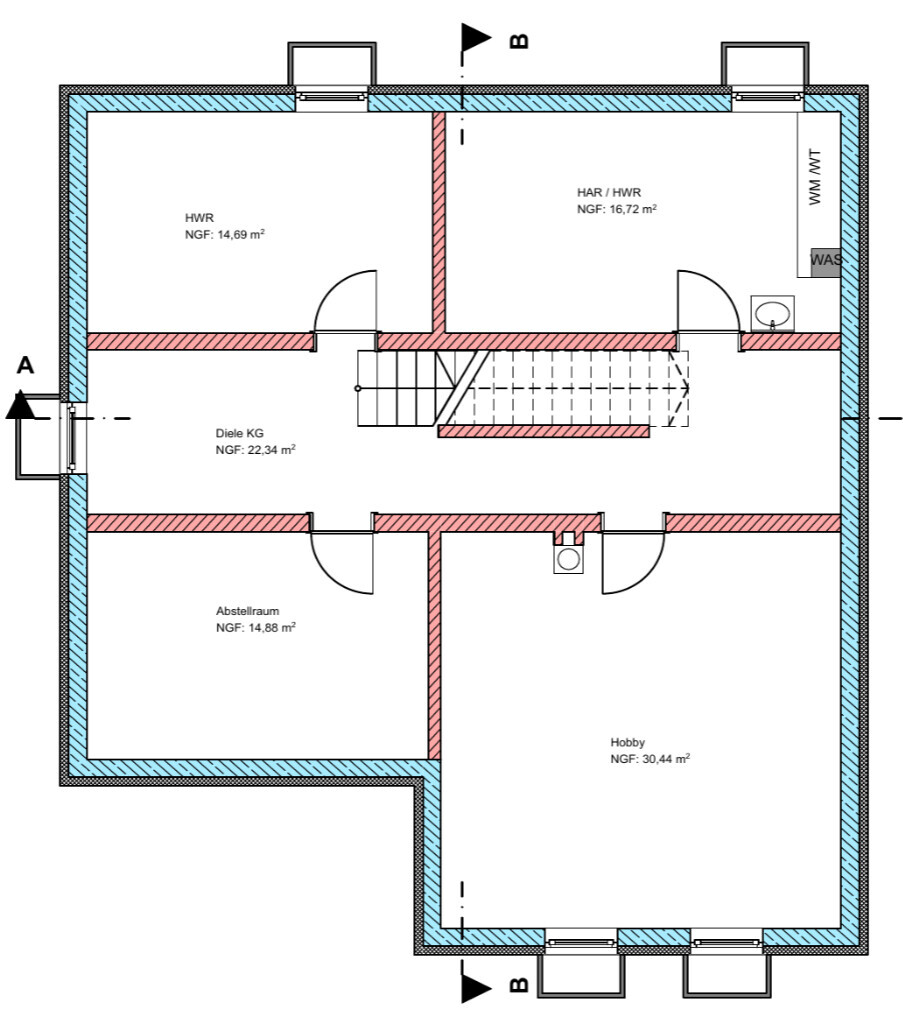
We are currently gathering offers for the shell construction (not a general contractor) and are still in the early planning phase, so nothing is set in stone yet. A specific KfW energy efficiency class is not planned due to lack of funding.
Heating will probably be done with an air-to-water heat pump. Only the hobby room in the basement will have underfloor heating.
One of the shell builders plans no insulation under the basement floor, while another proposes 12 cm (5 inches) of perimeter insulation.
A screed installer we contacted also prefers no insulation (for whatever reason).
It’s not really a big deal; the insulation shouldn’t blow the budget now.
I’m just a bit surprised that in 2023 some basements are still being built without insulation. Of course, heat rises and the ground maintains a more or less constant temperature. But still, does insulation really make so little difference?
Well, especially because of the underfloor heating in the hobby room, insulation should be mandatory anyway—I don’t want to be heating the ground.
What do you think?
Here is the shown basement floor plan. White tank waterproofing.
We are currently gathering offers for the shell construction (not a general contractor) and are still in the early planning phase, so nothing is set in stone yet. A specific KfW energy efficiency class is not planned due to lack of funding.
Heating will probably be done with an air-to-water heat pump. Only the hobby room in the basement will have underfloor heating.
One of the shell builders plans no insulation under the basement floor, while another proposes 12 cm (5 inches) of perimeter insulation.
A screed installer we contacted also prefers no insulation (for whatever reason).
It’s not really a big deal; the insulation shouldn’t blow the budget now.
I’m just a bit surprised that in 2023 some basements are still being built without insulation. Of course, heat rises and the ground maintains a more or less constant temperature. But still, does insulation really make so little difference?
Well, especially because of the underfloor heating in the hobby room, insulation should be mandatory anyway—I don’t want to be heating the ground.
What do you think?
A
Allthewayup1 Feb 2023 21:13Waldbewohner schrieb:
The costs wouldn’t ruin us, but I still wouldn’t want to do it just for fun. The resale value was basically the argument from the shell builder, and from an energy perspective, he also doesn’t consider it that important.
I can hardly estimate the heated hobby room with underfloor heating. After all, you don’t necessarily have to actively heat into the ground ;-) Do you have an energy consultant who can give you concrete numbers on how much the energy demand would differ in your case? I wouldn’t see it as that extreme. You do have some floor build-up under your screed with insulation towards the base slab – even if not much, usually it’s a few centimeters (inches). Then there is at least a 25cm (10 inches) thick concrete slab, and behind that is the soil. I’m not an expert, but I would estimate that about 70% of the heat output (due to lower resistance) escapes into the room, 25% is absorbed in the concrete, and only about 5% radiates into the ground. But I could be wrong 🙂
Waldbewohner schrieb:
About the waterproof concrete shell (“white tank”):
Sure, I’ve done some research and I know why it’s needed, how it’s done, etc. But that doesn’t make me an expert. So if you want, feel free to educate me.
I at least believe the shell builders we asked have experience and won’t knowingly cut corners.
Most people here build with waterproof concrete shells, and these are established family businesses—you get to know each other. We also built with a company like that, yet many things still happened. That doesn’t protect you from planning and execution errors that are obviously unintentional. Once the damage is done, that helps very little. Which use category will the finished basement fall under, and what exposure class applies to the soil conditions? You should definitely pay attention to what your shell builder includes in the contract. “White tank” is not a standardized term and is often used just to describe a particular type of concrete with a certain water-to-cement ratio. Also, a genuine waterproof concrete shell involves many specific planning and execution steps:
- Concrete with high resistance to water penetration (concrete quality)
- Control of structural cracks (crack width limitations; cracks running through the entire cross-section → component dimensioning)
- Managing crack connections through design and execution for high-quality use (hence the question about use category)
- Restraint stresses in the structure (statements on crack width and avoidance, reinforcement layout to optimize and avoid internal stresses)
- Joint planning and sealing (selection and arrangement), planning of penetrations
- Construction execution (concreting capability, compaction, and curing)
Waterproof concrete shells fall under monitoring class 2 in relation to “positive water pressure” scenarios, which is why supervision by an external expert is required → DIN 1045-3.
There is no separate DIN standard exclusively for building waterproof concrete shells; only the WU guideline provides more specific recommendations for planning and execution of watertight structures.
Based on my personal experience, I wouldn’t rely solely on a local shell builder, but everyone has to decide that for themselves :-)
Similar topics