
Hello everyone,
I would like to install the perimeter insulation on the gable end of our new build without a basement, after the base waterproofing was completed by a company.
Only weeks later did I notice that the base waterproofing has a sort of bend at about halfway up:
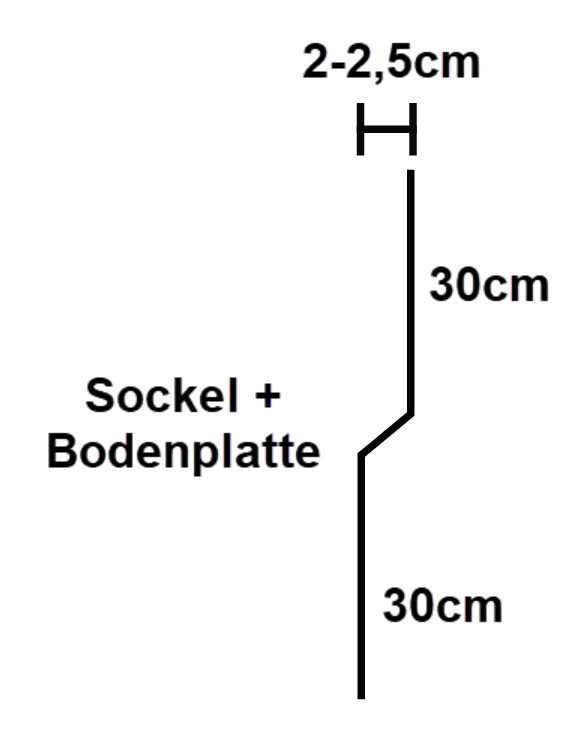
Now the question is: what is the best way to install the insulation? Should I use insulation 2 cm (0.8 inches) thicker at the bottom? Or should I apply foam and spray a thicker layer at the lower part?
Best regards
I would like to install the perimeter insulation on the gable end of our new build without a basement, after the base waterproofing was completed by a company.
Only weeks later did I notice that the base waterproofing has a sort of bend at about halfway up:
Now the question is: what is the best way to install the insulation? Should I use insulation 2 cm (0.8 inches) thicker at the bottom? Or should I apply foam and spray a thicker layer at the lower part?
Best regards
First, it might be helpful to clarify why the angle appeared. Is the wall not flush with the floor slab, causing a fillet or something similar to form there? Normally, a waterproof slurry (damp-proof slurry) would not create an offset of 2 to 2.5 cm (about 1 inch).
Otherwise, the cleanest approach would be to first install a layer of 2 cm (about 0.8 inches) thick XPS or EPS boards approved for base applications at the upper section, making sure they align as closely as possible with the ledge (ideally cutting the bottom at an angle to follow the bend). On top of that, lay another continuous layer of boards at the thickness you want to achieve in the end, taking care that the vertical joints of the lower layer never line up directly under the joints of the upper layer.
Otherwise, the cleanest approach would be to first install a layer of 2 cm (about 0.8 inches) thick XPS or EPS boards approved for base applications at the upper section, making sure they align as closely as possible with the ledge (ideally cutting the bottom at an angle to follow the bend). On top of that, lay another continuous layer of boards at the thickness you want to achieve in the end, taking care that the vertical joints of the lower layer never line up directly under the joints of the upper layer.
If the adhesive is approved for both, then yes. However, you will usually need to consult the manufacturer, as this is not a standard application. It would certainly make sense since the second layer will have both an insulation board (above the bend) and bitumen (below the bend) as contact surfaces.
Especially if you use XPS for the first layer, you need to check if a ribbed version is available in this thickness. It is definitely recommended to fully bond the second layer and, if possible, also use mechanical fastening. However, opinions differ on whether the benefits outweigh the disadvantages (damage to the building envelope).
What does the area above the base look like currently? Is a base profile and façade insulation already installed? If so, also consider the joint sealing/compression tape at the joint where the boards meet the bottom edge of the profile. For the second layer, you should taper the boards at the bottom. This is sometimes forgotten but is important for long-term performance.
Especially if you use XPS for the first layer, you need to check if a ribbed version is available in this thickness. It is definitely recommended to fully bond the second layer and, if possible, also use mechanical fastening. However, opinions differ on whether the benefits outweigh the disadvantages (damage to the building envelope).
What does the area above the base look like currently? Is a base profile and façade insulation already installed? If so, also consider the joint sealing/compression tape at the joint where the boards meet the bottom edge of the profile. For the second layer, you should taper the boards at the bottom. This is sometimes forgotten but is important for long-term performance.
Similar topics